
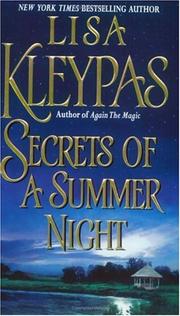
Secrets of a Summer Night
2,250-word summary 10 min read 375 pages in the book
- First published
- 2004
- Publisher
- Avon Books
- Pages
- 375
- ISBN
- 9780060091293
- Series
- Wallflowers (#1)
Reading options
What's inside (9 sections)
I picked this up because it is the door into Lisa Kleypas's Wallflowers books, the series about four young women parked along the edge of a London ballroom who decide to stop waiting to be noticed. I expected something light. What I found underneath the gossip and the ballrooms was a book with a fairly hard question at its center: how does a woman with no money keep her dignity while her family is closing in on her? Kleypas published it with Avon in 2004, and the original edition ran 375 pages. It opens the series, and it is the book where the friendship that holds the rest together gets formed.
Four women at the edge of the dance floor
The premise is almost aggressively simple. Annabelle Peyton, Lillian Bowman, Evangeline Jenner, always Evie, and Daisy Bowman are the young women nobody is dancing with. They are not ugly or stupid. They are simply not what the season is looking for, and they have reached the age where that starts to matter. At a ball they make a pact: each will help the others find husbands, and none of them will be left behind.
What makes the pact work as a story engine is that the four women need different things. Lillian is an American heiress with money and no patience for English rules. Evie is quiet, has a stammer, and is trapped in a household that uses her. Daisy is the youngest, still working out who she is. Annabelle is the one whose problem is most urgent, because her family has a name and almost nothing behind it. The book takes the idea of the wallflower seriously. These women are not waiting to be rescued. They are watching the room, working out who might be useful, and trying not to look as desperate as they feel.
Kleypas has said the friendship was inspired by her own school friends, the girls who stood together when no one asked them to dance. That origin shows. The banter between the four has a lived-in quality that the romantic plot does not always match. When they are together, the book crackles. When they are apart, Annabelle's storyline can feel a little thin by comparison.
The setting is England in the 1840s, which makes the Regency label that gets attached to these books a little loose. The manners and the marriage market are Regency-shaped, but the world is Victorian in its industrial wealth and its class anxieties. That tension is the book's best asset, because the men who matter here are the ones making money in trade while the old aristocracy looks down on them.
Annabelle's impossible arithmetic
Annabelle Peyton is beautiful, well born, and broke. Her father is gone, her mother is trying to keep up appearances, and a younger brother needs a future the family cannot pay for. She has had enough seasons to know that another one will not change anything. What she needs is not a love match but a wealthy husband, and she is honest with herself about that. The book does not pretend she is above the transaction. She is trying to keep a roof over her mother's and brother's heads.
That honesty is where Annabelle becomes interesting. She is not a heroine who secretly wants to be swept away. She is a young woman doing arithmetic. Lord Westcliff, the powerful earl whose Hampshire estate, Stony Cross Park, anchors much of the series, seems like the answer. He is rich, he is unimpeachable, and he is at least somewhat aware of her. Annabelle sets out to be noticed by him, which means playing a part she does not enjoy. The scenes in which she calibrates a smile or an opinion for his benefit are among the sharper things in the book, because Kleypas lets us see the calculation and her dislike of the calculation at the same time.
The pressure is never far away. There are dresses that have been worn too often, the fear of a creditor, a brother whose mistakes could become a scandal, and the constant awareness that a woman's reputation is the only collateral she has. Kleypas does a good job of making money feel like a physical presence in the room. Annabelle's choices are constrained in ways the men in her life never have to think about, and the novel keeps returning to that imbalance.
Her mother, Mrs. Peyton, is a study in denial, determined to preserve the appearance of gentility while the bills pile up. The scenes between mother and daughter have a weary edge. Annabelle loves her mother but cannot afford to share her illusions, and that isolation is part of what makes her vulnerable to Simon Hunt.
Simon Hunt, the man who will not marry
Simon Hunt is the opposite of Westcliff. He is self-made, rich, and thoroughly unpolished by the standards of the ton. He is a businessman, a man of trade, and the aristocracy treats him as someone who got into the room by mistake. He is also the only person in the book who sees Annabelle's situation clearly and says the quiet part out loud. When he tells her he is not the marrying kind and proposes that she become his mistress, it is a brutal offer, but it is not a dishonest one. He knows what she is worth and what she needs, and he is willing to pay.
That line about not marrying is the engine of the romance. Simon does not want a wife. He wants Annabelle, and he is prepared to take her on his own terms, which are terms that would ruin her socially. The tension between what he wants and what she can accept drives most of the middle of the book. He is a good match for her in the ways that matter: he is intelligent, he respects her mind, and he is not fooled by the performance she puts on for Westcliff. He is a disastrous match in the ways that matter just as much, because his solution to her problem requires her to give up the very thing she is trying to protect.
One detail worth knowing if you read a modern edition. The 2004 book opened with a prologue in which Simon kisses Annabelle at a theatre where she has gone to please her brother. It is a forceful, uninvited kiss, and it sets up the push and pull between them, her anger and the fact that she cannot stop thinking about him. In 2021 Kleypas released a substantially revised version that removed that prologue and rewrote large portions of the story. Readers who grew up on the original and readers who only know the updated text are, in a real sense, reading different books. I read with the original in mind, and the prologue's absence changes how Simon's early behavior registers.
Westcliff, meanwhile, is a useful counterweight. He is not a villain, exactly. He is a man whose world makes it easy to overlook Annabelle because she is not rich. The rivalry between him and Simon is a class argument as much as a romantic one, and the book is more interested in that argument than a typical genre romance usually bothers to be.
A house party and a dangerous offer
Much of the plot unfolds at a house party at Stony Cross Park, where the Wallflowers' plans are put into practice. This is where the series machine starts turning. Lillian Bowman and Westcliff collide in a way that obviously points toward the next book. Evie Jenner begins the long, slow uncovering of Sebastian St. Vincent that will occupy Devil in Winter. Daisy circles the edges, learning what she wants by watching the others. Annabelle works on Westcliff while Simon works on Annabelle, and nobody is getting exactly what they planned.
The result is a book with two speeds. The ensemble scenes are lively and generous, full of sideways glances and alliances. Annabelle's solo plot is tighter and more claustrophobic, moving from one bad option to a worse one. Her brother Hugh is the lever that keeps turning the screw. His debts and his judgment threaten to become public, and the price of keeping that quiet is more than the Peyton family can manage. Simon's offer starts to look less like an outrageous proposition and more like a trap closing.
There is a stretch in the middle where Annabelle seriously considers taking Simon's money and becoming his mistress. This is the book at its most unsettling, because Kleypas does not rush to rescue her from the choice. She thinks about what she would be giving up and what she would be buying. She tries to go through with it and discovers that she cannot. That failure is the honest center of the novel. Annabelle is not a woman with a secret fortune or a convenient relative. She is a woman with almost nothing, and her refusal to sell herself is a real decision rather than a foregone conclusion.
What follows is a near miss with Westcliff and a slow realization on Simon's part that the arrangement he wanted has stopped being enough. He has spent the book treating Annabelle as a woman who can be bought, and he has to arrive at the idea of marriage from a place that is not possession. The book is at its best when it makes him do that work rather than simply announcing that he has changed.
What finally changes
The resolution ties up the family crisis and the romance in the same knot. Simon helps with Hugh's trouble, using the kind of practical, slightly heavy-handed intervention that only he can manage. The scandal is contained. Westcliff turns out not to be the answer to Annabelle's prayers, which is the correct outcome for a man destined for Lillian in the next book. Simon, having spent most of the novel saying he does not marry, proposes marriage instead. Annabelle accepts, and the Wallflowers remain a group rather than dissolving into couples.
I like that the ending makes Simon give up the easy version of what he wanted. The offer to make Annabelle his mistress cost him nothing. Asking her to be his wife costs him the freedom he has spent the book defending. That is a reasonable amount of growth for a genre hero, and it is earned by the time he gets there. The wedding is handled with the mixture of warmth and light comedy that Kleypas does well, and the epilogue checks in on the other women so the series has somewhere to go.
The book's title, which sounds like a light summer read, is a little misleading. It is a story about a woman cornered by her own family's debts and a man who offers a solution she almost accepts. The secret of the title is less a mystery than the gap between what these two people say and what they mean.
Where it strains
For all that I admire the economic spine, the book has real weaknesses. Annabelle's peril is dialed up high enough that some of the turns feel mechanical, particularly the business with her brother, which exists mainly to create a deadline. Simon's opening offer is difficult to forgive on the page, and the novel's willingness to treat it as a romantic starting point is a product of its moment. Readers who want a hero who is gentle from the first chapter will have a hard time here.
The 2021 revision is the other complication. Readers have reported that roughly half the text was rewritten, with the prologue removed and chapters cut that gave the relationships more depth. If you pick up a current ebook, you may be reading a version that feels more stitched together than the 2004 book that earned the series its reputation. That is a genuine problem for a new reader trying to decide which text to trust, and it is worth knowing before you recommend it to someone.
There is also the question of the label. This is often shelved as Regency romance, but the wealth in it is industrial and the anxieties are Victorian. If you are looking for the narrow world of 1810s London, you will find something looser and more commercially messy here. That is a feature to me, but it is worth flagging for readers who want their period details tight.
Why it still gets read
The reason this book has stayed in print is not the plot mechanics. It is the four women. Kleypas built a series on the idea that female friendship is the structure that makes the romances possible, and this is the book where that structure gets assembled. You can see the template being set for the Hathaways and the later Kleypas series: a group of people who are awkward together, a heroine who thinks she is past her prime, and a hero whose money is both the solution and the problem.
Read it for Annabelle's arithmetic and for the scenes where the Wallflowers are alone together. Those are the parts that hold up. The proposal is satisfying, the class argument is more interesting than the genre usually allows, and the friendship is real. Just be aware that the book you buy today may not be quite the book that came out in 2004, and that Simon Hunt asks for a great deal before he decides to deserve her.
FAQ
Is Secrets of a Summer Night the first Wallflowers book?
Yes. Avon published it in 2004, and it introduces Annabelle Peyton, Lillian Bowman, Evie Jenner and Daisy Bowman before the rest of the series follows.
Should I read the 2004 edition or the revised 2021 version?
The 2021 edition removes the opening prologue and rewrites large parts of the story, so the two versions differ substantially. Readers who want the text that launched the series should look for the 2004 edition.
Does the book end with Annabelle married?
Yes. Simon Hunt gives up his refusal to marry and proposes, and the epilogue checks in on the other Wallflowers as well.
Similar books
More from Wallflowers first, then related titles.

Devil in Winter
A shy heiress with a stammer proposes a marriage of convenience to London's most notorious rake, then makes him prove he can be faithful.
2,548-word summary · 11 min read
To Sir Phillip, With Love
Outspoken Eloise writes a grieving botanist, visits unchaperoned, and stays for twins.
2,013-word summary · 9 min read
Romancing Mister Bridgerton
Colin Bridgerton returns and discovers Penelope Featherington is Lady Whistledown.
2,388-word summary · 11 min read
The Viscount Who Loved Me
Anthony Bridgerton vows to marry without love until Kate Sheffield challenges him at every turn.
2,666-word summary · 12 min read
The Duke and I
Daphne Bridgerton and Simon Basset fake a courtship that turns real, then face truth about children.
2,107-word summary · 9 min read
Bringing Down the Duke
In 1879 Oxford, a scholarship student and suffragist is tasked with winning over a powerful duke, only to be undone by the man she must persuade.
2,456-word summary · 11 min read
Shopaholic Ties the Knot
Becky Bloomwood plans two weddings at once while debts pile up and Luke's mother interferes.
2,218-word summary · 10 min read
It's in His Kiss
Julia Quinn's seventh Bridgerton novel pairs sharp tongued Hyacinth with Gareth St. Clair as an old Italian diary leads them toward hidden jewels and Lady…
2,908-word summary · 13 min read
An Offer From a Gentleman
Benedict falls for a masked Sophie at a ball, then finds her working as a housemaid after her stepmother evicts her.
2,320-word summary · 10 min read
The Wrong Bride
In Catharina Maura's Windsors opener, model Raven Du Pont takes her absent sister's place at the altar beside billionaire Ares Windsor, the man she has…
2,397-word summary · 11 min read
The Shoemaker's Wife
Two young Italians meet in the Alps, are separated by fate, and find each other again in New York before war pulls them apart, in a saga drawn from Adriana…
2,261-word summary · 10 min read
The Love of My Life
Emma loves her husband Leo and their little girl. Then Leo, an obituary writer, starts filing the facts of her life, and the woman he thinks he married begins…
2,803-word summary · 12 min read
Roomies
A Broadway archivist with a crush on a subway busker marries him to solve his visa problem, and finds the roommates arrangement harder to keep practical than…
2,030-word summary · 9 min read

My Policeman
In 1999 a retired teacher writes a confession to the dying man her husband once loved, unpacking a 1950s Brighton love triangle that cost three people…
2,450-word summary · 11 min read

Love Her or Lose Her
Rosie Vega wants more from life than a perfume counter and a silent marriage, so she asks her stoic husband Dominic to try therapy.
2,433-word summary · 11 min read
Broken Country
A historical love story built like a thriller: a farmer's wife in 1968, a son lost two years before, and the return of the man who once broke her heart.
2,461-word summary · 11 min read
The Mermaid Chair
Jessie Sullivan returns to her childhood home on Egret Island to care for her agoraphobic mother, then finds her marriage, her faith, and a monk's vow thrown…
2,237-word summary · 10 min read

Shopaholic and Sister
Becky Brandon returns from a ten-month honeymoon to meet the half-sister she always wanted, then discovers that Jess is thrifty, prickly, and nothing like the…
2,591-word summary · 12 min read
Mr. Maybe
Libby Mason wants a rich husband, but the wealthy man who proposes is dull and the broke writer she cannot forget is not offering forever.
2,322-word summary · 10 min read

Two by Two
Sparks's twentieth novel turns from first love to a marriage breaking up: Russell Green loses his wife and his job, then rebuilds his life around his…
2,192-word summary · 10 min read

This Time Next Year
Two women give birth minutes apart on New Year's Day 1990, and one takes the other's lucky name. Thirty years on, their children meet again.
2,194-word summary · 10 min read

On Chesil Beach
Two newlyweds spend one terrible night on Chesil Beach in 1962, and the rest of their lives is decided by it.
2,456-word summary · 11 min read

At First Sight
Jeremy and Lexie are married and expecting a baby when anonymous emails tell him the child may not be his.
2,317-word summary · 10 min read

2 States: The Story of My Marriage
A Punjabi boy from Delhi and a Tamil Brahmin girl from Chennai meet at IIM Ahmedabad, and turn a love marriage into a campaign to convince two families.
2,634-word summary · 12 min read
What the Wind Knows
Annie scatters her grandfather's ashes on Lough Gill and is pulled into 1921 Ireland, where she becomes the missing Anne Gallagher and falls for Dr. Thomas…
2,056-word summary · 9 min read

Marriage for One
Rose marries a cold lawyer to save her coffee shop, then discovers the arrangement was never only business.
2,032-word summary · 9 min read
Loving Frank
Mamah Borthwick Cheney leaves her family for Frank Lloyd Wright, and their affair becomes a public scandal that ends in tragedy at Taliesin.
2,034-word summary · 9 min read

The Bridges of Madison County
A four-day affair between an Iowa farm wife and a photographer asks what a brief happiness is worth against family duty.
2,487-word summary · 11 min read
The No-Show
Three women are stood up on Valentine's Day by the same man, but the timeline is not what it seems. O'Leary's warmest book with a knife in it.
2,127-word summary · 9 min read
Emerald Green
Gwyneth must close the blood circle that will crown an immortal tyrant, and the prophecy says her death is the final lock.
2,044-word summary · 9 min read