
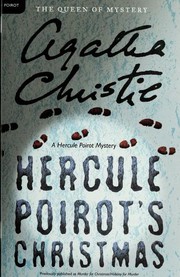
Hercule Poirot's Christmas
2,348-word summary 10 min read 256 pages in the book
- First published
- 1938
- Publisher
- Collins Crime Club
- Pages
- 256
- ISBN
- 9780062074010
- Series
- Hercule Poirot (#20)
Reading options
What's inside (10 sections)
I came to this expecting a cosy country-house puzzle with mince pies and a corpse discovered before the pudding. What Christie published in Britain on 19 December 1938 is much nastier. The first edition, a 256-page hardback from the Collins Crime Club priced at seven shillings and sixpence, came with a foreword announcing that readers had complained her murders were becoming too refined, so this would be "a good violent murder with lots of blood." She means it. A rich old man has his throat slit in a locked room while his family sits downstairs, and nobody in the house is especially sorry. It is one of the most tightly wound Poirot mysteries and one of the most unpleasant, which is probably why I liked it.
The invitation
Simeon Lee is a multi-millionaire, old and frail, and he has summoned his family to Gorston Hall for Christmas. The gesture is not made out of affection. Simeon is a tyrant who enjoys pulling his relatives' strings, and everyone knows it. His sons and their wives arrive already on edge: Alfred, who runs the business and lives with his father; George, an MP, with his wife Magdalene; David, the artist, with his wife Hilda; and Harry, the prodigal son everyone expects to be thrown out. There is also Pilar Estravados, a Spanish-born granddaughter Simeon went to some trouble to find. She is the daughter of his late sister Jennifer, and none of the siblings has ever met her. She turns out to be charming, which only deepens the unease.
Christie sets all of this in the weeks when every English household is supposed to be pretending to be merry, and the contrast is the point. The house is decorated, an elaborate dinner is in prospect, and the guests are all waiting for the old man to die so they can spend his money. The warmth of the season is a layer of paint over a family that has spent decades learning how to hurt one another. Simeon's late wife, the mother of David, was humiliated in front of the children, and that old wound is still fresh enough to be a motive for murder. Christie does not waste time on scenery. The Christmas trimmings exist so that the violence has something to rub against.
On Christmas Eve a surprise guest arrives. Stephen Farr is the son of Simeon's former partner in the diamond mines, and Simeon welcomes him with a warmth he never shows his own children. That afternoon he calls the family together to listen while he speaks on the telephone with his lawyer. He says only that he intends to change his will after Christmas. The words are incomplete on purpose. Christie knows that an inheritance dangled in front of a room full of people is worth more than any amount of physical evidence.
The scream
After dinner, several people hear furniture crashing and a hideous scream from Simeon's room. They run to the door and find it locked, and have to break it down. Inside, heavy furniture is overturned, crockery is smashed, and Simeon is dead in a great pool of blood, his throat cut. Christie borrows an epigraph from Macbeth for some editions, Lydia's line about the old man and how much blood he had, and the scene earns it. This is the violent murder the foreword promised, and it arrives with genuine shock.
Then the odd details start. The local superintendent, Sugden, is already at the front door before anyone has called the police. He says he was expected: Simeon had told him that a substantial quantity of uncut diamonds had been stolen from his safe. While everyone is reeling, Sugden notices Pilar pick something up from the floor and insists she hand it over. It is a small triangle of rubber and a little wooden peg. Nobody knows what they are, and the book is careful to keep them in view. Poirot is brought in alongside Colonel Johnson, the county chief constable, and the two of them begin the long business of asking how a man could be murdered in a room that no one could enter.
A house of suspects
The investigation is built on the plain fact that everybody in the house has a reason. Simeon was a collector of grudges. He mistreated his wife in front of David, who has carried the anger for years. He played Harry against the others and then threatened to cut him off. The theme Christie is working with here, one she returns to in Appointment with Death and later in Crooked House, is that a sadistic parent shapes the murderer he deserves. The victim's methodical cruelty has reproduced itself in his sons, and Poirot keeps circling the same point: study the children and you will understand the father.
There is more than one person in the house who is not who they claim. The butler, Tressilian, confuses the guests, and Poirot seizes on it. The four sons of Simeon's marriage, he realizes, may not be the only sons present. That single observation is the hinge of the whole solution, and Christie plants it early enough that the ending feels earned rather than sprung.
Colonel Johnson is a useful addition to the cast. He appeared in an earlier Poirot case, Three Act Tragedy, and he arrives here as a local man with local knowledge rather than as another brilliant outsider. That matters, because the joke of the book is that the most official person in the house, Superintendent Sugden, is the one who has written the script. Johnson gives Poirot someone to talk to who is neither a suspect nor a fool, and their conversations keep the investigation moving while the family members complain about one another. Christie understood that a detective needs a steady listener as much as a villain.
Clues that go nowhere, and one that does
Poirot and Johnson work through the physical evidence. The diamonds turn up mixed in with the stones of the decorative rockery outside, which removes theft as a motive and leaves everyone more suspicious, not less. The will is read. Alfred gets half, because he ran the business, and the rest is split among the other children. Pilar gets nothing, since her mother died a year earlier and the document does not name her. Alfred, David and Harry then do something that genuinely surprised me: they agree to pool their inheritances and give Pilar a share. She refuses, and Lydia tells her the offer is only what is just. The refusal is a clue to who she really is, though Poirot is still a few steps behind it.
The small piece of rubber becomes the live thread. Pilar and Stephen are playing with balloons when one bursts, and she remarks that the fragments look like what she picked up beside Simeon's body. Poirot warns her to be on her guard because she knows more than she realizes. Soon after, a stone cannonball is found balanced on top of her bedroom door and she is narrowly spared. That attempt is the moment the puzzle turns into a race, and Christie handles the shift well. Two cables from South Africa then unsettle the guest list further. The son of Simeon's old partner is reported dead, and Stephen admits his name is Stephen Grant. He had come to England to find the father he had never met, a man Simeon knew from a trip five years after his own marriage. Pilar, in turn, confesses that she is an impostor. The real Pilar died in a bombing as the two women crossed Spain during the civil war, and the woman calling herself Pilar, whose name is Conchita Lopez, took her place for the adventure. The offer of money was the one thing she could not accept.
The answer
With Sugden pushing to blame Pilar for the murder, Poirot takes the case apart in one of his big confrontation scenes. Sugden is another illegitimate child of Simeon's, the son of a local girl Simeon paid off and abandoned. He grew up nursing the grievance and planned his revenge with the patience of a man who had waited decades. He killed Simeon hours before the family heard the scream. Then he arranged furniture and other objects so they would collapse when pulled by a string from outside the house, and added a carnival toy that produced the hideous shriek when popped. That tiny bit of rubber Pilar found was part of the device. The locked room was theatre, and the timing was a lie.
The mechanics are worth dwelling on because they are so deliberately silly. A string pulled from outside tips furniture and crockery into a crash, and a popped carnival toy supplies the scream. The locked door is real enough, but it guards a scene that was staged hours earlier, so the time of death is the thing being hidden rather than the identity of the killer. Once Poirot shifts the argument from how the room was sealed to when the man died, the whole contraption turns into a prop. That is a neat trick in itself, and it explains why the little rubber scrap mattered so much. It was the one piece of the staging that the murderer forgot to take away.
Poirot gets there by noticing the family resemblance in mannerisms, the same set of gestures shared by Harry, Stephen and Sugden, and by a trick with a portrait: he sticks a false moustache on a picture of the young Simeon and sees Sugden in it. It is a flashy piece of detection, and it depends on a coincidence that Christie's critics called out at the time. The Times Literary Supplement complained that her stories relied too much on coincidence and manufactured effect, and that Poirot in retirement was becoming a colourless expert. I think both charges stick a little. But the solution also explains the peg and the rubber, the locked door, the scream and the superintendent's convenient arrival, and it does so with a neatness that is hard to grudge. Robert Barnard's two-word verdict, "Magnificently clued," is not far off.
The Christmas that never happens
What I remember most is not the trick but the aftermath, which is odd for a mystery. David is freed from years of hatred toward the father who humiliated his mother. Stephen takes Pilar, now Conchita, to South Africa to marry her, and Lydia promises them a proper English Christmas another year. Alfred and Lydia decide to sell the house and leave the whole ugly business behind. Alfred offers David the furniture that had belonged to his mother, and David politely refuses. The miniature gardens Lydia built in stone sinks are left to go, and she talks about making another one somewhere else. When Alfred thanks his wife for everything she has done, she answers that it was her duty as a wife. The line lands like a small, cold joke after all the blood.
The book ends with Poirot and Colonel Johnson in front of a wood fire. Poirot says he much prefers central heating. It is a perfectly Christie way to close a book about a family gathering that went wrong, and it tells you where her sympathies lie. The detective is not interested in Christmas. He is interested in the truth, and in getting warm.
What creaks
A few things are worth saying against it. The business of Pilar's identity is elaborate and, as Torquemada wrote in The Observer in 1938, rather irrelevant to the actual murder. The great scream that sells the locked room probably will not fool a careful reader, which was a complaint even in the book's own reviews. Christie leans on coincidence twice, once with Stephen's parentage and once with the portrait trick. The daughters-in-law, Lydia and Magdalene and Hilda, are thinly drawn compared with the sons, and they exist mostly to react. Poirot himself is less fun here than in the early novels, without Hastings to play against, and the TLS review noted that loss directly.
The book's publication history tells you how seriously Christie's contemporaries took it. It ran in ten parts in Collier's Weekly in America and in twenty parts in the Daily Express at home, under slightly different titles, and the first American edition appeared in February 1939 from Dodd, Mead as Murder for Christmas. A paperback in 1947 retitled it A Holiday for Murder, which rather misses the point. Even the dedicatory note was a response to readers who thought the murders had grown genteel. Christie was listening to her audience, and here she gave them what they asked for, then dared them to work out how it was done.
Against that, the construction is very good. The clues are planted openly, the wrong solutions are plausible, and the family's awfulness is specific rather than generic. You can feel the weekly instalment logic in the way each chapter turns, with a fresh suspicion handed to the reader at every break. The first edition has been reprinted many times, including a facsimile of the 1938 hardback, and it is worth reading in a form that keeps the original title. Whatever the label on the cover, this is a winter mystery about a family that should never have gathered, and it earns its bleak little ending.
Who should read it
Anyone who likes locked rooms, large unpleasant families and a detective who arrives after the worst has happened will find plenty here. Readers looking for a gentle festive read should be warned about the throat-slitting and the general absence of goodwill. It helps to know something about the Poirot series, since Colonel Johnson turns up from an earlier case and the detective is assumed to be a known quantity. On the other hand, it works on its own, and the solution does not depend on knowing any other book. If you want Christie at her most engineered and least sentimental, this is close to the top of the pile.
FAQ
Is Hercule Poirot's Christmas part of a series?
Yes. It is book twenty in the Hercule Poirot series, after Appointment with Death and before Sad Cypress.
Who kills Simeon Lee in Hercule Poirot's Christmas?
Superintendent Sugden, revealed as another illegitimate son of Simeon Lee, kills him and fakes the time of death with a staged locked-room scene.
Is this a cosy Christmas mystery?
No. Christie promised a violent murder and delivers one, with a slit throat, a family full of hatred and very little festive goodwill.
Similar books
More from Hercule Poirot first, then related titles.
The Mysterious Affair at Styles
Hastings reunites with refugee Poirot at Styles Court after Emily Inglethorp is poisoned in her locked room.
2,856-word summary · 13 min read
The Murder on the Links
Poirot arrives in France too late to save his client, who is found stabbed in a grave and was not the man he claimed to be. Christie's second Poirot novel.
2,055-word summary · 9 min read
The Murder of Roger Ackroyd
Retired Poirot probes a locked study murder in King's Abbot, told by the village doctor.
3,582-word summary · 16 min read
Murder on the Orient Express
Poirot is trapped by snow with thirteen strangers after an American is found stabbed in his berth.
2,004-word summary · 9 min read
The ABC Murders
Poirot and Hastings chase a killer who leaves an ABC railway guide near victims in Andover, Bexhill, and Churston. A salesman looks guilty, but publicity hides…
3,302-word summary · 15 min read
Death on the Nile
Poirot takes a Nile cruise where a young heiress is shot dead in her cabin.
4,077-word summary · 18 min read

One, Two, Buckle My Shoe
Poirot links a dentist murder to a missing banker and stolen millions.
2,549-word summary · 11 min read
Evil Under the Sun
Poirot's Devon holiday turns deadly when a flirtatious actress is strangled at a secluded seaside hotel in this 1941 puzzle.
2,380-word summary · 11 min read
Five Little Pigs
Sixteen years after a painter's murder, Poirot reopens the case at the request of a daughter who believes her dead mother was innocent.
2,027-word summary · 9 min read
Hallowe'en Party
A girl boasts she once saw a murder, then drowns in an apple-bobbing bucket. Poirot investigates both the claim and the killing.
2,232-word summary · 10 min read
The Body in the Library
A strange girl found dead in a library pulls Miss Marple into lies about dance halls and film.
2,017-word summary · 9 min read
The Memoirs of Sherlock Holmes
Doyle's second Holmes collection gathers twelve Strand stories, including the early case of the Gloria Scott and the confrontation with Moriarty at Reichenbach…
2,390-word summary · 11 min read
The Maltese Falcon
Sam Spade hunts a jeweled bird through lies after his partner is killed.
2,529-word summary · 11 min read
The Sign of Four
Mary Morstan's pearls lead Holmes and Watson from foggy London to Agra treasure and a Thames chase.
2,114-word summary · 9 min read
The Adventures of Sherlock Holmes
Twelve Strand cases from Irene Adler to the Copper Beeches, with Holmes at his sharpest and strangest.
3,579-word summary · 16 min read
The Hound of the Baskervilles
Holmes Watson probe spectral hound killing Baskervilles on Dartmoor.
2,596-word summary · 12 min read
A Study in Scarlet
Watson meets Holmes in Baker Street, a Brixton body bears the word Rache, and a Utah revenge tale explains it.
2,208-word summary · 10 min read
Crooked House
A family gathered around a dying patriarch in a twisted old house, and one of Christie's most famous revelations about who killed him.
2,059-word summary · 9 min read
At Bertram's Hotel
Miss Marple finds a luxury hotel fronting robbery and murder.
2,550-word summary · 11 min read
The Man in the Brown Suit
Anne Beddingfeld sees a Tube death in London and chases a paper clue to South Africa, diamonds, and the hidden Colonel.
2,292-word summary · 10 min read
The Murder at the Vicarage
Vicar Leonard Clement narrates the shooting of Colonel Protheroe while Miss Marple watches St Mary Mead.
2,926-word summary · 13 min read
And Then There Were None
And Then There Were None retold: ten to Soldier Island, rhyme deaths, no one left to tell.
2,137-word summary · 9 min read

There Will Be Bodies
Digging out a villa buried by Vesuvius, Flavia Albia finds chained corpses and a death someone tried to hide for ten years.
2,152-word summary · 10 min read
The New York Trilogy
Three linked novels turn a wrong-number call into a puzzle about names, authorship, and the stories people tell to stay sane.
2,259-word summary · 10 min read
The Last Coyote
On stress leave, Harry Bosch reopens the unsolved murder of his mother, a prostitute strangled when he was twelve, and finds corruption reaching the DA's…
2,069-word summary · 9 min read
The 5th Horseman
Two linked cases pull Lindsay Boxer and the Women's Murder Club into a hospital full of strange deaths and a luxury-car murder spree.
2,609-word summary · 12 min read

Visions of Sugar Plums
A strange man named Diesel appears in Stephanie Plum's kitchen days before Christmas and pulls her into hunting a bail-jumping toy maker. A short, silly, warm…
2,193-word summary · 10 min read
The Word Is Murder
A fictionalised Anthony Horowitz is talked into chronicling a prickly ex-detective's case: a woman murdered hours after planning her own funeral. A clever…
2,296-word summary · 10 min read
The Unquiet Grave
In Dervla McTiernan's fourth Cormac Reilly novel, a body found in a Galway bog turns out to be a missing school principal, and the case opens into something…
2,253-word summary · 10 min read
The Secret of the Old Clock
The first Nancy Drew novel: a sixteen-year-old detective follows a clue hidden in a clock to overturn a will and restore a family's inheritance.
2,011-word summary · 9 min read