
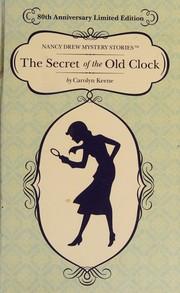
The Secret of the Old Clock
2,011-word summary 9 min read 210 pages in the book
- First published
- 1930
- Publisher
- Grosset & Dunlap
- Pages
- 210
- ISBN
- 9780448455303
- Series
- Nancy Drew (#1)
Reading options
What's inside (7 sections)
The first Nancy Drew
This is the book that started everything. Published on April 28, 1930, it is the first volume of the Nancy Drew Mystery Stories and introduced a sixteen-year-old detective who would become one of the most famous characters in American children's literature. The name Carolyn Keene was a pseudonym. The 1930 text was written by Mildred Wirt Benson under contract to the Stratemeyer Syndicate, which owned the name and controlled the series.
Nancy lives in River Heights with her father, Carson Drew, a criminal defense lawyer, and their housekeeper Hannah Gruen. Her mother is dead, which is mentioned without much elaboration. Nancy is a high-school graduate with a car, a talent for getting into other people's houses and a complete confidence that she can solve whatever she sets her mind to. The 1959 revision raises her age to eighteen and softens some of the edges, but the essentials are there from the first page.
The case concerns the estate of Josiah Crowley, a wealthy man who was taken in by the social-climbing Topham family and cut off his own relatives. When he dies, the will held by the Tophams leaves everything to them. Crowley's relatives, principally the Turner and Hoover sisters, are left penniless.
In the 1930 version, Nancy's motivation is plain dislike. She thinks the Tophams are snobs and newcomers who do not deserve their money. The 1959 rewrite adds a softer reason: her affection for little Judy, Crowley's distant niece, who is being raised by the Turners. That change tells you most of what changed between the two versions. The first Nancy enjoys taking the Tophams down. The revised Nancy is more charitable about it.
Mildred Wirt Benson wrote twenty-three of the first thirty Nancy Drew books under the Keene name, and she gave the character much of the voice that survived later rewrites. She was a journalist and a pilot, and her Nancy is active in a way that reflects her own life. The Stratemeyer Syndicate owned the rights and the pseudonym, so the arrangement was work for hire. Nobody who bought the book in 1930 would have known who wrote it, and for decades the name Carolyn Keene was treated as a person.
That history is part of the book's interest now. The 1959 revision was done by Harriet Stratemeyer Adams, who owned the syndicate by then. She changed the text substantially, removing racial stereotypes and reshaping Nancy into a more wholesome figure. Readers grew up with one version or the other depending on the decade, and arguments about which is the real Nancy Drew usually come down to which version a reader met first.
I picked this up because the site has no Nancy Drew books yet, and this is the starting point. It is also a strange and fascinating document of 1930, with a view of class and race that the later rewrite carefully removed.
The investigation
Nancy is aided early on by her friend Helen Corning, who appears in this book before Bess Marvin and George Fayne became the standard sidekicks. At a department store, Nancy finds a way to discredit the Topham sisters. In the original they break an expensive imported vase; in the 1959 version the confrontation centers on a torn evening gown. Either way, the scene establishes Nancy's method. She lets people reveal themselves and then makes them pay for it.
Interviewing Crowley's relatives and friends, she learns from an injured old woman that Crowley hinted the clue to his will was hidden in the family clock. To get inside the Topham home, Nancy sells Helen's charity tickets to the family and questions them about the clock. She is not yet a professional detective. She is a young woman with a good story and the nerve to walk into a house where she is not wanted.
During a downpour, her convertible top malfunctions and she takes shelter at the Hoover sisters' farm. In the 1930 text the sisters want to improve their hatchery and dressmaking skills. In the 1959 version, Allison Hoover is given singing lessons. These details are small, and their cumulative effect is to make the world of the book feel lived in. Nancy's confidence is the book's engine. She never considers that she might be wrong about the Tophams, and she is rarely wrong. That is a very satisfying quality in a detective and a slightly troubling one in a young woman who keeps breaking into buildings. The books were written to give girls a figure who acted instead of waited, and the freedom can feel startling now. Nancy drives herself, pays for her own gasoline and lies to people who deserve it.
The case moves through ordinary places: a department store, a farm, a summer camp.
Nancy follows the trail to a summer camp near the Tophams' vacation home, where the clock and the rest of the Topham furniture have been stolen by burglars. She is overpowered by one of them and imprisoned in a vacant house while the caretaker recovers from a drunken stupor induced by the criminals. While the burglars drink wine and beer at a wayside inn, which is pointedly illegal under Prohibition, Nancy retrieves the titular clock.
She deliberately hides the stolen clock from the police, and the climax includes gunfire during a police-robber chase. That moment is startling to a modern reader. Nancy does not simply solve the case. She withholds evidence, takes a risk with a firearm nearby and trusts her own judgment over the authorities. It is the most appealing thing about the original version.
The will
The denouement reveals the true will inside the old clock. The Tophams are disinherited and the Crowley property goes to the deserving relatives. The 1930 ending dwells on Nancy's delight in taking money from the Tophams and seeing it distributed to the destitute family and friends. The 1959 ending emphasizes rewarding the worthy kin and Nancy's more charitable outlook.
The difference between the two texts matters. The 1959 rewrite by Harriet Stratemeyer Adams also removes racial stereotypes, speeds up the action, expands Nancy's wardrobe and home life, and makes her, in the words of one common description, more sugar and less spice. The original is rougher and more satisfying in a blunt way. Nancy is not especially kind in 1930. She is clever, privileged and thoroughly convinced that the Tophams deserve what they get.
That is not a defense of the racial stereotypes. They are a real part of the 1930 text and one of the reasons the revision was necessary. The book is most valuable when read as both versions at once: an energetic detective story and a record of what a children's series was willing to say in 1930 versus 1959.
The chapter list of the revised text tracks the investigation with wonderful specificity: The Rescue, A Missing Will, An Unpleasant Meeting, Racing the Storm, A Surprising Story, An Exciting Appointment, The Angry Dog, A Forgotten Secret, Helpful Disclosures, Following a Clue, An Unexpected Adventure, A Desperate Situation, The Frustrating Wait, A Tense Chase, Nancy's Risky Undertaking, The Capture, Strange Instructions, A Suspenseful Search, Startling Revelations and A Happy Finale. Each title is a promise of the next small escalation.
The art and the afterlife
Russell H. Tandy drew the 1930 dust jacket and four interior illustrations. The 1937 edition cut three of those illustrations. In 1950 a Bill Gillies wraparound jacket appeared. In 1962 the art moved directly onto yellow-spined covers, and in 1965 Rudy Nappi's covers began, which is the image most people over a certain age remember.
The book ranked fifty-third on Publishers Weekly's 2001 list of all-time best-selling hardcover children's books in English, with about 2.7 million copies sold. The original 1930 text entered the American public domain on January 1, 2026. The 1959 revision is still copyrighted. That distinction is worth knowing because modern editions may use either text, and they are not the same book.
Adaptations include the 2005 point-and-click game Nancy Drew: Secret of the Old Clock from Her Interactive, a 2019 television episode called The Curse of the Dark Storm, and a 2026 Mini Mysteries retelling by Marci Kay Monson.
The book was followed by The Hidden Staircase later in the same year, and the series eventually ran to dozens of volumes. That first-year follow-up matters. The syndicate knew almost immediately that it had a success, and the pace of production that followed shaped everything about the character. Nancy Drew was never allowed to grow up or change, which is why the 1959 rewrite had to do the work of updating her instead.
The book's fame also explains why the two texts coexist. A publisher cannot simply replace a book this well known, so both versions circulate. A reader who found it in a library in 1970 got the revised story. A reader who picks up a modern edition of the original gets the 1930 text with the stereotypes intact and a note explaining them. Neither experience is quite the same as the one a child had in 1930, when the book arrived without any apparatus at all.
What I finished with
The book is not a great novel, and it does not need to be. It is a first book in a long series, written quickly for a syndicate, and its pleasures are the pleasures of a machine that was built to keep running. The clues are fair. The pace is brisk. Nancy is insufferable in ways that are charming and in ways that are not. The Tophams get what is coming to them.
I found the book most interesting in its details of ordinary life. The convertible that fails in the rain, the charity tickets, the women trying to learn new skills at the farm, the illegal beer at the inn. Those details make 1930 feel close. The mystery is a frame on which they hang.
The title is better than it needs to be. A clock that holds a will is a very good detective device, and the word "secret" does most of the work a chapter title could. You know there is something inside. The pleasure is watching Nancy find it before anyone else does, and enjoying the fact that nobody can stop her.
One last thing about the clock itself. A piece of furniture that holds a document is a very old device, and the book uses it without apology. The clue is simply there, waiting to be found by someone clever enough to look inside. That is the appeal of the form. A reader knows there is an answer hidden in an ordinary object, and the pleasure comes from watching a character who is certain she will be the one to find it.
I should note an edition detail for the site's metadata. The original 1930 edition predates ISBNs, so every ISBN attached to this book belongs to a modern reprint. The one used here is a Grosset and Dunlap hardcover catalogued as Nancy Drew number one. The page count reflects that edition rather than the 210-page first printing.
This is the first volume of the Nancy Drew Mystery Stories. It was published in April 1930 under the pseudonym Carolyn Keene, and the actual author of the text was Mildred Wirt Benson. The site treats it as the start of the Nancy Drew series, with order number one.
The novel's place in literary history is secure even if its prose is not. It created a template that hundreds of later books followed: a clever girl, a puzzle in a familiar place, adults who underestimate her and a solution she reaches before anyone else. That template has been revised many times, and the original still has an energy the polished versions lack. Nancy is not especially nice in this book. She is certain, and she is right, and nobody can stop her. For a generation of readers, that was the point.
FAQ
Who really wrote the first Nancy Drew book?
Mildred Wirt Benson wrote the 1930 text under the pseudonym Carolyn Keene, which was owned by the Stratemeyer Syndicate. Benson wrote twenty-three of the first thirty books.
Why are there two versions of the story?
Harriet Stratemeyer Adams rewrote the book in 1959, removing racial stereotypes, speeding the action and making Nancy more wholesome. Both texts still circulate in different editions.
Is the book in the public domain?
The original 1930 text entered the US public domain on January 1, 2026. The 1959 revision remains under copyright.
Similar books
More from Nancy Drew first, then related titles.
The Boxcar Children
Four Alden orphans run from a bakery, settle in an old boxcar in the woods, and learn to live on work, berries, and each other.
2,892-word summary · 13 min read
The Sign of Four
Mary Morstan's pearls lead Holmes and Watson from foggy London to Agra treasure and a Thames chase.
2,114-word summary · 9 min read
From the Mixed-Up Files of Mrs. Basil E. Frankweiler
Claudia and Jamie run away to the Met, chase whether a 225 dollar Angel is a Michelangelo, and trade secrets with Mrs. Frankweiler.
2,774-word summary · 12 min read
A Study in Scarlet
Watson meets Holmes in Baker Street, a Brixton body bears the word Rache, and a Utah revenge tale explains it.
2,208-word summary · 10 min read
The New York Trilogy
Three linked novels turn a wrong-number call into a puzzle about names, authorship, and the stories people tell to stay sane.
2,259-word summary · 10 min read
Evil Under the Sun
Poirot's Devon holiday turns deadly when a flirtatious actress is strangled at a secluded seaside hotel in this 1941 puzzle.
2,380-word summary · 11 min read
The Maze of Bones
When orphaned siblings Amy and Dan Cahill choose a clue over a million dollars at their grandmother's will reading, they are swept into a global race through…
2,831-word summary · 13 min read
The Book of Three
A restless assistant pig-keeper in mythical Wales chases his escaped oracle pig and finds himself beside Prince Gwydion in a war against the Lord of Annuvin.
2,019-word summary · 9 min read
The Beekeeper's Apprentice
In 1915 a bookish fifteen-year-old American girl stumbles across a retired Sherlock Holmes keeping bees on the Sussex Downs, and talks him into taking her on…
2,215-word summary · 10 min read
Pinocchio
A wooden puppet with a talent for trouble gets chance after chance to become a real boy. Collodi's 1883 original is stranger, darker and funnier than the…
2,600-word summary · 12 min read
Momo
A girl with a gift for listening takes on grey-clad thieves who persuade a city to save its time, in Michael Ende's 1973 fable about efficiency and attention.
2,275-word summary · 10 min read
Five Little Pigs
Sixteen years after a painter's murder, Poirot reopens the case at the request of a daughter who believes her dead mother was innocent.
2,027-word summary · 9 min read
The Mouse and the Motorcycle
A bored mouse named Ralph finds a boy's toy motorcycle in a hotel room and starts a secret life of night rides, mishaps, and unlikely friendship.
2,254-word summary · 10 min read
Hercule Poirot's Christmas
Simeon Lee invites his family to Gorston Hall for Christmas, then is found dead in a locked room. Poirot sorts a household where nearly everyone has a reason…
2,348-word summary · 10 min read

Heist Society
A teenage art thief gets expelled from boarding school, then has two weeks to steal five paintings back from a London museum and clear her father.
2,781-word summary · 12 min read
The Moonstone
A cursed yellow diamond vanishes on the night of a birthday party, and eight witnesses tell what they saw.
2,603-word summary · 12 min read
The Vanishing Stair
Stevie Bell returns to Ellingham Academy under a secret bargain, chasing the truth about a 1936 kidnapping while a new death makes the school feel smaller and…
2,026-word summary · 9 min read
The Borrowers
A family of tiny people live under the floorboards of an English house, borrowing what they need until a lonely boy and a suspicious housekeeper change…
2,164-word summary · 10 min read
The Memoirs of Sherlock Holmes
Doyle's second Holmes collection gathers twelve Strand stories, including the early case of the Gloria Scott and the confrontation with Moriarty at Reichenbach…
2,390-word summary · 11 min read
The Murder on the Links
Poirot arrives in France too late to save his client, who is found stabbed in a grave and was not the man he claimed to be. Christie's second Poirot novel.
2,055-word summary · 9 min read
The Caves of Steel
Detective Elijah Baley must solve a Spacer's murder in a domed New York, partnered with R. Daneel Olivaw, a humaniform robot built in the victim's image.
2,445-word summary · 11 min read

The Swiss Family Robinson
Shipwrecked Robinsons build treehouses and tame island beasts.
2,400-word summary · 11 min read
The Penultimate Peril
Baudelaires as concierges in a hotel sort friends from foes before the end.
2,234-word summary · 10 min read
The Maltese Falcon
Sam Spade hunts a jeweled bird through lies after his partner is killed.
2,529-word summary · 11 min read
The End
Baudelaires wash on an island where others decide what safe means.
2,320-word summary · 10 min read
The Body in the Library
A strange girl found dead in a library pulls Miss Marple into lies about dance halls and film.
2,017-word summary · 9 min read
Charlie and the Great Glass Elevator
Charlie and Wonka overshoot Earth in the glass elevator, meet alien Knids, then risk age pills and Minusland.
2,514-word summary · 11 min read
The Prince and the Pauper
Tom Canty and Prince Edward swap clothes in Tudor London and live each other's lives, from palace dinners to prison cells, until a hidden seal decides the…
2,979-word summary · 13 min read
The Hostile Hospital
The Baudelaires hide in half-built Heimlich Hospital, uncover a thirteen-page file hinting a parent survived, and flee Olaf's surgery trap through fire.
2,658-word summary · 12 min read
The Grim Grotto
Snicket eleventh Baudelaire book, Sept 2004 HarperCollins, 323 pages: the Queequeg crew, Gorgonian Grotto fungus, Fiona choice, and Sunny wasabi cure that…
2,789-word summary · 12 min read