
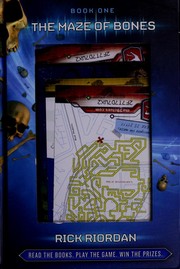
The Maze of Bones
2,831-word summary 13 min read 220 pages in the book
- First published
- 2008
- Publisher
- Scholastic
- Pages
- 220
- ISBN
- 9780545060394
- Series
- The 39 Clues (#1)
Reading options
What's inside (9 sections)
I picked this one up because I remembered the racket around The 39 Clues when it first appeared, the trading cards and the hidden bookmarks and the online game that was supposed to make reading feel like a hunt. I wanted to find out whether the book that started it all could hold up once you stripped away the marketing. The Maze of Bones was published by Scholastic on September 9, 2008, the first novel in the series, and it is a slim 220-page hardcover in the first edition. Rick Riordan, better known for Percy Jackson, wrote this opening volume of what was planned as a ten-book relay, with a different author taking the baton each time. What I found was a quick, smart adventure that makes history feel like a treasure map, and that mostly works, even though it leaves a few of its big promises hanging.
The hook is the kind that grabs you right away. Grace Cahill, the elderly matriarch of a family that supposedly produced everyone from Napoleon to Houdini, is dying. In her last moments she asks her lawyer, William McIntyre, to change her will to an alternate version. She dies, and a man in a dark suit steps in to talk with McIntyre about something the family is not meant to know. That man, and the plan he and the lawyer are cooking up, hover over the entire book without ever being explained. It is a tidy piece of setup, and it puts a low hum of menace under all the puzzle-solving.
A deathbed change to the will
The story really gets going at Grace's funeral, where her orphaned grandchildren, Amy and Dan Cahill, turn up under the care of their guardian, Aunt Beatrice. Amy is fourteen and bookish, the kind of kid who reads the plaques in a museum. Dan is eleven, restless, and always hungry. They are also the grandchildren Grace favored, which becomes clear as the day goes on. At the service they bump into a crowd of other Cahills. There are the Holt siblings, Hamilton, Reagan, and Madison, all athletic and military about everything. There are the Kabra siblings, Ian and Natalie, wealthy and cool and already looking down their noses. There are the Starling triplets, who are academic and painfully proper. Jonah Wizard, a famous singer, is there too, along with Alistair Oh, a polite older man with a talent for gadgets, and Irina Spasky, who has the stillness of a trained KGB spy.
A chosen few are called into a private reading of the will. McIntyre plays a video of Grace, who tells the assembled relatives that they have a decision to make. Each of them can take one million dollars, or each can take a single clue. Most of the family, sensibly, takes the money. Ian and Natalie Kabra are the first to grab a clue, and they are quickly followed by the Holts, the Starlings, Jonah, Alistair, and Irina. That leaves seven teams in the race. Amy and Dan at first want the money like everyone else, but they realize that Grace would have wanted them to choose the clue, so they turn down their million dollars and accept a sealed manila envelope.
Before they leave, McIntyre gives them a private warning. "Beware the Madrigals," he says, and refuses to say more. It is a great little hook, a name that promises danger and then stays stubbornly unexplained for the rest of the book. I liked the mystery of it, and I also felt the small frustration of being dangled a threat that never pays off here. That is a pattern in The Maze of Bones: it is very good at opening doors and not always in a hurry to walk through them.
A burning house and the trail of Benjamin Franklin
With their envelope in hand, Amy and Dan head to Grace's mansion and poke around the library. Amy finds a secret passage, and in the library she discovers an annotated copy of Benjamin Franklin's Poor Richard's Almanack. Alistair Oh shows up in the passage, and Amy hands him the almanack to look at, a decision that will come back to bite her. Before the two teams can settle anything, the mansion catches fire. They escape separately, and Amy and Dan spot a mysterious figure in a dark suit watching from outside.
They run home to their au pair, Nellie Gomez, who is young and more than a little out of her depth. Amy and Dan spill the whole story, and to her credit Nellie agrees to come with them. The first clue points to Benjamin Franklin, who, they learn, was a Cahill himself. That is the series' central trick, the idea that history's great minds and movers were all members of this one sprawling family, each branch with its own gift. The Ekaterina branch, for instance, is the one for inventors and tinkerers. The clue sends the siblings to the Franklin Institute in Philadelphia, where they dig through Franklin's papers and uncover secret messages. The Starlings, hunting the same lead, get taken out when a bomb goes off in the museum. It is a rough introduction to how dangerous this contest is meant to be.
The Franklin material is where the book's research shows. Riordan sprinkles in real details about Franklin's life, his inventions, and his writing, and he makes the puzzle-solving feel active rather than passive. Amy and Dan are not told where to go; they work it out from odd references to a "maze of bones" and from annotations in old books. When it is done well, you can almost see the trail they are following. The historical tidbits are the best part of the book, and they are what kept me turning pages even when the plot started to feel mechanical.
Across the Atlantic, into a trap
All the teams end up in Paris, where Irina Spasky has somehow gotten hold of the almanack. Jonah Wizard offers Amy, Dan, and Nellie a ride to their hotel, but Dan spots Irina, and he quietly asks the singer to drop them at a different hotel instead. That is the sort of quick thinking that makes Dan a satisfying protagonist. He is the kid who notices things. They tail Irina to a stronghold used by the Lucian branch of the family, steal a strange orb from it, and use it to find a set of coordinates pointing to an island. They follow the lead into what turns out to be a trap. The ground gives way beneath them and they land in a pit. Their relative attacks are constant and sometimes absurd, and the Holts try to steal their clue while they are stuck, only to be scattered by shadowy attackers. Dan uses a concussive grenade to buy them a way out, and once again the man in the dark suit is seen watching from the edges.
This section has the breathless, one-thing-after-another pace of a good chase, but it also shows the book's weakness for piling on coincidences. Every corridor has an enemy, every enemy has a gadget, and the siblings escape each scrape with a bit of luck. It is fun in the moment. It is less convincing when you stop to think about how many narrow escapes a pair of kids can have in a single afternoon. Still, Riordan keeps the stakes clear and the geography easy to follow, which is more than I can say for a lot of children's adventures.
Skulls, a number puzzle, and a photograph in the tracks
The trail leads Amy and Dan into the catacombs, the tunnels under Paris lined with the stacked bones and skulls of millions of people. It is the perfect setting for a book whose title promises a maze of bones, and Riordan makes the most of the creepiness. Amy, who has a head for patterns, spots an array of skulls with numbers carved into them. She realizes it is a magic box, a number puzzle that Franklin himself invented, something like sudoku, and that three numbers are missing. Those missing numbers turn out to be coordinates to the next clue.
The Kabras ambush them in the tunnels. Amy threatens to smash the skulls rather than let Ian and Natalie copy the numbers, and Alistair Oh suddenly appears and tackles Natalie before she can fire a dart gun at Amy. The alliances shift constantly in this book, which keeps you guessing about who is really on whose side. Amy, Dan, and Nellie flee through the tunnels and end up in a train tunnel with a train bearing down on them. Dan's backpack gets caught in the tracks, and he cannot yank it free. Amy pulls him out just in time, but the train takes the backpack with it, and with it the last photograph Dan had of his parents.
That loss is the most genuinely affecting moment in the book. Up until then Dan has been the comic relief, the kid cracking jokes and eating everything in sight. When he breaks down over the photo, the story suddenly shows what has been driving him beneath all the cleverness. Amy comforts him, and it is the closest the two siblings come to a quiet, honest scene. I wished there were more of that. The book is so busy moving from one puzzle to the next that it rarely lets the grief sit still, and the emotional beats land best when they are allowed to breathe.
The church beneath Montmartre
Back in the library, Amy studies Franklin's papers and keeps seeing the same odd phrase on his shopping lists: iron solute. Nellie, who has been more useful than anyone expected, points out that iron solute has uses in metalworking and printing. A surveyor's map made by scientists who worked with Franklin's lightning rods gives them a grid, and the coordinates lead to the church of Saint-Pierre de Montmartre. Dan finds a grave with a Lucian crest and no name, and the siblings borrow tools from the church shed and dig until they uncover stairs leading back into the catacombs.
Below the church they find a small chamber with faded murals. Amy reads the pictures and realizes they show four original Cahill siblings, each holding a symbol of a different talent. One holds a dagger, one a bronze mechanism, one a sword, and one a harp, and they stand for the four branches of the family: Lucian, Ekaterina, Tomas, and Janus. Behind them a house burns, echoing both Grace's mansion and the fire that killed Amy and Dan's parents. In the middle of the room, on a pedestal, sits a vase decorated with images of Franklin. Amy finds sheet music on its base and a glass vial wrapped in paper inside. Scrambled letters on the vial give instructions for charging it.
Jonah Wizard turns up to steal the clue, and Amy does something she has not managed to do all book: she finds her voice. She stands up to him, threatens to break the vial, and makes him back off. The Holts arrive in an ice cream truck, and inside the church Alistair and Irina have formed an alliance and demand the vial. A crate of ice cream hurtles across the room and knocks both of them senseless, which is as ridiculous as it sounds, and Nellie calls the police. Amy and Dan climb the bell tower, where Amy figures out that charging the vial means hanging it from one of Franklin's lightning rods on the roof. Lightning strikes, the vial glows green, and she grabs it and climbs back inside.
Ian Kabra then arrives on a kite, ties Dan up, and claims he has poisoned him. He says he will trade the antidote for the vial. Amy hands it over to save her brother, only for Dan to reveal that Ian was bluffing. The police show up, the relatives scatter, and the siblings escape with what turns out to be the real prize.
What Amy kept in her pocket
The ending is a small, clever win. Ian flew off with the glowing vial, but Amy held on to the paper it was wrapped in, and that paper is the actual clue. Over pain au chocolat with Nellie, Amy works out that the sheet music comes from an adagio for the armonica, an instrument Franklin invented. Dan recognizes the tune because their father used to play it, which turns a puzzle into something personal. Amy also cracks the word play at last. The word "Resolution" from the original clue is an anagram for "iron solute," the ingredient they kept seeing in Franklin's notes. And initials on the sheet music point to none other than Wolfgang Amadeus Mozart. Vienna is their next stop.
McIntyre turns up at their table, offers to help them pawn a jade necklace for cash, and is turned down. He gives back Saladin, the family cat, which cheers Dan up after the lost photograph. Then the book cuts to McIntyre meeting the man in the dark suit on the Eiffel Tower observation deck, saying the siblings no longer trust him and that he will have to take more drastic steps to control them. The clue race continues elsewhere, the Madrigals are still a mystery, and the source of the Cahill family's power is nowhere near found. The Maze of Bones ends the way a first installment has to end: it solves one small piece and opens a dozen new questions.
Critics were mostly kind when the book came out. It entered the New York Times children's chapter book list at number one on September 28, 2008, and stayed on the list for twenty-four weeks. Publishers Weekly called it a mix of "suspense, perils, and puzzles" and a "rollicking good read," while noting that the story "does not end so much as drop off a cliff." School Library Journal said the book dazzles and stands on its own. Mary Quattlebaum, writing in the Washington Post, thought the villainous relatives were rather flat but that the historical details and swift plot would keep readers engaged. Austin Grossman, in the New York Times, was more mixed. He liked the dramatic premise but called Amy and Dan "agreeably flawed" while pointing to a manufactured, focus-grouped quality, and he thought the supporting characters were stereotypes and the writing carefully bland. A graphic novel adaptation by Ethan Young arrived in 2023.
I think both readings have a point. The book is undeniably engineered. There is a clue, a chase, a narrow escape, and a new clue, repeated with the reliability of clockwork, and the villains are mostly types rather than people. The manufactured feel Grossman noticed is real. But the engineering also produces a genuinely addictive read, and the historical material gives it a texture that a lesser puzzle hunt would lack. The themes of talent and power give the family concept some weight, since the whole premise is that whoever assembles the clues will gain enormous influence, and Amy and Dan have to discover what their own gifts are along the way.
Where it works and where it stumbles
What I would tell a reader considering this book is to enjoy it for what it is: a fast, smart romp through history with a puzzle in every chapter and two likable kids at the center. It is best read quickly and with a willingness to accept that not everything will be explained. The fun is in the hunt, the coded messages, the magic boxes, and the little shocks of recognition when a famous name turns out to be a Cahill. Amy's habit of reading the world closely is a pleasure to watch, and Dan's hunger and impulsiveness give the pair a decent rhythm.
The frustrations are real, though. The man in the dark suit and the Madrigals are dangled as threats and never resolved here. The relatives are cartoonishly nasty, with few shades of gray. The ending is a deliberate cliffhanger, so anyone looking for a complete story in one volume will be disappointed. And the emotional moments, especially the business with the lost photograph, are the parts that linger, yet they get far less space than the chases. The book is at its best when it slows down enough to let Amy and Dan be kids who lost their parents, and at its weakest when it is racing to the next puzzle.
I finished it understanding why the series took off. It hands a young reader a reason to care about Franklin and Mozart and the catacombs of Paris, and it wraps the history in a game with real stakes. It is not a book that offers deep character study or a tidy conclusion. It is a first step, confident and a little cocky, in a much longer race, and as a first step it does its job well.
FAQ
Is The Maze of Bones a complete story or part of a series?
It is the first novel in The 39 Clues, a ten-book series in which different authors wrote different volumes, and it ends on a cliffhanger with the larger hunt unresolved.
Who are Amy and Dan Cahill?
They are orphaned siblings, fourteen and eleven, who turn down a million dollars at their grandmother's will reading and chase clues about their family's hidden power.
What is the answer to the first clue?
Amy decodes the word Resolution as an anagram for iron solute, an ingredient in the Cahill family's mysterious serum, which points them toward Mozart and Vienna.
Similar books
More from The 39 Clues first, then related titles.
The Chalice of the Gods
Percy needs three recommendation letters from three gods to apply to college, so his first quest is recovering a stolen chalice from the god of old age.
2,106-word summary · 9 min read
The Ship of the Dead
Magnus and his crew sail to the edges of the Norse worlds to stop Loki from launching Naglfar, the ship of the dead.
2,426-word summary · 11 min read
The House of Hades
Percy and Annabeth cross Tartarus while the five close the Doors of Death before Gaea wakes.
2,910-word summary · 13 min read
The Secret of the Old Clock
The first Nancy Drew novel: a sixteen-year-old detective follows a clue hidden in a clock to overturn a will and restore a family's inheritance.
2,011-word summary · 9 min read
The Thief
A boastful young thief is pulled from a prison to steal a legendary stone for the king's magus, and the story he tells about himself is not the whole story.
2,514-word summary · 11 min read
The Icebound Land
Captured and enslaved in Skandia, Will fights a drug that erases him while Halt and Horace cut a bloody road through Gallica to bring him home.
2,088-word summary · 9 min read
Lioness Rampant
Alanna searches for the Dominion Jewel with the Shang Dragon, then returns to Tortall to face Duke Roger at Jonathan's coronation.
2,478-word summary · 11 min read

Heist Society
A teenage art thief gets expelled from boarding school, then has two weeks to steal five paintings back from a London museum and clear her father.
2,781-word summary · 12 min read
The Brothers Hawthorne
Jameson infiltrates an underground London gambling club for the father he never knew while Grayson protects his half-sisters in Phoenix from a dead man's…
2,019-word summary · 9 min read
The Reappearance of Rachel Price
Bel films a doc when her missing mother walks back after years.
2,254-word summary · 10 min read
The Cousins
Three cousins work at their rich grandmother island resort while digging into why their parents were cut off.
2,565-word summary · 11 min read
Two Can Keep a Secret
Twins new to Echo Ridge dig into aunt's murder as homecoming threats return.
2,078-word summary · 9 min read
The Mysterious Benedict Society
Four gifted children pass strange tests and go undercover at a school hiding a mind control machine.
2,130-word summary · 9 min read
The Angel Experiment
Six winged kids escape the lab that made them and fly cross country to rescue their youngest from wolf hybrids.
2,037-word summary · 9 min read
From the Mixed-Up Files of Mrs. Basil E. Frankweiler
Claudia and Jamie run away to the Met, chase whether a 225 dollar Angel is a Michelangelo, and trade secrets with Mrs. Frankweiler.
2,774-word summary · 12 min read

The City of Ember
Two twelve-year-olds trade jobs and chase a chewed-up note to save their fading underground city before its lights fail.
2,998-word summary · 13 min read
The Final Gambit
Avery, Jameson and Grayson face Toby's past, Eve's claim and Blake's trap to solve Tobias's last game and keep the fortune.
2,464-word summary · 11 min read
The Hawthorne Legacy
Avery hunts for lost Toby Hawthorne while old wills, postcards and a violent rival force her to face what the inheritance really costs.
2,576-word summary · 11 min read
We Were Liars
Cadence Sinclair returns to Beechwood Island after an accident she cannot recall, chasing summers with Johnny, Mirren and Gat toward the truth.
1,923-word summary · 9 min read
The Inheritance Games
Avery Grambs inherits billions from a stranger and must live a year in Hawthorne House.
3,286-word summary · 15 min read
Holes
Stanley Yelnats digs holes at Camp Green Lake while a broken promise, a buried outlaw, and a boy named Zero close in around him.
2,456-word summary · 11 min read
The Tyrant's Tomb
Apollo, still trapped in a mortal teenager's body, carries Jason Grace's coffin to Camp Jupiter and must learn what a hero is before the emperors destroy it.
2,292-word summary · 10 min read
The Burning Maze
Apollo, still trapped in a mortal teenager's body, follows a dangerous prophecy through the Labyrinth with Meg and Grover as the Triumvirate's grip tightens.
2,248-word summary · 10 min read
The Hammer of Thor
Magnus and Sam chase Thor's stolen hammer to a giant wedding heist, with Alex Fierro joining Floor Nineteen as Loki bargains and Ragnarok stirs.
3,068-word summary · 14 min read
The Dark Prophecy
Mortal Apollo and Leo cross America to free the Oracle as Commodus hunts them.
2,368-word summary · 11 min read
The Serpent's Shadow
Carter and Sadie Kane have three days to bind Apophis by his shadow before the serpent rises and unmakes the world.
2,941-word summary · 13 min read

The Throne of Fire
Carter and Sadie Kane have five days to wake the sun god Ra before the serpent Apophis breaks free and eats the world.
2,867-word summary · 13 min read
The Sword of Summer
A homeless Boston teen learns he is a Norse god son and dies on day one stopping a fire giant.
2,116-word summary · 9 min read
The Hidden Oracle
Apollo lands as a teen in New York with no powers and must earn his way back with Meg and demigods.
1,933-word summary · 9 min read

The Blood of Olympus
Seven demigods stop Gaia waking while Reyna brings Athena statue.
2,196-word summary · 10 min read