
Reading options
What's inside (7 sections)
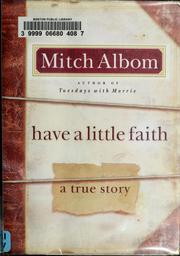
I picked this one up because a friend said it was the Albom book for people who were tired of being told what to believe. That sounded about right. Mitch Albom had already given readers Tuesdays with Morrie and The Five People You Meet in Heaven, books that turned dying and the afterlife into something you could discuss over coffee. Have a Little Faith arrived in 2009 from Hyperion in New York. The hardcover I read runs 272 pages, and its jacket was designed to resemble the old, worn prayerbook of the rabbi at the center of the story, the kind held together with rubber bands. That small design choice tells you what kind of book this is. It is about faith as something handled daily, frayed at the edges, and kept anyway.
Albom insists he did not begin with a thesis about religion. He began with a phone call and a promise. The man who made the request was his childhood rabbi, Albert L. Lewis, and the favor was simple to state and strange to hear from a nonagenarian. Would Albom deliver his eulogy when the time came?
The two men at the center of this book could hardly be farther apart on a map or in a bank account, and that distance is the whole design of the thing. One is a respected rabbi in an affluent New Jersey suburb. The other is a former addict preaching to homeless people in a Detroit church with a leaking roof. Albom moves between them for two hundred and seventy pages, and he never quite decides which one taught him more. That refusal to pick a winner is, I think, the point.
Albom writes the way a reporter writes, which is to say he notices rooms and clothes and the exact shape of a hesitation. He is a novelist by habit, and he knows when to let a scene carry an idea instead of explaining it. The risk in a book like this is that the writer becomes the story, that every person on the page exists mainly to produce a lesson for the narrator. Some of that happens here. Lewis and Covington are filtered through Albom's sensibility so thoroughly that you sometimes feel you are reading about Albom's reactions rather than the men themselves. But the best scenes push back against that, and the book is at its strongest when it lets a person be difficult, funny, or ordinary without immediately turning him into a moral.
A last request from the Reb
Albom grew up in the Philadelphia area, and Rabbi Lewis was the pulpit rabbi at Temple Beth Sholom, first in Haddon Heights and later in Cherry Hill, New Jersey. Lewis was born in 1917, ordained at the Jewish Theological Seminary, and took over a congregation of about fifty families in 1948 while still in rabbinical school. He never left. By the time he retired in 1992, four years after the synagogue moved to Cherry Hill, the congregation had grown by a factor of twenty to roughly a thousand families. Albom calls him the Reb, from the Yiddish word for rabbi, and he describes a man who preached in stories and sometimes sang his sermons and even his conversations. A nurse who cared for Lewis near the end told Albom that he sang all the time.
When Lewis asked for the eulogy, Albom agreed, but on one condition. He wanted to interview the old man first, to know him as a person and not only as a rabbi. What started as a dodge against an awkward duty turned into a long series of conversations. Lewis, it seems, understood exactly what he was doing. Albom has said in interviews that the request was probably a way of drawing him back toward the roots of his own faith and back to God a little bit. That is the quiet engine of the memoir. The student who thought he was doing a favor for a teacher was being handed something he did not know he needed.
Lewis died on February 10, 2008. The funeral and the eulogy came two days later, which means most of the book was written before the ending was known. That gives the early chapters a peculiar patience. Albom is collecting a life while it is still being lived, sitting with a man who has asked him to remember him properly and who keeps changing the subject toward something more interesting than himself.
The rabbi was no gentle background figure. He had been president of the Rabbinical Assembly, a leader in Conservative Judaism, a chaplain at a county mental hospital, and a tireless organizer of interfaith visits and youth pilgrimages to Israel. He wrote a history of the shofar for the Encyclopedia Judaica and two books of his own. Albom mostly leaves that resume alone. He is after the man who would turn a hospital visit into a story and a story into a small instruction in how to live.
Sermons from the Reb
The book is built in two alternating strands. With Lewis, Albom mixes reported conversation with the rabbi's own mini-sermons, the stories he told from the pulpit. One of them, delivered in 1981, has stayed with me. A soldier's family is being moved to a distant post. Their little girl sits at the airport among the duffel bags, sleepy and leaning against the luggage. A woman walks by, pats her head, and says, Poor child, you haven't got a home. The girl looks up, surprised. But we do have a home, she says. We just don't have a house to put it in.
That is Lewis's method in a nutshell. He does not announce a lesson about belonging or about what makes a home. He tells you an airport scene and lets you arrive at the lesson yourself. Albom, who is a good reporter, keeps the rhythm intact. He gives the story room and then gets out of the way. The book is full of moments like this, where a throwaway anecdote from a sermon turns out to be carrying the weight of a chapter.
Other chapters widen the picture. Lewis talks about the death of his four year old daughter Rinah, the twin of another daughter, and the anger that came with it, and the slow work of faith through that grief. Albom does not rush the man toward consolation. He lets the anger sit on the page for a while. Lewis describes his secret to happiness as a kind of gratitude, the ability to look at an ordinary day and feel satisfied by it. He calls his congregation a Kehillah Kedoshah, a sacred community, and for decades he treated that title as a description rather than a compliment. A Conservative rabbi by training and instinct, he built a "heimish" synagogue, a homey place where people were known by name, and he spent a career arguing that Jews and Christians could learn each other's traditions in person rather than at a distance.
The Reb comes across as funny, demanding, and completely at ease with the smallness of daily religious life. When he is in the hospital near the end, people come by just to hear his stories or ask for a blessing. He is still teaching. That is the version of faith Albom wants us to see, one that does not stop working when the body fails, and one that does not require an argument to be real.
Life of Henry
The second strand is called Life of Henry, and it takes Albom back to Detroit, his hometown, and into a church that could not have looked more different from Temple Beth Sholom. Pastor Henry Covington led the I Am My Brother's Keeper Church. He was an African American Protestant minister who had been a drug addict, a dealer, and a convict before he took up the pulpit. His congregation was largely homeless. The roof leaked when it rained.
Albom does not soften any of that. He puts the leaky roof and the hungry parishioners on the page early, and he lets the contrast with the comfortable New Jersey suburb do its work. One man speaks to people who have arrived at security and belonging. The other speaks to people who are trying to survive the week. Both men, Albom keeps insisting, are doing the same job.
Covington is a harder figure to render than Lewis, and the book half admits it. He has a history that resists a clean retelling. Albom gives us his anger, his swagger, his past, and the stubborn habit of showing up for people nobody else wants. The pastor is not presented as a saint in training. He is presented as a man who found a use for a past that would have disqualified him almost anywhere else. There are scenes of him talking to people in the street, arguing, persuading, feeding, and occasionally losing his temper, and the effect is of a life lived at a volume the suburban rabbi never needed. When Covington died on December 21, 2010, a little over a year after the book appeared, Albom delivered his eulogy too. That symmetry was not planned, and you can feel him noticing it.
What links the two men is not a creed. It is attention. Lewis noticed the soldier's daughter in the airport story, and Covington notices the person sleeping outside the church. Albom's real subject is that kind of noticing, which he treats as the practical content of faith. One man's faith is measured in a well kept synagogue bulletin and a life of study. The other's is measured in whether the roof gets fixed before winter. Albom never says one measurement is better, though he clearly finds the Detroit one harder to ignore.
The eulogy and the tape
The last section moves to the funeral on February 12, 2008. Albom stands in a synagogue full of people who have come to say goodbye to their rabbi, and he has to deliver the speech he promised years earlier. He admits that he did not want to do it. He felt that a congregant could never eulogize his leader. What he realizes in the pulpit is that thousands of people are eulogizing Lewis at the same time, in cars on the way home and over dinner tables. A eulogy, he writes, is no more than a summation of memories.
Then there is the tape. Lewis had recorded a seven minute message to be played at his own funeral, and the congregation hears a voice that is gone but still teaching. He talks about God and immortality, thanks the people who shared his life, and signs off with the words Shalom Haverim, goodbye, friends. The "singing rabbi" ends with a song, and even in print the effect is odd and moving, because a recorded voice refuses the finality of the room.
Albom's own closing line is the one people quote from this book. He says that to imagine a world without Lewis in it is to imagine a world with a little less God in it, and then adds that God is not a diminishing resource, so he cannot believe that. It is a fine line, and it is the book's argument in one sentence. Presence is felt as a loss when someone dies. The thing they pointed toward is not used up by their absence.
What "a little faith" means
The title comes out of that same modest logic. Nobody in this book claims to possess a mountain moving certainty. Lewis jokes and sings and admits doubt. Covington counts the people he can feed this week. Albom describes himself as someone who believed and then drifted, and who is pulled back by watching two men who never left. A little faith, in this telling, is enough to get through a Tuesday, and it is the kind that survives contact with a leaky roof. The book was used by religious and nonreligious groups for interfaith discussions after it came out, which seems right. It gives people with very different commitments something to talk about that is not a doctrine.
The book also has a practical afterlife. In the Author's Note, Albom pledges a tenth of his profits to charity, including the church, the synagogue, and the shelters in the story. Conversations with Covington led to the A Hole in the Roof Foundation, which repairs the buildings where faith groups serve homeless people. The first project was Covington's own church. Later work reached the Caring and Sharing Mission and Orphanage in Port au Prince after the 2010 earthquake. The book topped the New York Times hardcover nonfiction list in January 2010, and it was turned into a Hallmark Hall of Fame film in 2011, with Martin Landau as Lewis, Laurence Fishburne as Covington, Bradley Whitford as Albom, and a screenplay by Albom himself. It aired on ABC in November of that year.
I should say where the book falls short. Albom writes in a polished, almost rehearsed voice, and the neatness of the structure can flatten the lives it describes. The broad contrast between a comfortable synagogue and a poor city church is real, but it is also simplified, and some readers will feel that Covington's hardest edges are sanded down to make the parallel work. This is not a book of theology. If you want an argument about God, you will find a sentiment rather than a proof. Albom is also careful to keep his own doubts in a small register, which makes the tidy moral arc feel a little too managed at times. His habit of ending chapters on a perfectly turned line can start to feel engineered after two hundred pages.
Still, the thing I remember is the airport. A child says she has a home but no house to put it in. That is the whole book in a single scene, and it explains why people keep handing it to one another.
FAQ
Who are the two men in Have a Little Faith?
Rabbi Albert L. Lewis, Albom's childhood rabbi in Cherry Hill, New Jersey, and Pastor Henry Covington, who led a largely homeless congregation in Detroit. Albom interviewed both men and delivered eulogies for each.
Is Have a Little Faith a work of theology?
No. It is a 2009 memoir about two religious leaders and what Albom learned from them. It offers stories and reflections rather than a systematic argument about God.
Why is the book called Have a Little Faith?
The title reflects the modest, workaday faith Albom observes in both men. Neither claims certainty; Lewis jokes and sings, and Covington measures faith in whether the church roof gets fixed.
Similar books
The Pursuit of God: The Human Thirst for the Divine
Ten short chapters on wanting God rather than merely knowing about him, from a pastor who wrote the book in a single night on a train.
2,014-word summary · 9 min read
My Utmost for His Highest
A posthumous collection of 366 daily devotional readings assembled from Oswald Chambers's sermons, built around surrender, discipleship and the gap between…
2,015-word summary · 9 min read
Captivating: Unveiling the Mystery of a Woman's Soul
A Christian companion to Wild at Heart in which John and Stasi Eldredge argue that women carry three God-given desires that wounds can bury. Warm, scriptural…
2,722-word summary · 12 min read
The Prayer of Jabez: Breaking Through to the Blessed Life
A tiny 2000 devotional built on two verses in Chronicles became a publishing phenomenon and a lightning rod for criticism.
2,296-word summary · 10 min read
Same Kind of Different as Me
An art dealer and a formerly homeless sharecropper tell the story of the friendship that began at a Fort Worth mission and the woman who insisted on it.
2,023-word summary · 9 min read
Love Does
A lawyer and activist tells stories of saying yes, showing up, and loving people through ordinary, often ridiculous actions.
2,411-word summary · 11 min read
90 Minutes in Heaven: A True Story of Death and Life
A pastor declared dead at a 1989 crash scene describes ninety minutes he says he spent in Heaven, then thirteen months of surgeries, depression, and recovery.
2,246-word summary · 10 min read
Blue Like Jazz
Donald Miller leaves youth group faith in Texas for Portland and Reed College, where a confession booth and shared house life reshape his view of Christian…
2,366-word summary · 11 min read
Wild at Heart: Discovering the Secret of a Man's Soul
Why do men feel bored and tame? John Eldredge argues a man's heart is wild by design, and that recovering it means facing the wound and the question of whether…
2,289-word summary · 10 min read
A Grief Observed
In four raw notebooks written after his wife Joy died, C. S. Lewis records grief as fear, anger and doubt, then slowly learns to live without easy consolation.
3,692-word summary · 16 min read

Infidel
Ayaan Hirsi Ali's memoir of a Somali childhood, a forced marriage, a Dutch asylum claim, and the political fight that followed the murder of Theo van Gogh.
2,041-word summary · 9 min read

The Magnolia Story
How Chip and Joanna Gaines met, closed their first shop, nearly lost everything in a housing development, and built Fixer Upper.
2,994-word summary · 13 min read
God Is Not Great
Hitchens argues religion poisons life across history and texts.
2,545-word summary · 11 min read
10% Happier
An ABC newsman panics on air, then finds meditation without losing his edge.
2,590-word summary · 12 min read
The Case for Christ
An atheist journalist cross-examines scholars on the Gospels, the tomb, and the resurrection to test the evidence for Jesus.
2,882-word summary · 13 min read
The Hiding Place: The Triumphant True Story of Corrie Ten Boom
The Ten Booms hide Jews in Haarlem, suffer Ravensbruck, lose Betsie, and learn forgiveness.
2,593-word summary · 12 min read
Everything I Know About Love
Dolly Alderton recalls bad dates flatshares and female friendship in her twenties memoir.
2,194-word summary · 10 min read
Eat, Pray, Love
Eat, Pray, Love retold: divorce, Italy for pleasure, India for practice, Bali for balance.
1,962-word summary · 9 min read
Tuesdays with Morrie
A sportswriter visits his old professor each Tuesday as ALS takes hold, talking through love, work, aging, and death in short lessons that still read clearly.
2,463-word summary · 11 min read
Survival in Auschwitz
A chemist deported from Turin records ten months in Auschwitz with a restraint that makes the horror impossible to look away from.
2,177-word summary · 10 min read

Motherland: A Feminist History of Modern Russia, from Revolution to Autocracy
A feminist history of modern Russia told through women's lives, from the revolutionaries of 1917 to Pussy Riot and the politics of today.
2,191-word summary · 10 min read

I Feel Bad About My Neck: and Other Thoughts on Being a Woman
In short, funny essays written just after her sixty-fifth birthday, Nora Ephron takes on aging, vanity, a White House summer, and the daily upkeep of looking…
2,099-word summary · 9 min read
How to Change Your Mind
Pollan blends the history of psychedelic research, his own guided trips, and current neuroscience to ask what these drugs reveal about consciousness.
2,466-word summary · 11 min read
You Can Heal Your Life
Louise Hay's 1984 bestseller argues that thoughts and beliefs shape the body, pairing a mirror-and-affirmation workbook with an A to Z list of ailments and…
3,672-word summary · 16 min read

Women Who Run with the Wolves
A Jungian analyst reads fairy tales as maps to a woman's instinctual self, from La Loba to Bluebeard and Vasalisa.
2,331-word summary · 10 min read
The Witch of Portobello
A journalist collects testimony from those who knew Athena, a woman born in Transylvania who became a dancer and teacher in Portobello. Coelho keeps her fate…
2,499-word summary · 11 min read

The Princess Diarist
Built from diaries Fisher kept at nineteen while filming the first Star Wars movie, this 2016 memoir revisits her affair with Harrison Ford and the strange…
2,360-word summary · 10 min read
The Power of Your Subconscious Mind
Joseph Murphy argues that the subconscious accepts whatever the conscious mind repeats, so worry and confidence quietly grow into very different lives.
2,259-word summary · 10 min read

Taste: My Life Through Food
Stanley Tucci's memoir traces his life through food, from a Calabrian family kitchen in Katonah to film sets, marriage and a cancer fight that cost him his…
2,503-word summary · 11 min read
Stories I Only Tell My Friends
Rob Lowe's 2011 memoir runs from an Ohio lumberyard to the Oval Office, through Brat Pack fame, a public scandal, sobriety and a television comeback, told with…
2,234-word summary · 10 min read