
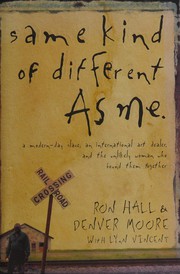
Same Kind of Different as Me
2,023-word summary 9 min read 237 pages in the book
- First published
- 2006
- Publisher
- Thomas Nelson
- Pages
- 237
- ISBN
- 9780849900419
Reading options
What's inside (9 sections)
This book arrived with a subtitle that made me suspicious: A Modern-Day Slave, an International Art Dealer, and the Unlikely Woman Who Bound Them Together. It sounds like a parable designed to make the reader feel good. What I found instead was a strange, uneven, often powerful memoir about two men who should never have met, written in alternating first-person chapters that let each of them tell his own story. Ron Hall and Denver Moore published it with Thomas Nelson in 2006, with Lynn Vincent as collaborator. It is a Christian book, and it is also a book about race in America that is more honest than its packaging suggests.
Denver
Denver Moore's chapters are the best thing in it. He was born in 1937 in Red River Parish, Louisiana, and raised by his grandparents, Big Mama and PawPaw, on a sharecropping farm. The family is trapped in debt bondage to a man they call the Man. They pick cotton, they never see a paycheck, and they cannot leave.
The book opens with a scene that tells you what kind of world Denver grew up in. As a teenager, he changes a flat tire for a white woman. Three white boys ride up, accuse him of bothering her, lasso his neck, and drag him down the road. The woman says nothing. Denver survives, but the lesson is clear. His body is not safe around white people, and no one will protect him.
When Denver is five or six, the family house catches fire. He tries to rescue Big Mama, but the roof collapses. He and his brother listen as she wakes and screams. His father, BB, is stabbed to death, probably by a jealous husband. Denver goes to live with Uncle James and Aunt Etha, where life is hard farm labor, hunting, moonshine, and strict Christianity.
There is one bright story in this stretch. Denver befriends Bobby, the plantation owner's nephew, and picks scrap cotton for three years to buy a red-and-white Schwinn bicycle with a squeeze horn. It is the first new thing he has ever owned, and he is eleven. The scene matters because it shows what Denver can do when he is allowed to want something. It also shows how little he is allowed to want.
In his late twenties he hops a freight train out of Louisiana. He is illiterate. He ends up homeless in Fort Worth, with a stint in Los Angeles and a robbery conviction that sends him to Angola prison. He serves about ten years of a twenty-year sentence, works the cotton fields, and comes out harder than he went in. By the time Ron Hall meets him, Denver is a man who has learned that the world takes everything and gives nothing back.
The prison chapters are short and brutal. Denver does not dwell on the violence, but he does not soften it either. He describes the cotton fields, the guards, the men who were broken and the men who became dangerous. When he is released, he has no family to return to and no skills that the outside world values. He drifts back to Fort Worth and the streets. The book is clear that his homelessness is not a moral failure. It is the end of a road that started in a sharecropper's field.
The Union Gospel Mission is the third main character. It is a real place, and the book treats it with affection. Don Shisler runs it with a combination of patience and fatigue. Chef Jim Morgan feeds hundreds of people a day. The volunteers are church people, students, and men who are there because they have nowhere else to be. The mission is not portrayed as a solution to poverty. It is a room where people are seen, and that is enough for the story it tells.
Ron
Ron Hall's chapters are slicker and less interesting, which is part of the book's problem. He grows up in Haltom City, Texas, with an alcoholic father. He attends TCU, meets Deborah Short, gets drafted, and becomes a salesman, then an investment banker, then an art dealer. He buys a Charles Russell painting called The Signal and sells it through a California collector for a profit equal to a year's salary. The Armani suits, the Dallas mansion, and the Rolls-Royce follow. Deborah is not impressed.
Ron has an affair with a painter in Beverly Hills. Deborah finds out, throws things at him, and insists on marriage counseling. She tells him that they are going to rewrite the future history of their marriage. That line is the hinge of the book. Deborah is the engine of everything that happens next, and Ron knows it.
The art world chapters are the weakest in the book, partly because Ron is less interesting when he is succeeding. He buys and sells paintings, flies to California, and learns to perform the role of a rich man. The details are glossy and a little hollow, which may be the point. His life before Denver is a collection of things. The book only comes alive when he starts to lose control of it.
Deborah sees an article about the Union Gospel Mission and insists they volunteer. They meet Don Shisler, the manager, and Chef Jim Morgan. Deborah has a vision of the mission transformed by yellow flowers. She commits them to serving every Tuesday. Then she has a second dream, based on Ecclesiastes 9:15, about a poor wise man who will save the city. On their third week, Denver throws a chair in the dining hall because his shoes were stolen. Deborah grips Ron's arm and says this is the man from her dream. Ron has to befriend him.
The friendship
Ron pursues Denver for weeks. He calls him Dallas by mistake. He offers money, rides, help. Denver refuses all of it. Finally, at the Cactus Flower Café, Denver asks what Ron wants. Ron says friendship. Denver asks for a week to think about it, then says he will be Ron's friend only if it is for life.
The explanation is the best scene in the book. Denver uses a fishing metaphor. White people catch fish and let them go. He will not be a catch-and-release friend. Ron, who has spent his life making deals, has no answer. He agrees.
The friendship that follows is not a simple mentor story, although the book sometimes frames it that way. Denver teaches Ron more than Ron teaches Denver. At the Modern Art Museum, Denver calls abstract art a scam. When he sees Ron's key ring, he asks whether Ron owns the keys or the keys own him. Ron begins to see Denver as the professor and himself as the student. The inversion is real, and it is the reason the book works when it works.
Deborah
Deborah is the character the book loves most, and it is easy to see why. She is stubborn, generous, and direct. She refuses to let Ron's money or status excuse him. She also refuses to let Denver be a project. When she is diagnosed with cancer on April 1, 1999, the book becomes a different kind of story.
The medical details are grim. A mass in her abdomen, spots on her liver, chemotherapy, surgery, a remission, then a return. Denver prays beside the mission Dumpster every night. Deborah sees Jesus and angels. Denver has a simultaneous vision. He later says God tells him to pray with Ron to release her. She dies. At her funeral at Rocky Top, Denver speaks and receives a standing ovation. Donations of $350,000 follow.
The aftermath is the part I did not expect. Denver is terrified that Ron will abandon him now that Deborah, the woman who bound them together, is gone. He has been abandoned before. Then Deborah appears to him at the ranch and says, "Denver, you are welcome in our home." Ron and Denver live as family. In September 2001 they take a road trip to Red River Parish, and the book ends with the two of them still friends.
What works
Denver's voice is unforgettable. The dialect is rendered on the page, which some readers will find distracting, but it gives him a presence that Ron's polished chapters lack. His stories about sharecropping, prison, and homelessness are specific and unsentimental. He does not ask for sympathy. He tells you what happened.
The book is also honest about the limits of charity. Ron's early attempts to help Denver are clumsy and self-serving. Deborah's vision is more generous, but even she is working from a position of comfort. The book knows that the friendship is unusual, and it does not pretend that one relationship fixes the systems that produced Denver's poverty. It just shows two men who chose each other.
What it dodges
The subtitle calls Denver a modern-day slave, which is both accurate and exploitative. He was a sharecropper trapped in debt bondage, and later a prisoner in a system that used convict labor. The book gestures at that history, but it does not examine it. The focus stays on the personal relationship, and the structures that made Denver's life so hard remain background.
The book also centers Ron. Deborah's dream, Ron's art career, Ron's guilt, Ron's redemption. Denver is the wise friend who helps Ron become a better man, which is a familiar and comfortable role for a Black character in a white memoir. The book tries to invert that dynamic, and sometimes succeeds, but the frame is still Ron's. Readers who are tired of white-savior narratives will notice.
Deborah is also close to a saint, and the book knows it. She is generous, brave, and right about almost everything. That makes her death powerful, but it also makes her less interesting than she might have been. The memoir is written by two men who loved her, and they are not interested in her flaws. I understand that. I also wanted to know what she was like when she was wrong.
The faith element will work for some readers and not others. The book presents Deborah's visions and Denver's prayers as real events, not metaphors. If you share the belief, the story is a testimony. If you do not, it is a window into someone else's faith. Either way, the human story survives the theology. The friendship is the miracle the book is actually about.
The epilogue is worth mentioning because it refuses the tidy ending the subtitle promises. Denver does not become rich or move into a mansion. He becomes part of Ron's family, with all the awkwardness that implies. The two men take a road trip to Red River Parish, and Denver shows Ron where he came from. The scene is quiet and a little unresolved. It is the right note for a book that is more honest about friendship than about systems.
There is also the question of fact. The book is a memoir, not journalism, and some details have been reconstructed or compressed. The exact year Denver left Louisiana and the precise nature of his conviction vary between accounts. That does not make the story false. It does mean you should read it as a remembered story, not a documented history.
Should you read it
Read it for Denver. Read it for the Cactus Flower Café and the catch-and-release speech. Read it for Deborah, who is the best argument in the book for the idea that a person can change a family by refusing to accept its excuses. Read it for the scene where Denver asks whether Ron owns his keys or the keys own him, which is worth more than most sermons.
Do not read it as a policy book or a complete history of race in Texas. It is a memoir about three people, and it is most truthful when it stays small. I finished it moved and uneasy at the same time. The friendship is real. The framing is not innocent. Both things can be true.
FAQ
Is Same Kind of Different as Me a true story?
It is presented as a memoir and is based on the lives of Ron Hall, Denver Moore, and Deborah Hall, though some scenes and dates have been reconstructed.
What does catch and release mean in the book?
Denver uses the phrase to describe white people who make friends with him and then abandon him. He tells Ron he will only be friends if the commitment is for life.
Does Deborah Hall die in the book?
Yes. She is diagnosed with cancer in 1999, goes into remission, then dies. Her death is the turning point that tests whether Ron and Denver's friendship will survive.
Similar books
Down and Out in Paris and London
Orwell's account of washing dishes in Paris hotels and tramping through London does not ask for pity, only for a clear look at how poverty actually works.
2,282-word summary · 10 min read

Love Does
A lawyer and activist tells stories of saying yes, showing up, and loving people through ordinary, often ridiculous actions.
2,411-word summary · 11 min read

The Magnolia Story
How Chip and Joanna Gaines met, closed their first shop, nearly lost everything in a housing development, and built Fixer Upper.
2,994-word summary · 13 min read
90 Minutes in Heaven: A True Story of Death and Life
A pastor declared dead at a 1989 crash scene describes ninety minutes he says he spent in Heaven, then thirteen months of surgeries, depression, and recovery.
2,246-word summary · 10 min read
Maid: Hard Work, Low Pay, and a Mother's Will to Survive
Stephanie Land's memoir of cleaning houses as a single mother on the poverty line, and of the paperwork that made every step forward cost something else.
2,039-word summary · 9 min read

Blue Like Jazz
Donald Miller leaves youth group faith in Texas for Portland and Reed College, where a confession booth and shared house life reshape his view of Christian…
2,366-word summary · 11 min read
Nickel and Dimed: On (Not) Getting By in America
A journalist works waitress, cleaning, retail, and care jobs undercover to test whether full-time work keeps a person housed and fed.
2,328-word summary · 10 min read
Just Mercy
A young lawyer defends Walter McMillian on Alabama death row and children in adult prisons.
2,232-word summary · 10 min read

The Hiding Place: The Triumphant True Story of Corrie Ten Boom
The Ten Booms hide Jews in Haarlem, suffer Ravensbruck, lose Betsie, and learn forgiveness.
2,593-word summary · 12 min read

Everything I Know About Love
Dolly Alderton recalls bad dates flatshares and female friendship in her twenties memoir.
2,194-word summary · 10 min read

The Glass Castle
Jeannette Walls's memoir of a childhood spent hungry and moving, from a stove fire at three to a Bronx apartment and parents on the street.
2,255-word summary · 10 min read

Long Walk to Freedom
Mandela's account of a Thembu childhood, a law practice, a banned movement, twenty-seven years in prison, and the negotiation that ended apartheid.
2,454-word summary · 11 min read
Nothing to Envy
Barbara Demick follows six defectors from Chongjin through the North Korean famine, showing how ordinary people lived, believed, and finally left.
2,068-word summary · 9 min read

In Order to Live: A North Korean Girl's Journey to Freedom
A young North Korean girl crosses the Yalu, survives trafficking in China, and rebuilds her life in Seoul in this unsparing memoir.
2,027-word summary · 9 min read

Too Much and Never Enough: How My Family Created the World's Most Dangerous Man
Mary L. Trump's 2020 memoir traces how a cold, zero-sum Queens household shaped her uncle, and uses family tax documents to challenge his self-made story.
2,059-word summary · 9 min read

Infidel
Ayaan Hirsi Ali's memoir of a Somali childhood, a forced marriage, a Dutch asylum claim, and the political fight that followed the murder of Theo van Gogh.
2,041-word summary · 9 min read
Year of Yes: How to Dance It Out, Stand in the Sun and Be Your Own Person
Shonda Rhimes takes her sister’s accusation seriously and spends a year saying yes to the things that frighten her, from live television to her own reflection.
2,585-word summary · 11 min read

The Girl with Seven Names: A North Korean Defector's Story
Hyeonseo Lee crossed the frozen Yalu River at seventeen, spent years hidden in China, escaped to South Korea, and later returned to rescue her family.
2,404-word summary · 11 min read

Beautiful Boy: A Father's Journey Through His Son's Addiction
David Sheff recounts watching his son Nic slide into meth addiction, and his own desperate, humbling search for how to help without destroying them both.
2,076-word summary · 9 min read
Lone Survivor: The Eyewitness Account of Operation Redwing and the Lost Heroes of SEAL Team 10
Marcus Luttrell's account of the 2005 SEAL mission in Afghanistan that killed three of his team and left him alone.
2,144-word summary · 10 min read
Life
The Rolling Stones guitarist tells his own story: a Dartford childhood, the band's first gigs, the drug raids, the tax years and Patti Hansen.
2,761-word summary · 12 min read
Dry
A memoir of drinking, rehab and relapse, and the strange business of getting sober one morning at a time.
2,643-word summary · 12 min read

Dear Girls: Intimate Tales, Untold Secrets & Advice for Living Your Best Life
Ali Wong's debut collects fourteen letters to her daughters, covering sex, money, work, marriage, Vietnam, and being a working Asian American mother.
2,266-word summary · 10 min read

Why I'm No Longer Talking to White People About Race
Reni Eddo-Lodge traces black British history and shows how institutions, culture, and everyday assumptions keep producing racial inequality.
2,071-word summary · 9 min read
Travels with Charley
Steinbeck drives across America with his poodle Charley, looking for the country he remembers and finding a place that has changed.
2,039-word summary · 9 min read
The Blind Side: Evolution of a Game
Michael Lewis traces how the left tackle became a premium position and tells the story of Michael Oher, a homeless Memphis teenager whose size and speed made…
2,038-word summary · 9 min read

Smoke Gets in Your Eyes: And Other Lessons from the Crematory
A young medieval history graduate takes a job at an Oakland crematory and becomes a mortician, confronting the physical reality of death and the funeral…
2,003-word summary · 9 min read

Scrappy Little Nobody
Anna Kendrick's essays trace her path from a Portland childhood and Broadway to Hollywood, with jokes, anxiety, and a refusal to pretend fame fixed her.
2,092-word summary · 9 min read
Red Notice
An American financier in Moscow exposes a $230 million tax fraud, watches his lawyer die in prison, and turns the case into an international human rights law.
2,008-word summary · 9 min read

The Letters of Vincent van Gogh
Vincent van Gogh's letters to his brother Theo, in a Penguin Classics selection edited by Ronald de Leeuw, trace a decade of work, faith, and obsession.
2,611-word summary · 12 min read