
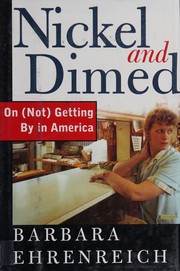
Nickel and Dimed: On (Not) Getting By in America
2,328-word summary 10 min read 221 pages in the book
- First published
- 2001
- Publisher
- Metropolitan Books
- Pages
- 221
- ISBN
- 9780805063882
Reading options
What's inside (8 sections)
I picked this one up because it kept showing up in two places at once. It was on school reading lists, and it was on lists of books people wanted off school reading lists. That combination usually means a book has hit a nerve with facts rather than style. Nickel and Dimed: On (Not) Getting By in America was published in 2001 by Metropolitan Books, and the first edition runs 221 pages. It grew out of a spell of undercover work its author did between 1998 and 2000, moving from city to city and taking whatever low wage jobs she could get. The question she carried with her sounds simple. In a country where politicians were promising that any job could lift a person out of poverty, was that actually true?
Ehrenreich came to the experiment with an unusual background. She was trained as a biologist and working as a journalist, which meant she could observe working life closely and write about it plainly. She set herself ground rules before she started. She would not use her education, her contacts, or her real work history to get ahead. She would take the cheapest lodging she could find and accept whatever jobs were offered to someone with no qualifications. She began with a small cushion of savings and a car, which matters, and she says so herself. The cushion is part of the story, because even with it, she barely held on.
The book started as an article for Harper's Magazine in early 1999 and grew as she kept going. It later won a Christopher Award, became a staple of classrooms and book groups, and drew a companion volume in 2005, Bait and Switch, about hunting for white collar work. But the original stands on its own. It is short, funny in places, angry in others, and built from three stretches of labor in three states.
Key West: waitressing and the arithmetic of rent
She begins in Key West, Florida, where the sun shines on some of the hardest low wage math in the country. Tourist towns need armies of servers, cooks, and cleaners, and the rents reflect what visitors will pay, not what workers earn. Ehrenreich finds a small efficiency apartment and a waitressing job at a busy diner, earning a few dollars an hour plus tips. On paper the tips look like they might close the gap. In practice they swing wildly with the season, the shift, and the mood of strangers.
The work itself is relentless in ways that office veterans never picture. She learns the choreography of a full station during a rush: coffee poured without looking, orders held in memory, complaints absorbed with a smile. Her feet swell. Her back locks. She is hungry in a building full of food, because eating on shift is treated as theft. Management watches the dining room the way lifeguards watch a pool, correcting posture, speech, and attitude. A slow minute is a moral failure. There is no place to sit down.
So she takes a second job, and this is where the book's argument starts to form. One paycheck covers the rent or the food, not both. Two jobs cover both but destroy the body. She sleeps in fragments, eats standing up, and spends her one free hour doing laundry. Her coworkers live the same equation without her exit plan. They double up in trailers, lend each other cars, and cover each other's shifts when a child gets sick. Nobody she meets is lazy. Everyone is tired past the point where tired is a feeling and into the region where it is a condition.
What struck me in these chapters is how much of the difficulty is housing, not wages in isolation. A low hourly rate would be survivable in a cheap town with cheap rooms. Key West has no cheap rooms. The deposits, the weekly rates at motels for people who cannot save a month's deposit, the long commutes from the only affordable streets, all of it functions as a tax on being poor. Ehrenreich does the sums out loud, and they do not work. That is the whole chapter in one line, and she refuses to dress it up.
Portland: scrubbing houses by the clock
The second stop is Portland, Maine, where she signs on with a franchised housecleaning service. If waitressing was hard, this is punishing. Teams of women are driven from house to house on tight schedules, expected to scour each home in about an hour. The quotas allow no rest, no lunch worth the name, and no mercy for knees, backs, or lungs. The cleaning chemicals burn. The vacuum bags burst. Homeowners leave notes about missed baseboards while the crew is already late for the next address.
Ehrenreich is good on the small humiliations. The uniforms. The pep talks from managers who never hold a mop. The rule against eating or drinking in clients' homes, enforced while the work dehydrates you. The timed efficiency that treats every house as identical, though some are hoarded and some are mansions. Her body starts filing complaints she cannot answer. She soaks her feet, tapes her joints, and keeps going, because the alternative is admitting the assignment beat her in week two.
Her lodging here is a motel room that eats her wages the way Key West rent did. This is one of the book's running discoveries, and it deserves emphasis. Poverty in America often looks like paying more for worse shelter: weekly motel rates instead of monthly leases, because you cannot assemble a deposit. She meets women on her crew who have worked out survival systems of impressive sophistication. They know which managers can be charmed, which houses tip in cash, which chemicals to avoid breathing. There is real skill here. The book's most quoted conclusion grows directly out of these chapters, that no job is truly unskilled. Anyone who believes cleaning houses takes no knowledge has never been timed doing it.
She also starts noticing the surveillance culture of low wage employment. Drug tests. Personality quizzes that ask whether you agree that stealing is wrong, as if honesty were a measurable substance. Rules about jewelry, hair, and conversation. The message underneath is that the worker is a risk to be managed rather than an adult to be trusted. Ehrenreich bristles at it, and her bristling is honest. She is a middle aged professional being treated like a suspect teenager. Many of her coworkers have endured it for years without blinking, which tells its own story about what the labor market teaches people to accept.
Minneapolis: big boxes and bedpans
The final stretch takes her to Minneapolis, where she works two jobs at once: a sales clerk at a giant discount retailer and an aide in a nursing home. The pairing is deliberate. One job represents the new service economy at its most polished, all training videos and team spirit. The other represents care work, the labor everyone praises and nobody pays for.
The retail chapters are darkly comic. Orientation fills her head with slogans and procedures. The floor work is a maze of stocking, zoning, and smiling while customers treat the staff as furniture. Pay is low, hours are scheduled to avoid full time thresholds, and advancement glimmers somewhere far above, always one more training module away. She finds the work boring in a way waitressing never was. A slammed diner at least has drama. A half empty aisle at midnight has only the clock.
The nursing home is the emotional center of the book. She is assigned to the dietary side, hauling meal carts, scraping trays, and helping feed residents who cannot feed themselves. The home runs short staffed, as so many do, which means every absence doubles someone else's load. The pay is no better than retail, while the work asks for strength, patience, and nerve. She writes about the residents with a tenderness that never turns sentimental. Old age here is not a metaphor. It is a room that smells of disinfectant, a woman who needs her food cut small, a man who brightens when someone remembers his name.
She cannot sustain both jobs, and the collapse is instructive. Even a healthy adult with no dependents, working herself to the edge, cannot hold the line. Her coworkers do it because they must, and the cost shows in their bodies and tempers. One of the quiet strengths of these chapters is that Ehrenreich never presents herself as heroic. She quits jobs. She cries in her car. She calls the experiment off when her body gives out. The honesty about her limits is what makes the testimony credible.
What the numbers say
Step back and the book's argument is brutally plain. Full time work at the wages she found does not reliably cover food, shelter, and transport in the same city. Rents demand deposits that low savings cannot assemble. Cars break and there is no bus. Illness means lost shifts, which means lost housing. One emergency anywhere in the chain, a sick child, a dead transmission, a cut in hours, drops the whole structure. Her coworkers are not failing at budgeting. They are doing impossible arithmetic with skill and still coming up short.
The secondary argument is about dignity. Low wage jobs in her account come wrapped in suspicion. Applicants must prove they are not thieves and not addicts before they mop a floor. Managers monitor bathroom breaks and conversation. Schedules change without notice, while workers must give total availability. The power runs one way. When she writes about the personality tests and the drug screens, she is describing a labor market that treats poverty as a character flaw and employment as a favor. Readers who have only ever been hired for their brains may find this the most eye opening part. Being managed as a bundle of risks is its own kind of exhaustion.
None of this is presented as academic research, and the book is upfront about that. There are no control groups here. There are three cities, a handful of jobs, and one observer with a notebook. What the book offers instead of data is witness. It puts a specific human body into specific jobs and reports what happened to it. That body got hurt, got hungry, and got scared about rent. Millions of bodies without book contracts go through the same, with no article at the end.
Where the experiment wobbles
Fair criticism starts with the cushion. Ehrenreich began with savings, a car, and the knowledge that she could leave. She was white, healthy, and educated, moving through labor markets that treat those traits as currency. A single mother with no car and no savings faces a harsher version of everything described here, and the book can only gesture at that harder version. Ehrenreich admits this in her closing assessment. She argues, reasonably, that her advantages make the findings worse, not better. If someone with every backup still barely scraped by, what does that say about those with none? It is a fair answer, but readers should know the limit going in.
Time is the second limit. She spends weeks, not years, in each job. She never faces a winter of heating bills, a child's illness, or the slow grind of aging in heavy labor. She rents rooms but never signs a lease she cannot break. Some critics have called the project tourism, and the charge sticks to the edges even if the center holds. She saw the surface of this life with unusual clarity. She did not live the depth of it.
The book is also stronger on witness than on remedy. The closing pages offer moral urgency rather than a program. Readers looking for policy proposals, organizing strategies, or economic theory will need to look elsewhere. And the humor, which is real, occasionally softens what it should sharpen. A funny story about a bizarre manager can make systemic cruelty feel like a collection of bad bosses. To her credit, Ehrenreich usually pulls the lens back in time. But not always.
Set against that, the virtues hold. She respects her coworkers on the page, giving them jokes, intelligence, and interior lives instead of turning them into exhibits. She reports her own failures without self pity. And she found a form, the short undercover narrative, that carries argument inside story. Few books about economics get finished by their readers. This one does, because it reads like a novel about work rather than a lecture.
Who should read it
This is a short book that earns its place in classrooms. Anyone who has ever worked a service job will recognize the managers, the tests, the arithmetic. Anyone who has never worked one, especially anyone who manages people who do, should read it as basic education. It pairs well with classroom discussion precisely because it is arguable. Students can fight about the methods, the cushion, and the conclusions, and come out understanding the economy better either way.
A few practical notes. The edition most readers find is the 2001 Metropolitan Books hardcover text, later reprinted many times with reading guides. A companion book, Bait and Switch, published in 2005, applies the same undercover method to white collar job hunting and makes a natural second volume. The book has also been challenged in some school districts, which is worth knowing and worth ignoring. Books that make people uncomfortable about wages and dignity tend to attract exactly that response.
I finished it in two sittings and thought about it for much longer. Not because it told me poverty exists. Everyone knows that. Because it showed, job by job and rent check by rent check, how work itself can keep a person poor, and how much intelligence and endurance the poor bring to a game tilted against them. That is a harder thing to know, and this small book makes it plain.
FAQ
Did Barbara Ehrenreich really work those low wage jobs?
Yes. Between 1998 and 2000 she worked undercover in Key West, Portland, and Minneapolis, starting from a Harper's Magazine article in early 1999. She used no education or contacts and took the cheapest lodging she could find.
Which jobs and cities does the book cover?
A waitress in Key West, Florida; a housecleaner for a franchise service in Portland, Maine; and a discount retail clerk plus a nursing home aide in Minneapolis, Minnesota.
Why is Nickel and Dimed still assigned and debated?
It won a Christopher Award, became a classroom staple that has also faced school challenges, and gained a white collar companion, Bait and Switch, in 2005.
Similar books

Down and Out in Paris and London
Orwell's account of washing dishes in Paris hotels and tramping through London does not ask for pity, only for a clear look at how poverty actually works.
2,282-word summary · 10 min read

Long Walk to Freedom
Mandela's account of a Thembu childhood, a law practice, a banned movement, twenty-seven years in prison, and the negotiation that ended apartheid.
2,454-word summary · 11 min read
Nothing to Envy
Barbara Demick follows six defectors from Chongjin through the North Korean famine, showing how ordinary people lived, believed, and finally left.
2,068-word summary · 9 min read

In Order to Live: A North Korean Girl's Journey to Freedom
A young North Korean girl crosses the Yalu, survives trafficking in China, and rebuilds her life in Seoul in this unsparing memoir.
2,027-word summary · 9 min read

Too Much and Never Enough: How My Family Created the World's Most Dangerous Man
Mary L. Trump's 2020 memoir traces how a cold, zero-sum Queens household shaped her uncle, and uses family tax documents to challenge his self-made story.
2,059-word summary · 9 min read
Same Kind of Different as Me
An art dealer and a formerly homeless sharecropper tell the story of the friendship that began at a Fort Worth mission and the woman who insisted on it.
2,023-word summary · 9 min read

Infidel
Ayaan Hirsi Ali's memoir of a Somali childhood, a forced marriage, a Dutch asylum claim, and the political fight that followed the murder of Theo van Gogh.
2,041-word summary · 9 min read

The Girl with Seven Names: A North Korean Defector's Story
Hyeonseo Lee crossed the frozen Yalu River at seventeen, spent years hidden in China, escaped to South Korea, and later returned to rescue her family.
2,404-word summary · 11 min read
Red Notice
An American financier in Moscow exposes a $230 million tax fraud, watches his lawyer die in prison, and turns the case into an international human rights law.
2,008-word summary · 9 min read
Maid: Hard Work, Low Pay, and a Mother's Will to Survive
Stephanie Land's memoir of cleaning houses as a single mother on the poverty line, and of the paperwork that made every step forward cost something else.
2,039-word summary · 9 min read

A Promised Land
First-volume memoir from Iowa 2008 through the 2011 bin Laden raid, crisis management and doubt.
2,243-word summary · 10 min read
Between the World and Me
Coates writes to his son about the Black body in America, from Howard to the loss of Prince Jones.
2,234-word summary · 10 min read
Hillbilly Elegy
Vance traces Mamaw and Papaw from Kentucky to Middletown through addiction, Marines, and Yale Law.
3,390-word summary · 15 min read

The Glass Castle
Jeannette Walls's memoir of a childhood spent hungry and moving, from a stove fire at three to a Bronx apartment and parents on the street.
2,255-word summary · 10 min read
Nudge: Improving Decisions About Health, Wealth, and Happiness
Thaler and Sunstein show how defaults, framing, and social cues steer choices, and argue for choice architecture with an opt-out.
3,146-word summary · 14 min read
Year of Yes: How to Dance It Out, Stand in the Sun and Be Your Own Person
Shonda Rhimes takes her sister’s accusation seriously and spends a year saying yes to the things that frighten her, from live television to her own reflection.
2,585-word summary · 11 min read

Love Does
A lawyer and activist tells stories of saying yes, showing up, and loving people through ordinary, often ridiculous actions.
2,411-word summary · 11 min read

Beautiful Boy: A Father's Journey Through His Son's Addiction
David Sheff recounts watching his son Nic slide into meth addiction, and his own desperate, humbling search for how to help without destroying them both.
2,076-word summary · 9 min read

The Magnolia Story
How Chip and Joanna Gaines met, closed their first shop, nearly lost everything in a housing development, and built Fixer Upper.
2,994-word summary · 13 min read
Lone Survivor: The Eyewitness Account of Operation Redwing and the Lost Heroes of SEAL Team 10
Marcus Luttrell's account of the 2005 SEAL mission in Afghanistan that killed three of his team and left him alone.
2,144-word summary · 10 min read

Life
The Rolling Stones guitarist tells his own story: a Dartford childhood, the band's first gigs, the drug raids, the tax years and Patti Hansen.
2,761-word summary · 12 min read
Dry
A memoir of drinking, rehab and relapse, and the strange business of getting sober one morning at a time.
2,643-word summary · 12 min read

Dear Girls: Intimate Tales, Untold Secrets & Advice for Living Your Best Life
Ali Wong's debut collects fourteen letters to her daughters, covering sex, money, work, marriage, Vietnam, and being a working Asian American mother.
2,266-word summary · 10 min read
America (The Book): A Citizen's Guide to Democracy Inaction
Jon Stewart and the Daily Show writers turn a high school civics textbook inside out, with a foreword from beyond the grave.
2,511-word summary · 11 min read

Why I'm No Longer Talking to White People About Race
Reni Eddo-Lodge traces black British history and shows how institutions, culture, and everyday assumptions keep producing racial inequality.
2,071-word summary · 9 min read
Travels with Charley
Steinbeck drives across America with his poodle Charley, looking for the country he remembers and finding a place that has changed.
2,039-word summary · 9 min read
The Blind Side: Evolution of a Game
Michael Lewis traces how the left tackle became a premium position and tells the story of Michael Oher, a homeless Memphis teenager whose size and speed made…
2,038-word summary · 9 min read

Smoke Gets in Your Eyes: And Other Lessons from the Crematory
A young medieval history graduate takes a job at an Oakland crematory and becomes a mortician, confronting the physical reality of death and the funeral…
2,003-word summary · 9 min read

Scrappy Little Nobody
Anna Kendrick's essays trace her path from a Portland childhood and Broadway to Hollywood, with jokes, anxiety, and a refusal to pretend fame fixed her.
2,092-word summary · 9 min read
Prisoners of Geography: Ten Maps That Tell You Everything You Need to Know About Global Politics
Tim Marshall explains how mountains, rivers, coasts, and resources shape the choices of nations, from Russia's flat borders to the chokepoints of the South…
2,328-word summary · 10 min read