
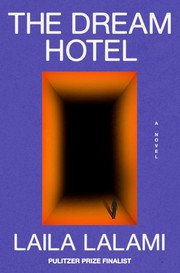
The Dream Hotel
2,687-word summary 12 min read 336 pages in the book
- First published
- 2025
- Publisher
- Pantheon Books
- Pages
- 336
- ISBN
- 9780593317600
Reading options
What's inside (8 sections)
I picked this up because the premise sounded like something that could happen to me on my next flight. A woman lands at LAX after a conference, walks up to the gate, and is pulled aside because of what she dreamed while she was asleep on the plane. It is the kind of idea that sounds absurd for about thirty seconds and then stops sounding absurd at all. Laila Lalami published The Dream Hotel on 4 March 2025 with Pantheon Books, and by the time I was a hundred pages in I had stopped treating it as science fiction and started treating it as a weather report from a slightly later version of our own country.
The book is a near-future dystopia, but its machinery is painfully ordinary. There is no dramatic collapse, no wasteland. There is a medical implant and a government agency and a form to fill out. That ordinariness is what got me. Lalami's great trick is to take the surveillance we already carry around in our pockets and walk it a few steps forward until it becomes law.
A landing, and a number assigned to a dream
Sara Hussein is a museum archivist in her late thirties, a Muslim American woman returning to Los Angeles from a conference in Britain. She has a husband and twin toddlers waiting at home. Nothing about her arrival suggests anything is wrong until agents of the Risk Assessment Administration stop her. The RAA is the agency that has grown up around a piece of technology called the Dreamsaver, an implant first developed to treat sleep apnea. Somewhere along the way the implant learned to record and read dreams, and the agency learned to treat those dreams as evidence.
The charge against Sara is specific and terrible. The data from her Dreamsaver, the agents tell her, shows she is at imminent risk of murdering her husband. She has a number now, a risk score the system has flagged, and a status that overrides anything she can say about her own intentions. She is informed that she must be held for twenty-one days of observation. Twenty-one days. She has a flight to catch, children at home, a job, a life that stops making sense the moment the number is spoken aloud.
What struck me first was how polite the whole encounter is. Nobody shouts. Nobody draws a weapon. The agents are doing a job, following a protocol, reading from a system that does not require them to understand what it says. Sara's objection, which is the obvious one, that she has no intention of hurting anyone and never did, has no place to go. The RAA does not ask what she meant. It asks what the data predicts. In that single move Lalami sets up the entire moral problem of the book: what happens when a society decides that a prediction is the same as a deed.
I kept thinking about how many of our own institutions already work this way. A score appears, a flag goes up, and the person in front of the screen has neither the time nor the authority to argue with it. The Dream Hotel takes that habit of mind and gives it a uniform and a badge.
Twenty-one days, then the school
The observation period is the first of several moves in the book, and each one is smaller and more bureaucratic than the last. Sara is held, counted, watched. The twenty-one days pass. Then, instead of going home, she is told she will be transferred to a retention center. The word retention is doing a great deal of work here. The center does not call the women prisoners but retainees, and the language everywhere is chosen to soften what is happening. Lalami is very good at this kind of language, the way an institution invents gentle words for hard facts.
The retention center is housed in a repurposed elementary school. I could not get that detail out of my head. A building built for children, now filled with women who have been accused of dream crimes. Sara is placed there with other women, each of whom has been flagged by her own Dreamsaver data. The crimes are different in each case but the mechanism is identical: a dream was recorded, an algorithm assigned it meaning, and the state decided the meaning was a threat.
The school setting matters beyond its irony. It is a place designed to make people small, to put them in rooms and ring bells and tell them when to move. The retainees are adults with careers and families, and the building treats them like pupils who cannot be trusted to sit still. I found that detail more disturbing than any locked door would have been. A prison announces what it is. A school that has been quietly turned into a prison asks you to pretend nothing has changed.
Sara is assigned to work in the facility's laundry room. This detail, which sounds like a small bit of world building, turns out to be one of the most important things in the book. The laundry is work. It is repetitive, physical, and it puts her in contact with the other women and with the machinery of the place. She is not sitting in a cell waiting for a lawyer. She is sorting sheets and folding towels while her stay quietly lengthens. The laundry is where she learns how the center actually runs, and it is where the seeds of what comes later are planted.
Rules that move whenever you reach for them
The central cruel joke of the retention center is that compliance is supposed to earn release. The women are told this over and over. Keep your head down, follow the rules, stop having the dreams, and you will go home. The trouble is that the rules shift constantly, and every deviation, even a deviation nobody could have predicted, extends the stay.
This is the part of the book that felt most true to me, and also the hardest to read. Sara does what she is told. She tries to be the model retainee. She works in the laundry, she obeys the bells, she does everything the system asks. And the system keeps moving the finish line. A rule that applied yesterday does not apply today. An infraction she did not know she committed adds another block of time. The weeks stretch into months and then into nearly a year.
The logic is circular, and it is meant to be. Release depends on stopping the dreams. But the dreams are not fully under Sara's control, and the implant that records them is not hers to switch off. She is being asked to prove a negative, to demonstrate that a machine will never again flag her, while the machine keeps watching. I wanted to put the book down during some of these passages, not because they were badly written but because the trap was so well made. There is no correct move. There is only the appearance of a correct move, which the institution can redefine at will.
Lalami keeps the pressure on by refusing to make the guards cartoonish. Most of the people running the center are not sadists. They are functionaries who believe the system is reasonable and who can point to their own rules to prove it. That is more frightening than a villain with a cruel streak, because a cruel villain can be removed. A reasonable system reproduces itself.
I should say that the repetitiveness of this section is deliberate, and that it is also where some readers may start to feel the book dragging. Mark O'Connell, writing in The New York Times, praised the premise but found the politics unsubtle and the plot repetitive. I understand the complaint. There are only so many times you can watch a rule shift before the point has been made and then made again. But I think the repetition is doing something specific: it is putting the reader inside the experience of a sentence with no fixed length. Sara cannot see the end of it, and neither can you.
The women in the laundry room organize
The book changes gear when the women stop treating their situation as a series of individual problems. The retainees begin to organize. This is where Sara's time in the laundry pays off, because the work stoppage that eventually wins her freedom grows out of the relationships and the knowledge she has built there. She is not a lone hero who talks her way out. She is part of a group that decides, collectively, to stop cooperating.
I liked this turn a great deal, partly because it rescues the book from the trap of making Sara an exception. A lesser novel would have revealed that she was innocent all along in some neat, provable way and let her walk out with an apology. Lalami does not do that. Sara wins her freedom through solidarity and disruption, through other women deciding that the only rule left to follow is the one they make together. The work stoppage is the moment the school stops behaving like a school.
What makes the organizing convincing is how ordinary it is. There is no stirring speech, no single charismatic leader who changes everything. The women compare notes, they notice the same injustices, and they find that they have all been told the same lies in slightly different words. The laundry, which had been a place of sentenced routine, becomes a place where they can talk while their hands are busy. Lalami understands that resistance often starts in the places where people are already thrown together.
Sara's role in the stoppage is what finally gets her out. She goes home. She is reunited with her husband and her twin toddlers, the family whose safety was used as the reason to lock her up in the first place. The children, it turns out, have been told to keep their heads down. Her husband and kids urge her to be quiet now that she is free, to let the whole thing go and resume a normal life. That is the understandable human response to what she has been through.
But Sara does not let it go. The book ends with her planning how to free the friends she left behind, partnering with a former retainee. She has come home to a house that wants her to forget, and she has decided that forgetting is the one thing she will not do. I found this ending both satisfying and unsettling. It refuses the comfortable note of a woman safe in her family's arms. It also refuses to pretend that one person's freedom means much while the machinery is still running.
What the dreams are really about
It would be easy to read The Dream Hotel as a story about a bad technology, but Lalami has said the book pushes the surveillance of the smartphone era to its logical extreme while staying with questions of identity, power and belonging that have interested her all along. That line helped me understand why the novel feels less like a warning about implants and more like a novel about being a person in a system that has decided what you are.
Sara is a Muslim American woman, and the fact that she is stopped at an airport and treated as a statistical risk does not land the same way it would for a different character. The book is quietly insistent that the machinery of prediction does not fall evenly. Who gets flagged, whose dream gets read as a threat, who is believed when they say they meant no harm: these are questions with answers that have everything to do with power. I do not think Lalami is writing a simple story about racially motivated profiling, but I do think she knows that a system which claims to read your inner life will read it through the same biases it already has.
The imagined crime in the book is murder, which is a useful choice. Murder is the thing we most want to prevent and the thing we are most willing to give up liberty to prevent. Lalami uses it to show how easily a society can be persuaded that prevention is a form of justice. If the state can lock you up for what you might do in a dream, then the old distinction between thinking and acting has been erased. The book keeps returning to that erasure from different angles, and it is the intellectual spine that holds the plot together.
The Dreamsaver itself began as a medical device, built to treat sleep apnea. I keep coming back to that detail because it is so recognizably the way technology actually arrives. Nothing arrives labeled as a tool of control. A medical device that helps people sleep does not look like a tool of control until the data it gathers turns out to have other uses, and the uses become rules, and the rules become a building full of women who cannot go home. Lalami is not arguing against medicine. She is arguing against the assumption that a tool stays in the box we first put it in.
The comparisons, and where the book falls short
The reviews made much of the book's lineage. Publishers Weekly called the result "chillingly original" and compared it to Minority Report, the Philip K. Dick story about arresting people for crimes they have not committed. Kirkus drew parallels with The Handmaid's Tale. Both comparisons are fair, and both are a little limiting. The Dream Hotel borrows the predictive premise of one and the institutional suffocation of the other, but it is a novel about an airport, an office and a laundry room, and that is what gives it its own texture.
The novel was shortlisted for the 2026 Edgar Award and the Arthur C. Clarke Award, which tells you something about where it sits: part thriller, part speculative fiction, part literary novel about a woman's interior life. It does not fully belong to any of those categories, and that is a strength until it is not. Vulture criticized the abruptness of the ending. I see the point. The final turn toward Sara's plan to free her friends arrives quickly, after so many pages of patient accumulation, and I wanted more time with the decision. The book has earned the ending intellectually, but it may not have earned it emotionally for every reader.
The politics, too, are laid on thick in places. O'Connell's complaint about unsubtle politics is not unreasonable. There are moments when a character explains the logic of the system in terms so plain that the argument becomes a lecture. I do not mind a novel with a clear point of view, and Lalami's point of view is one I share, but the best passages are the ones where she trusts the scene to make the point. The laundry room does more work than any speech about surveillance.
And yet I closed the book thinking about it in a way I do not close most books. The premise is the thing, and the premise is strong: a woman is punished for a dream she did not choose, in a building that used to teach children, under rules that change whenever she gets close to the exit. Lalami keeps that image sharp even when the prose around it loosens. I would hand this to anyone who has ever felt the small daily indignity of being reduced to a number by a system that will not explain itself. I would warn them that the middle stretches long, and that the ending moves faster than the rest. I would tell them that the title is a kind of joke, because the dream and the hotel are both stand-ins for a plainer feeling: being held somewhere you cannot leave by people who are sure they are helping you. That feeling, more than the science fiction, is what has stayed with me.
FAQ
Is The Dream Hotel based on a true story?
No. It is a work of near-future fiction, though Lalami has said it pushes the surveillance of the smartphone era to its logical extreme while staying with familiar questions of identity, power and belonging.
Why is the book compared to Minority Report and The Handmaid's Tale?
Publishers Weekly called it 'chillingly original' and compared its predictive premise to Minority Report, while Kirkus drew parallels with The Handmaid's Tale for its institutional control of women.
Does Sara get out, and what happens at the end?
Yes. A work stoppage she helps lead wins her release and a return to her husband and twin toddlers, but the novel closes with her planning to free the friends she left behind, alongside a former retainee.
Similar books
I Who Have Never Known Men
Forty women in a cage, one child who remembers nothing, and a nearly empty world above the bunker. Harpman's quiet, unexplained dystopia.
2,025-word summary · 9 min read

MaddAddam
Toby and Ren rebuild a camp after the plague while Zeb reveals the past and the Crakers invent a religion around Oryx and Crake.
2,201-word summary · 10 min read

Vox
In a near-future America, women are fitted with counters that allow them a hundred spoken words a day. A linguist fights to reclaim her voice and save her…
2,434-word summary · 11 min read
Death of the Author
Okorafor's Africanfuturist novel follows a disabled Nigerian American writer whose blockbuster novel and its robot characters force her to ask who really owns…
2,468-word summary · 11 min read

Iron Widow
Wu Zetian enlists to avenge her sister, kills her pilot, and becomes an Iron Widow in a mecha Huaxia where the machines are built to kill women.
2,444-word summary · 11 min read

The House of the Scorpion
A clone raised in a drug lord's poppy fields learns what he was made for and chooses what to do with the life he was given.
2,527-word summary · 11 min read

The Age of Miracles
A California girl grows up while the Earth's rotation slows, and ordinary adolescence continues alongside slow catastrophe.
2,417-word summary · 11 min read

Her Body and Other Parties: Stories
Eight stories where bodies, medicine and old fairy tales get taken apart, with a green ribbon running through the whole book.
2,997-word summary · 13 min read

The Memory Police
On an unnamed island, ordinary things keep vanishing from memory, and a novelist hides her editor from the police who make sure the vanished stay forgotten.
2,440-word summary · 11 min read
Severance
Candace keeps office routine as fever empties New York, then joins survivors.
2,340-word summary · 10 min read
The School for Good Mothers
A mother sent to a reform school fights to keep her daughter under cold surveillance and strict rules.
2,114-word summary · 9 min read



The Circle
Hired by the world most powerful internet firm, Mae trades privacy for praise until dissent turns fatal.
2,092-word summary · 9 min read

The Power
Girls gain electric skeins and the world reorders through four witnesses.
2,070-word summary · 9 min read


The Testaments
Aunt Lydia, Agnes and Nicole conspire to bring down Gilead fifteen years later.
2,516-word summary · 11 min read

Station Eleven
After a flu empties the world, a traveling troupe plays Shakespeare for small towns linked by one dead actor.
2,480-word summary · 11 min read
The Handmaid's Tale
Atwood's The Handmaid's Tale retold: Offred in Gilead, the Commander, Serena Joy, Mayday, and the van.
2,369-word summary · 11 min read
1984
A long retelling of George Orwell's 1984: Winston Smith's quiet rebellion in Oceania, the Party's grip on truth and memory, and why the ending still lands as…
2,110-word summary · 9 min read

Wayward
With Ethan Burke now sheriff, Wayward Pines runs on cameras, fear and a founder's private plan, until a murder forces him to choose between order and the truth.
2,252-word summary · 10 min read

The Wilderness
Four Black women move through twenty years of friendship in Angela Flournoy's discontinuous, widely praised second novel.
2,141-word summary · 10 min read
The Sisters
Three sisters watch one another take the lives they imagined, across thirty years in Stockholm and Tunisia, in a novel that bends time like an accordion.
2,199-word summary · 10 min read

The 100
Three centuries after a nuclear war, a hundred teenage prisoners are sent from a failing space colony to test whether Earth is livable again.
2,152-word summary · 10 min read

One Boat
A woman returns to a Greek coastal town after her father's death, and the holiday she took nine years earlier after her mother's death keeps breaking through.
2,143-word summary · 10 min read
Misinterpretation
An unnamed Albanian interpreter in New York is drawn into the trauma of a Kosovo war victim, and the empathy she brings home begins to undo her marriage.
2,546-word summary · 11 min read

What We Can Know
In McEwan's eighteenth novel, a lonely scholar in a flooded, diminished Britain chases a vanished poem that could win him the professorship he has long wanted.
2,408-word summary · 11 min read

Theft
Gurnah traces three linked lives in Tanzania, where a servant's accusation of theft opens a family history of love, duty and quiet betrayal.
2,454-word summary · 11 min read
The Reluctant Fundamentalist
In a Lahore cafe, Changez tells a nervous American how Princeton and a New York career gave way to anger after September 11.
2,340-word summary · 10 min read
The Pull of the Stars
Over three days in a Dublin maternity ward in 1918, a nurse, a suffragette doctor on the run and a young volunteer face the flu, childbirth and unexpected love.
2,578-word summary · 11 min read