
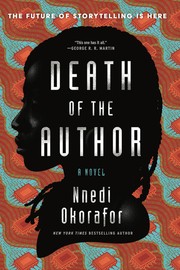
Death of the Author
2,468-word summary 11 min read 448 pages in the book
- First published
- 2025
- Publisher
- William Morrow
- Pages
- 448
- ISBN
- 9780063445789
Reading options
What's inside (9 sections)
I picked this one up for the title more than anything else. "Death of the Author" is a phrase that has followed me since university, attached to an old argument about who gets to say what a story means once it leaves the writer's hands. I wondered what a novel might do with that idea, and whether it would be a dry exercise or something with blood in it. Okorafor's 2025 book turned out to be a loud, messy, frequently funny argument about who gets to tell a story, written by someone who clearly enjoys picking fights with her own subject. It is an Africanfuturist novel, published by William Morrow, and it runs to 448 pages. By the end I felt I had been argued with, lectured, and occasionally won over, sometimes all on the same page.
The book follows Zelunjo Onyenezi-Onyedele, a Nigerian American writer who goes by Zelu. She became paraplegic at twelve in an accident, and that fact sits underneath everything that follows without ever being the whole story. Okorafor introduces her at her sister's wedding, and the news she receives there is that she has been fired from her job as an adjunct writing professor in Chicago. It is a rough entrance. A wedding is a place where families gather to perform a version of themselves, and Zelu arrives into that performance carrying bad news she did not choose. She goes back to her parents' house, and from that unpromising position she starts writing a novel called Rusted Robots.
A wedding, a firing, and a book written at home
I want to linger on that opening because it sets the terms of the whole book. Zelu is a writer who has just lost the small institutional footing she had. She is also a disabled Black woman moving through a family that has its own ideas about what success looks like. Okorafor does not spend pages explaining the accident or treating it as a single defining wound. It is simply the condition of Zelu's life, the thing she navigates, and the source of other people's assumptions about her. That choice mattered to me. A lesser book would have turned the accident into a swooping tragedy. This one is far more interested in what Zelu does next.
The return to her parents' house is where the family material begins to hum. These are high-achieving people, doctors and lawyers, and the book is sharp about the particular pressure of being the writer in a family like that. Okorafor uses the word "Naijamerican" for the identity Zelu is negotiating, and the tensions around it are specific rather than generic. There is the immigrant family's faith in respectable professions. There is the question of what counts as a real career. There is the quieter question of how much of yourself you are allowed to keep when your family has already decided who you are. I recognised the dynamic even though the details are far from my own life.
What Zelu writes in that house becomes a phenomenon. Rusted Robots is a science fiction novel, and in the world of the book it becomes a blockbuster, bringing her instant fame and a great deal of money, followed quickly by a film adaptation. This is where the novel starts to move fast, and where I started to feel the two strands of the story pulling apart in an interesting way. The fired adjunct becomes the celebrated author almost overnight. Okorafor is clearly enjoying the absurd speed of it. One moment Zelu is working out what to do with her life, and the next she is being turned into a brand.
I liked this stretch for its energy, and I also mistrusted it a little. The rise is so swift that it has the feel of a fable about fame rather than a careful account of a career. That may be the point. Okorafor is interested in what success does to the people around a writer, and in how quickly a family can rewrite its opinion of you once money arrives. The family's reaction to Zelu's success is mixed, which is the honest outcome. Nobody is purely proud, nobody is purely resentful, and the arguments that follow are less about the books than about what her books mean for everyone else's picture of the family.
The exoskeleton and the argument about walking
After publication, an MIT scientist named Hugo Wagner offers Zelu an experimental exoskeleton that lets her walk. She takes it. She uses it in place of her wheelchair, and the decision sets off a fresh round of criticism, this time from two directions at once. Relatives object, and so do disability activists. Okorafor is careful enough to let both objections have a shape rather than turning them into cartoons. The relatives' concern is tangled up with ideas about normality and about what they want for her. The activists' objection comes from a different place, grounded in the politics of disability and the suspicion that a device designed to make a body look fixed is really an argument that the body was wrong to begin with.
This is the part of the book I found most thought-provoking, and also the part I am least sure Okorafor fully controls. Zelu's choice to walk in the exoskeleton is presented as her decision, and the book defends her right to make it. At the same time, the criticism she draws is given real weight, so the reader is left holding both positions without an easy referee. I finished those chapters sympathetic to Zelu and still bothered by the ease with which the technology is offered to her, as though a scientist with a prototype can simply arrive and solve a life. That unease is probably intentional. It fits a book that keeps asking whether any technology comes neutral.
The exoskeleton is not a side issue that gets dropped once the argument is made. It changes how Zelu moves through the world and how other people read her body, which means it changes the story she thinks she is living. Okorafor keeps the physical reality of it in view without turning it into a miracle. That steadiness is one of the book's quiet strengths.
A seat on a rocket, and a pregnancy before launch
Then a tech mogul named Jack Preston offers Zelu a seat on a commercial space mission. It is exactly the kind of opportunity that arrives in this kind of story, and Okorafor does nothing to disguise its absurdity. A writer who has just become famous, who has just started walking again, is now being offered a trip into space by a billionaire with a rocket. The book almost winks at the pattern. Fame, technology, and money keep arriving as gifts from men with laboratories and launch schedules, and Zelu keeps having to decide what to do with them.
Shortly before the launch, she discovers she is pregnant. That turn reworlds everything. The space mission stops being a stunt and becomes a decision with another life in the balance, and a life that is hers. I do not want to spoil more of the mechanics of the launch than the story requires, because the anticipation is part of how those chapters work. What matters is that Okorafor sets up a collision between a writer who has spent the book asserting control over her story and a pregnancy that is emphatically not a plot she can simply edit. The title starts to press harder at this point. Who, exactly, is authoring this life?
Ngozi, Ankara, and Ijele, inside Rusted Robots
Interspersed through the book are thirteen chapters of Rusted Robots itself, so the reader is never allowed to forget that Zelu's invention has a life of its own. The novel within the novel is set in a future where every human being is dead except an Igbo woman named Ngozi. That is a striking premise, and Okorafor commits to it. The world is populated not by people but by machines with names and quarrels and habits of mind. Embodied robots called Humes collect human stories. Disembodied artificial intelligences called NoBodies want to destroy them. The quarrel between these two tribes of machines is the engine of the inner novel.
The Hume who matters most is Ankara. She is damaged during something called the Rusted Robots protocol, and Ngozi repairs her by installing a NoBody named Ijele inside her body. If that sounds like a recipe for disaster, it is. Ankara and Ijele begin as enemies forced to share a chassis, and their first responses are horror at one another. What follows is the strangest friendship in the book, because it is also an argument about what a story is. The two are initially appalled, then gradually become lasting companions, and their union eventually lets Ankara do something no machine in her position should be able to do. She writes an original story.
That story saves both machine tribes. Extraterrestrial beings called Trippers threaten them, and what rescues the Humes and the NoBodies is Ankara telling the story of Zelu's life. I want to sit with that for a moment, because it is the book folding itself into a knot. A writer invents a robot who learns to write by telling the writer's own life, and that act of telling rescues the writer's creations. The boundary between Zelu and her invention is not merely blurred here. Okorafor seems intent on dissolving it.
What the double narrative is arguing about
The critic Gary K. Wolfe praised Ankara's narrative as a counterpoint to Zelu's, and that seems exactly the right way to describe what the structure is doing. These are not two stories stuck together for decoration. They are two versions of the same question, asked at different scales. Zelu is a person trying to own her life while institutions, family, technology, and biology keep claiming a hand in it. Ankara is a machine trying to become an author in a world that has decided what machines are for. Both are asking how a story can belong to anyone.
Okorafor is working with several large ideas at once here: authorship, artificial intelligence and art, disability, and diaspora. The book keeps these in motion rather than sorting them into tidy lessons. The AI art question runs through the NoBodies and Humes, who are divided over whether the stories of the dead can be collected, owned, or destroyed. The diaspora question lives in the "Naijamerican" arguments around Zelu's family, in the pressure to be legible to two worlds at once. The disability question lives in the exoskeleton and in who gets to decide what a body needs. What ties them together is the question in the title. If the author is dead, who is left to be responsible for the story?
This is the book at its most ambitious, and I think largely successful. Okorafor is willing to let the ideas argue with each other instead of marching them toward a single conclusion. There is genuine comic energy in the machine chapters too, which keeps the philosophical material from going stiff. Watching Ankara and Ijele learn to share one body is a good deal more engaging than a lecture about artificial intelligence would have been.
Where the book strains
I should be honest about where I lost patience. Okorafor's melodramatic turns are frequent, and the near-collapse of the boundary between writer and creation, which is such a rich idea, starts to feel heavy-handed after a while. There are moments when the book seems worried that the reader will miss the point about authorship, so it leans in and states it again. I found myself wishing it trusted me more. A few of the coincidences in Zelu's outer story, especially the speed and number of the transformations, stretched my belief. The exoskeleton, the film deal, the rocket seat, and the pregnancy all arrive in a run that feels orchestrated rather than lived.
The family arguments are the other weak point. Okorafor is sharp on the pressure of a "Naijamerican" identity, as I said, but the arguments sometimes repeat rather than deepen. The relatives circle the same objections about career, normality, and respectability several times, and by the third or fourth round I felt the book was making a point it had already made. That is a problem of rhythm more than of insight. The material is good, and the families in it are capable of surprise, but the repetition flattens what could have been a slow burn into something closer to a loop.
Some readers will also bounce off the scaling up of the outer plot. If you pick this up expecting a quiet literary novel about a writer and her family, the commercial space mission and the interplanetary robots will feel like a different book crashing the party. I think that collision is intentional, and I enjoyed it, but it is a real dividing line. This is a novel that wants to be a family drama and a machine fable at once, and the seams occasionally show.
What I carried away
Still, I closed the 448 pages feeling that the mess was mostly the point. This is a book that refuses to be tidy about who owns a story, and it is at its best when it is least interested in settling the question. The friendship between Ankara and Ijele is a strange, lovely invention, and it gave me more than the louder turns in Zelu's outer life did. Okorafor's handling of disability is thoughtful without being reverent, and her portrait of a family negotiating a writer's success is sharp even when it goes around in circles.
The title, which sent me to the book in the first place, turns out to be less a declaration than a dare. Okorafor keeps asking what happens when the person who starts a story stops being the person who controls it, and she never lets the answer stay still. Zelu writes a novel that escapes her, and Ankara writes a story that saves her makers. In both cases the act of telling belongs to somebody the original author never entirely intended. I finished convinced that the argument was worth having, even where the book fumbled the delivery.
I would hand this to a reader who enjoys books that argue with themselves, who is interested in Africanfuturism or in the politics of disability and artificial intelligence, and who can tolerate a story that changes gear without warning. I would be cautious with a reader who wants a tightly controlled plot or a single clean theme. Okorafor has written a novel with a great deal in it, and some of it strains at the seams. Almost all of it is alive.
FAQ
What is Rusted Robots?
It is the science fiction novel that Zelu writes after returning to her parents' house, and in the story it becomes a blockbuster with a quick film adaptation. Thirteen chapters of the novel appear inside Okorafor's book.
Who are the Humes and the NoBodies?
In Rusted Robots, the Humes are embodied robots who collect human stories, while the NoBodies are disembodied artificial intelligences who want to destroy them. The Hume Ankara and the NoBody Ijele end up sharing a body.
What does the book say about disability?
Zelu uses an experimental exoskeleton after being fired, a choice that draws criticism from relatives and disability activists. The novel treats the decision as hers while letting those objections carry real weight.
Similar books
The Dream Hotel
A Muslim American archivist lands at LAX and is detained because her sleep implant says she might kill her husband. Lalami's near-future novel follows her into…
2,687-word summary · 12 min read
The Sisters
Three sisters watch one another take the lives they imagined, across thirty years in Stockholm and Tunisia, in a novel that bends time like an accordion.
2,199-word summary · 10 min read
Theft
Gurnah traces three linked lives in Tanzania, where a servant's accusation of theft opens a family history of love, duty and quiet betrayal.
2,454-word summary · 11 min read
Sunrise on the Reaping
Twenty-four years before Katniss, sixteen-year-old Haymitch Abernathy is swept into the fiftieth Hunger Games, where District 12 must send four tributes and…
2,198-word summary · 10 min read
Source Code
Bill Gates's first memoir retells his Seattle childhood, from a grandmother's Ritz crackers to nights sneaking out to code. It stops just before the MS-DOS…
2,473-word summary · 11 min read
Saga, Volume 4
Book Two opens with Alana and Marko trying to raise Hazel in hiding on Gardenia, while a vengeful robot kidnaps Prince Robot IV's newborn son.
2,003-word summary · 9 min read
Good Girl
A nineteen-year-old artist in Berlin, grieving her mother, falls into an unequal romance with an American author who offers escape from the ideal of the good…
2,579-word summary · 11 min read
Flashlight
Susan Choi's Booker-shortlisted novel opens with a father and daughter on a breakwater in 1978, then follows the loss outward through four generations and…
2,849-word summary · 13 min read
Detransition, Baby
Torrey Peters's debut follows three Brooklyn adults as an unexpected pregnancy pushes them to imagine an unconventional family. Funny, sharp, and unwilling to…
2,925-word summary · 13 min read
Black and Blue
A nurse leaves her abusive police-officer husband and vanishes into small-town Florida with her son, where a new name buys years of peace and a fear that never…
2,456-word summary · 11 min read
A Palace Near the Wind
In this 2025 science-fantasy novella, a Feng princess takes her sister's place as a human king's bride intending to assassinate him on her wedding day.
2,304-word summary · 10 min read
Great Big Beautiful Life
Two rival journalists chase the biography of a reclusive media heiress on a Georgia island, only to find her family history holds a secret bigger than either…
2,394-word summary · 11 min read
The Diamond Age: Or, A Young Lady's Illustrated Primer
A stolen nanotech primer raises a poor girl in 22nd-century Shanghai, and Neal Stephenson turns her education into an argument about class, freedom, and who…
2,055-word summary · 9 min read
Unaccustomed Earth
Lahiri’s second story collection follows Bengali families in America and abroad, tracing the quiet distances between parents and children, spouses, and the…
2,333-word summary · 10 min read
The House of the Scorpion
A clone raised in a drug lord's poppy fields learns what he was made for and chooses what to do with the life he was given.
2,527-word summary · 11 min read
The Age of Miracles
A California girl grows up while the Earth's rotation slows, and ordinary adolescence continues alongside slow catastrophe.
2,417-word summary · 11 min read

Sing You Home
A music therapist, her new wife and an evangelical ex-husband end up in court over three frozen IVF embryos.
2,952-word summary · 13 min read
Saga, Volume 3
Marko, Alana, and Hazel hide on the planet Quietus with the reclusive author who inspired their romance, while assassins and a prince close in.
1,989-word summary · 9 min read
Exhalation
Ted Chiang's second collection contains nine stories about time, memory, free will, and artificial minds, told with clarity and moral seriousness.
2,075-word summary · 9 min read
Upgrade
A Gene Protection agent is infected with an upgrade virus that makes him stronger and faster than human, and only he can stop his sister from releasing it on…
2,166-word summary · 10 min read
Altered Carbon
Kovacs wakes in a new sleeve to solve a rich man's own murder.
2,231-word summary · 10 min read
Cryptonomicon
Codebreakers in World War II and hackers in the 1990s chase gold, ciphers, and a secret data haven.
2,280-word summary · 10 min read
White Noise
Jack Gladney teaches Hitler studies, flees a chemical cloud with his family, and chases a drug for dread in DeLillo's funny and bleak 1985 novel of…
2,768-word summary · 12 min read
Warcross
Emika Chen glitches into the Warcross Tokyo championship, joins the Phoenix Riders to hunt the masked Zero, and must face Hideo Tanaka's plan to read minds for…
2,826-word summary · 13 min read
The Poet X
Harlem teen Xiomara finds voice in slam poetry against strict mother, church, and a love she must hide.
2,056-word summary · 9 min read
The Color of Water
A Black journalist presses his white mother about her hidden past, from a Virginia store to twelve college degrees.
2,457-word summary · 11 min read
Life As We Knew It
Sixteen-year-old Miranda keeps a diary while an asteroid strike on the moon brings tsunamis, blackouts, and a frozen year of hunger to her Pennsylvania town.
2,485-word summary · 11 min read
Among the Hidden
Twelve-year-old Luke, an illegal third child, befriends Jen and faces the cost of stepping out of hiding.
2,923-word summary · 13 min read