
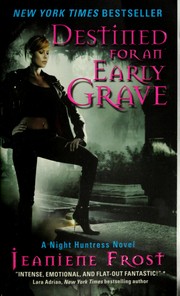
Destined for an Early Grave
2,924-word summary 13 min read 400 pages in the book
- First published
- 2009
- Publisher
- Avon
- Pages
- 400
- ISBN
- 9780061583216
- Series
- Night Huntress (#4)
Reading options
What's inside (9 sections)
- A holiday in Paris that never gets started
- The sixteen-year-old whose life was rewritten
- Silver, a ghoul queen, and a ghost in New Orleans
- Getting the memories back, and losing the ground beneath her
- A heartbeat that should not be there
- The duel, the cheating, and the fire
- What stayed with me, and what did not
- Key takeaways
- FAQ
I came to this one as the fourth book in a series I had already grown attached to, and I expected a fairly standard outing: Cat and Bones solve a problem, trade a few sharp remarks, and end up stronger than they started. What I got instead was a book that puts the couple's marriage under a slow, deliberate pressure and then asks whether love can survive a person learning that her own past was edited by other people. It is published as Night Huntress, Book 4, and it first appeared in 2009 from Avon, an imprint of HarperCollins. The paperback runs about 400 pages. By the end I had a much clearer sense of why this particular book hits harder than the ones around it.
The story picks up at a moment that feels warm and hard-won. Cat Crawfield is half human, half vampire, and she has been hunting the undead alongside Bones, the vampire she loves and has married, for roughly six years. They have fought rogue vampires and a vengeful Master, and they have sealed their devotion with a blood bond. They finally take a vacation, and they choose Paris. It is the first time in the series you get the sense that these two might actually get to be ordinary for a while. Frost lets that feeling sit for only a few pages before she pulls the rug out.
A holiday in Paris that never gets started
The trouble begins in Cat's sleep. She starts having dreams about a blond vampire she does not recognize, a man who insists with total conviction that Bones is not really her husband and that she belongs to someone else. In the dream something is always chasing her, something huge and wrong, and the stranger keeps pressing his claim. Cat wakes terrified, and the dreams do not stay put. They follow her into the day, and they unsettle her enough that she cannot enjoy the city she and Bones came to see.
Mencheres, an ancient vampire who is Bones's grandsire, arrives with armed guards and explains who the dream visitor is. His name is Gregor, and he is not merely a nuisance. Gregor is known as the Dreamsnatcher, a vampire with the rare and ugly ability to reach into a person's sleep and pull that person across distance to him. He has been locked away for years, and now he is loose. Worse, he says Cat is his wife. He says he took her once, when she was sixteen, long before she met Bones, and that he bound himself to her before Mencheres intervened.
That is the hook that drives the whole book, and it is a smart one. The threat is not just a vampire with an army. It is a claim on Cat's history that she has no way to check. Gregor can say what he likes about a bond and a marriage, and Cat has no memory of any of it. That gap between his certainty and her blank spot is where the real tension lives. The Paris setting does quiet work too. A city built for romance turns into a place where Cat cannot trust her own nights, and the vacation becomes the last calm moment before everything starts moving.
The sixteen-year-old whose life was rewritten
Mencheres does not only explain who Gregor is. He admits that he erased Cat's memories of the time she spent with Gregor. His reasoning, as he gives it, is protection. He saw what Gregor was doing, stopped it, imprisoned him, and took the memory away so Cat could live a life free of that influence. In his own telling, he also steered her toward Bones, because he believed her future power could not be allowed to fall under Gregor's control. On paper that sounds like a rescue. In the room, it lands like a violation.
I found this the most interesting part of the novel, because Frost does not let anyone off the hook neatly. Mencheres may genuinely have saved Cat. He also made a series of choices about her life without ever asking her, and the book keeps returning to that uncomfortable fact. Cat's whole identity as a hunter and a wife is built on a story she was told about herself, and now a piece of that story has been revealed as something someone else wrote. When she asks to see what was taken, she is not being reckless. She is asking for the most basic kind of ownership over her own mind.
Bones reacts badly, and I understood him even when I disagreed with him. He loves Cat, and the idea that she might once have been bound to another man terrifies him. His fear is not only jealousy. He knows Gregor is stronger than he is, and he knows the erased memories are the lever Gregor will use. So he argues against her digging them up. He wants to keep her safe and keep their marriage intact, and he tells himself those are the same goal. Cat hears something different. She hears another person deciding what she is allowed to know, for her own good, exactly as Mencheres did. Their argument is the emotional engine of the book, and it hurts because both of them are speaking from a real place.
Silver, a ghoul queen, and a ghost in New Orleans
Frost does not keep the conflict in the dream world. Gregor's people attack Cat and Bones in Paris with ghouls, and Bones is hit with silver, which is poison to a vampire. He is badly injured, and Cat has to get him out, carrying him to safety in a way that shows just how much strength she has even as a half vampire. They reach Spade's place, then regroup and head back toward the United States, trying to stay ahead of a threat that can reach them through sleep. The physical stakes are clear now. Gregor does not have to win a fair fight. He can come for them in bed.
Their search for allies takes them to New Orleans, where they go to Marie Laveau, the ghoul queen known as Majestic. Cat meets her beneath Saint Louis Cemetery and tells her plainly that she recognizes only Bones as her husband, whatever Gregor claims. Majestic is not the kind of ally who instantly pledges loyalty. She rules her territory with real authority and refuses to let vampires turn her city into a battlefield. That refusal gives the scene its texture. Cat and Bones are used to solving problems with force, and here they have to deal with a power that simply will not be pushed around. Gregor shows up in the open at one point, and Marie stops the two men from tearing each other apart in her streets.
New Orleans also gives Cat Fabian, a ghost who attaches himself to her. He has no army, no title, and no political weight, which makes him an odd figure among all these ancient powers. What he does have is the ability to move unseen, and that turns him into a useful observer and spy. I liked this thread more than I expected to. In a book crowded with master vampires and ghouls, the character who matters because he is overlooked is a nice bit of balance. Fabian's loyalty is small and genuine, and it stands against the grand claims everyone else is making about Cat.
The ghoul side of the conflict gets uglier through Apollyon, who spreads the story that Cat intends to become some kind of vampire ghoul hybrid and threaten the ghouls. It is a rumor, and it works because fear is easier to spread than truth. The political pressure builds alongside the personal pressure, and the two feed each other. By the time Cat and Bones leave New Orleans, the fight is no longer only about one possessive vampire. Whole factions are watching, and each one has an opinion about what Cat is and what she should be allowed to become.
Getting the memories back, and losing the ground beneath her
Cat eventually makes the choice Bones feared. She uses the dream connection to reach Gregor, because his blood is the one thing that can restore what Mencheres took. The memories come back in pieces, and what she sees is a sixteen-year-old girl living with Gregor for a stretch of weeks. He charmed her. He influenced her. He tried to shape her future before she had the experience to understand what was happening to her. The scenes are unsettling, and they are also more complicated than Gregor wants them to be. What Cat recovers does not prove that she belonged to him. It proves that he manipulated her, which is a very different thing.
When she returns to Bones with the truth, the reunion is not the happy ending a romance reader might expect. Bones is hurt that she went to Gregor alone, and frightened by what she might have felt there. Cat is hurt that he tried to decide for her. They separate, and Bones leaves her space on the grounds that she should be free to choose without him standing in the way. It is a generous gesture and a painful one. For her part, there is no real choice to make in her mind. Bones is the one she loves. But the damage from the secrets does not vanish just because her feelings are clear, and the book is honest about that.
Cat lands with Vlad Tepesh, and this is where Frost gives the story some of its best company. Vlad is powerful, dangerous, and dryly funny, and he takes Cat in without treating her as something fragile. He gives her room to fall apart and then to think. His friendship becomes one of the steadier things in her life while her marriage is suspended. I have always liked that Frost writes friendship between men and women without turning it into a forced romance. Vlad is genuinely an ally here, and the scenes with him have a sharpness that keeps the grief from going soft.
This stretch of the novel also pushes hardest on the theme of consent. Mencheres took her memories. Gregor claims a bond made when she was a teenager. Bones withheld what he knew. Even well meaning people keep treating Cat's life as something to be managed. The book does not lecture about it. It simply keeps putting Cat in rooms where other people have already decided what is best for her, and lets her keep answering that she will decide for herself. That repeated friction is what makes the title land. An early grave is one possible outcome of all this power being aimed at her, but losing control of her own story is the one she refuses.
A heartbeat that should not be there
The practical problem is that staying half vampire leaves Cat vulnerable to Gregor's dream power. She decides to become a full vampire, and Bones turns her. What follows is not a normal transformation, and this is the part of the book that changes the series going forward. Cat keeps a heartbeat. She does not behave like a newly made vampire is supposed to. Most strikingly, she finds she can take on the abilities of vampires whose blood she drinks. After drinking Vlad's blood, she suddenly manifests his power over fire. It arrives during the rescue of her mother, Justina, when Gregor has taken her and turned her into a vampire. Cat sets fires during the attack and realizes what she can do.
The rescue is costly. Cat's friend Rodney is killed, and the victory carries real grief along with it. Justina is gotten back, but she has been changed, and that change is not undone by the fight. These consequences matter because they stop the climax from feeling clean. Gregor's move against Cat's mother is personal and cruel, and the book does not let the family cost disappear into the action. A transformed mother and a dead friend are the price of the win, and Cat has to live with both.
At a formal gathering meant to calm the political situation, Cat's condition alarms vampires and ghouls alike. She is breaking rules they thought were fixed, and their fear of her is immediate. This is where the bigger design becomes clear. Making Cat a full vampire solves one problem and opens a much larger one. She is stronger now, but she is also strange in a way that other powers will want to study, fear, or control. The book is at its best when it lets that idea sit without explaining it away. Frost is clearly setting up the rest of the series, and the setup is woven into the character rather than dropped as a surprise at the end.
Mencheres finally tells the full truth about his visions of Cat's future power and why he took her from Gregor and arranged for her to meet Bones. Bones is furious, and Cat has to face the fact that even the people who love her have tried to direct her fate. I thought this was the right note to end the emotional thread on. There is no clean apology that fixes everything. There is a truth spoken at last, and the characters have to decide what to do with it. The book trusts the reader to sit with that discomfort instead of wrapping it up in a speech.
The duel, the cheating, and the fire
The conflict is settled the old way, with a formal duel between Gregor and Bones. It is brutal, and Gregor does not fight fair. He uses a blade laced with liquid silver, which weakens Bones badly and turns the contest into something close to an execution. Bones is near losing when Cat steps in. Her newly awakened fire comes up, and she destroys Gregor, ending his claim and his threat in one moment. It is the payoff the title promises, and it arrives through the power she chose to take on rather than through someone saving her.
The aftermath shows how tangled the politics have become. The Law Guardians move against Cat for interfering in a sanctioned duel, and for a moment it looks as though the girl who fought for control of her own life will be punished for taking it. Bones exposes Gregor's cheating, and Lucius confirms that the rules were broken first. Cat is spared. The sequence is tidy in a way the rest of the book is not, and I think that is a fair criticism. The machinery of the supernatural courts resolves quickly once the evidence appears, and the tension drains faster than the earlier chapters earned. Still, it satisfies on an emotional level. Gregor loses because he cheated and because Cat refused to be his.
Cat and Bones end up back together, and the book gives them a reunion rather than a clean bill of health. Their trust has been damaged, and the memories Mencheres removed are now hers again, with all the awkwardness that comes with them. Justina is alive but changed. Gregor is dead. Cat is a full vampire with a heartbeat and abilities that do not behave according to the rulebook, and the supernatural world is watching her closely. That is a lot to carry out of a single book, and Frost is clearly pointing at what comes next.
What stayed with me, and what did not
For all the supernatural machinery, this is a book about a woman deciding who gets to make choices about her life. That thread runs through the erased memories, the possessive claim, the husband who wants to protect her by keeping her ignorant, and the ancient vampire who arranged her life for what he saw as her own good. Cat's answer to all of them is the same, and she earns it through the choices she makes rather than through a speech. The fire at the end matters because it is her power, taken on her terms, used to end a threat to her life and her marriage.
The book is not without drag. The political middle section in New Orleans runs long, and the ghoul rumors and faction maneuvering sometimes feel like they are there to fill space between the personal beats. Some of the dialogue between Cat and Bones repeats the same argument a few times before it moves, and the resolution with the Law Guardians wraps up more neatly than the rest of the story. Readers who want the snappy pace of the earlier books may find the long passages of memory and consequence slower than they expect. I did notice the stretch, though I think the emotional payoff justifies most of it.
I would hand this to someone who has read the earlier Night Huntress books and wants to see the series take a real emotional risk. It is the entry where Cat and Bones stop being a unit that simply defeats threats and start being a couple that has to work through what threatens them from inside. I would be cautious with a reader who only wants a fast monster fight. There is plenty of action, but the heart of the book is a conversation about memory, consent, and whether love survives the truth. That is a heavier ask than the title suggests, and it is the reason this fourth book is the one I remember most clearly.
FAQ
Is Destined for an Early Grave a standalone novel?
No. It is the fourth book in Jeaniene Frost's Night Huntress series, published by Avon in 2009, and it picks up years into the relationship between Cat and Bones. It draws on events from the earlier books.
What is Gregor's claim on Cat?
Gregor, known as the Dreamsnatcher, says he kidnapped Cat when she was sixteen and bound himself to her before Mencheres erased her memories. He can reach her through dreams and insists she belongs to him.
Does Cat stay a half vampire?
No. She chooses to become a full vampire to counter Gregor's dream power, and Bones turns her. The change is unusual: she keeps a heartbeat and can take on the powers of vampires whose blood she drinks.
Similar books
More from Night Huntress first, then related titles.
Halfway to the Grave
Half vampire Cat hunts rogues to atone until Bones captures her and pulls her into vampire politics and love.
2,995-word summary · 13 min read
One Foot in the Grave
Cat hunts vampires with Bones while her Sire plots from the grave.
2,200-word summary · 10 min read
At Grave's End
Cat and Bones face Max, a zombie-raising ancient vampire, and a prophecy that ties their marriage to Patra's death in the third Night Huntress novel.
2,061-word summary · 9 min read
The Lunatic Cafe
Anita Blake takes a missing-shapeshifter case into St. Louis werewolf politics while Jean-Claude and Richard both press their claim on her.
2,327-word summary · 10 min read

The Darkest Night
A woman who hears the voices of the past meets an immortal warrior who dies every night in Gena Showalter's first Lords of the Underworld novel, a dark…
3,483-word summary · 15 min read
Night Pleasures
An accountant is kidnapped by a soul-stealing Daimon and handcuffed to a two-thousand-year-old Dark-Hunter, beginning a romance that forces him to want…
2,039-word summary · 9 min read
Lover Reborn
A grieving vampire warrior learns that the only way to free his dead mate from a cold afterlife is to love another, as a rival clan challenges the Blind King's…
2,768-word summary · 12 min read
A Hunger Like No Other
Kresley Cole's 2006 paranormal romance pairs a Lycan freed after a thousand years of Fae captivity with a Valkyrie who has no wish to be claimed.
2,539-word summary · 11 min read
Lover Unleashed
Paralyzed vampire warrior Payne and surgeon Manny Manello collide in an adult paranormal romance, as Xcor's Band of Bastards arrives in Caldwell for revenge.
2,374-word summary · 11 min read
Angels' Blood
Nalini Singh's 2009 Guild Hunter opener sends vampire hunter Elena Deveraux after a murderous archangel in New York, while its most powerful ruler watches.
2,367-word summary · 11 min read
Lover Enshrined
Phury's celibacy, addiction, and duty collide when Cormia enters his life, in J.R. Ward's sixth Black Dagger Brotherhood novel of war, ritual, and mating built…
2,630-word summary · 12 min read
Lover Unbound
Scarred genius Vishous falls for human surgeon Jane after a Lesser attack pulls her into his hidden war.
2,786-word summary · 12 min read
Lover Revealed
Human cop Butch loves Marissa from afar until Lessers take him and the Brotherhood fights to bring him home.
2,592-word summary · 12 min read

Revelations
Schuyler is pulled into the Force household as Silver Bloods rise, and a Conclave gathering in Rio ends in bloodshed.
2,166-word summary · 10 min read
My Roommate Is a Vampire
A struggling artist takes a cheap room in Chicago and discovers her polite, nocturnal roommate is a vampire with a proposition.
2,502-word summary · 11 min read

White Hot Kiss
Layla is half Warden, half demon, and one kiss from her steals a soul. A demon prince warns that Hell is hunting her, and she must choose between the clan that…
2,299-word summary · 10 min read

The Darkest Part of the Forest
In a town built around a sleeping horned boy in a glass coffin, a girl discovers she has been spending her nights as a faerie king's knight and remembers none…
2,012-word summary · 9 min read
Shadowland
Ever Bloom cannot touch Damen without risking his life. As she hunts for a cure, a mysterious surfer named Jude arrives and her loyalty to Damen is tested.
2,301-word summary · 10 min read

Magic Bleeds
The fourth Kate Daniels novel finds Kate investigating a magical plague in Atlanta while her relationship with Curran fractures and an ancient enemy tied to…
2,236-word summary · 10 min read

Evernight
A girl raised among vampires falls for a human boy at a Gothic boarding school, unaware that he hunts her kind.
2,200-word summary · 10 min read
The Laughing Corpse
A millionaire offers Anita Blake a fortune to raise a three-hundred-year-old corpse, then names the human sacrifice it would take. A zombie murder follows.
2,290-word summary · 10 min read

Magic Strikes
Drafted into the Order of Merciful Aid, Kate Daniels investigates the beating of her friend Derek and finds a hidden tournament where rakshasas fight in human…
2,012-word summary · 9 min read
Destined
In the ninth House of Night novel, Zoey Redbird takes her fight with Neferet to the High Council while an ancient bull stirs and a vessel built for murder…
2,317-word summary · 10 min read
Dead Ever After
In the final Sookie Stackhouse novel, Sookie is framed for murder, Eric is bound to another vampire, and a choice about Sam may decide her future.
2,388-word summary · 11 min read

Six Scorched Roses
A dying scholar bargains with a reclusive vampire for blood, and six roses turn a transaction into a slow, dangerous romance.
2,663-word summary · 12 min read

Magic Burns
A magic flare hits Atlanta, and mercenary Kate Daniels must recover stolen maps, find a missing witch, and keep a teenage girl alive while Celtic gods try to…
2,021-word summary · 9 min read

Masquerade
After Cordelia's death, Schuyler flies to Venice to find her exiled grandfather, then returns to the Blue Bloods as they prepare for a masked ball and a hidden…
2,543-word summary · 11 min read

The Awakening / The Struggle
A popular high school girl falls for a vampire, then discovers that his dangerous brother wants her too, in the first two books of the Vampire Diaries series.
2,660-word summary · 12 min read
Circus of the Damned
A rogue master vampire arrives in St. Louis and Anita Blake is caught in an undead turf war, with a science teacher in the crossfire.
2,757-word summary · 12 min read
Lore
Lore Perseous, the last of a hunted bloodline, is pulled back into the Agon when a wounded Athena offers her revenge against the god who killed her family.
2,188-word summary · 10 min read