
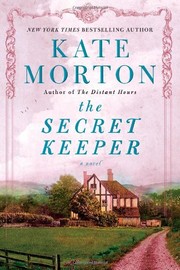
The Secret Keeper
2,262-word summary 10 min read 496 pages in the book
- First published
- 2012
- Publisher
- Atria Books
- Pages
- 496
- ISBN
- 9781439152812
Reading options
What's inside (7 sections)
I came to this one straight after The Forgotten Garden, which I had loved, and with the wrong expectation. I thought I knew the Morton formula by then. Old house, papers in an attic, two timelines meeting in a late reveal. The Secret Keeper has all of that machinery. Kate Morton published it in 2012, and the Atria Books paperback I cite runs 496 pages with ISBN 9781439152812. But the opening is sharper and stranger than her other books, and it unsettled me in a way the garden mystery never did. A girl watches her mother kill a man in the first pages. Then she says nothing for fifty years.
That silence is the actual subject. Not the stabbing, which the police rule self defense within days, but the fact that Laurel Nicolson, who saw it happen, never asks her mother about it until her mother is nearly gone. I found that believable in a way that bothered me. Children accept the official story when the alternative would break the family. Laurel tells the police what they need to hear. She goes off to London, becomes a celebrated actress, plays other people for a living, and leaves the one role she cannot play, that of the girl in the tree, alone for decades.
The setup deserves a slow retelling because Morton loads it with small weights. It is 1961, high summer, at Greenacres, the Nicolson farm in Suffolk. The family is picnicking by the stream. Laurel is sixteen and hiding in her childhood treehouse, thinking about a boy called Billy and about getting out, to London, to the stage, to a life bigger than farm routines. From the tree she sees a stranger coming up the road on foot. Her mother Dorothy goes to meet him. They talk. Something in the posture of the two figures is wrong even from a distance. Then the knife, from the picnic things, and it is over fast. The only other witness is Gerry, Laurel little brother, who is two years old and playing nearby. He will not remember. Laurel will remember everything and tell no one the parts that matter.
What sticks is Dorothy afterward. She is calm. She holds the family together through the police visit and the local talk. The ruling comes down as everyone says it will. A frightened woman defending herself against a strange man. Life resumes. School, harvest, Christmas. I kept waiting, in those early chapters, for a confrontation between mother and daughter, and Morton refuses it. That refusal is the point. The house absorbs the event the way old houses do. Nobody names it. Laurel learns to act, in both senses, around the memory.
Greenacres fifty years later
The second timeline opens in 2011. Laurel is in her sixties, famous, tired in the particular way of people who have performed emotion for decades. Dorothy is ninety and fading at Greenacres. The sisters gather, with the practical sadness of families who know what is coming. Rotas for sitting with their mother. Tea going cold. Talk about the farm and who will do what with it. Laurel finds herself sleeping in her old room, listening to the house, and the memory of 1961 comes back with a physical force she did not expect. She realizes she knows almost nothing about Dorothy before the marriage. Where she grew up. What she did in the war. Who her people were. Her siblings know even less.
So Laurel starts digging, with Gerry help. He is grown now, steady, a little amused at his famous sister turning detective, and he proves useful in the unglamorous ways these searches go. Archives. Electoral rolls. Old addresses that no longer exist. A photograph with a face scratched at or a name written wrong on the back. A letter kept for no clear reason. Morton writes this research patiently, and I mean that as praise with an edge, which I will get to. There is pleasure in watching Laurel learn how little a child sees. She interviews people who knew Dorothy young. Each one gives her a different woman. A shy girl. A sharp girl. A girl who wanted out.
One thread leads to Vivien. That name means nothing to Laurel at first. It belonged to a friend of her mother, or someone her mother once knew in London during the war, a beautiful woman who seems to have mattered enormously and then vanished from Dorothy stories. Laurel follows Vivien the way you follow a light between trees. Every document points a little further back, into the early forties, into a London of blackout curtains and crowded canteens and rented rooms. The present day chapters are quiet. Long drives. Phone calls. Sitting with a dying woman who sometimes speaks clearly about small things and goes vague on the large ones. I read them quickly, wanting to get back to the war, and then felt guilty about that, which is probably what Morton wants.
Wartime London: Dolly, Jimmy, and Vivien
Young Dorothy, called Dolly then, arrives in London with hunger for a different life. She is engaged to Jimmy, a decent young man with real talent as a photographer, who is documenting the city as the bombing starts. They are poor and in love in the way young people are when the future feels both urgent and endless. Dolly takes volunteer shifts at a canteen. She notices, across the street or in the orbit of her shifts, a woman who seems to have everything she lacks. Vivien. Married to Henry Jenkins, a known writer. Beautiful in the effortless way that makes other women stand straighter. Confident among people who matter. Dolly wants her friendship with an ache she does not examine.
The errand with the necklace is where the trouble starts, and Morton stages it beautifully. A borrowed necklace needs returning. A friend of Vivien passes it to Dolly at the canteen with a promise attached. Dolly sees her opening. She will hand it back herself and make the connection. The meeting goes badly. Vivien is cold, dismissive, perhaps deliberately cruel, perhaps only careless in the way the secure can be with the striving. Dolly walks away burning. Anyone who has been young and snubbed by someone they admired will recognize the heat. Most of us nurse it for a week. Dolly nurses it into a plan.
I will not lay out the plan step by step, because the slow uncovering is the best stretch of the novel, but its shape is this. Dolly decides to punish Vivien by striking at what Vivien values. She uses what she knows about Jimmy movements, about letters, about who is where during raids, and she sets something in motion that she believes she can control. She cannot. The Blitz does not respect private schemes. Bombs fall on schedules no one chooses. Dolly parents are killed. Streets she knew become gaps. And in the chaos her neat revenge curdles into something with a body count she never intended, binding the three of them, Dolly and Jimmy and Vivien, in guilt and debt that will last lifetimes.
Morton is strong here on the texture of the war. Not battles or strategy, but the small logistics. Queues. Rationed food eaten standing up. Sleeping in shelters with strangers breathing around you. Showing up for a shift not knowing if the building will be there. Jimmy with his camera, trying to record it all, sometimes braver about other people danger than his own. Henry holding court in rooms with the curtains drawn, playing the celebrated author while his marriage thins. Vivien moving through it all, vivid and careless and more fragile than she looks. And Dolly watching, always watching, learning the wrong lessons about what other people lives cost.
Where the book drags
Honesty requires the complaint. At 496 pages this is long for the story it tells, and the middle repeats. Laurel finds a lead, drives somewhere, meets someone who almost remembers, is told to come back or to ask someone else, reads a letter, sleeps badly, repeats. Two or three of these witnesses could have been folded into one. The sisters blur. Apart from Laurel and Gerry, the present day family stays sketched, and one sister in particular exists mostly to voice doubt about Laurel project. Readers who want a tight thriller will fidget. I fidgeted, around page 300, and started skimming the driving scenes.
Dolly herself is hard company for long stretches. Morton clearly means her to be difficult. She is envious, status hungry, prone to rewriting slights into injuries. Some readers will dislike spending half a long novel inside her head. I did, at points, and then caught myself thinking that was the honest choice. A sweeter Dolly would make the ending cheaper. The book needs you to see how a girl like this could do what she does, and then live with it for seventy years by becoming someone else entirely. Still, there were evenings I put the book down and did not pick it up fast the next day. The wartime chapters carry the weight. The 2011 frame, for longeurs, only holds it.
A smaller gripe. Morton withholds one document past the point of fairness. Laurel has a letter in hand, or nearly, and the narrative finds reasons to delay its reading for sixty pages. Once is suspense. Twice is a tic. If you read a lot of dual timeline mysteries you will also see the outline of the final reveal before Morton confirms it. The clues are fair, maybe too fair. A name that does not fit. A photograph dated wrong. A story Dorothy told about her youth that contradicts a record. I guessed the shape late, later than some reviewers, and it still landed, but guessers should brace.
The last hundred pages
When the reveal comes, it reframes both timelines at once. Laurel finally learns who her mother was before Greenacres, and why a stranger walked up the farm road in 1961. I will keep the mechanics vague because they deserve to land fresh, but the turn concerns identity in the oldest sense. A name buried. A debt carried across decades. The man in 1961 was not a stranger in the way the police report said. He knew Dorothy from the war years, and he came about something owed. What Laurel saw from the tree was not random violence and not quite self defense either. It was the last payment on a bill from 1941.
Morton handles this without theatrics, which surprised me. No courtroom speech. No villain monologue. Dorothy, dying, gives Laurel fragments rather than a confession, and Laurel assembles the rest from what she has gathered. There is one scene I will remember, very quiet, where Laurel understands that her mother spent her whole adult life performing a part as demanding as anything Laurel played on stage. The competent farm wife. The cheerful mother of many. The woman with no past worth mentioning. And underneath, always, the girl who set something cruel in motion during the Blitz and paid for it every day after. Laurel, the professional pretender, recognizes the craft. That recognition, not forgiveness exactly, is the closing note.
Does it hold together. Mostly. One coincidence near the end strained me, involving who kept which papers and for how long, and a reader with archive experience may raise an eyebrow. But the emotional logic is sound. People do keep the one letter they should have burned. They do carry a photograph for sixty years rather than throw it in the bin. Morton trusts that, and she is right to. The last chapters move fast after so much patience, and I finished them standing in my kitchen, dinner going cold, which is my private test for whether an ending works.
Why it stays with me
For all my fidgeting in the middle, this is the Morton novel I think about most. The Forgotten Garden is warmer. The Distant Hours has the better house. But The Secret Keeper asks the harder question. How well can you know your parents. Laurel knew her mother routines, her recipes, her way with grandchildren, and knew nothing. Most of us are Laurel. We never ask, or we ask when the answers would cost too much, and then one day the person who could answer is ninety and drifting, and we are left with archives and guesses.
Read it if you like wartime fiction built on domestic detail rather than battlefields, or if you enjoy watching a mystery solved through paper rather than chases. Skip it if you need brisk pacing or cannot abide an unsympathetic young heroine. Content notes, since people ask me. A fatal stabbing seen by a child, described plainly. Deaths in the Blitz, including parents. A wartime revenge plot with real consequences. Grief around a dying parent, handled at length. Nothing lurid, but the book does not look away.
What I keep is the treehouse image. A sixteen year old girl above a picnic, dreaming of Billy and London and applause, looking down at her mother talking to a man by the road. In a minute she will see something that edits her whole family story. She will climb down, say the necessary things, and carry the uncut version alone until she is old herself. Morton lets that girl wait fifty years for her answers. When they come, they are not justice. They are something sadder and more useful. An understanding of what her mother was, and what it cost her to become it.
FAQ
When was The Secret Keeper published?
Kate Morton published it in 2012, with Mantle in the UK and Atria in the US. The Atria Books paperback runs 496 pages and the ISBN is 9781439152812.
Who are the main characters?
Laurel Nicolson, her mother Dorothy, the glamorous Vivien who befriends and wounds the young Dorothy, and Jimmy, the photographer Dorothy was engaged to.
Is it part of a series?
No. It stands alone, though it shares Morton interest in dual timelines and houses full of secrets.
Similar books
The Tuscan Child
After her father's death, Joanna follows a returned letter to Tuscany and uncovers his wartime love, a hidden painting and a village secret. A dual-timeline…
2,095-word summary · 9 min read
The Clockmaker's Daughter
A London archivist finds a Victorian satchel holding a photograph, a sketchbook and a letter, then follows them to Birchwood Manor, where a young woman died in…
2,886-word summary · 13 min read
The Lake House
Detective Sadie reopens 1933 Edevane baby vanishing tied to writer Alice.
2,055-word summary · 9 min read
The Forgotten Garden
A Brisbane woman traces a century old abandonment from an English country house to a Cornish cove and a hidden author.
2,056-word summary · 9 min read
Only Time Will Tell
A Bristol dockworker's son wins a scholarship, falls in love with the daughter of the family that owns the shipyard, and learns that his father's death was not…
2,082-word summary · 9 min read
The Echo of Old Books
Barbara Davis's 2023 novel sends a rare-book dealer in 1984 New Hampshire hunting for the authors of two unpublished volumes that tell opposite sides of one…
2,491-word summary · 11 min read
Those Who Save Us
A Minnesota professor hunts her mother's hidden wartime past in Weimar, where survival came wrapped in an SS officer's protection. A dual timeline about…
2,345-word summary · 10 min read
Death Comes to Pemberley
P.D. James drops a murder onto the Pemberley estate and sends Wickham to trial, reading Austen's most famous marriage through the machinery of Georgian justice.
2,318-word summary · 10 min read
The War That Saved My Life
Ten-year-old Ada has never left her London flat, hidden away because of her clubfoot. Wartime evacuation sends her to Kent, where a reluctant guardian and a…
2,252-word summary · 10 min read
The Redbreast
Harry Hole chases an ageing sniper through modern Oslo while two Norwegian volunteers on the Eastern Front carry a fifty-year-old betrayal toward a royal…
2,453-word summary · 11 min read
The Lost Girls of Paris
In 1946, a war widow finds an abandoned suitcase in Grand Central holding photographs of twelve women who vanished in the war, and follows their story back to…
2,668-word summary · 12 min read
The Keeper of Happy Endings
Barbara Davis's 2021 standalone braids a Paris dressmaker's wartime losses with a grieving Boston artist who unlocks her family's secrets through an old row…
2,437-word summary · 11 min read
The Huntress
A Soviet night pilot, a Boston photographer doubting her stepmother Annelise, and a Nazi hunter chase Die Jagerin from wartime Europe to 1950 Boston in a long…
2,666-word summary · 12 min read

The Book of Lost Names
A young forger in occupied France helps Jewish children flee with new names while keeping a secret book of the truth.
2,097-word summary · 9 min read
The Rose Code
Three Bletchley Park women reunite in 1947 to expose a wartime traitor in Quinn's codebreaking novel.
3,219-word summary · 14 min read
The House at Riverton
In 1999, ninety eight year old maid Grace Bradley tapes the truth about a 1924 shooting at Riverton Manor, poet Robbie Hunter, two sisters and a lie held for…
2,433-word summary · 11 min read
The Orphan's Tale
A Dutch teenager rescues a Jewish baby from a death train and joins a German circus, where a Jewish aerialist teaches her to fly.
2,943-word summary · 13 min read

The Japanese Lover
A Polish refugee and the son of a Japanese gardener fall in love in San Francisco in 1939, then keep the affair secret for nearly seventy years.
2,286-word summary · 10 min read

The Beach House
A young valet is beaten to death at a Hamptons party, and his law-student brother spends a year building a case against the family that covered it up.
2,049-word summary · 9 min read
The Art Forger
A disgraced Boston painter agrees to copy a Degas stolen from the Gardner Museum, then begins to suspect the original she is copying is itself a forgery.
2,117-word summary · 9 min read

Anatomy: A Love Story
In 1817 Edinburgh, a noblewoman who wants to be a surgeon disguises herself to study anatomy and falls for the grave robber who supplies her with bodies.
2,031-word summary · 9 min read

The Shadow Sister
Star D'Apliese steps out of her sister's shadow and follows a bookshop clue into the Edwardian life of Flora MacNichol, a woman who gave up love for duty.
2,260-word summary · 10 min read
The Only Woman in the Room
A novel about Hedy Lamarr's escape from an arms-dealer husband, her Hollywood career, and the frequency-hopping patent the Navy ignored.
2,067-word summary · 9 min read
The Unmaking of June Farrow
A woman in a North Carolina flower-farming family walks through a red door into 1951, where she must solve her mother's disappearance and decide whether to…
2,701-word summary · 12 min read
The Boleyn Inheritance
Three women narrate Henry VIII's fourth and fifth marriages: a foreign bride who survives, a teenage queen who does not, and the widow who opens the door.
2,391-word summary · 11 min read
The Black Dahlia
James Ellroy builds a fiction around the real Black Dahlia murder, following two Los Angeles cops whose partnership and obsessions destroy them.
2,533-word summary · 11 min read
Once Upon a River
A wounded man stumbles into a riverside inn carrying what appears to be a drowned child who is not quite dead, and the story braids the guesses of everyone who…
2,173-word summary · 10 min read
The Storyteller's Secret
A New York journalist goes to India to learn why her grandmother loved a British officer, and why a family servant kept the truth for forty years.
2,270-word summary · 10 min read
Stones from the River
Trudi Montag is born a dwarf in a small German river town in 1915 and grows up to keep the town's library and its secrets, from the First World War to the…
2,818-word summary · 13 min read

Last Night at the Telegraph Club
The 2021 National Book Award winner follows Lily Hu, a Chinese American teenager in 1954 San Francisco, as she falls for Kath and learns what it costs to be…
2,336-word summary · 10 min read