
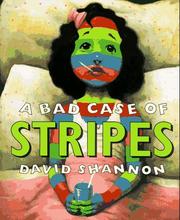
A Bad Case of Stripes
2,604-word summary 12 min read 32 pages in the book
- First published
- 1998
- Publisher
- Blue Sky Press
- Pages
- 32
- ISBN
- 9780590929974
Reading options
What's inside (9 sections)
I came to this book through a four-year-old who wanted the one with the girl who turned into a rainbow. I expected a quick read, maybe five minutes and a giggle. I got a 32-page picture book published in 1998 by Blue Sky Press, an imprint of Scholastic, and I spent far longer on it than I meant to, because the silliness is doing serious work. David Shannon wrote and illustrated it, and the pictures are the reason it has stayed in print and in classrooms for decades. By the last page I had been made to laugh, made slightly uncomfortable, and then made to think about how much of what I do is really me and how much is a guess at what other people want.
That is a lot to ask of a book with very few words on each page. But that is the trick. Shannon, the author of the raucous David books, understands that a small child's world can feel enormous, and that a body gone wrong is a neat way to show what anxiety feels like when you cannot name it. The story is a fable about a girl who tries so hard to be like everyone else that she stops being herself, and the strangeness of the images is what makes the lesson land without a lecture.
A girl who will not eat what she loves
Camilla Cream loves lima beans. That is the first line, more or less, and it is also the whole problem. She loves them and never eats them, because all her friends hate them and she wants to fit in. Shannon does not spend time explaining how a child arrives at that decision. He just shows us a girl who has made herself the manager of other people's opinions, and the first day of school is the test.
The morning routine is where I think most readers recognise themselves. Camilla tries on forty-two outfits. She stands in front of the mirror in each one, waiting for the right arrangement of clothes to tell her she will be accepted. None of them seem quite right. Then she puts on a red dress, looks in the mirror, and screams. Her mother runs in and screams too. "You're completely covered with stripes!" she cries. Camilla is striped from head to toe, a rainbow of thick solid colour.
Her mother puts her back in bed and keeps her home from school, which is both a relief and a disaster for Camilla. She does not want to miss the first day, but she is afraid of what the other kids will say, and she has no idea what to wear with those stripes anyway. That line always gets me, because it is so exact. Even in the middle of a medical mystery, her first worry is coordination. What do I wear with this?
The family doctor, Dr. Bumble, comes the next afternoon. He asks the kind of questions a doctor asks when nothing obvious is wrong: coughing, sneezing, a runny nose, aches, pains, chills, dizziness, uncontrollable twitching. Camilla says no to all of it. She feels fine. Dr. Bumble declares that she is well enough to go back to school tomorrow and gives her an ointment for the stripes. He is the first of many adults who will be certain and wrong.
The first day of school goes sideways
The next day is a disaster. Everyone laughs at Camilla. They call her "Camilla Crayon" and "Night of the Living Lollipop." She tries her best to act as if everything were normal. Then the class says the Pledge of Allegiance, and her stripes turn red, white and blue and she breaks out in stars.
This is the moment the book's rule becomes clear. Camilla's body is listening. Whatever people say or do around her shows up on her skin. A kid yells for purple polka dots and she becomes purple polka dots. Someone shouts "Checkerboard" and a pattern of squares covers her. Soon the whole class is calling out shapes and colours, and poor Camilla is changing faster than you can change channels on a TV. Shannon draws this with such glee that it is easy to forget the cruelty underneath it. These children are not being mean in a targeted way. They are playing. But to Camilla, every suggestion is a command her body has to obey.
It is worth pausing on that, because it is the book's sharpest idea. Camilla's problem is usually described as wanting to fit in. I think it is more specific than that. She has no filter. Every outside influence goes straight onto her skin, and she has no way to refuse it. The stripes are not a punishment for vanity. They are what happens to a person who has practised agreeing for so long that agreeing becomes automatic.
By that night, Mr. Harms the principal calls her parents. He is sorry, but Camilla is too much of a distraction and cannot come back until the stripes are gone. Some of the other parents are afraid the stripes might be contagious. Camilla is embarrassed. Two days ago everyone liked her; now nobody wants to be in the same room with her. Her father asks if there is anything he can get her, and she says no, thank you. What she really wants is a nice plate of lima beans, but she has been laughed at enough for one day.
That last beat is quiet, and it is the hinge of the whole story. The cure is sitting right there, in the thing she wants and refuses to name.
An army of experts makes everything worse
What follows is a parade of people who are sure they know what is wrong with Camilla, and none of whom ask her what she likes. Dr. Bumble brings four specialists: Dr. Grop, Dr. Sponge, Dr. Cricket and Dr. Young. They squeeze, jab, tap and test her. They rule out the mumps, the measles, chickenpox and sunburn, then hand her a bottle filled with different coloured pills. Take one of each before bed. The next morning Camilla wakes up looking like a giant pill.
Then come the experts, because specialists are not enough. Dr. Gourd and Mr. Mellon, described as the finest scientific minds in the land, poke and prod her and announce that it is a virus. Fuzzy balls appear all over her. Or a bacteria. Squiggly little tails pop out. The experts look at Camilla, then at each other, and say they need to go over the numbers again back at the lab. They never call back. They do not have a clue, and they do not have a cure.
By now all the news stations know about the incredible changing kid, and reporters come to the house. Each suggested cause adds another feature: roots, berries, crystals, feathers and a long furry tail. At one point the only thing left of Camilla is her pink bow. This is the part children love and adults wince at, and I think both reactions are right. The transformations get more outrageous page by page, and they are genuinely funny. They are also a picture of a child being handled by people who see a problem to solve rather than a person to listen to.
Last of all comes an environmental therapist who tells Camilla to close her eyes, breathe deeply and become one with her room. Camilla does exactly that. She melts into the walls and the bed, her lips and eyes becoming part of the room around her. Her parents are close to despair. Every confident intervention has made her less herself, until there is hardly a Camilla left to recognise.
I have read this section to children who cheer at each new transformation and to adults who go quiet at the room. The room is where the joke stops being funny. It is the logical end of a girl who has spent the whole book becoming whatever is asked of her. There is nothing left to ask.
The old woman and a bag of lima beans
Just when hope is gone, there is a tiny knock at the door. An old woman, "just as plump and sweet as a strawberry," says she thinks she can help. She goes into Camilla's room, looks around, and delivers the diagnosis in the book's best line: "What we have here is a bad case of stripes. One of the worst I've ever seen!" Then she takes a bag of lima beans out of her bag.
Camilla asks if they are magic beans. The old woman says no, they are just plain lima beans, and asks whether Camilla would like some. Camilla wants a big heaping plate more than just about anything, but she is still afraid to admit it. "Yuck," she says. "No one asked for lima beans, especially me." The old woman says sadly that she guesses she was wrong about Camilla, and starts to walk away.
That is when Camilla calls her back. "The truth is I really love lima beans." The old woman says she thought so, pops a handful of beans into Camilla's mouth, and the branches, feathers and squiggly tails begin to disappear. The whole room swirls, and when it stops Camilla is back to normal. As she leaves, the old woman says, "I knew the real you was in there somewhere," pats Camilla on the head, and vanishes into the crowd outside.
The curing is instant and a little too neat, and I will get to that. But the emotional turn happens before the beans, in the sentence where Camilla tells the truth. She does not do it because she is promised a reward or because the old woman commands her. She does it because the one person who has understood her is about to walk away, and she would rather be known than comfortable in her lie. That is a real choice, and it is the reason the ending is not cheap even though it is tidy.
Afterward, Camilla is not quite the same. Some of the kids at school say she is weird, but she does not care. She eats all the lima beans she wants, and she never has a touch of stripes again. The last picture shows her with a multicoloured bow in her hair, tucking in.
Why such a small book gets discussed so much
A book this short should not have a second life, but A Bad Case of Stripes does. In a 2007 online poll the National Education Association listed it among its Teachers' Top 100 Books for Children, and it turns up in studies of what fourth-grade teachers read aloud. Educators use it to talk about bullying, about being brave enough to eat your vegetables, and about the difference between who you are and who other people think you are. The Prindle Institute for Ethics has a whole discussion guide built around it, with questions about whether it matters what other people think, whether Camilla is still Camilla after she has become her room, and what being yourself actually means.
Those questions sound heavy for a picture book, and they are. Prindle connects the story to John Locke's idea that identity is tied to consciousness, and to Aristotle's distinction between necessary and accidental properties. If a child can still say she is Camilla while she is a wall, what exactly is the real Camilla? The old woman calls the girl in human form the real one, which raises the awkward suggestion that her human shape is the necessary part. I have sat with that question and I am not sure Shannon intends an answer. The book seems more interested in the felt experience of having no stable shape than in solving a philosophical puzzle.
The fable structure is what lets it carry all this. A fable is a small story with a point, and Shannon keeps his point light enough that a five-year-old can take it as a story about a girl and lima beans while an adult sees the machinery. Kirkus called it "a good poke in the eye of conformity," imaginative and vibrant and at times quite spooky, with artwork that keeps pace with the tale. Another reviewer praised Shannon's gift for facial expressions. The illustrations do much of the argument. You can see Camilla's misery in her face even while the situation gets more absurd around her.
What does not quite work
I want to be fair about the limits, because this book is often treated as untouchable. Lesley Beckett Balcom, reviewing it in CM Magazine in 1999, called the illustrations bold and surreal and "the strength in a book that tries rather too hard to teach a lesson." I think that is right. The middle stretch, with its doctors and experts and news crews, has the rhythm of a lesson being assembled. Each new specialist exists to make one more point about grown-ups who do not listen, and after a while the satire of institutions feels broad rather than observed.
The cure is also very easy. One honest sentence and a handful of beans, and years of anxious habit fall away. Real children do not change their behaviour so cleanly, and the book gives no sense that Camilla has to practise being herself or that she might slip back. The old woman is more a magical helper than a character, arriving exactly when needed and disappearing once her work is done. It is a satisfying shape for a story, but it is a shape, not a life.
There is also the odd matter of the adults. Camilla's parents are mostly helpless, Dr. Bumble is a caricature, and the experts are figures of fun. That is the book's design, and it works for children, who often experience adults as a confusing and powerful category. For a grown reader it can feel like an easy shot. Nobody in Camilla's world models the behaviour the story asks her to adopt, which is simply to say what you want and let the words be enough.
None of this spoils the book for its intended audience. A four-year-old is not keeping a ledger of narrative fairness. But if you are handing this to an older child or an adult, it is worth knowing that the moral arrives pre-packaged and that the strange, funny middle is doing more interesting work than the tidy ending.
The thing I keep coming back to
The image that stays with me is not the cure or the rainbow or even the giant pill. It is the forty-two outfits. Shannon could have opened with the stripes and saved himself a page, but he gives us a girl in a bedroom trying on the wrong version of herself over and over before anything supernatural happens. The magic is an exaggeration of something ordinary. She is already changing to fit other people before her skin starts doing it literally.
That is why the book has lasted. It does not tell children that being different is noble in the abstract. It shows a child being worn down by small, constant corrections, and then shows what it might look like if that pressure became visible. The stripes are the pressure made physical. When they go away, what remains is a girl with a bow in her hair eating something her friends think is gross. It is a small ending, and it is exactly the right size.
FAQ
What is A Bad Case of Stripes about?
It is a 1998 children's book by David Shannon about a girl named Camilla Cream whose skin changes into whatever patterns and colours the people around her suggest, until she learns to accept that she really loves lima beans.
Who published A Bad Case of Stripes and how long is it?
Blue Sky Press, an imprint of Scholastic, published it in 1998. The first edition is a 32-page picture book that David Shannon both wrote and illustrated.
Why do teachers use A Bad Case of Stripes in class?
The National Education Association listed it among its Teachers' Top 100 Books for Children in a 2007 poll, and educators use it to discuss bullying, being yourself and identity, with philosophy guides built around questions about what makes Camilla herself.
Similar books
Miss Nelson Is Missing!
Room 207 gets kind Miss Nelson, then terrible Viola Swamp instead.
2,597-word summary · 12 min read
The Gashlycrumb Tinies
Edward Gorey's 1963 alphabet book marches twenty-six children through a series of very bad endings, in thirteen rhyming couplets and a handful of unnervingly…
2,200-word summary · 10 min read
The Poky Little Puppy
One slow puppy misses the trouble and gets the desserts in this 1942 Golden Book that became the best-selling hardcover children's book in the United States.
2,322-word summary · 10 min read
Amelia Bedelia
A literal-minded housekeeper follows her employer's list to disastrous and funny effect in the 1963 picture book that made wordplay a children's staple.
2,038-word summary · 9 min read

Hard Luck
Rowley has a girlfriend, so Greg turns to a Magic 8 Ball, a family Easter hunt and the school yearbook for answers.
2,586-word summary · 11 min read
The Story of Ferdinand
A gentle Spanish bull would rather smell flowers than fight, and when he is taken to the bullring he simply sits down among the flowers in the ladies' hats.
2,135-word summary · 9 min read
Click, Clack, Moo: Cows That Type
Cows learn to type, demand electric blankets, and go on strike in a deadpan picture book about negotiation and withheld labor.
2,617-word summary · 12 min read
Caps for Sale
A peddler balances his caps on his head, naps under a tree, and wakes to find monkeys wearing his stock in this 1940 picture book.
2,787-word summary · 12 min read
The Stinky Cheese Man and Other Fairly Stupid Tales
Scieszka and Lane Smith take nine fairy tales apart, joke by joke, while Jack, the narrator, keeps losing the pages.
2,206-word summary · 10 min read
The Third Wheel
Greg tries to find a date for the Valentine's dance, ends up the third wheel in his own plan, and watches Rowley get the girl.
2,019-word summary · 9 min read
Sideways Stories from Wayside School
Thirty stories, one class per floor, and a teacher who turns students into apples: Louis Sachar's absurd school classic.
2,045-word summary · 9 min read
Don't Let the Pigeon Drive the Bus!
A bus driver leaves the reader in charge with one rule, and a very persuasive pigeon spends the rest of the book trying to break it.
2,084-word summary · 9 min read
Tales from a Not-So-Fabulous Life
Nikki starts private school and writes mean-girl survival in her diary.
2,587-word summary · 11 min read
Frindle
Nick Allen calls a pen frindle, defies Mrs. Granger and a school ban, and watches the joke grow into news, trademarks, and a dictionary entry.
2,405-word summary · 11 min read
The Monster at the End of This Book
Grover begs readers not to turn pages for fear of a monster, until the ending reveals himself.
2,061-word summary · 9 min read
Tales of a Fourth Grade Nothing
Nine-year-old Peter Hatcher tries to get through fourth grade while his toddler brother Fudge steals every scene.
2,469-word summary · 11 min read
Curious George
Curious George retold: a monkey sails from Africa to the city, phones the fire station, floats off on balloons, and finds home.
2,979-word summary · 13 min read
The Last Straw
Frank wants Greg toughened through sports while Greg dodges everything and military school looms.
2,020-word summary · 9 min read
The Austere Academy
The Baudelaires endure Prufrock Prep, meet the Quagmires, and face Olaf as Coach Genghis in book five.
2,175-word summary · 10 min read
Madeline
Ludwig Bemelmans's 1939 Madeline: the twelve girls in Paris, Miss Clavel, the midnight appendix scare, and why the smallest girl became a classic.
2,944-word summary · 13 min read
If You Give a Mouse a Cookie
A mouse gets a cookie and turns one small favor into a whole busy day.
2,560-word summary · 11 min read
Witches
Colin Hawkins's rhyming picture book teaches small readers to spot witches, flaps and all.
2,783-word summary · 12 min read
The Cat in the Hat
A tall Cat turns a rainy day upside down for Sally and her brother, with Thing One and Thing Two in tow.
2,546-word summary · 11 min read
Matilda
Brilliant Matilda Wormwood teaches herself to read, faces her crooked parents and the fearsome Miss Trunchbull, and finds Miss Honey.
2,296-word summary · 10 min read
The Long Haul
Greg Heffley's summer road trip goes sideways with a towed boat, a live pig, and a family in a purple van.
2,311-word summary · 10 min read
The Runaway Bunny
A little bunny says he will run away, and his mother promises to follow. This 1942 picture book turns a child's first wish for independence into a gentle,…
2,765-word summary · 12 min read
Momo
A girl with a gift for listening takes on grey-clad thieves who persuade a city to save its time, in Michael Ende's 1973 fable about efficiency and attention.
2,275-word summary · 10 min read
Kristy's Great Idea: A Graphic Novel (The Baby-Sitters Club Graphic Novels #1)
Raina Telgemeier adapts Ann M. Martin's first Baby-Sitters Club novel into a full-color graphic novel about four Stoneybrook friends who start a babysitting…
2,373-word summary · 11 min read
The Idiot
A Turkish-American freshman at Harvard falls in love through email with a Hungarian math student and spends a summer in Hungary trying to turn correspondence…
2,019-word summary · 9 min read