
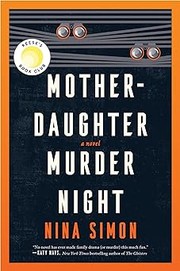
Mother-Daughter Murder Night
2,762-word summary 12 min read 368 pages in the book
- First published
- 2023
- Publisher
- William Morrow
- Pages
- 368
- ISBN
- 9780063315044
Reading options
What's inside (8 sections)
- A diagnosis and a detective who used to be powerful
- Three women, one cottage, and a great deal of baggage
- A corpse on the tour, and a detective who has made up his mind
- Lana plays detective, and the neighbors turn out to have secrets
- The dinner party and the fire in the barn
- What Simon leaves on the page afterward
- Key takeaways
- FAQ
I came to this book knowing almost nothing about Nina Simon beyond the fact that she had spent her career running museums and libraries and making them more welcoming places. The idea of a museum director writing a murder mystery appealed to me, and the premise sounded almost too neat: a difficult, sick mother moves in with the daughter she barely knows and ends up solving a killing. What I did not expect was how much of the book is really about the friction of three women sharing a small house, or how sharply Simon writes about being old, ill, and suddenly invisible. Published by William Morrow in September 2023, this was Simon's first novel, and it reads like a book written by someone who has watched a lot of mysteries with someone she loved. It was a Reese's Book Club pick and landed on Barnes and Noble's list of the best books of 2023, which probably explains why I kept seeing it.
A diagnosis and a detective who used to be powerful
The book opens not with a corpse but with Lana Rubicon lying on her kitchen floor, unable to get up. She is a successful commercial real estate developer in Los Angeles, the kind of woman who is used to being obeyed, and the first thing she does after calling 911 is phone her assistant to reschedule her meetings. Tests at the hospital reveal brain tumors. There is surgery at Stanford, chemotherapy that wrecks her body, and eventually the news that her condition is chronic and the tumors cannot all be removed. She is told she has Stage 4 cancer.
Lana's first act of defiance is to decide where she will recover. She agrees to go to Elkhorn, a coastal stretch near Monterey Bay, to stay with her daughter Beth. The two have been apart for five years and were only beginning to repair things after a breast cancer scare of Lana's. Beth, who is a nurse, calls in favors to get her mother in front of a top brain surgeon, and then she drives her mother north and puts her in her granddaughter's bed. It is a strange, tender reversal: the formidable Lana doing what she is told, meekly, because for once she has no choice.
Seventeen weeks pass. Lana is bored and restless much of the time. She is used to being consulted and needed, and now she is mostly alone in the house while Beth works and her granddaughter Jack is at school or out on the water. One night at two in the morning, bored and unable to sleep, she looks through binoculars and sees a man in the distance pushing a wheelbarrow down by the slough. He unloads something into the water. She cannot make out what it is. The scene is small and quiet, and it is the seed of everything that follows. I liked that the clue arrives as an accident of insomnia rather than as a detective's instinct. Lana is not looking for a mystery. The mystery walks into her field of view because she is awake when everyone else is asleep.
Three women, one cottage, and a great deal of baggage
The house in Elkhorn is a ramshackle cottage near the water, far from the polished life Lana knows. Beth lives a modest, semi-bohemian life there and works with marine mammals; in one of the book's early scenes she has to bury a dead harbor seal using a damask tablecloth her mother once gave her as a Chanukah gift. That detail tells you more about this family in a paragraph than a chapter of explanation could. The tablecloth is beautiful and useless for the task, and Beth uses it anyway.
Jack, full name Jacqueline Avital Santos Rubicon, is fifteen, part Jewish and part Filipino, and gives kayak tours for a living. She is saving for a used sailboat. She is also the one who finds the body. The three women are at odds in the way families are when love and resentment have had years to settle into the same rooms. Beth resents her mother's bossiness and old habits. Lana resents being pitied. Jack is caught between them and is also just a teenager trying to keep a job and a sense of herself.
The dynamic is the best part of the book, and Simon earns it. Lana is genuinely difficult, often funny, and sometimes very moving. She has spent a life being the person who decides things, and now her body has taken that away. Beth is stretched thin between caring for her mother and raising her daughter. Jack, who is brown-skinned and has an absent father, understands early on that the police will not treat her the way they would a white teenager. When the detectives come asking questions, Beth is afraid for her daughter in a way Lana, at first, cannot quite grasp. The generational argument about whether race will matter is handled carefully and without a lecture. Lana's belief that it will not, and Beth's knowledge that it will, sit side by side until experience proves Beth right.
I should note the pace of the early chapters. Simon takes her time setting up the household before anyone turns up dead. There is a prologue with the seal, a long hospital sequence, and several chapters of domestic detail before the mystery really begins. Some readers will find that slow. I did not mind it, because the domestic detail is the point. If you do not care about these women by the time the body appears, the rest of the book has nothing to stand on.
A corpse on the tour, and a detective who has made up his mind
The body is found during one of Jack's kayak tours. Out on the slough, a man in a life jacket is spotted floating in the water. Jack paddles over, begins to prepare for CPR, and then realizes the man is dead. She calls the Coast Guard, accounts for everyone in her group, and later shows the authorities where she found him. The dead man is Ricardo Cruz, a naturalist who worked for a local land trust.
Two detectives handle the case. Nicoletti is the one in charge, aggressive and quick to assume the worst. Ramirez is quieter and kinder, though she is not above repeating the mistakes Jack made on that tour, like letting guests drink. The reservation book shows that Ricardo paid for Jack's Saturday night sunset tour but never checked in, which means he was there, or someone wanted it to look as though he was. Nicoletti leans on Jack, asks whether she is more than friends with her coworkers, and makes a remark about girls like her. It is a nasty piece of questioning, and the scene is uncomfortable in exactly the way Simon intends. Jack is a brown girl with an absent father facing a middle-aged white detective who has already decided what she is.
Lana, who has been quiet and mostly housebound, suddenly finds her voice. She tells the detectives that on the Saturday morning in question she saw a man with a wheelbarrow on the far side of the slough. Nicoletti says the man died a mile or two away, and Lana corrects him: that is where the body was found, not necessarily where he died. It is the first time anyone in the house takes her seriously, and it is also the moment she decides she will do the investigating herself. She does not trust the police to listen to Jack, and she does not trust them to listen to an old woman with a cancer diagnosis either. So she starts gathering her own evidence, dragging a reluctant Beth along with her.
Lana plays detective, and the neighbors turn out to have secrets
What follows is a cozy mystery with an engine in the form of a very stubborn grandmother. Lana uses the skills she honed in commercial real estate: she reads documents, notices what is missing, makes phone calls she has no business making, and treats everyone she meets as a potential source. She gets into the land trust office, studies a letter of intent, photographs papers, and finds a handwritten note that she tucks away. She looks at calendars and realizes Ricardo accompanied a dying man named Hal Rhoads to doctor's appointments. She follows the money and the property lines, convinced for a long time that the killings are about a fight over land.
The people around the slough are not what they seem. Paul Hanley, Jack's boss at the kayak shop, becomes the police's main suspect, and he is not helping himself by disappearing. Lana eventually finds him and his friend Scotty and learns what they have been hiding: an unlicensed marijuana grow on land they lease from the Rhoads family, moved to the docks after the murder brought too much attention. That subplot supplies some of the book's humor and a good deal of its tension, because Lana needs Paul's help and the police want only to arrest him.
The Rhoads family is at the center of the tangle. Hal Rhoads is dead, his death ruled a murder in its own right. His wife Diana is a wealthy woman with a wellness center on her mind and a past she keeps carefully locked away. Their son Martin manages the ranch. There is a story about a barn fire thirty years ago that killed Hal and Diana's mother, and the name of a woman named Sofia, whose husband died in that fire. Little by little, Lana and Jack pull these threads. A key discovery comes from the geography itself: a winding creek connects the ranch to the slough, and a bicycle with panniers, life jackets, and a kayak all point back to the Rhoads property. The killer, they realize, moved Ricardo's body through the water.
The investigation has its share of contrivance. Lana gets locked in a room at the land trust, which turns out to be a sticking door rather than a deliberate trap. She guesses, guesses wrong, and guesses again, and the book sometimes leans on coincidence to move her from one clue to the next. A more patient mystery writer might have tightened this. But Simon keeps the emotional stakes high, and Lana's wrong turns feel like the mistakes of an amateur, which is what she is. The book is more interested in what investigating does for Lana than in whether she is good at it.
The dinner party and the fire in the barn
The climax takes place at a dinner party at the Rhoads house, and it is staged beautifully. Beth and Jack are there, Lana arrives late, and Martin announces that there is a warrant out for Paul's arrest. Lana slips outside, spots a pickup truck she recognizes from the night of the fire, finds a black bag in Martin's car, and then goes upstairs to look through Diana's drawer. She finds notes in the same handwriting as the note she took from the land trust, and a photograph of Ricardo as a young man. Slowly the truth arranges itself, and it is not the story anyone expected.
Ricardo and Diana were not lovers in the usual sense. He had been staying at the house once a week, helping Diana heal after the death of the man she was engaged to, a duke in England who died in his sleep. She wanted him to help build her wellness center. But Ricardo was secretly working with Hal on a different plan for the land, through the land trust, and when Diana learned this there was a falling out. She said nothing because she knew her late fiancé's death would make her a suspect if Ricardo died too. The love at the heart of the case was familial. Hal and Ricardo had grown close over the years, building something together, and Martin watched it happen.
That is what breaks the case open. In the barn, Jack finds a catcher's mitt with both Martin's and Ricardo's names on it. Lana realizes that Martin killed Ricardo at the ranch, drove to San Francisco to build an alibi, and came back to dispose of the body. He then killed his own father, Hal, because Hal was going to change the inheritance. Confronted, Martin pours gasoline around the barn and prepares to burn it down, planning to blame the bird bombs the land trust uses to keep other birds away. He reveals that he has carried a secret for thirty years: he accidentally started the fire that killed his mother, and Hal helped him cover it up while never forgiving him. He flicks his lighter.
Jack grabs a kayak and strikes Martin, knocking the lighter and the gun from his hands. There is an explosion, part of the barn catches fire, and Jack loses consciousness. Detective Ramirez arrives and arrests Martin. It is a big, noisy ending for a book that has mostly been about quiet domestic resentments, and Simon earns it by making Martin's motive small and human rather than grand. He did not kill for power or for money in the abstract. He killed because he watched his father and his mother's memory choose someone else over him, and he could not bear it. Lana, who knows a thing or two about feeling unappreciated by family, says as much to him before he strikes her.
What Simon leaves on the page afterward
The last chapters are surprisingly gentle. Martin pleads guilty to nearly all the charges. Diana decides to use the land for both her wellness spa and the plan Ricardo and Hal had devised, a compromise that lets the conservation-minded and the sentimental each keep something. Lana gives Ramirez a more traditional outfit to celebrate her promotion, and Ramirez replies that she has to wear loud clothes to get people's attention. It is a small exchange, but it lands: the two women understand each other in a way that would have been impossible at the start.
Lana's tumors are shrinking. She can return to work, but she is no longer sure what she wants to do with herself. Beth and Lana agree that Lana should move out of the house so Jack can have her room back. Lana decides to live in Beth's garage and start remodeling it the next day, and to build a business in Elkhorn. Jack considers an internship with the harbormaster. Nobody's life is restored to what it was. The women simply go on, slightly altered by what they have been through together.
That ending is the reason the book stuck with me. This could have been a puzzle with a body count and a tidy solution. Instead it is about a woman who loses her power and looks for a new way to be visible, and about a family that has to make room for a difficult relative and, in doing so, learns something about itself. Simon's background shows in the way she observes the small institutions around the slough, and how the people inside them justify what they do. The book is at its best when it stays close to that level, watching how a community works and how a family forgets that its members are allowed to change.
It is not a perfect book. The plot has more moving parts than it can always carry, and a few of the clues arrive just when the story needs them. Some of the supporting characters, especially Paul and Scotty, are drawn mostly as types. Lana's voice can be so sharp that the humor occasionally tips into caricature. And the mystery, when it is finally explained, depends on a chain of coincidences that would not survive much scrutiny. None of that undid my pleasure in the book, because the thing I cared about was the relationship between these three women, and Simon gets that right in scene after scene.
I would hand this to a reader who likes mysteries with a lot of personality and a setting they can picture, and who does not mind a first novel that is a little overstuffed. I would be careful with a reader who wants a tight, ruthless puzzle, or who has no patience for long passages about a difficult mother and her long-suffering daughter. For everyone else there is a vivid slice of life near Monterey Bay and a grandmother who finds that other people's low expectations give her room to work.
FAQ
Is Mother-Daughter Murder Night Nina Simon's first novel?
Yes. William Morrow published it in September 2023 as her debut novel, after she had already written nonfiction about museums and community work. It was a Reese's Book Club pick and one of Barnes and Noble's best books of 2023.
Who is the murder victim, and who kills him?
The victim is Ricardo Cruz, a naturalist who works for a local land trust. Martin Rhoads kills him and later his own father, Hal, because he believes they are taking the family ranch and its inheritance away from him.
Is this a cozy mystery or a darker thriller?
It reads as a cozy mystery with humor and a close-knit coastal setting. There is little gore, and most of the violence stays off the page until the confrontation in the barn, though the family tensions are taken seriously.
Similar books
Vera Wong's Unsolicited Advice for Murderers
A widowed teashop owner pockets a flash drive from a dead man and mothers her suspects into confessing.
2,564-word summary · 11 min read
The Impossible Fortune
Osman gathers the Coopers Chase pensioners for a fifth mystery that opens on a quiet year, a wedding, a vanishing guest and a code worth a fortune in Bitcoin.
2,685-word summary · 12 min read

Dial A for Aunties
A wedding photographer accidentally kills her blind date, and her mother and three aunties help her hide the body during the biggest wedding of their careers.
2,076-word summary · 9 min read

Everyone in My Family Has Killed Someone
A mystery writer narrates his own snowbound family reunion, where everyone has killed someone and the bodies pile up.
2,961-word summary · 13 min read
Not a Happy Family
After a bitter Easter dinner, Fred and Sheila Merton are found dead and their three adult children each hold a motive.
3,764-word summary · 17 min read
The No. 1 Ladies' Detective Agency
Precious Ramotswe opens a detective agency in Gaborone and solves small cases with tea, patience, and kindness.
2,029-word summary · 9 min read

There Will Be Bodies
Digging out a villa buried by Vesuvius, Flavia Albia finds chained corpses and a death someone tried to hide for ten years.
2,152-word summary · 10 min read
The Rest of Our Lives
A law professor drives his daughter to college, then heads west instead of home, testing a private promise he made twelve years ago.
2,238-word summary · 10 min read

The Nix
A stalled novelist and community college professor goes looking for the mother who left him and finds a radical activist whose rock thrown at a governor made…
2,214-word summary · 10 min read
The Moonlight Child
On a cold January night, Sharon Lemke sees a child washing dishes in a neighbour's kitchen and decides she cannot ignore it.
2,169-word summary · 10 min read
The Long Haul
Greg Heffley's summer road trip goes sideways with a towed boat, a live pig, and a family in a purple van.
2,311-word summary · 10 min read
The Hangman's Daughter
In 1659 Bavaria, a hangman ordered to torture an innocent midwife instead investigates the deaths of children marked with a strange tattoo.
2,523-word summary · 11 min read
Palaver
A mother shows up uninvited at her estranged son's Tokyo apartment, and the two spend the weeks before Christmas talking their way toward something like…
2,465-word summary · 11 min read
Only Son
A brief, funny, melancholy debut about a boy whose father dies in 1982 Florida, and the man he becomes, still trying to read the mystery of that loss.
2,170-word summary · 10 min read
Dad Is Fat
A comic essay collection about raising five kids in a two-bedroom New York apartment, delivered in Gaffigan's dry, deadpan voice.
2,196-word summary · 10 min read

Yellow Crocus
In 1837 Virginia, an enslaved wet nurse is separated from her own son to raise a planter's daughter, and the two women build a love the law says cannot exist.
2,094-word summary · 9 min read

Visions of Sugar Plums
A strange man named Diesel appears in Stephanie Plum's kitchen days before Christmas and pulls her into hunting a bail-jumping toy maker. A short, silly, warm…
2,193-word summary · 10 min read
Three Days in June
A Baltimore mother loses her job, and her ex-husband turns up with a rescue cat, in Anne Tyler's short, funny novel about the three days around her daughter's…
2,867-word summary · 13 min read
The Vacationers
A New York family's two-week stay in Mallorca turns into a comedy of exposed secrets when a magazine editor's affair and a son's debts come to light.
2,324-word summary · 10 min read
The Unquiet Grave
In Dervla McTiernan's fourth Cormac Reilly novel, a body found in a Galway bog turns out to be a missing school principal, and the case opens into something…
2,253-word summary · 10 min read
The Reversal
Mickey Haller prosecutes a child killer's retrial with ex-wife Maggie and half-brother Harry Bosch on his team.
2,056-word summary · 9 min read
The Maze of Bones
When orphaned siblings Amy and Dan Cahill choose a clue over a million dollars at their grandmother's will reading, they are swept into a global race through…
2,831-word summary · 13 min read

The Kitchen God's Wife
Amy Tan's second novel pairs a San Jose speech therapist with her Chinese mother, whose account of war, an abusive husband, and a narrow escape comes out in a…
2,896-word summary · 13 min read
The Hallmarked Man
A body in a silver vault behind Freemasons' Hall sends Strike and Robin into a world of coded letters, secret societies and a girl whose whole identity may be…
3,084-word summary · 14 min read
The Brass Verdict
Mickey Haller takes over a murdered lawyer's caseload and a Hollywood double-murder trial, with Harry Bosch circling the edges.
2,672-word summary · 12 min read
The Beautiful Mystery
In a cloistered Quebec monastery, a chant-singing monk is murdered and Gamache must break a vow of silence to find the killer. Eighth in the Chief Inspector…
2,262-word summary · 10 min read

Taste: My Life Through Food
Stanley Tucci's memoir traces his life through food, from a Calabrian family kitchen in Katonah to film sets, marriage and a cancer fight that cost him his…
2,503-word summary · 11 min read

Smokin' Seventeen
Stephanie's bonds office is a motor home on a construction site where dead bodies keep turning up, and the killer seems to know her name.
2,342-word summary · 10 min read

Sizzling Sixteen
Stephanie Plum has five days to raise nearly $800,000 when her cousin Vinnie is kidnapped over a gambling debt, and the only plan involves an alligator and two…
2,533-word summary · 11 min read

Shadow Ticket
Pynchon's tenth novel, his first in twelve years, sends a Milwaukee detective across 1932 Europe after a cheese heiress, a clarinetist, and a very strange lamp.
2,348-word summary · 10 min read