
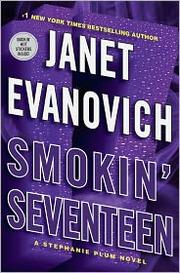
Smokin' Seventeen
2,342-word summary 10 min read 320 pages in the book
- First published
- 2011
- Publisher
- Bantam
- Pages
- 320
- ISBN
- 9780345527684
- Series
- Stephanie Plum (#17)
Reading options
What's inside (9 sections)
A body in the dirt behind the bail bonds office
I came to Smokin' Seventeen because the last Stephanie Plum book I read ended with her holding airline tickets and refusing to say who was going with her. That is a mean trick to play on a reader, and 2011's Bantam hardcover, all 320 pages of it, mostly keeps the trick going while wrapping it around a murder case that starts in a hole in the ground. By the time I finished, I had a pile of dead bodies, a man who cooked too much, and a cliffhanger that ran straight into the next book.
The bonds office has burned down. Vinnie Plum has rented space from Mooner, a stoner who lives in a motor home, so the office is a bus that Stephanie never knows where to find. That is a fair picture of her professional life: she works for a man who cannot keep a building standing and parks her career in a stranger's driveway.
One Monday morning she drives down Hamilton Avenue and finds the usual crowd gathered around a backhoe. There are two cop cars, Joe Morelli's green SUV, the medical examiner's truck, Vinnie, Connie the office manager, and Mooner. They are all staring into a shallow pit. A half-rotted hand sticks out of the dirt, and near it something that might be part of a skull. Morelli guesses it is Lou Dugan, a local bar owner, and a ring helps confirm it. Stephanie, who has seen her share of ugly scenes, files this one high on what she calls the Gonna Gork Meter. That dry, ghoulish narration is the reason I kept reading even when the plot got silly.
The other opening thread is stranger. At the bakery, Morelli's grandmother Bella gives Stephanie "the eye," a family curse that settles on her like bad weather. Stephanie breaks out in a pimple the size of Mount Vesuvius and finds her hormones in overdrive. It is ridiculous, and it is also exactly the sort of domestic nonsense that makes these books feel lived in. The Italian family rituals and the murder scene sit side by side, and neither is treated as more important than the other.
The bodies keep coming
Lou Dugan is the first, but he is not the last. Over the next couple of weeks, five bodies turn up in and around Trenton, buried or dumped in ways that look designed to get Stephanie's attention. Some come with messages, one envelope marked "FOR STEPHANIE." Surveillance video catches a figure in a Frankenstein mask hauling a body onto the construction site, though the image is too blurry to identify anyone. Stephanie studies that tape over and over, convinced she recognizes the way the person moves.
The victims become a grim little roster: Dugan the bar owner, a lawyer named Lucarelli, a banker named Gordon Kulicki, Sam Grip, and Juki. Later there are connections to a burned car and a woman named Francie, plus hints of two more bodies buried in a Georgia cornfield. The police start talking about a serial killer. Stephanie keeps saying the names out loud, trying to find the thread, and the thread turns out to be money and a very old grudge rather than anything as tidy as the poker game she and Morelli imagine.
Her frustration is understandable. The killer is careful about vehicles, using one of Harry's moving vans to haul a victim's car out to a graveyard in the Pine Barrens so his own car never turns up in the evidence. A burned car gives Stephanie a thread to pull on, and the trail eventually leads to Francie, the cousin whose job and savings he took. It is the one piece of police work that feels earned, and even that does not surface until the killer has all but explained himself.
One of the more uncomfortable scenes takes place at Dugan's funeral, where Nick Alpha corners her. His brother died in an earlier book, and Stephanie pulled the trigger, so his threat is personal and not empty. For a while she is sure Alpha is the killer. It is a fair guess, given how the evidence keeps pointing at someone who knows her routine, but it is also a red herring with a short shelf life. Evanovich uses him to keep the pressure on, then parks him until the finale.
I should say something about the tone here, because the book asks you to accept a lot. A woman is being buried in a construction lot, and the people around her are mostly worried about parking spaces, bakery gossip, and whose turn it is to cook. That clash is the series' whole trick, and in Smokin' Seventeen it works more often than it should.
Skips, a vampire, and a very patient robber
While the bodies pile up, Stephanie still has a job. Vinnie hands her a short list of people who skipped court, and the two names she chases are played almost entirely for laughs. Ziggy Glitch is an elderly man whom Lula is convinced is a vampire. Merlin Brown is an armed robber with a habit of vanishing at the wrong moment. Neither case has much to do with the murders, and that is fine. The bail jumps are the bass line under the main tune.
Lula, Stephanie's partner and driver, is in fine form. She has theories about the vampire, opinions about everyone's love life, and a talent for turning a simple surveillance job into a two-car pileup. Grandma Mazur is around too, shopping and gossiping and threatening to marry someone, and Connie keeps the office running from the RV. These are the people who make the book feel like a place rather than a puzzle box. When the plot thins, I was happy to spend time with them.
The motor home itself becomes a running gag. It is cramped, it smells, and it is parked on a site where a killer is leaving bodies. Vinnie's plan to rebuild gets tangled up with a crime scene, which is a small, neat piece of irony. Evanovich is good at this kind of practical comedy, the kind built on broken elevators, bad coffee, and cars that refuse to start.
Stephanie has her own small routine of dread. She is popping Tums by the handful as the bodies stack up, and she talks to herself in the elevator on the way to her apartment, running through the day's problems: the men, her missing sex drive, a job that is not bringing in money. It is a minor touch, but it makes her fear feel ordinary rather than heroic. She is a woman with indigestion and rent worries who happens to be chasing a serial killer, and the books never let her forget the rent.
Morelli, Ranger, and a man who cooks
The romantic plot arrives in the form of Dave Brewer. Stephanie's mother, worried that neither Morelli nor Ranger will ever put a ring on her daughter, fixes her up with a former high-school football star who has come back to Trenton after his divorce. Dave is attentive, he is charming, and he cooks. He makes pot roast, he wants to teach Stephanie to cook, and he seems pleased to be in her kitchen. All of that is meant to read as wholesome. By the end, the cooking is one of the details that gives him away.
Morelli, the Trenton cop Stephanie keeps sleeping with and never quite committing to, remains the steady option. Ranger, the security consultant with the black Lexus and the unreadable past, remains the exciting one. Neither man settles anything. They circle her, they help with the case, they trade digs, and the book ends without a choice. If you came for a decisive romantic payoff, you will not get one here. The triangle is less a story engine than a holding pattern, and it has been one for many books by this point.
What is new is Dave, and the way he slides into the group as the nice guy everyone approves of. His mother meets Stephanie's mother in the checkout line at the market, and that is enough to launch the matchmaking. Stephanie goes along with it mostly to keep her mother quiet. The small scenes of family pressure are funny in a familiar way, though the joke about a grown woman being nagged into dating starts to feel stretched by the fourth or fifth repetition.
The killer at the dinner table
The turn comes slowly. Stephanie watches the surveillance tape again and decides the figure in the mask moves like Dave. She mentions it to Morelli, who is skeptical, mostly because Dave is the sort of man who teaches a woman to cook. Morelli has a point, and the book lets the doubt sit for a while. Meanwhile Dave keeps turning up, keeps cooking, then turns up uninvited in her apartment with a key he stole from her own drawer.
The confrontation in her kitchen is the best scene in the book, and it is genuinely chilling. Dave blocks the door, admits he took the key, and says he has come for her. He is stealing her, he explains, because Morelli stole his girl back in high school. The woman he took to the prom ended up with Morelli in the school parking lot, and decades later he has decided to even the score. It is a petty, absurd motive, and Dave delivers it with such calm that it lands. He tells Stephanie he has killed nine people, that he snaps necks because it is clean, and that he buried two men in a cornfield in Georgia. He killed his cousin for her job and the money in the company safe. He worked in foreclosures at a bank, and Dugan, a sharp operator he had known since childhood, saw a way to buy foreclosed houses cheaply through holding companies. Together they manipulated paperwork and took houses out from under people who had lost their mortgages. When one borrower fought back, Dave did time until his bail was set. Dugan grew nervous, moved money into a Buenos Aires bank, and asked Dave to drive him to the airport, so Dave killed him first. The lawyer, the banker, Grip, and Juki all died because they knew too much about the paper trail. The bodies addressed to Stephanie were his idea of a game, and the Frankenstein mask was his idea of a joke.
He pulls out an envelope with plane tickets to Thailand and offers her a choice: come with him and start a new life, or die and go with him anyway. It is a nasty piece of theater, and Stephanie's response is to keep talking, keep moving, and look for a way out. For a few pages the book drops the wink and becomes a tight, ugly hostage scene. Evanovich writes fear well, and the detail that sticks is Dave's pride in his work, his genuine surprise that anyone would object.
Three men, two gunshots, and a ticket to Hawaii
The rescue, if you can call it that, arrives in the parking lot. Nick Alpha steps out from behind a car and tells Dave to walk away, because he has business with Stephanie. Dave pulls Stephanie's gun. Then a black Lexus rolls forward, and Regina, Dave's mother, is at the wheel. Within seconds there are three people who want Stephanie dead, which she notes with the weary amusement of a woman who has stopped being surprised.
Alpha shoots Dave. Regina drives the Lexus into Alpha, and he dies too. Stephanie, crouched behind a parked car, does not rush to help either man. She calls 911, then calls Morelli and Ranger, and watches the red and blue lights wash over the lot. Dave is dead, Alpha is dead, and Regina is in jail facing a vehicular homicide charge. The case closes because the killer and his rival killed each other, not because of a clever piece of detective work. That is a blunt way to end a mystery, and it left me a little cheated. All those bodies and all those clues, and the answer walks into a parking lot and gets run over.
Then the last page does its trick. Stephanie has a trip to Hawaii in front of her and tells Lula she is going, but she does not say who is going with her. The next book opens with her flying home from that vacation, refusing to discuss it, so the cliffhanger works as a bridge. As an ending, though, it is a shrug dressed up as a tease.
What works and what sags
The best thing here is the voice. Stephanie's first-person narration is fast, dirty, and funny, and it carries scenes that have no business being as entertaining as they are. The bakery, the motor home, Grandma's curses, and Lula's theories all feel like they belong to the same slightly unhinged world. I also liked the kitchen confrontation, which shows that Evanovich can turn the humor off when she wants to and write something cold.
The mystery is the weak half. Five bodies, a mask, and a pile of clues lead to a killer who confesses at length and then gets shot in a parking lot. Nick Alpha exists mainly to be a threat and then a conveniently dead rival. The romantic triangle is frozen, and several of the jokes about dieting, aging, and family nagging feel tired. This is not a good place to start the series, since much of the pleasure comes from knowing Lula, Grandma, Morelli, and Ranger already.
Still, I closed the 320-page hardcover in a good mood. Smokin' Seventeen is a Bantam book from 2011 that knows exactly what it is: a broad comedy with a body count, held together by a narrator who can make a pimple and a murder scene funny in the same chapter. Read it for the people, not for the puzzle.
FAQ
Is Smokin' Seventeen a good place to start the Stephanie Plum series?
It can be read on its own, but it assumes you already know Lula, Grandma Mazur, Morelli, and Ranger. Much of the fun comes from that familiar cast, so starting with the earlier books is better.
Who is the killer in Smokin' Seventeen?
It is Dave Brewer, the former high-school football star Stephanie's mother sets her up with. He kills to hide a foreclosure fraud and to get even with Morelli for taking his prom date decades earlier.
Does Stephanie choose between Morelli and Ranger at the end?
No. She ends up with plane tickets to Hawaii and refuses to name her travel companion, a cliffhanger that leads straight into Explosive Eighteen.
Similar books
More from Stephanie Plum first, then related titles.

One for the Money
Janet Evanovich's One for the Money fully retold: Stephanie Plum's first bounty hunt, Morelli on a murder charge, Ranger, Lula, Ramirez, and why Trenton still…
2,339-word summary · 10 min read

Two for the Dough
Janet Evanovich's Two for the Dough retold: Stephanie Plum's second hunt, a missing gun dealer, Morelli and Ranger, and why Trenton still charms.
3,677-word summary · 16 min read
Three to Get Deadly
Stephanie hunts a beloved candy man holding army money everyone wants.
1,981-word summary · 9 min read

Four to Score
Stephanie hunts waitress Maxine Nowicki through coded clues, firebombs, and counterfeit cash while living with Morelli in Trenton.
2,870-word summary · 13 min read

High Five
Stephanie hunts missing Fred with Ranger's help while Morelli sulks and Grandma shops for funerals and husbands.
2,228-word summary · 10 min read

Hot Six
Stephanie Plum hunts a missing bail jumper tied to Ranger's mentor while Morelli, Lula, and Grandma Mazur stir Trenton chaos.
2,035-word summary · 9 min read

Seven Up
Stephanie hunts old mobster Eddie DeChooch, finds a body, a missing heart, and trouble from Morelli to Ranger.
2,798-word summary · 12 min read
Hard Eight
Janet Evanovich's Hard Eight fully retold: a missing mother and child, Abruzzi's medal hunt, Valerie's rescue, and Ranger crossing a line.
2,961-word summary · 13 min read

Visions of Sugar Plums
A strange man named Diesel appears in Stephanie Plum's kitchen days before Christmas and pulls her into hunting a bail-jumping toy maker. A short, silly, warm…
2,193-word summary · 10 min read
To the Nines
Janet Evanovich's ninth Stephanie Plum case retold: a missing skip, threats in Trenton, and a rescue run to Las Vegas.
2,839-word summary · 13 min read

Ten Big Ones
Stephanie witnesses a gang robbery dressed as a devil, and the Comstock Street Slayers put her on a list of people to kill.
2,062-word summary · 9 min read
Eleven on Top
Stephanie quits bounty hunting for normal jobs, but a killer and a wedding keep pulling her back.
2,508-word summary · 11 min read

Twelve Sharp
Stephanie Plum is stalked by a woman claiming to be Ranger's wife, and when Ranger's daughter is kidnapped, Stephanie becomes both bait and target.
2,064-word summary · 9 min read
Lean Mean Thirteen
Stephanie Plum's ex-husband disappears after she attacks him, leaving her suspected of murder and chasing a forty-million-dollar secret through Trenton.
2,100-word summary · 9 min read

Fearless Fourteen
Bounty hunter Stephanie Plum babysits a teenager, guards a fading singer, and hunts nine stolen million dollars under her boyfriend's basement.
2,466-word summary · 11 min read
Finger Lickin' Fifteen
Lula sees a celebrity chef decapitated and talks Stephanie into entering a barbecue contest to lure the killers, while Ranger hires her to find a security leak…
2,248-word summary · 10 min read

Sizzling Sixteen
Stephanie Plum has five days to raise nearly $800,000 when her cousin Vinnie is kidnapped over a gambling debt, and the only plan involves an alligator and two…
2,533-word summary · 11 min read

Explosive Eighteen
Stephanie Plum flies home from a ruined Hawaii trip to find her seatmate murdered and a photograph that has the FBI, fake agents and a killer on her trail.
2,393-word summary · 11 min read
Finlay Donovan Is Killing It
A broke single mom novelist is mistaken for a hitwoman over lunch and takes the job. Funny crime caper, first in the series.
2,538-word summary · 11 min read

The Paying Guests
A widowed mother and her unmarried daughter take in lodgers in 1922 south London, and a secret affair between Frances and Lilian pulls them into a murder case.
2,661-word summary · 12 min read

Feet of Clay
A clay golem goes mad and a Patrician is poisoned as Vimes and the Watch untangle a murder plot in the nineteenth Discworld novel.
2,308-word summary · 10 min read

Size 12 Is Not Fat
Former teen pop star Heather Wells investigates two dorm elevator deaths while juggling her ex, her crush, and a size-12 wardrobe.
2,805-word summary · 12 min read

First Grave on the Right
Charley Davidson is a private investigator in Albuquerque and the grim reaper. When three murdered lawyers come back as ghosts, her two jobs collide.
2,770-word summary · 12 min read

Say You're Sorry
A widowed prosecutor defends the teenager accused of killing her babysitter, uncovering a small town's secrets and a killer hiding in plain sight.
2,116-word summary · 9 min read
Finlay Donovan Knocks 'Em Dead
Someone has put a contract on Finlay Donovan's ex-husband, and the novelist and her nanny have to find the hitman before the school pickup.
1,990-word summary · 9 min read

Men at Arms
The City Watch gets new recruits and a murder case when the Disc's only handgun turns up in Ankh-Morpork, in the fifteenth Discworld novel.
2,216-word summary · 10 min read

Dial A for Aunties
A wedding photographer accidentally kills her blind date, and her mother and three aunties help her hide the body during the biggest wedding of their careers.
2,076-word summary · 9 min read

Bridget Jones: The Edge of Reason
Bridget doubts Mark, takes a job with Daniel, and lands in trouble in Thailand.
2,198-word summary · 10 min read

Tangled
Told by a cocky businessman, a bet to win the new associate who rejects him turns into real pursuit, strict rules, a painful reveal and a wedding-level happy…
2,868-word summary · 13 min read

The Roommate
Uptight Clara shares a flat with porn star Josh and teams up to build ethical adult films for women.
2,362-word summary · 10 min read