
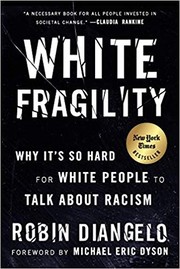
White Fragility: Why It's So Hard for White People to Talk About Racism
2,904-word summary 13 min read 192 pages in the book
- First published
- 2018
- Publisher
- Beacon Press
- Pages
- 192
- ISBN
- 9780807047415
Reading options
What's inside (8 sections)
I kept seeing this book before I read it. Black cover, big white block letters, a gold sticker about the bestseller list. In the summer of 2020 it sat on every bookstore table near the door, next to stacks of other titles about race. Friends quoted it, argued about it, posted photos of it. I finally picked up the paperback, published by Beacon Press in 2018 at 192 pages, expecting a lecture. What I found felt closer to a workshop manual written by someone who had spent years standing in tense rooms, watching conversations about race fall apart in real time.
Robin DiAngelo is a white educator who spent decades leading diversity trainings, mostly for white audiences in workplaces and schools. She first used the phrase white fragility in a 2011 journal article, then built this book around it. The edition I read opens with a foreword by Michael Eric Dyson, then an author note, an introduction called We Can't Get There from Here, twelve short chapters, and a resources section for readers who want to keep going. Claudia Rankine praised it on the cover as the kind of book that lets readers see racism as something beyond the acts of bad people. That quote turns out to be a fair preview of the whole argument.
A trainer walks into a tense room
The first chapter drops you straight into DiAngelo at work. She describes the pattern she kept seeing as a facilitator. A session on race would start calmly enough. Then someone, often a person of color or a co-facilitator, would name a racial pattern in the room or in the company. The temperature would change fast. A white participant would cry. Another would argue that the facilitator had it wrong. Someone else would shut down completely, arms crossed, eyes on the table. Sometimes a person walked out. Afterward the evaluations would call her divisive or angry, and the organization would hesitate to invite her back.
I found these opening pages convincing because they match rooms I have sat in. Not diversity workshops, just ordinary meetings where someone raises an awkward point about hiring or promotion and the whole group suddenly becomes very interested in the agenda. DiAngelo says she started collecting these reactions the way a naturalist collects specimens. Tears, silence, counterattack, guilt speeches, sudden claims of reverse discrimination. Different faces, same function. Each move steered attention away from the feedback about race and back toward the comfort of the white participants.
She is blunt about her own place in this. She writes as a white woman talking mostly to white readers, and she says so early. That choice shapes everything. Some readers will find it honest. Others will find it grating, since the book spends most of its energy on white reactions rather than on the people harmed by racism. Both responses make sense, and the tension never fully leaves.
One detail stuck with me. DiAngelo says white participants often treated her, a white facilitator, as the safe person to appeal to when a facilitator of color said something hard. They would glance at her as if to say, you explain it. She learned to refuse that role. It is a small moment, but it shows the dynamic she means better than any definition. The room reorganizes itself around white comfort without anyone voting on it.
Racism as the water, not the shark
Chapters two through four lay out the theory, and this is where readers either buy in or put the book down. DiAngelo argues that most white Americans picture racism the wrong way. In her account, people imagine racism as isolated acts by cruel individuals, cross burnings and slurs, villains twirling mustaches. She calls this the good/bad binary, and she returns to it again and again. If racists are only bad people, then good people like us cannot be racist, and any suggestion otherwise feels like a false accusation.
Against that picture she sets a different one. Racism, she says, is the system we all swim in. Laws, neighborhoods, school funding, hiring networks, media images, all of it was built during centuries when white people held explicit power, and the machinery kept running after the civil rights movement ended formal segregation. She distinguishes between prejudice, which anyone can hold, and racism as prejudice backed by institutions. A Black employee can dislike white colleagues, but that dislike does not carry the weight of banks and courts and landlords behind it. Only white prejudice does, in her framework, because white people still control most of those levers.
She spends real time on life after the civil rights era. Open slurs became shameful, which was progress, but talk about race went polite and coded. Colorblind phrases took over. I treat everyone the same. I was taught to see people as individuals. She argues these lines sound kind while protecting the speaker from noticing patterns. If you refuse to see race, you cannot see that resumes with white sounding names get more callbacks, or that one neighborhood has new textbooks while another has buckets under the leaks. The studies she points to on hiring and housing are familiar ones, widely reported elsewhere, and she uses them to say the playing field only looks level from the stands.
The part about segregation hit me hardest. DiAngelo notes that most white Americans live, learn, worship, and socialize almost entirely with other white people. She is not guessing about herself here. She describes her own upbringing and adult life as insulated in exactly this way. When your daily circle is all white, she says, you develop expectations of racial comfort. Nobody challenges your view of yourself. Nobody points out a blind spot. Then a multiracial setting interrupts that comfort, and even a small stress feels enormous. That gap between low exposure and high reaction is the engine of the whole book.
She gives this condition a physical metaphor. White equilibrium. People rest in a state where race never comes up, and any disturbance triggers moves that restore the calm. Fragility is not weakness in the crying sense, she insists. It is low stamina. A muscle never asked to lift suddenly asked to carry weight.
The good/bad binary
Chapter five deserves its own space because everything else hangs on it. DiAngelo argues that white moral identity depends on being seen as not racist, and that this need blocks learning. Show a white person evidence of a racial pattern in their own behavior, and the response is rarely curiosity. It is defense. How dare you call me that. You do not know my heart. I marched in the sixties, or my best friend is Black, or I adopted a child from another country. The details change. The structure holds. The conversation becomes a trial about character, and the original question about impact gets misplaced.
She connects this to three beliefs she says most white people absorb early. First, individualism, the idea that each person is unique and group patterns say nothing about me. Second, meritocracy, the faith that effort decides outcomes, which makes unequal results look like proof of unequal effort. Third, objectivity, the confidence that my view is neutral while others bring bias. Each one sounds like common sense. Each one, she says, works as a shield. If I am only an individual, data about groups cannot touch me. If the system is fair, complaints about it must be excuses. If I am neutral, your account of racism is the emotional one.
I argued with this chapter in the margins, and I think that is the point. Some of her applications feel too fast. Individualism is not only a dodge. It carries real moral weight, the insistence that people should be judged for their own actions. Meritocracy is flawed, obviously, and also partly true in specific cases. DiAngelo sometimes writes as if naming the shield settles the matter. Still, I recognized the courtroom move she describes. I have watched friends, kind and generous ones, hear a clumsy sentence about their blind spots and respond as if they had been charged with a crime. The trial framing rang true even where her remedies felt thin.
She also takes on intent. In her workshops, she says, white participants constantly redirect from effect to motive. I did not mean it that way. She answers that motives matter less than results. If my elbow knocks over your glass, the floor is still wet. Apologize, clean it up, adjust your stance. Do not spend twenty minutes proving elbows are innocent. I found that image useful, and I have reused it since. It lowers the temperature without lowering the standard.
What fragility looks like up close
The middle chapters, seven through ten, read like field notes. DiAngelo lists the triggers that tend to set off white defensiveness, and the list is long enough to make most white readers flinch at least once. Being told that your opinion has racial implications. Being asked to sit with feedback about a racist pattern without rebutting it. Being in a meeting where people of color speak openly about their experience. Being asked to consider how your race has shaped your life. A reader working through these will start hearing their own past sentences. I did.
Then she catalogs the responses. Silence and withdrawal. Anger and counterattack. Tears and guilt performances. Intellectual debate that buries the point under definitions. Claims that the real problem is class, or region, or personality, anything that moves race off the table. She is especially sharp on crying. Not because tears are fake. She treats them as real and still costly. When a white person cries after receiving feedback on race, the room rushes to comfort the crier. The person who gave the feedback becomes the villain. The lesson everyone absorbs is to never raise it again.
Chapter ten covers what she calls the rules of engagement, the unspoken terms white participants enforce. Do not make us uncomfortable. Do not suggest our views are shaped by race. Racism must be intentional to count. Only certain people get to call something racist, and never in this tone, at this meeting, in these words. She argues these rules guarantee that racism can never be discussed in a way white people would accept, which keeps every discussion permanently premature. Reading this, I thought of performance reviews I have seen where feedback about culture fit sailed through while feedback about race got flagged as too sensitive. The double standard operates quietly, through process objections rather than insults.
Her workshop stories carry these chapters. A manager who insists his team is like family while every promotion goes to people who look like him. A teacher who says she loves all her students equally while her discipline referrals tell another story. A volunteer who describes herself as colorblind and then describes her neighborhood, her church, and her book club, all white, without noticing the pattern. DiAngelo does not present these people as monsters. She presents them as typical, which is precisely what makes the pages uncomfortable. There is no villain to exile. There is only a mirror.
White women's tears and where she points next
Chapter eleven, on white women's tears, drew the most attention and the most heat. DiAngelo argues that when white women cry in cross-racial settings, history and sympathy combine in a specific way. Tears read as vulnerability, institutions respond with protection, and the Black colleague who offered criticism ends up cast as the aggressor. She notes that white women can draw on gender based sympathy while still holding racial power over people of color in the room, a combination with an ugly lineage in American history, from false accusations to workplace complaints that end careers.
Her advice here is blunt to the point of rudeness, and she knows it. Cry, but do not make the multiracial meeting your tissue. Take it to other white people doing the same work. Come back and deal with the feedback. Do not expect the person you harmed to manage your feelings about it. Some readers found this passage cruel. Others, including a number of Black women writers who reviewed the book, said it named something they had lived through for years and rarely saw acknowledged in print. The divide over this chapter previews the wider fight about the book.
The final chapter tries to turn diagnosis into practice. DiAngelo tells white readers to stop treating the question as whether they are racist and start asking how racism moves through them. Expect to be uncomfortable. Build stamina the way you build any capacity, through repetition. Listen longer before answering. Apologize briefly and specifically instead of delivering a speech about your character. Seek feedback from people who trust you enough to be honest, then prove you can hear it without retaliation. Read the books on her resources list. Treat the work as permanent rather than as a course with a certificate at the end.
I wish this chapter were longer and more concrete. The prescriptions take up far less space than the diagnosis, and they lean toward attitudes rather than actions. There is little here about hiring, lending, zoning, school boundaries, or voting, the machinery that would still grind on if every white reader achieved perfect humility. DiAngelo would answer that her assignment is the conversational layer, and that other books cover policy. That is fair as far as it goes. Still, a reader who finishes the book will know a lot about how to receive feedback and much less about what to do on Monday morning at the office or the ballot box.
Where the critics push back
No honest account of this book can skip the backlash, because the backlash is now part of the story. White Fragility spent roughly three years on the bestseller list and became a staple of workplace reading groups. Then came a wave of sharp criticism, including from Black intellectuals whose objections deserve a full hearing.
The linguist John McWhorter made the case most forcefully, first in a widely read 2020 magazine essay and later at book length. His charge is that DiAngelo infantilizes Black people, casting them as permanent experts on white souls and fragile souls who need protection from hard conversation, while telling white people they carry a stain nothing can remove. He argues the framework explains away disagreement, since denial of racism becomes proof of fragility, which makes the theory impossible to test. I think the circularity objection lands. A framework where objection confirms the diagnosis needs stronger guardrails than this book provides.
The writer Coleman Hughes pressed a different point. Even if every claim about white psychology were true, he argued, the book directs energy toward attitudes and confession while saying little about the policies that shape lives, from housing to policing to schools. The journalist Kelefa Sanneh, surveying the antiracism bestseller wave, raised a related worry. Books that center individual awakening can substitute for harder structural fights, leaving readers feeling they have acted because they have felt. These criticisms share a theme. The book is strong on the seminar room and weak on city hall.
Academic reviewers added their own notes. Sociologists sympathetic to structural accounts of racism questioned the thin research base, the heavy reliance on workshop anecdotes, and the way a book about decentering whiteness keeps whiteness at center stage for 169 pages of main text. Some noted the awkward commerce of it, a white trainer selling white audiences a book about white feelings during a season of Black protest. Supporters answer that the book never claimed to be a peer reviewed study, and that its job was to give ordinary readers language for moments they kept mishandling. Both things can be true. The anecdotes are vivid and possibly unrepresentative. The language helped many readers while leaving the deeper scholarship to others.
My own gripes sit alongside these. The book repeats itself. The same binary, the same equilibrium image, the same workshop beats return chapter after chapter, and a short book starts to feel padded. The intended reader is so firmly white that anyone else may feel like an observer at someone else's training. And DiAngelo sometimes writes about Black colleagues in ways that use them as teaching props, their pain converted briskly into her lesson. She seems aware of this risk and does not fully escape it.
And yet I would still hand this book to a particular friend. The one who says he treats everyone the same and means it kindly. The one who froze when a colleague mentioned race in a meeting and changed the subject to the parking lot. For that reader, the early chapters offer something genuinely useful. A vocabulary for the freeze. A picture of the courtroom reflex. A practical image, the spilled glass, for separating motive from repair. Short books that give one stuck reader a next step have earned their shelf space, even when scholars rightly ask for more.
What stayed with me was not a slogan but a shift in the question. I used to enter these conversations wondering how to prove my intentions were good. I left the book asking something plainer. When race enters the room, do I help the discussion continue, or do I help it end. That question has followed me into meetings since, and it usually tells me what to do before my comfort finishes voting.
FAQ
When was White Fragility published and by whom?
It was published on June 26, 2018 by Beacon Press. The paperback runs 192 pages with ISBN 9780807047415 and a foreword by Michael Eric Dyson.
What does DiAngelo mean by white fragility?
DiAngelo means the defensive reactions white people show when race is raised, such as anger, tears, silence, or counterattack, which restore comfort and end the discussion.
Is this book only for white readers?
No. She writes mainly to white readers, but the book speaks to anyone willing to face its account of systemic racism, and its critics include Black scholars worth reading alongside it.
Similar books

Why I'm No Longer Talking to White People About Race
Reni Eddo-Lodge traces black British history and shows how institutions, culture, and everyday assumptions keep producing racial inequality.
2,071-word summary · 9 min read
The New Jim Crow: Mass Incarceration in the Age of Colorblindness
How mass incarceration became a racial caste system after civil rights.
2,413-word summary · 11 min read
So You Want to Talk About Race
Oluo gives plain rules for talking about race at work and home.
2,597-word summary · 12 min read
How to Be an Antiracist
Kendi blends memoir and history to argue that fair policy, not self fixing, creates an equal society.
2,513-word summary · 11 min read
Invisible Women: Data Bias in a World Designed for Men
Data treating men as default harms women in medicine, work, transit, and design, with fixes from studies worldwide.
2,316-word summary · 10 min read
Between the World and Me
Coates writes to his son about the Black body in America, from Howard to the loss of Prince Jones.
2,234-word summary · 10 min read
Nudge: Improving Decisions About Health, Wealth, and Happiness
Thaler and Sunstein show how defaults, framing, and social cues steer choices, and argue for choice architecture with an opt-out.
3,146-word summary · 14 min read

Long Walk to Freedom
Mandela's account of a Thembu childhood, a law practice, a banned movement, twenty-seven years in prison, and the negotiation that ended apartheid.
2,454-word summary · 11 min read

Nothing to Envy
Barbara Demick follows six defectors from Chongjin through the North Korean famine, showing how ordinary people lived, believed, and finally left.
2,068-word summary · 9 min read

In Order to Live: A North Korean Girl's Journey to Freedom
A young North Korean girl crosses the Yalu, survives trafficking in China, and rebuilds her life in Seoul in this unsparing memoir.
2,027-word summary · 9 min read

Too Much and Never Enough: How My Family Created the World's Most Dangerous Man
Mary L. Trump's 2020 memoir traces how a cold, zero-sum Queens household shaped her uncle, and uses family tax documents to challenge his self-made story.
2,059-word summary · 9 min read
Same Kind of Different as Me
An art dealer and a formerly homeless sharecropper tell the story of the friendship that began at a Fort Worth mission and the woman who insisted on it.
2,023-word summary · 9 min read

Infidel
Ayaan Hirsi Ali's memoir of a Somali childhood, a forced marriage, a Dutch asylum claim, and the political fight that followed the murder of Theo van Gogh.
2,041-word summary · 9 min read

Down and Out in Paris and London
Orwell's account of washing dishes in Paris hotels and tramping through London does not ask for pity, only for a clear look at how poverty actually works.
2,282-word summary · 10 min read
The Girl with Seven Names: A North Korean Defector's Story
Hyeonseo Lee crossed the frozen Yalu River at seventeen, spent years hidden in China, escaped to South Korea, and later returned to rescue her family.
2,404-word summary · 11 min read
Made to Stick: Why Some Ideas Survive and Others Die
The Heath brothers break down why some ideas vanish on contact while others lodge in memory, tracing six traits that make a message stick.
2,527-word summary · 11 min read
Cultish: The Language of Fanaticism
Amanda Montell argues that the real machinery of a cult is its vocabulary, and she traces how loaded language from 1960s communes to modern wellness brands and…
2,087-word summary · 9 min read
America (The Book): A Citizen's Guide to Democracy Inaction
Jon Stewart and the Daily Show writers turn a high school civics textbook inside out, with a foreword from beyond the grave.
2,511-word summary · 11 min read
The Blind Side: Evolution of a Game
Michael Lewis traces how the left tackle became a premium position and tells the story of Michael Oher, a homeless Memphis teenager whose size and speed made…
2,038-word summary · 9 min read
Red Notice
An American financier in Moscow exposes a $230 million tax fraud, watches his lawyer die in prison, and turns the case into an international human rights law.
2,008-word summary · 9 min read
Prisoners of Geography: Ten Maps That Tell You Everything You Need to Know About Global Politics
Tim Marshall explains how mountains, rivers, coasts, and resources shape the choices of nations, from Russia's flat borders to the chokepoints of the South…
2,328-word summary · 10 min read
Catch and Kill: Lies, Spies, and a Conspiracy to Protect Predators
Ronan Farrow recounts how NBC killed his Harvey Weinstein reporting, then how The New Yorker published it and helped ignite #MeToo.
2,057-word summary · 9 min read
Native Son
Richard Wright's landmark novel follows Bigger Thomas through one panicked night in Chicago and the manhunt, trial and reckonings that follow, exposing the…
2,265-word summary · 10 min read
The World Is Flat: A Brief History of the Twenty-first Century
Thomas L. Friedman's 2005 bestseller argues that technology, trade, and open borders leveled the global playing field, and it names the ten forces that did it.
2,369-word summary · 11 min read
What the Dog Saw and Other Adventures
Nineteen New Yorker essays on pitchmen, ketchup, Enron, profiling, late bloomers and the limits of prediction, arranged in three parts.
2,049-word summary · 9 min read
Evicted: Poverty and Profit in the American City
Desmond follows eight Milwaukee families and two landlords through a year of evictions, showing how losing a home causes poverty rather than just reflecting it.
2,032-word summary · 9 min read
The Warmth of Other Suns
Three migrants ride north out of Jim Crow toward Chicago and LA.
2,561-word summary · 11 min read
The Fire Next Time
Baldwin writes his nephew and faith on race in America.
2,463-word summary · 11 min read
Hidden Figures
Black women computers at Langley launch rockets past Jim Crow.
2,385-word summary · 11 min read
Behind the Beautiful Forevers: Life, Death, and Hope in a Mumbai Undercity
Life in a Mumbai slum near the airport, where families hustle for a better future.
2,406-word summary · 11 min read