
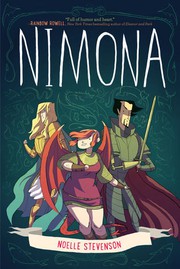
Nimona
3,495-word summary 16 min read 272 pages in the book
- First published
- 2015
- Publisher
- Quill Tree Books
- Pages
- 272
- ISBN
- 9780062278227
Reading options
What's inside (9 sections)
I picked up Nimona because a friend kept telling me it was the funniest sad book on her shelf. That sounded like a contradiction. It turned out to be accurate. I read the 2015 Quill Tree Books edition, the collected print version that runs 272 pages, in two sittings on a couch with bad lighting. I finished it fast, then sat with it for a while, then flipped back to the start to look at faces I had rushed past the first time.
The basic setup is simple enough to explain at a party. Ballister Blackheart is a villain with a lair, a moustache, a missing arm, and a code. Nimona is a young shapeshifter who shows up at his door and declares herself his sidekick. He did not ask for one. She does not care. Together they take on the Institute, the shining organization that trains heroes and keeps the kingdom safe, or so the posters say. What follows is part heist story, part friendship story, part argument about who gets called a monster and why.
If you know the backstory, the shape of the book makes more sense. Nimona started as a webcomic, posted online from 2012 to 2014 while N.D. Stevenson was in school. It grew a large following page by page, with readers reacting in real time. The print edition collects and revises that material. You can feel the webcomic roots in the pacing. Scenes arrive in bursts. Some chapters feel self contained, like episodes. Jokes land in single panels. Then the plot turns serious fast near the end, the way a story can when its author has lived with the characters for years and suddenly has to bring it home. That history does not excuse every rough edge, but it explains the energy. This is a young artist figuring out a voice in public, and much of the time that voice is sharp and sure.
A villain who files paperwork
Ballister Blackheart is my favorite kind of villain at the start, the kind who takes villainy seriously as a profession. He has a lair built into rock. He has plans. He has rules about not killing, about proportion, about making a point rather than making a mess. He monologues a little. He sulks a little. He wants the Institute to look foolish, not to see the town burn. There is something touching about how much he cares about doing bad deeds correctly.
His backstory comes out in pieces. He once trained at the Institute alongside Ambrosius Goldenloin, a golden boy hero who still works for the other side. The two were close. Something went wrong during a crucial trial or tournament, depending on how you read the flashbacks, and Ballister lost his arm and his standing. The book keeps the exact mechanics a bit loose, which is probably wise for a comedy that also wants a grudge to carry weight. What matters is the result. Ballister left, or was pushed out, and built an identity around being the villain the kingdom expects. Ambrosius stayed inside the system and became its face.
I like that the book never makes Ballister competent in the boring way. He is smart about science and planning. He builds gadgets. He thinks three moves ahead when the plan involves sneaking into a bank or spoiling a parade. He is terrible at managing a teenager who can turn into a dragon. That gap drives half the comedy. He will be explaining the importance of stealth while Nimona is already kicking through a wall as a gorilla. His exasperation is constant, but it never tips into cruelty. You can tell early that he wants someone to look after, even if he would deny it in full villain voice.
The art sells this. Stevenson draws Ballister with long limbs, sharp angles, a cape that never quite behaves. His expressions do a lot of work. One raised eyebrow carries whole pages of dialogue. In quiet scenes, when he is alone with his notes or looking at old photos, his face softens in a way the text never has to explain. For a book with so much shouting and explosions, those small panels stuck with me.
Nimona kicks the door in
Nimona announces herself. She does not knock so much as arrive. One minute Ballister is brooding, the next there is a kid on his doorstep with pink hair, a wide grin, and an offer he cannot quite refuse. She can turn into anything. A cat, a shark, a dragon, a small angry child with sharper teeth than expected. She picks forms for fun, for shock, for convenience. Need to get through a vent? Mouse. Need to scare guards? Something with wings. Need to make Ballister laugh despite himself? Something rude.
Her power reads as joy at first. That is the trick. Under the jokes, Nimona is lonely and angry in a way she does not have words for yet. She attaches to Ballister fast. She calls him boss. She teases him. She tests him, pushing to see if he will flinch when she shows teeth or scales or something stranger. He mostly does not, which both delights and unsettles her. She is used to people deciding she is too much.
The book leaves parts of her past open. There are hints of old fear, of villagers with torches, of a long life spent being named as a threat. The print edition keeps this mythic rather than detailed. I think that is the right call for the tone, though readers who want hard rules for the magic will feel shortchanged. How old is she? What are her limits? Can she stay in one shape if she wants to? The answers stay soft. What stays clear is her emotional logic. She wants someone to choose her without asking her to be smaller or more normal first.
Her humor is physical and verbal at once. She poses. She narrates her own entrances. She argues about villain plans the way a kid argues about bedtime, with total confidence and zero interest in precedent. One running joke is how badly she fits Ballister's careful schemes. He wants to plant a fake rumor. She wants to rob a train in dragon form. He wants to time a break in for midnight. She is already inside, eating snacks. The comedy works because the art times it well. A beat panel, a tiny Nimona in a huge hallway, a guard's face in the last panel. You hear the pause.
There has been a lot of discussion about Nimona and identity, including readings around genderfluid experience and queer identity. The book itself does not hand you a label or a speech. Nimona shifts bodies the way some people shift clothes, with ease and pleasure, and gets furious when others try to fix her in one form. Ballister accepts the shifting without making it a project. If you want to read that as a story about being allowed to change, the text supports you. If you read it more broadly as a story about refusing to fit a role assigned by an institution, that works too. I appreciated that Stevenson lets the metaphor breathe instead of pinning it down.
Jousts, banks, and bad plans
The middle of the book runs on missions. Ballister picks targets that will embarrass the Institute. Nimona picks targets that will be fun. They compromise badly, which is perfect for us.
Early jobs have a Saturday cartoon feel. They crash a joust, the kind of public hero event the Institute loves. Crowds, armor, commentary, bright banners. Ballister wants to expose cheating or cowardice. Nimona wants to fight everyone. The sequence lets Stevenson draw motion, which he clearly enjoys. Horses rear. Lances snap. Nimona turns into something large at exactly the wrong moment. Ambrosius shows up looking noble and conflicted, and you can see the old friendship flicker under the rivalry. It is funny and a little painful, which becomes the book's signature mix.
Other missions follow a similar pattern. Sneak into a facility. Steal or spoil something. Argue on the way out. There is a bank job, lab break ins, chases through markets and alleys. The kingdom itself is a mashup, medieval towers and banners on top of security cameras, laser grids, and television news. That blend is part of the joke. Knights talk like action heroes. Scientists talk like fantasy wizards. Newscasters report dragon sightings with straight faces. The worldbuilding never gets a full map or timeline, and honestly it does not try to. The setting is a stage for the argument between order and mischief.
What keeps these chapters from feeling repetitive is the shifting dynamic. Ballister starts as the boss in name. Nimona slowly becomes the engine. He plans. She improvises. He worries about civilians. She assumes civilians will run, and they usually do. He keeps score. She keeps souvenirs. Along the way, small moments build trust. He patches her up. She waits for him when she could fly off. He defends her to people who call her a thing instead of a person. She notices, even when she pretends not to.
Bold truth of this stretch is that the comedy carries character work without pausing for it. You learn who they are by how they rob a place together. Ballister is careful because he thinks the world already expects the worst of him and he refuses to prove it right. Nimona is reckless because she thinks the world already decided she is a monster, so why not enjoy the perks. Those two theories of being an outsider rub against each other in every job. It is entertaining, and it sets up the darker turn without announcing it.
The Institute and its shining story
Every funny villain story needs a shiny hero organization with cracks in the paint, and the Institute fills the role well. On the surface it is all white armor, clean halls, public ceremonies, and slogans about protection. The Director speaks for it in calm, reasonable tones. Ambrosius Goldenloin serves as its champion, handsome and earnest, the kind of hero kids put on lunchboxes. Guards march. Scientists invent. The news repeats the official line.
Ballister knows the line is false because he lived inside it. The book reveals, in steps, that the Institute's founding story may not be what citizens learned in school. There are hints of an older history involving dragons or monsters, fear, and a deal that hardened into law. The details stay general, told in stories and half remembered accounts rather than textbook pages. Again, I think vagueness helps the fable quality but hurts readers who want a clean conspiracy with dates and documents. You get the shape of a lie rather than the footnotes.
Ambrosius sits in the middle of this. He believes in the Institute longer than Ballister does, partly from loyalty and partly because it gave him a place after their falling out. He still cares for Ballister, in a complicated way the book handles with care. Their scenes together have a different rhythm from the heist scenes. Less banter, more pauses. You sense guilt on both sides. Ambrosius wonders if he failed his friend. Ballister wonders if caring still counts as weakness. The book, to its credit, never turns Ambrosius into a simple sellout. He is a decent person inside a flawed machine, which is a harder part to play.
The Director is colder. Without spoiling exact beats, she represents the will to keep the story clean at any cost. Where Ballister wants to embarrass the Institute into change, she wants to protect it from questions. That collision drives the last third. Jokes thin out. Stakes rise. Background characters who once played for laughs start making choices with real costs. The shift can feel abrupt on a first read. One chapter you are laughing at a shark in a hallway, the next you are looking at a city bracing for something awful. I felt the whiplash. I also felt why Stevenson wanted it. The point is that stories told by powerful groups stop being funny when someone gets hurt for real.
What it is really asking
Under the capes and explosions, Nimona asks who gets to decide what a person is. The Institute sorts people into hero and villain, human and monster, normal and threat. Ballister accepted the villain label and tried to wear it neatly. Nimona refuses every label and dares people to deal with it. The town watches on screens and picks sides based on the latest footage. Sound familiar? The book never winks too hard at our world, but the parallel sits there for anyone who wants it.
Friendship is the counter argument. Ballister and Nimona do not fix each other. He does not cure her anger. She does not cure his bitterness. They just keep showing up. He learns to say plainly that she matters to him, which for a guarded man in a cape is a big speech even when it is short. She learns to trust that someone will stay after seeing the scary shapes, which for her is harder than fighting an army. Those lessons arrive through action more than dialogue. A hand held out. A choice to stay in the room. A rescue that costs something.
The ending leans into sacrifice and scale. I will keep specifics light because this is a short book and the last pages hit harder fresh. The broad strokes are fair to share. Nimona faces a moment where her size and power become the only answer to a threat aimed at many people. Ballister faces a moment where words and gadgets are not enough and he has to trust her completely. The Institute faces exposure. Whether the cost feels earned will vary by reader. For me, the emotion landed even as the logistics blurred. I cared who lived and who was forgiven. I was less sure how the city would function the next day, or what the new rules would be. The book chooses feeling over paperwork. Given Ballister's love of paperwork, that choice is funny in itself.
A fair criticism is that the finale moves very fast. Plot threads that built slowly get resolved in a handful of pages. A reveal about the past arrives, lands, and is immediately overtaken by action. Characters make large decisions with little debate. On a first read I felt breathless in a good way, then slightly cheated on reflection. A few more quiet scenes before the climax would have given the losses and reconciliations more air. As it stands, the book asks you to fill gaps with affection for the leads. Most readers will, because the leads earn it, but it is still a rush job at the close.
Another honest note is that the world stays thin. The kingdom has texture in single panels, a shop sign, a news ticker, a crowd reaction, but no sustained sense of how ordinary life works. Who farms? Who governs besides the Institute? What do people think when cameras turn off? The story does not need those answers to work as a fable, yet their absence makes the stakes feel abstract in the final battle. You worry about Ballister and Nimona and Ambrosius. You worry less about the city as a place, because it was always backdrop.
Tone is the third wobble. The jump from prank comedy to grief is intentional, and Stevenson commits to it, but some readers will feel the seam. A character who was a punchline becomes a wound. A joke about blowing things up reads differently after real damage. I think the book wants that discomfort. It wants you to notice when play tips into harm. Still, if you came only for light heists, the last act may feel like a different story wearing the same costumes.
From webcomic to shelf to screen
Part of why Nimona rewards a second read is seeing how much craft grew between the webcomic and the book. Early webcomic pages are looser, sketchier, full of experiment. Faces slide around. Backgrounds drop out when dialogue speeds up. By the print edition, lines are cleaner, staging is clearer, action reads better left to right. Stevenson revised and redrew portions, tightened dialogue, added scenes. You can sense an artist learning to control time across panels. Jokes that once needed three panels now need two. Sad scenes hold longer on a face.
The art style overall stays expressive rather than polished in a corporate sense. Lines have wobble. Colors are flat and bright, pinks and greens against gray stone and white armor. Lettering feels hand done. Sound effects burst. This looseness fits the story. A slicker style would make Nimona feel contained. Here she looks like she might leap off the page or chew the border. Ballister, all points and swoops, looks like he irons his cape and still loses the fight with it. The contrast tells you who they are before they speak.
Then there is the afterlife. After years of start and stop development at one studio, a Nimona film arrived on Netflix in 2023 with a new visual approach and many story changes. The movie keeps the core pair and the questions about heroes and monsters, but it reshapes missions, adds characters, and paces the reveal differently for a feature runtime. Watching it after reading is strange in a good way. Some jokes survive intact. Some emotional beats hit harder with voice and music. Some choices simplify what the comic left messy. I would not call one version definitive. The book is scrappier and more personal. The film is smoother and louder. Together they show how sturdy the premise is. Put these two in any medium and people will root for them.
Reread value is high, partly because the book is short. At 272 pages with many full page images and splash panels, you can revisit it in an evening. The second time, I caught setup I had missed. A line about history that sounded like flavor now sounded like warning. A background poster now looked like propaganda. A small flinch on Ambrosius now read as guilt. The comedy also improved on return, because I was less busy tracking plot and more free to enjoy timing. If you read comics for plot alone, Nimona may feel slight for the price. If you read for character faces and line level jokes, it pays back.
Who is it for? Younger teens and up will find much to love, though parents should know the end gets intense and sad. New comics readers will find it welcoming, since it needs no prior universe knowledge. Queer readers have embraced it for reasons that feel earned rather than assigned, because the book treats self definition as ordinary and good. Longtime fantasy fans may find the world too thin and the rules too soft. Comedy fans who dislike a turn toward grief should brace. I fall in the middle. I wish the world were thicker and the ending roomier, and I still think about these two when I see a blank stretch of sky in a comic where something huge could appear.
My copy now has bent corners and a loose spine. That is not a metaphor. I lent it, got it back, lent it again. Each time the borrower laughed at the same early pages and went quiet at the same late ones. That pattern tells me the book works where it counts. It makes you care about a villain who tries to be good at being bad, and a kid who can be anything and still fears being no one. When the final pages ask what love looks like between people the world calls wrong, the answer is not a speech. It is staying, even when staying hurts. For a story that started as doodles online between classes, that is a remarkable place to land.
Why it still matters
I keep Nimona near my other graphic novels, spine out, pink bright against darker books. It reminds me that small stories can carry large feelings without puffing up. Stevenson did not build a thousand page world. He built two people, a broken friendship, a shiny lie, and a series of escalating pranks that stop being pranks. Then he asked what happens when someone refuses to shrink for comfort. The answer is messy, funny, and sad, often on the same page.
If you have not read it, start cold and let the missions carry you. If you have read it, try it again slowly and watch the background. Notice how Ballister stands near doors, ready to leave, until late in the book when he starts standing between Nimona and harm. Notice how Nimona takes up more space when she is happy and less when she is scared, whatever shape she wears. Those choices are the real summary. Plot can be retold. Care, drawn line by line, has to be seen.
FAQ
Was Nimona first a webcomic?
Nimona began as a webcomic published online from 2012 to 2014, then was collected in print by Quill Tree Books in 2015 with revisions and new material.
Is there a Nimona movie?
Yes. A film version was released by Netflix in 2023 after years in development elsewhere, with changes to plot and pacing but the same central pair.
What themes does Nimona focus on?
Readers often point to identity and acceptance, plus questions about heroes and villains, though the book frames these ideas through jokes and action rather than speeches.
Similar books

Bone, Vol. 1: Out from Boneville
Three cartoon cousins are run out of Boneville, separated by locusts, and dropped into a valley where rat creatures and an old grudge are waiting.
2,155-word summary · 10 min read
Witches Abroad
Three Lancre witches fly to Genua to stop a fairy godmother from forcing a servant girl into a storybook marriage, and find a city arranged around a happy…
2,651-word summary · 12 min read
Chainsaw Man, Vol. 1: Dog and Chainsaw
A broke teenage devil hunter and his chainsaw dog get a second life, a government leash, and a fight that stops mid-swing in Fujimoto's horror comedy.
2,584-word summary · 11 min read
Hogfather
Death fills in for a missing Father Christmas, Susan Sto Helit hunts the Hogfather, and the twentieth Discworld novel turns Santa into a management problem.
2,871-word summary · 13 min read
Saga, Volume 3
Marko, Alana, and Hazel hide on the planet Quietus with the reclusive author who inspired their romance, while assassins and a prince close in.
1,989-word summary · 9 min read

Orlando
A young Elizabethan nobleman becomes a woman and lives for centuries, moving through English history while writing a single poem about an oak tree.
2,030-word summary · 9 min read
Locke & Key, Vol. 1: Welcome to Lovecraft
After their father is murdered, the Locke children move into a haunted family estate where keys unlock doors to ghosts, other places, and dangerous secrets.
2,019-word summary · 9 min read
Cemetery Boys
A trans brujo in East Los Angeles summons the ghost of a boy who refuses to move on, and together they uncover a murder hidden beneath Día de los Muertos.
1,997-word summary · 9 min read
The Stonekeeper
After their father's death, Emily and Navin chase a monster into a hidden world to save their mother, and Emily's great-grandfather's amulet offers power at a…
2,753-word summary · 12 min read
Sourcery
A dying wizard hides his soul in a staff, his eighth son becomes a sourcerer strong enough to break the world, and Rincewind is sent to stop him with a sock.…
2,404-word summary · 11 min read
Men at Arms
The City Watch gets new recruits and a murder case when the Disc's only handgun turns up in Ankh-Morpork, in the fifteenth Discworld novel.
2,216-word summary · 10 min read
Captive Prince
Betrayed by his half-brother and sold to the enemy kingdom as a pleasure slave, Prince Damianos must survive in the court of Vere without revealing who he…
2,063-word summary · 9 min read
Wayward Son
Simon and Baz road trip America after the war to decide what normal means.
2,505-word summary · 11 min read
Reaper Man
Death gets fired and farms while Windle Poons refuses to die.
2,579-word summary · 11 min read
The Prince and the Dressmaker
A Paris prince hides a love of gowns and hires a young seamstress, and together they risk his crown for one dazzling season.
2,582-word summary · 11 min read
Saga, Volume 2
Alana and Marko flee with baby Hazel while exes, princes, and ghosts close the net.
2,028-word summary · 9 min read
Every Heart a Doorway
Nancy returns from the Halls of the Dead to a school for travelers, where a murder forces portal children to face grief, belonging and the price of going home.
2,400-word summary · 11 min read
Queen of Air and Darkness
Emma and Julian face the Cohort, Thule, and the parabatai curse in Cassandra Clare's 880-page Dark Artifices finale of love, Faerie bargains, battle, weddings,…
2,653-word summary · 12 min read
A Dirty Job
Grieving San Francisco secondhand shopkeeper Charlie Asher inherits the Death job, collecting souls into vessels while raising little baby Sophie as Minty…
2,454-word summary · 11 min read
Going Postal
A hanged con artist must revive Ankh-Morpork's dead Post Office and outwit a murderous rival in Pratchett's 33rd Discworld novel.
2,228-word summary · 10 min read

Dream Country
Four Sandman shorts on muses, cats, Shakespeare, and a veiled heroine.
2,001-word summary · 9 min read
Our Ex's Wedding
A struggling wedding planner and a winery owner who share one heartbreaking ex must join forces to pull off that ex's big day.
2,200-word summary · 10 min read
Lore Olympus: Volume One
Sheltered Persephone meets lonely Hades at an Olympus party, and gossip, old trauma, and new power test their slow bond.
2,283-word summary · 10 min read
Gideon the Ninth
Swordswoman Gideon guards necromancer Harrow in a deadly Emperor trial.
2,232-word summary · 10 min read
Fables, Vol. 1: Legends in Exile
Exiled fairy tales hide in New York, and sheriff Bigby Wolf must solve Rose Red's bloody disappearance.
2,984-word summary · 13 min read

Black Butler, Vol. 1
A twelve year old earl and his demon butler keep a Victorian manor running by day and handle dark work for the Queen.
2,877-word summary · 13 min read
The Light Fantastic
Rincewind and Twoflower fall off the world while wizards race a red star.
1,974-word summary · 9 min read
Heartstopper: Volume Five
Nick and Charlie face exams and university distance while holding on.
2,057-word summary · 9 min read
Fun Home: A Family Tragicomic
Alison Bechdel's graphic memoir about her father, their shared secrets, and the funeral home they called Fun Home in rural Pennsylvania.
2,755-word summary · 12 min read
Equal Rites
A dying wizard passes his staff to a baby girl, and Granny Weatherwax escorts Esk to Unseen University in Pratchett's third Discworld book.
2,871-word summary · 13 min read