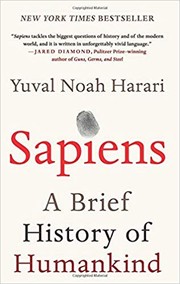
Sapiens: A Brief History of Humankind
2,145-word summary 10 min read 443 pages in the book
- First published
- 2011
- Publisher
- Harper
- Pages
- 443
- ISBN
- 9780062316097
- Original title
- קיצור תולדות האנושות
Reading options
What's inside (11 sections)
Sapiens is the rare book that made me argue with it on the train and still recommend it afterward. Yuval Noah Harari is an Israeli historian who teaches at the Hebrew University of Jerusalem, and when he wrote this book in Hebrew and published it in Israel in 2011, he expected a modest academic readership. The English edition, translated with John Purcell and Haim Watzman, turned it into a global phenomenon. Bill Gates and Barack Obama mentioned it. Bookshop tables piled it high. People who had not finished a history book since school were finishing this one.
Part of the appeal is structure. Harari cuts seven million years into four big acts: the Cognitive Revolution, the Agricultural Revolution, the unification of humankind, and the Scientific Revolution. Each section gets a clear thesis and a stack of stories. The other part of the appeal is attitude. He is not protective of human self-image. He opens by pointing out that Homo sapiens was one of several human species on the planet, not obviously the most promising, and that for most of our history we were ecologically unremarkable. Then something happened in our heads, and the rules changed.
An animal of no significance
The first chapter is deliberately deflating. For most of the last two million years, evolution produced a parade of humans and human-like relatives: Homo erectus, Homo neanderthalensis, Homo denisova, possibly others we have not named. They were not our ancestors in a simple line. They were cousins. They made tools, controlled fire in some cases, buried their dead in some cases, and lived in small bands.
Harari's claim is that Homo sapiens did not win because of bigger brains in some straightforward way, and not because of a single killer invention. Neanderthals had large brains too. What changed, he argues, was a mutation roughly seventy thousand years ago that gave sapiens a new kind of cognitive ability: the capacity to talk about things that do not exist. Not just where the lions are, but the spirit of the lion, the tribal ancestor, the deal with the gods.
He calls this the Cognitive Revolution, and its decisive product is the shared fiction. A chimpanzee can believe that the big male is the leader. A human can believe that the leader draws authority from the stars, from a law written on paper, from a company that exists only as a story lawyers tell. Fiction, in Harari's framing, is not the opposite of truth. It is the technology that lets strangers cooperate in large numbers.
The chapter on the day in the life of Adam and Eve is a useful reality check on noble-savage fantasies. Foraging life was not a vacation. It involved hard labor, parasites, predators, and violence. It was also varied, with more rest and more dietary diversity than the agricultural life that followed. Harari keeps both halves of that picture in view, which is why later chapters can treat the farmer's bargain as genuinely mixed rather than as pure progress.
The agricultural trap
If the Cognitive Revolution is the book's most famous idea, the Agricultural Revolution is its most provocative. Harari calls it history's biggest fraud. Not a conspiracy, he is careful to say, but a trap that individuals could not refuse and no one designed.
The story goes like this. Around twelve thousand years ago, in the Fertile Crescent and several other places, people began domesticating wheat, rice, maize, and other plants. Wheat did not so much get domesticated as domesticate us. To grow it you had to stay put, clear fields, haul water, weed, and store grain against pests and thieves. Calories per acre went up, which meant more children survived, which meant population grew, which meant each family had to work harder just to stand still.
Harri walks through the archaeological comparison: a medieval Egyptian peasant worked longer hours than a forager, ate a narrower diet, was more vulnerable to famine, and caught more infectious disease from living near animals and their waste. The reward was civilization's infrastructure: cities, writing, empires, art, philosophy. Individuals paid the price so that the collective could experiment. He borrows an image of history as a kind of auction where each generation bids away its leisure for the next generation's possibilities.
This is where critics get loudest. Anthropologists point out that the forager-to-farmer transition took thousands of years, was regionally uneven, and was not a single moment of decline. Some early agricultural communities were relatively healthy. Harari compresses hard, and he knows it. His aim is argument, not survey. Read the chapter as a tilt against default optimism rather than as the final word.
Memory, writing, and the birth of bureaucracy
Once populations get dense and strangers need to cooperate, brains stop being enough. Harari loves clay tokens and tablets from Mesopotamia, originally used to track jars of grain and herds of goats, evolving into writing. Writing, in this account, is not primarily poetry. It is accounting. Literature arrives later, riding on a system built for ledgers.
He makes a related point about imagined communities. A village of a hundred people can run on gossip and reputation. A city of a hundred thousand cannot. Law codes, tax records, calendars, and standardized names let institutions treat people as entries. The same machinery that lets empires function also lets them dehumanize. Harari does not moralize this so much as diagram it.
Money is the most successful shared fiction of all. A gold coin, a paper note, a number in a bank app: all are valuable because enough strangers act as if they are. Harari's section on money is one of the clearest short explanations I have read of why trust systems scale better than barter. You do not need to find someone who wants your shoes and has the fish you need. You need only a story everyone already believes.
Empires and religions as unifiers
Part three of the book is about the arrow of history, meaning the long trend toward larger and larger units of cooperation. Harari treats empire not as a dirty word but as the dominant political form for most of recorded history. He argues that most cultures are imperial blends, that the languages and gods we treat as pure were forged in conquest and administration, and that cultural purity is itself a modern fiction.
His treatment of religion follows the same pattern. Instead of ranking religions, he groups them by how they relate to a universal order. Ancient polytheisms, in his telling, were often flexible about local gods while keeping a cosmic logic. Monotheism tended to be more exclusive and eventually more missionary. Buddhism and other paths focused on individual experience of suffering and its end. Harari is himself a vegan and takes Buddhist ideas seriously, but he does not spare any tradition from the fiction test.
The chapter on the law of religion includes an uncomfortable observation about human sacrifice and its slow replacement with symbolic substitutes. He is not trying to shock. He is trying to show that moral progress, where it happened, usually came from theological argument and political pressure rather than from sudden enlightenment.
The scientific deal with empire and capitalism
The Scientific Revolution begins, Harari says, with the discovery of ignorance. Before it, the dominant European assumption was that the important truths were already known, in scripture and in the ancients. After it, admitting you did not know something became the starting point of research rather than a mark of failure.
From there he links science to the other two powers of the modern age: empire and capitalism. Exploration expeditions doubled as intelligence operations. Empires funded laboratories because knowledge paid. Capitalism's distinctive contribution was the credit revolution: the idea that the future will be bigger than the present, so you can borrow against it and invest. Harari's running example is the difference between a medieval lord who hoards surplus and a modern investor who puts surplus to work expecting growth.
He is at his most economist-like in the chapter on the capitalist creed, with the famous line about the baker and the rich man, and at his most skeptical in the chapters that follow. The industrial revolution, he argues, created the modern work discipline and the factory clock as much as it created machines. The family and the community lost many of their economic functions to the market and the state. Happiness does not automatically scale with GDP, which sets up the book's most reflective section.
Happiness, and then the end of Homo sapiens
Harari asks what all this progress was for, and he does not give a comfortable answer. He surveys three candidate sources of happiness: pleasure in the senses, a sense of life meaning, and the absence of craving. Research on subjective well-being suggests rising income helps up to a point, that adaptation eats gains quickly, and that our biochemical set point reasserts itself. Whether ancient peasants were happier than foragers, or modern office workers than medieval monks, he treats as genuinely open and mostly unanswerable with the data we have.
The final chapters go where few popular history books go: the future of the species. Genetic engineering, brain-computer interfaces, artificial intelligence. Harari argues that we are acquiring the ability to redesign the forces that shaped us, and that the natural next step is not a better Homo sapiens but something else. He uses the phrase "the last Homo sapiens" deliberately, the way earlier chapters used "the last Neanderthal." The book ends not with a neat moral but with a question about what we want to become.
How to read it well
Sapiens is not a textbook, and treating it like one will make you angry. Specialists have written long rebuttals: archaeologists disputing the forager timeline, biologists disputing the uniqueness of the cognitive mutation, economists disputing the credit story, psychologists disputing the happiness data. Some of those critiques land. Harari synthesizes aggressively, picks vivid examples over representative ones, and sometimes presents a hypothesis with the confidence of a settled fact.
I think the right way in is as a book of frames. Each chapter gives you a lens: shared fictions, the agricultural trap, imperialism as a cultural blender, ignorance as a research program. Once you have the lens, go read the specialist who will complicate it. The lens still helps you see the complication.
What I took with me was a habit of noticing which parts of my world are load-bearing stories. Money, human rights, the weekend, the corporation, the nation: all work because we collectively agree to act as if. That does not make them fake. It makes them fragile in one way and powerful in another. Harari's gift is making that obvious without making it dull.
If you only read one section, read the Cognitive Revolution and the chapters on money and empire. If you want the full effect, read straight through and keep a pencil handy, because you will want to mark the sentences you either want to shout at or quote to someone else. Both reactions mean the book is doing its job.
The afterlife of the book
Sapiens spawned sequels and a graphic adaptation for a reason. Once readers accept the frame of shared fictions, they want the frame applied to tomorrow: Homo Deus on technology and immortality, 21 Lessons on the present century. The original remains the strongest of the three because the historical sweep gives the arguments room to breathe before the prescriptions begin.
Classrooms use it too, sometimes carefully, sometimes as a catch-all. The danger is students treating its confidence as a substitute for sources. The opportunity is exactly the opposite: a book this readable can send a curious teenager into a real library, where the complications are waiting, and where disagreement with Harari becomes education rather than damage.
What I kept
A year after reading it, the phrase I still use is shared fiction, not as a sneer but as a tool. When a policy debate stalls, I ask which story each side is defending. When a market panics or calms, I ask which story is currently load-bearing. When someone says a border or a brand or a currency is obvious, I ask what happens if enough people stop believing.
That habit did not make me cynical. It made me more interested in the glue. Harari's real subject is not the past. It is the ongoing human trick of building rooms out of agreement and then living as if the walls were stone.
If you read Sapiens, keep a skeptical pen nearby and a patience for compression. You will need both. In return you get a set of lenses that keep working long after the last page, which is more than most books of any length can offer.
FAQ
Is Sapiens a reliable history textbook?
It is a grand synthesis aimed at general readers. Specialists often disagree with details, but the book is strongest as a set of lenses for thinking about history.
What is the cognitive revolution in Sapiens?
Harari's term for when Homo sapiens gained the ability to talk about things that do not physically exist: myths, gods, laws, and institutions that coordinate large groups.
Does Harari think progress makes people happier?
He is skeptical. He argues that material power and subjective happiness do not rise in lockstep, and that for many eras the evidence for lasting gains is thin.
Similar books
More like Sapiens: A Brief History of Humankind →
Guns, Germs, and Steel: The Fates of Human Societies
Diamond argues geography and crops explain why some societies expanded faster than others.
3,432-word summary · 15 min read

The Prince
Machiavelli advises Lorenzo on rule through fear and love, fortune, cruelty and mercy.
2,204-word summary · 10 min read
The Boys in the Boat: Nine Americans and Their Epic Quest for Gold at the 1936 Berlin Olympics
Washington rowers led by Joe Rantz chase gold in Hitler's Berlin in 1936.
2,439-word summary · 11 min read

Killers of the Flower Moon: The Osage Murders and the Birth of the FBI
In 1920s Oklahoma, Osage oil wealth makes tribal members targets for murder, forcing the young FBI under Tom White to expose the conspiracy behind the Reign of…
2,403-word summary · 11 min read

John Adams
McCullough follows Adams from Braintree lawyer to second president.
2,515-word summary · 11 min read

Greenlights
McConaughey shares outlaw stories and greenlight catching from Texas to Hollywood.
2,577-word summary · 11 min read