
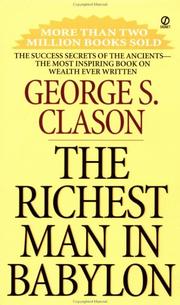
Reading options
What's inside (8 sections)
I picked up The Richest Man in Babylon because I kept hearing it quoted by people who do not usually agree about money. One friend swears by index funds. Another keeps cash in envelopes. Both of them mention Arkad. I wanted to see what a slim book from 1926 could still say that had not already been said better elsewhere. The answer surprised me. The advice is plain to the point of stubbornness, and that is why it sticks.
Clason was a Denver publisher who wrote short pamphlets about thrift and put them in ancient dress. Banks and insurance companies handed them out in the early 1920s. In 1926 he bound them as a book. The Signet paperback I used runs 224 pages and reads in an evening. It is set in old Babylon, full of chariots and clay tablets and men who speak in thee and thou. Under the costume it is a manual: save first, spend less than you earn, put money to work carefully, protect it, and get better at earning.
What makes it readable is that Clason rarely lectures directly. He lets Arkad and a handful of other Babylonians learn the hard way.
Bansir, Kobbi, and the question everyone asks
The book opens with two tired workmen. Bansir builds chariots. Kobbi plays the lyre. They sit on a wall and watch life go past and admit they are broke despite years of work. They have enough skill to stay busy. They never have enough left to feel safe.
They go to see their old schoolmate Arkad, now called the richest man in Babylon. Arkad receives them kindly and does not pretend luck did it. He tells them how he started as a scribe, carving tablets for hire in the hall of records. He earned little and spent all of it, like his friends.
The turn comes through Algamish, the money lender. Algamish orders a copy of the Ninth Law and promises Arkad two coppers if it is finished in two days. Arkad works through the night to finish. Then he asks the question that drives the whole book: how did you get rich? Algamish answers in one line that Arkad repeats for the rest of his life. A part of all I earn is mine to keep.
Arkad tries it. He saves a tenth. At first it feels thin. He is tempted to spend it. After a year he takes his savings to Azmur the brickmaker, who says he is sailing to Tyre to buy rare Phoenician jewels to resell at a profit. It ends badly. The jewels turn out to be glass. Arkad loses everything.
That failure matters more than the first saving. Arkad goes back to Algamish, ashamed. Algamish does not scold him for long. He tells him to ask a brickmaker about bricks and a jeweler about jewels, and never to trust savings to a man who has no practice with the thing proposed. Advice is free, Algamish says, but only some of it is worth taking. Arkad saves again. This time he lends to Aggar the shield maker, who buys bronze in bulk and repays with a rental. Arkad leaves the rental with the capital so it compounds. He learns the three moves he will teach forever: acquire, keep, and put to earning use. Algamish later takes him to Nippur to manage lands, and Arkad grows from scribe to owner.
I liked this opening because it lets Arkad be foolish first. He is not born wise. He buys glass jewels. Anyone who has chased a hot tip will recognize the sting.
The seven cures taught to a hundred men
The middle of the book widens. The king notices that Babylon has grown rich from canals and temples, yet most citizens hold nothing. Gold has slipped into a few hands. He asks his chancellor how to make many wealthy men rather than a few. The chancellor answers that men who know how should teach it. They send for Arkad.
Arkad asks for a class of one hundred men. For seven days he gives them one cure each for a lean purse. I read this section slowly because every later chapter assumes you know these seven.
The first cure is to start the purse fattening. For every ten coins placed in the purse, spend only nine. Clason phrases it as a vow. It sounds small until you try it for three months.
The second cure is to control spending. Arkad says what we call necessary expenses will rise to meet income unless we object. Desires grow like weeds wherever there is room. His remedy is a budget written on clay: list each desired outlay, keep the necessary ones and a few chosen pleasures inside nine tenths, cross out the rest without grief. One student in red and gold protests that a budget will make him a pack animal. Arkad answers that a man who writes his own budget is not a slave to it. The budget shows leaks and defends the cherished wish against casual wishes.
The third cure is to make gold multiply. Saved coins in a jar satisfy a miser but earn nothing. Arkad wants each coin put to labor so its children and its children’s children labor too. His example is the shield maker loan, where interest left with principal builds the stream.
The fourth cure is to guard against loss. Do not be charmed by large promised returns if principal may vanish. Study safety, demand reclaimable security, and consult men whose daily work is handling money. This repeats the Azmur lesson in formal dress.
The fifth cure is to own your roof. Arkad argues that rent paid year after year benefits the landlord while ownership, paid on similar terms, leaves the payer with land and house that rise in value and lower living cost. He even suggests using the home for a shop or garden.
The sixth cure is to provide for age and family. No man stays young for work forever. Arkad urges buying land or other income that will pay later, and arranging protection for wife and children.
The seventh cure is to grow your power to earn. Desire must be definite. Wishing to be rich is vague. Wishing for five pieces, then ten, then twenty, trains judgment. Study your craft, seek skill, respect yourself enough to ask for pay that matches value.
When I finished this section I wrote the seven on a card. They fit on one card. That is the point. Clason trusts repetition over novelty.
Luck, Kalabab, and the five laws
After the classroom comes a debate about luck. Men gather and argue whether good fortune favors some by chance. Arkad joins them and says luck favors men who act. He tells of merchants who seized openings and workmen who waited. The moral is blunt: opportunity comes to those who accept it, not to those who discuss it.
That leads to the campfire tale that carries the five laws of gold. The narrator is Kalabab, an old traveler who once worked in the household of Nomasir, the son of Arkad. Kalabab opens with a choice: a bag of gold or a clay tablet carved with wisdom. His listeners pick gold. He smiles and says they would waste it without the wisdom to keep it.
Then he tells Nomasir’s story. Arkad refuses the Babylon custom where sons wait at home for inheritance. He sends Nomasir out for ten years with two gifts: a bag of gold and a tablet inscribed with five laws. When Nomasir returns he must account. If worthy, he inherits. If not, the estate goes to the priests.
Nomasir admits he failed fast. He backed a horse wager that proved a swindle and put money into a business he did not understand. He lost the gold, sold his horses and slave to live, and nearly fell into bondage. Only then did he read the tablet closely and memorize it.
The five laws, as Arkad carved them, run like this. First, gold comes gladly to the man who puts by a tenth to build an estate. Second, gold works diligently for the owner who finds it profitable employment. Third, gold clings to the cautious owner who follows the counsel of men skilled in its handling. Fourth, gold slips away from the man who commits it to unfamiliar business or to ventures disapproved by the skilled. Fifth, gold flees forced impossible earnings, tricksters, and romantic inexperience.
Nomasir lives by these after his fall. He saves a tenth even from small wages. He invests only in known trades. He asks for counsel. He refuses glittering promises. Over years he builds a merchant business, returns to Babylon, and lays before his father a bag of Nineveh gold equal in weight to the Babylon gold he lost, plus two more bags as proof that wisdom outweighs coin. Arkad accepts him as heir.
I found this the strongest chapter. It corrects the first section. Saving is not enough. Keeping requires refusal. The laws are strict about unfamiliar risk, which feels severe until you remember Azmur and the glass jewels.
The lender’s chest and the city walls
Two shorter parables test the laws from the other side: lending.
Rodan the spear maker receives fifty pieces of gold as a gift from the king. It is more than he has ever carried. His sister asks him to lend it to her husband Araman, who wants to become a merchant. Rodan is torn between family loyalty and fear.
He visits Mathon, the lender of gold and dealer in jewels. Mathon does not give a yes or no. He opens his token chest, where he keeps a pledge from each borrower until repaid. He shows a bronze neck piece kept for a dead friend who spent himself poor for a lavish wife and died by the knife in a quarrel. He shows an ox bone ring from a farmer who borrowed after locusts, repaid after harvest, then borrowed again for long haired goats and built a herd that will supply costly rugs. He shows a knotted pack rope from Nebatur the camel trader, a trusted merchant whose tokens come and go because his judgment is sound.
Mathon’s rule is plain. The safest loans rest on property worth more than the loan, or on proven ability with a clear plan and security. A loan to an earnest man with no experience and no security is not kindness. It burdens both sides. He tells Rodan to keep his gold, since a gift for labor carries no duty to lend, and if he does lend to the brother in law, to lend only a year’s savings and only after a wise plan passes Mathon’s review. Rodan learns that idle gold earns nothing, but rushed gold returns never.
The walls chapter is brief. Babylon prides itself on high walls that no enemy has taken. Clason uses them as a figure for protection around money and family: reserves built before trouble. A city without walls begs for siege. A purse without reserves does the same.
Dabasir, the tablets, and Sharru Nada
The last long stretch belongs to Dabasir, and it is my favorite because it is the most concrete about debt.
Dabasir meets Tarkad, a young man who owes him two coppers from a moon ago and a piece of silver from before. Tarkad cannot pay and looks away. Dabasir does not rage. Over a meal he tells how he became a camel trader after being a slave in Syria.
As a youth Dabasir learned saddle making from his father, married, and earned little. He wanted more than he could afford. Shopkeepers gave credit. He bought raiment and goods beyond his pay, borrowed from friends, and found he could not both live and repay. His wife went back to her father. He fled Babylon to find easy wealth elsewhere. Instead he was robbed, then sold for two pieces of silver to a Syrian chief. He thought it an adventure until his master offered him as a eunuch to his wives. Only the intercession of Sira, who needed a camel tender she could trust to visit her sick mother, saved him. He led her camel and told her his story. She answered with scorn that cut him: his debts were enemies who had driven him out, and a king fights enemies rather than running. If he had the soul of a free man he would return, face creditors, house his wife, and earn respect.
Dabasir takes her words to heart. He escapes across the desert, returns to Babylon, and visits every creditor to ask indulgence. Most receive him gladly. A few revile him. Mathon the lender helps by sending him to Nebatur, who needs buyers of sound camels for the king’s expedition. Dabasir knows camels from Syria and prospers, first as buyer, later as partner.
The proof is in the clay tablets that follow. An archaeologist’s letters frame them as finds sent to St. Swithin’s College. The tablets are Dabasir’s own record, written one full moon at a time under Mathon’s plan.
Tablet one states the resolve: follow an exact plan out of debt into means. Tablet two lists creditors and sums. Fahru the cloth weaver, Sinjar the couch maker, Ahmar and Zankar his friends, Harinsir the jewel maker, Diarbeker his father’s friend, Alkahad the house owner owed fourteen silver, Mathon owed nine silver, Birejik the farmer, and others, totaling one hundred and nineteen pieces of silver and one hundred and forty one pieces of copper. Tablet three records his visits and promises to pay two tenths of earnings among creditors evenly, asking patience.
Then come the monthly entries. Dabasir divides all earnings by rule: one tenth kept as his own, seven tenths for home, food, clothes, and small pleasures, two tenths for debts. In one moon he earns nineteen silver buying sound camels for Nebatur, keeps nearly two, lives on the seven tenths with his loyal wife, and reduces debts by almost four silver. In a lean moon he earns only eleven silver, eats herbs, buys no raiment, yet still pays the tenths. Ahmar, who had cursed him, commends the small payment. Alkahad rages and is told to return the coin if he refuses it, then relents. In a rich moon he earns forty two silver from a fine herd, buys sandals and meat, and pays more than eight silver to creditors without protest. After three moons more he holds twenty one silver of his own and walks straighter. After twelve moons he pays the last debt and feasts. Alkahad, once harshest, calls him bronze that holds an edge and offers future credit.
A modern letter closes the sequence. The professor who receives the translation tries the same seventy percent living limit on his own check, pays old bills, and watches savings grow while life feels easier than before. It is sentimental, yet it lands because we saw each moon.
The book ends with Sharru Nada, the merchant prince riding at the head of a caravan, troubled inwardly, talking with Hadan Gula, grandson of his old partner Arad. Sharru tells how both men were once pledged as bonds for unpaid loans and knew slavery. Sharru talked his way into a baker’s shop, learned the trade, and counted himself lucky to work. His master later pledged him for a gambling debt and he dug canals until Arad, freed and prospered, bought his freedom and took him as partner by smashing the title tablet on cobbles. Hadan, pressed by debts himself, hears in this not luck but method: work learned well, masters served faithfully, freedom purchased, partnership earned. Sharru’s caravan moves on, but the point stays. No man is held down who respects himself enough to repay and learn.
What still works and what creaks
I will keep the card with the seven cures, and I will keep Dabasir’s split in mind whenever money feels tight. Pay a tenth to yourself first. Live on less than nine tenths. Make savings earn through familiar, secured uses. Ask people who handle money daily. Those habits do not age.
Still, a friend reading over my shoulder asked the right questions, and the book does not fully answer them.
It is dated. Women appear mainly as wives to be housed. Slavery is used as a plot device without pause. The home ownership cure assumes stable prices and steady work, which many cities no longer offer. A tenth saved is simple to say and hard for a household already choosing between rent and food. Clason never mentions illness or the fees that eat small accounts.
It is also simple by design. The same three ideas return in new robes: save ten percent, compound it, avoid loss. After a while I could predict the turn. The goddess of luck chapter scolds waiting. The five laws scold haste. Mathon scolds soft lending. Dabasir demonstrates the budget. Repetition teaches, but it can tire a reader who wants tools for choosing funds, handling tax, or judging insurance. You will not find those here.
That simplicity is also the defense. Most money books fail because they add cleverness before habit exists. Clason builds habit first. He gives names to faces: Bansir hesitating, Rodan tempted by family, Tarkad dodging Dabasir, Alkahad shouting then softening. I remembered the nineteen silver moon and the eleven silver moon better than any formula.
Read it as a beginning, not a complete plan. Take the tenth, the budget of nine tenths, the demand for security, and the insistence on learning a craft. Leave room for the parts Clason never knew: higher housing costs, changing work, and the need for wider protection than walls. If you want parables that make thrift feel honorable rather than pinched, Arkad’s school still admits pupils.
FAQ
Was The Richest Man in Babylon first published in 1926 or 1930?
The parables began as pamphlets distributed by banks and insurers, were collected as a book in 1926, and Clason later issued an illustrated 1930 edition. 1926 is the original book publication year.
Is this book only for beginners with debt?
It speaks most clearly to beginners and debtors because Dabasir and Nomasir start broke, but savers also use the tenth saved, the budget rule, and the caution about loss.
Does the book oversell buying a home and simple rules?
Yes, in places. Owning a home and saving a tenth do not fit every market or income, and the stories skip over taxes, fees, and bad luck. Treat the rules as habits to adapt, not promises.
Similar books

The House of Mirth
Lily Bart, beautiful and penniless at twenty-nine, navigates New York's marriage market until a Dorset yacht scandal strips her of the only currency she has.
2,468-word summary · 11 min read
Vanity Fair
Becky Sharp schemes her way up Regency society while loyal Amelia waits, in Thackeray's witty novel without a hero.
2,698-word summary · 12 min read
Jonathan Livingston Seagull
A gull who loves flight over food is exiled, learns perfection, and returns to teach dawn lessons.
1,998-word summary · 9 min read
How to Win Friends and Influence People
Carnegie's 1936 guide to getting along offers plain habits for listening, praise, and persuasion. This summary walks through its parts, stories, limits, and…
2,360-word summary · 10 min read

The Long Winter
Dakota Territory, 1880: seven months of blizzards cut a town off from the railroad, and a family survives on twisted hay, ground wheat, and a dangerous wheat…
2,210-word summary · 10 min read

The Guest
Cast out of her wealthy boyfriend's Hamptons house, twenty-two-year-old Alex spends five days talking her way through other people's homes and accounts.
2,165-word summary · 10 min read

The Crying of Lot 49
A California woman named executor of her ex-lover's estate follows a muted post horn into a possible centuries-old postal conspiracy, and Pynchon refuses to…
2,003-word summary · 9 min read
Silas Marner
A falsely accused weaver hoards gold in Raveloe until a stolen hoard and an abandoned child remake his narrow life.
2,699-word summary · 12 min read

Revolutionary Road
A Connecticut couple who believe they are too good for the suburbs plan to move to Paris, and the plan slowly exposes everything they cannot say to each other.
2,085-word summary · 9 min read

Make Way for Ducklings
A pair of mallards raise eight ducklings on the Charles River and lead them across Boston to the Public Garden, with a little help from a friendly policeman.
2,044-word summary · 9 min read

What Happened to You?
Oprah Winfrey and psychiatrist Bruce Perry explain how early experience shapes the brain, and why asking what happened to someone works better than asking what…
2,238-word summary · 10 min read

The Courage to Be Disliked: The Japanese Phenomenon That Shows You How to Change Your Life and Achieve Real Happiness
A philosopher and an angry young man argue over five nights about Adlerian psychology, trauma, approval, and the freedom to be disliked.
2,054-word summary · 9 min read
Rosencrantz and Guildenstern Are Dead
Stoppard's 1966 play retells Hamlet from the wings, where two minor courtiers wait, joke, and walk toward a death they cannot see.
2,021-word summary · 9 min read

Little Town on the Prairie
In the spring after the Long Winter, fifteen-year-old Laura sews shirts, studies for a teaching certificate, and helps send her blind sister Mary to college.
2,071-word summary · 9 min read
Amelia Bedelia
A literal-minded housekeeper follows her employer's list to disastrous and funny effect in the 1963 picture book that made wordplay a children's staple.
2,038-word summary · 9 min read

Moonwalking with Einstein: The Art and Science of Remembering Everything
A journalist spends a year training for the U.S. Memory Championship and discovers that extraordinary memory is mostly technique, attention, and a lot of…
2,027-word summary · 9 min read

Howards End
Forster's 1910 novel follows two families, a house in Hertfordshire, and a burned note, asking whether money and feeling can ever be connected.
2,187-word summary · 10 min read

The Total Money Makeover: A Proven Plan for Financial Fitness
Dave Ramsey lays out seven Baby Steps, from a $1,000 starter fund to a paid-off house, with the debt snowball at the center.
2,663-word summary · 12 min read
The Mitten
Jan Brett retells a Ukrainian folktale about a boy, a lost white mitten, and the woodland animals that crowd inside until a bear sneezes.
2,609-word summary · 12 min read
The Agony and the Ecstasy
Irving Stone turns Michelangelo's seventy years of carving, painting, and arguing with popes into a novel about the cost of making something that outlives you.
2,260-word summary · 10 min read

Sophie's Choice
A young Southern writer in 1947 Brooklyn befriends a brilliant, unstable couple and slowly learns the story of the Polish Catholic woman at the center of their…
2,798-word summary · 12 min read

Fathers and Sons
Arkady brings the nihilist Bazarov home to his father's estate, and a generational argument turns into love, a duel, and an early death.
2,192-word summary · 10 min read

Clifford the Big Red Dog
Emily Elizabeth picks the smallest puppy in the litter, loves him as hard as she can, and wakes up to a dog the size of a house.
2,092-word summary · 9 min read
Year of Yes: How to Dance It Out, Stand in the Sun and Be Your Own Person
Shonda Rhimes takes her sister’s accusation seriously and spends a year saying yes to the things that frighten her, from live television to her own reflection.
2,585-word summary · 11 min read
The Story of Ferdinand
A gentle Spanish bull would rather smell flowers than fight, and when he is taken to the bullring he simply sits down among the flowers in the ladies' hats.
2,135-word summary · 9 min read
Naked Lunch
Burroughs's banned 1959 collage novel follows Bill Lee through addiction, Tangier, and the nightmare bureaucracy of the Interzone.
2,082-word summary · 9 min read

Go, Dog. Go!
Dogs drive, work, play, and climb a tree for a party in this Beginner Book built on repetition, opposites, and one very unpopular hat.
2,196-word summary · 10 min read
Don't Sweat the Small Stuff ... and It's All Small Stuff: Simple Ways to Keep the Little Things from Taking Over Your Life
Richard Carlson’s 1997 bestseller offers one hundred short chapters on lowering the volume on daily irritations, and it is more pragmatic than its title…
2,502-word summary · 11 min read
Caps for Sale
A peddler balances his caps on his head, naps under a tree, and wakes to find monkeys wearing his stock in this 1940 picture book.
2,787-word summary · 12 min read

Made to Stick: Why Some Ideas Survive and Others Die
The Heath brothers break down why some ideas vanish on contact while others lodge in memory, tracing six traits that make a message stick.
2,527-word summary · 11 min read