
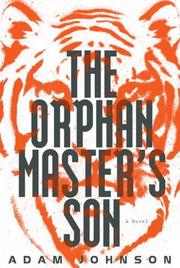
The Orphan Master's Son
2,219-word summary 10 min read 443 pages in the book
- First published
- 2012
- Publisher
- Random House
- Pages
- 443
- ISBN
- 9780812992793
Reading options
What's inside (10 sections)
The first thing you notice in The Orphan Master's Son is the voice coming out of the loudspeaker. Throughout North Korea, the novel says, speakers in homes and on street corners broadcast the state's version of events, and people are required to listen. Adam Johnson builds the whole book on the gap between that broadcast and what actually happens to the people beneath it. Random House published the novel in January 2012, and it runs 443 pages in hardcover. In April 2013 it won the Pulitzer Prize for Fiction. Johnson teaches creative writing at Stanford, and he spent roughly seven years on the project. He read the memoir of a gulag survivor, Kang Chol-hwan's The Aquariums of Pyongyang, along with defector testimony and reams of state propaganda, and in 2007 he managed a supervised visit to North Korea that showed him the rehearsed surface of Pyongyang and very little underneath. This is not reportage. It is an act of imagination about a country where the wrong kind of imagination can cost you your life.
The Orphanage and the Tunnels
Pak Jun Do grows up in a state orphanage in Chongjin, on the farthest edge of the country, and he is the orphan master's son, which grants him nothing but a title. His father runs the place. His mother was a singer from Pyongyang; she is gone, and her absence is one of the questions the book eventually answers. Jun Do is useful to the orphanage because he can read and because he can be trusted to decide which children get which scraps. Then he turns fourteen, and the orphanage empties. The state conscripts the children into the military and sends many of them into the tunnels, the underground positions near the border, where they dig and fight and die in the dark. Orphans are considered the lowest class of citizen and therefore expendable, and the book is blunt about it. Jun Do becomes good at the tunnels. He becomes, in the state's terms, useful.
The tunnel sections are among the strangest in the novel. They are rendered with almost no sentiment, as a kind of work, and the horror sits in the flatness of the telling. When the men run out of boots they take the boots off the dead, and Jun Do learns to walk on his knees through water so the feet of the man in front will break the cold for him. The book takes the facts of life at the bottom of the society and refuses to decorate them.
The Kidnapper
Jun Do's competence gets him moved, if that is the word, into an abduction unit. North Korea, in the novel as in the historical record, kidnaps foreign citizens, and Jun Do's unit takes Japanese people off the coast and delivers them into the country, where they are supposed to become useful to the state. He does the work without much conscious objection, which is part of the point. The novel is interested in how ordinary people become instruments, and Jun Do is almost frighteningly ordinary. One operation goes wrong and a Japanese woman dies, and the guilt attaches to him and never fully leaves.
What he earns from this work is language. The state teaches him English, because a man who can read and speak it is worth more, and that skill becomes the hinge of his life. It is also where the novel begins to show its sympathy for him without excusing him. He knows what he has done. He keeps doing it, mostly because the alternative does not exist for someone born where he was born.
The Sea and the Shark
After the tunnels and the abductions comes the fishing boat. Jun Do is assigned to a vessel as a signal operator, listening to foreign radio traffic and translating it, and the job gives him something he has never had: a window. He grows attached to the crew, especially a second mate who becomes his friend, and he becomes fascinated by the outside world he can only hear. Two American girls are trying to row across the Pacific, and the fragments of their transmissions reach him like messages from another planet. More dangerous still, he hears broadcasts from the International Space Station, and the difference between what he can hear and what the state has told him becomes impossible to ignore. The second mate reaches the same conclusion and defects, and the crew has to invent a story to explain what happened.
Their story is that a shark attacked Jun Do. He was bitten, nearly killed, and recovered, and the state, always hungry for a hero, swallows it and declares him a national hero for surviving. The sequence is darkly funny, and it also changes his status. A hero can be given a better place in the world, and Jun Do is given a place: he is added to a delegation that will travel to the United States.
The Trip to America
The delegation goes to America to recover technology that the North Koreans claim was stolen from them. In fact the North Koreans stole it from the Japanese, and the Americans intercepted and confiscated it, and the whole errand is a lie dressed up as a grievance. In Washington, Jun Do meets a Texas senator and a government agent named Wanda, who seems to sympathize with him and quietly gives him a way to contact her. The negotiations collapse when the senator realizes that the man he has been treating as the head of the delegation is a decoy, a figurehead, and that the real power sits somewhere else. He refuses to deal with them, and the delegates go home.
The punishment for failure is worse than the failure. Jun Do and the others are tricked into a prison mine, and once they are inside they simply cease to exist. The state does not execute people like this; it erases them. The first half of the novel ends with Jun Do at the bottom again, this time carrying the added weight of having briefly seen the outside.
The Interrogator
Here the book changes shape, and the change is the best thing in it. The second half is narrated in part by an unnamed interrogator for the state whose real work is writing biographies. Prisoners are interrogated, but the state's deeper need is for a version of a life, and the interrogator assembles these versions as a by-product of torture. He has been given a hard case: Commander Ga Chol Chun, a national hero, arrested for murdering his wife, the famous actress Sun Moon, and their children. Ga will not talk. He absorbs everything the interrogator and his superiors do to him and says almost nothing.
The interrogator, who narrates in the first person and is by turns petty, self-justifying, and painfully human, becomes obsessed with the prisoner, and the book lets us watch him try to write a life story that will satisfy the state while quietly failing to match the man in front of him. A third voice is threaded through the book as well, the voice of the state's own propaganda broadcast, which keeps announcing the official version of the very events we are watching from a different angle. Three narrators, three truths, and the reader has to decide which to believe.
Sun Moon and Commander Ga
The prisoner is Jun Do. He survived the prison mine and, in a confrontation there, killed the real Commander Ga, a rival of the Dear Leader, Kim Jong-il, who also wanted Sun Moon. By taking Ga's name and face, Jun Do stepped into a life that had already been built for someone else. The Dear Leader does not mind, because Ga's disappearance is convenient for him; he installs Jun Do as Sun Moon's replacement husband and keeps the pieces where he wants them.
Sun Moon is a movie star, the most photographed woman in the country, and her life is not her own. At first she makes Jun Do sleep in a dirt cellar beneath the house, and he is disgusted by the real woman behind the image he had worshiped from a distance. She is vain, demanding, and dismissive of ordinary people. Slowly he understands what she has been made to endure. The real Commander Ga, the man whose name he now carries, was a sadist who married her to spite the Dear Leader, and the Dear Leader himself has spent years controlling her career and her body without ever quite taking what he wanted. When he could not have her, he quietly destroyed her film work. Jun Do comes to see that her arrogance is armor and that her life is a jail with better clothes.
Their marriage becomes real in a strange way. Sun Moon and her children, a boy and a girl, come to accept him, and after watching Casablanca she realizes how much of her career has been propaganda with no art in it, and she asks him to help her and the children get out of the country. It is the one promise in the novel that matters.
The Plan and the Ending
The Dear Leader has captured one of the American rowers, the same girls Jun Do once heard on the radio, and he wants to trade her for the confiscated technology and then keep the technology anyway, humiliating the Americans in the process. He also plans to have Ga killed once the deal is done, so that he can finally have Sun Moon. Jun Do sees the trap clearly and reaches out to Wanda.
An American delegation arrives to collect the rower, and Kim stages an elaborate performance for them, with Sun Moon at the center of it. While the Dear Leader is distracted by his own show, Jun Do smuggles Sun Moon and the children onto the American aircraft and lets himself be captured in order to guarantee their escape. The Dear Leader is stunned by the betrayal. He has Ga arrested and sentenced to death. The interrogator, who has been trying to write a true account of the man, is told that an official version of Ga's life has already been written and broadcast, and that the interrogation now has a different purpose, which is to find out where Sun Moon has gone. He tries to break the prisoner with a machine meant to reshape the mind, and Ga turns the machine against them and kills himself with it.
The novel ends inside the fog of the state's version. The official broadcast declares that Commander Ga died heroically trying to stop the Americans from abducting Sun Moon, and it turns him into a martyr to be revered forever. Whether Sun Moon and the children reached safety, or were recovered, or were never really free, is left deliberately unresolved. The regime's story and the private truth cannot both be checked, and the book refuses to pretend otherwise. Jun Do's last act is to refuse to be rewritten. He dies as himself, which is the only freedom the state cannot take back.
What the Book Costs, and Who Should Read It
The Orphan Master's Son earned comparisons to the great political novels when it appeared, and much of the praise was deserved. Michiko Kakutani in The New York Times called it daring and remarkable, and the Pulitzer committee followed in 2013. The structure is genuinely inventive, the Dear Leader is drawn as a plausible, petty, dangerous man rather than a cartoon, and the book has real momentum for something almost four hundred and fifty pages long. Johnson's decision to give the state its own voice, the loudspeaker that keeps contradicting the plot, is the trick that makes the whole thing work.
There are fair objections. The first half drifts from tunnels to kidnapping to fishing boat to diplomacy, and it can feel like a series of set pieces rather than a single life. Some readers find the tonal shifts jarring, because the book will move from atrocity to satire within a page. The second half is more tightly wound but also more static, much of it taking place in a single interrogation room, and the dense, dreamlike closing chapters ask a lot of patience. A few critics, including Christopher Beha in the Times, found the propaganda interludes clever but thin next to the suffering they are meant to frame. The novel is also not a reliable guide to North Korea; Johnson has said so himself, and anyone wanting the documented history should read the defectors' memoirs instead. It is a hard book, violent and bleak, with torture on the page and children in danger, and it does not offer consolation. Readers who want a clean moral or a hopeful finish will not get either one, and the book seems to consider that refusal a form of honesty.
What it offers instead is one young man's voice, preserved against the loudspeaker. Jun Do spends his life being told what he is, and the novel gives him the last word anyway. That is the argument the book makes, and it makes it well enough that, years after North Korea's own propaganda has been forgotten, this invented story still feels like it is telling the truth.
FAQ
Is The Orphan Master's Son based on a true story?
It is fiction. Adam Johnson built it from defector memoirs, more than a decade of state propaganda, and histories, plus a supervised 2007 visit to North Korea, but Pak Jun Do, Commander Ga, and Sun Moon are invented characters. Johnson himself has said the book is not a reliable guide to the country.
What awards did The Orphan Master's Son win?
It won the 2013 Pulitzer Prize for Fiction. It was also a finalist for the 2012 National Book Critics Circle Award and won the 2013 Dayton Literary Peace Prize for fiction.
When was The Orphan Master's Son published?
Random House published it in January 2012. The 443-page count and ISBN on this page come from the Random House hardcover.
Similar books

Middlesex
Cal Stephanides traces three generations from Greece to Detroit to explain being intersex and becoming himself.
2,013-word summary · 9 min read

Violeta
A woman born in 1920 writes her life story to her grandson, from one pandemic to another, through wealth, ruin, passion, and dictatorship in South America.
2,555-word summary · 11 min read

The Idiot
A Turkish-American freshman at Harvard falls in love through email with a Hungarian math student and spends a summer in Hungary trying to turn correspondence…
2,019-word summary · 9 min read

The Beach
A young backpacker follows a dead man's map to a hidden island community, then discovers what the people there are willing to do to keep it secret.
2,067-word summary · 9 min read
Prelude to Foundation
A young Hari Seldon arrives on Trantor with a theory he cannot yet prove, and a hunt through the planet-city forces him to turn psychohistory into a real…
2,013-word summary · 9 min read

James
Percival Everett retells Huckleberry Finn from Jim's side, giving him a library, a hidden school, and a voice the novel lets loose.
2,211-word summary · 10 min read

Fathers and Sons
Arkady brings the nihilist Bazarov home to his father's estate, and a generational argument turns into love, a duel, and an early death.
2,192-word summary · 10 min read
Unaccustomed Earth
Lahiri’s second story collection follows Bengali families in America and abroad, tracing the quiet distances between parents and children, spouses, and the…
2,333-word summary · 10 min read

Ivanhoe
A disinherited Saxon knight, a great tournament, a besieged castle and a trial by combat. Scott's most famous novel, set in England in 1194.
2,834-word summary · 13 min read
The Sisters Brothers
Two hired killers ride from Oregon to Gold Rush California to murder a prospector, and find their trade, their brotherhood, and the frontier myth coming apart.
2,095-word summary · 9 min read

Bring Up the Bodies
Thomas Cromwell sets out to destroy Anne Boleyn, building a case from rumor and revenge while Henry VIII waits to marry Jane Seymour.
2,066-word summary · 9 min read
The False Prince
A nobleman buys four orphans and tells them only one will survive to impersonate the missing prince. The narrator, a defiant thief named Sage, has other plans.
2,044-word summary · 9 min read

Olive, Again
Elizabeth Strout returns to Crosby, Maine, as Olive Kitteridge marries Jack Kennison, confronts her son, and faces old age, grief, and small-town judgment.
2,333-word summary · 10 min read

Nemesis Games
The Rocinante crew scatters across the solar system just as Marco Inaros and the Free Navy bombard Earth. The Expanse reaches its turning point.
2,506-word summary · 11 min read

The Swiss Family Robinson
Shipwrecked Robinsons build treehouses and tame island beasts.
2,400-word summary · 11 min read
The Most Fun We Ever Had
Four Sorenson sisters orbit perfect parents hiding old cracks.
2,590-word summary · 12 min read

The Accidental Tourist
Grieving Macon writes travel guides for haters of travel, then Muriel intrudes.
2,252-word summary · 10 min read
News of the World
Captain Kidd carries captive Johanna home across 1870 Texas.
2,571-word summary · 11 min read

Men Without Women
Seven stories about men living after women leave, die, or stay distant.
2,673-word summary · 12 min read
Let the Great World Spin
A wire walker crosses the towers as Bronx lives collide below.
2,338-word summary · 10 min read

Kitchen
Orphan Mikage finds home in a kitchen with Yuichi and Eriko after loss.
2,597-word summary · 12 min read
Ham on Rye
Henry Chinaski grows up rough in Depression Los Angeles and finds writing.
2,244-word summary · 10 min read

Disgrace
A professor falls after an affair, then faces violence at his daughter farm.
2,533-word summary · 11 min read

An Object of Beauty
Lacey climbs the art world from Sotheby to fraud and fall.
2,629-word summary · 12 min read

The Fall
A fallen Paris lawyer confesses in an Amsterdam bar, tracing guilt from Paris success to a bridge he failed to face.
2,220-word summary · 10 min read
The Celestine Prophecy
A restless American chases a missing manuscript through Peru and learns Nine Insights about coincidence, energy, and how people vie for attention.
2,599-word summary · 12 min read
The Art of Fielding
A flawless college shortstop loses his throw at Westish College, and five tangled lives must face failure and change.
2,519-word summary · 11 min read
The Signature of All Things
Botanist Alma Whittaker grows up in Philadelphia trade wealth, studies mosses, marries distant Ambrose Pike, and sails to Tahiti seeking how species change.
2,535-word summary · 11 min read