
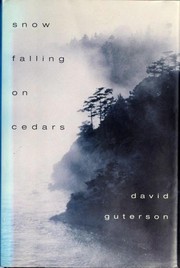
Snow Falling on Cedars
2,224-word summary 10 min read 345 pages in the book
- First published
- 1994
- Publisher
- Harcourt Brace
- Pages
- 345
- ISBN
- 9780151001002
Reading options
What's inside (7 sections)
Snow Falling on Cedars by David Guterson was first published in 1994 by Harcourt Brace, a 345 page novel with ISBN 9780151001002. It won the PEN/Faulkner Award and became the kind of book passed from hand to hand. I picked it up expecting a courtroom story and found something slower and sadder, a murder trial wrapped around a whole island history. It took me longer than I planned because the middle asks for patience, but the closing stretch paid off.
The setup pulls you in fast. It is December 1954 on San Piedro, a fictional island in Puget Sound off the Washington coast. Snow is falling through a murder trial that has the whole community packed into the courthouse. Kazuo Miyamoto, a Japanese American fisherman and war veteran, stands accused of killing Carl Heine, a fellow fisherman found dead in his own gillnet out on the water. The sheriff found Carl's boat drifting with its nets out, Carl tangled below, and a wound on his head that did not look like drowning alone. The prosecution says Kazuo struck Carl and left him to die. The defense says the sea did it.
Guterson keeps cutting between the courtroom and the past, so the trial scenes land with more weight each time. You learn the island before you learn the verdict, and by the time the lawyers rest, you understand why this charge stuck to this man.
An island of strawberries and gillnets
San Piedro runs on two harvests. Strawberries in the fields and salmon on the water. The white families mostly farm or fish, and the Japanese families, who arrived decades earlier, do the same work for thinner margins. Everybody knows everybody. Kids share classrooms, men share the fishing grounds, women trade news at the stores. That closeness makes the splits worse, because people remember exactly who slighted whom and when.
The island's fishing life gets rendered in close detail. Boats, tides, fog, nets, the pecking order of the grounds. Carl Heine fished the way his father did, working hard and saying little. Kazuo Miyamoto fished with the same stubborn pride. When Carl's body turns up, the island reads the death through old grudges before any witness speaks. A German family and a Japanese family, a disputed piece of land, a war that put one group behind wire and sent the other group's sons to fight. The snow keeps falling outside the courthouse windows while all of it gets dragged into the light.
I liked how physical this part feels. Cold decks, wet rope, the smell of fish holds, kitchens warmed by stoves. Guterson fished and taught in the Pacific Northwest, and the labor scenes carry that knowledge. If you have ever worked outside in winter, the opening chapters will get under your skin.
Ishmael and Hatsue
The heart of the book is not really the trial. It is Ishmael Chambers, the reporter covering it, and the girl he never got over.
Ishmael owns and edits the island paper, the San Piedro Review, after his father's death. He came home from the Pacific war missing an arm and carrying a wound that never closed. Before the war he loved Hatsue Imada, a Japanese American girl his age, with the total devotion of a teenager. They met in secret inside a hollowed-out cedar in the woods, a hiding place that felt like their own country. For a while it was tender and real. Then the war came, and Hatsue ended it.
Hatsue is now Hatsue Miyamoto, the defendant's wife, sitting behind Kazuo in the courtroom with their children. Ishmael has to watch her every day while taking notes for the front page. He tells himself he is a professional. He is not. He still loves her, still replays the cedar tree, still aches with the unfairness that history handed her to someone else.
What makes this work is that Hatsue is not written as a prize. She made a choice with reasons. Her mother pressed her to act properly, to marry within her community, to stop a romance that could only bring shame in wartime. Hatsue herself felt the pull of duty and the fear of what people would say. Her letters to Ishmael from the camps grow cooler, and the break hurts exactly because it is understandable. She chose a life she could defend. Ishmael never forgave life for letting her.
There is a fair criticism to make here. Hatsue can feel distant on the page, seen mostly through Ishmael's longing and through courtroom glimpses. Some readers will wish she got more scenes of her own, more mess and humor, more of the woman Kazuo actually married. I felt that gap too. But the distance is also the point. Ishmael never really knew her as an adult, and the book refuses to pretend otherwise.
Manzanar and the seven acres
To understand the charge against Kazuo, you have to go back to the land.
Before the war, Kazuo's father arranged to buy seven acres of strawberry land from the Heine family, paying in installments. The families shook on it. Then Pearl Harbor came, and the order went out, and the Miyamotos were sent to the internment camp at Manzanar in California along with the other Japanese islanders. Payments stopped because there was no income and no freedom. While they were gone, the land was sold out from under them to another farmer, Ole Jurgensen.
After the war, Kazuo came home with medals and tried to buy those acres back. For a time it looked possible. Carl Heine, who had inherited the farm, seemed willing to sell. Then Carl changed his mind, under pressure from his mother Etta, who felt her family owed the Miyamotos nothing. The deal died. Kazuo took it as theft with a legal cover. Carl took it as his right. The island took sides along lines drawn years before.
The Manzanar chapters are among the strongest in the book. Families in barracks behind barbed wire, dust everywhere, kids trying to stay normal in school, parents trying to keep authority when the government has taken everything else. Hatsue grows up fast there. So does her sense that the romance with Ishmael belongs to a childhood the war ended. Guterson does not rush these pages, and he does not soften them. The camp ran on fear and paperwork, and the island welcomed its Japanese neighbors home with cold stares and short hires.
This history is what the prosecutor leans on. A disputed seven acres, a proud man who felt robbed, a dead man who would not sell. Motive, the state says, plain as day.
Hooks against Nels
The trial itself is a contest between two men who could not be more different.
Alvin Hooks prosecutes with heat. He talks about the wound on Carl's head, about blood found on a boat part, about Kazuo's military training in hand to hand fighting. He floats the idea that Kazuo struck Carl with something like a fisherman's implement or a training weapon and then let the sea finish the job. He keeps reminding the jury, in so many words, that Kazuo is Japanese, that the war taught him how to kill, that island folks know what these people did. It is ugly, and it works on some faces in the box.
Nels Gudmundsson defends with patience. Old, ill, principled, he believes the system has to hold even when the crowd wants otherwise. He picks at the state's case piece by piece. The blood evidence is thin. The medical testimony cannot say for sure what made the wound. The sea is full of hard edges, masts, booms, gaffs, and a man tangled in a net in fog and cold could have been hurt a dozen ways. He calls witnesses who speak for Kazuo's character. He reminds the jury that suspicion is not proof.
Sheriff Art Moran and his deputy did honest work at the start, but the investigation bent toward the obvious suspect fast. Carl's widow Susan Marie testifies, grieving and certain in the way grieving people are certain. Etta Heine testifies about the land. Neighbors testify about bad blood. Through it all Kazuo sits still, saying little, which some jurors read as dignity and others read as guilt. That split, dignity versus guilt, is the whole island in miniature.
One scene I keep thinking about comes from Nels rather than any witness. Old and ailing, he gets up and speaks to the jury about reasonable doubt as if it were a sacred trust, the one barrier between a crowd and a man. It is the moral center of the book. Against it, Hooks has numbers and insinuation. The contrast tells you which kind of law each man serves. Nels also carries his own history with the island's bias, and his weariness gives his words force. He knows he is asking twelve neighbors to acquit a man many of them already convicted at the cannery and the church social.
The weather becomes a character in these chapters too. Snow piles against the courthouse doors, the lights flicker, witnesses arrive stomping boots. The storm strands people and slows everything, which lets suspicion simmer. Guterson times revelations to the storm's breaks, so a clear cold morning can carry a testimony that changes the room's temperature.
Courtroom sections can run long, and readers who want pace may fidget. Witnesses repeat points. Lawyers circle. But the slowness mirrors a real December trial in a snowbound courthouse, and the accumulation matters. Each testimony adds a tile to a mosaic of prejudice that most white islanders cannot see in themselves.
The ship in the fog
While the lawyers argue, Ishmael stumbles onto something.
Digging through maritime records for background, the kind of dull research that fills a reporter's week, he finds evidence that a large vessel passed through the waters near where Carl died in the foggy hours before the body was found. A freighter moving at night throws a heavy wake. A lone fisherman standing on deck in fog, surprised by rolling water, can be thrown against the hard fittings of his own boat, knocked overboard, and tangled in his own gear before he can recover. The head wound, the drowned lungs, the empty sea around him. It fits without any killer.
This discovery puts Ishmael in a vise. Hand it over and he may free the husband of the woman he loves, the man he has resented for a decade. Sit on it and the trial runs its course toward a verdict that prejudice has already half written. Guterson stretches this dilemma well. Ishmael rows out to the fishing grounds in lousy weather, stands where Carl stood, feels the water move under him. He thinks about his father, who ran the paper before him and wrote editorials defending the Japanese islanders when that cost subscribers. Arthur Chambers argued in print that the removal was wrong, and the island never forgave him for it. His presses lost business, his friends went quiet, and his son grew up watching principle carry a price tag. Now Ishmael holds the same choice in smaller hands. A set of records, a quiet word to the right person, and the trial shifts. He thinks about what kind of man he wants to be, and whether a son can finally match his father.
There is also Hatsue to consider in these pages, waiting outside the courtroom drama her husband endures. She carries herself with composure, but Guterson lets you see the strain in small gestures, hands folded too tight, glances at her children. She knows what a conviction would mean, and she knows the island well enough to fear it. Her presence reminds you the trial is not an abstract puzzle. A family eats or starves on the outcome.
I will not spell out every beat of the closing pages, but the records reach the court, the accident explanation gets its hearing, and the case against Kazuo collapses for lack of proof. The ending is quiet rather than triumphant. Nobody gets the lost years back. The island does not magically heal. Snow keeps falling, and people go home to separate houses.
A note on balance. The book asks a lot of its readers in the middle third. Fog descriptions, boat handling, trivial testimony, long flashbacks. Some passages about nature run rich, and Nels's closing arguments read like essays at times. I found myself skimming a page here and there. But the research scenes and the land history never dragged for me, because they connect straight to the question the book keeps asking. When your neighbors were taken away in trucks, what did you do, and what do you owe them now.
That question is why the novel won its prizes and why it still gets assigned. The 1999 film version with Ethan Hawke brought the story to a wider audience and earned an Academy Award nomination for its cinematography, but the book remains the fuller experience. The fog, the cedar woods, the courtroom, the camps. It is a murder mystery that turns into a history lesson that turns into a love story that never got its chance. Read it in winter if you can. The snow on the page feels colder that way, and the small mercies at the end feel warmer.
FAQ
When was Snow Falling on Cedars published?
Harcourt Brace published it in 1994. The first edition runs 345 pages with ISBN 9780151001002.
Is Snow Falling on Cedars part of a series?
No. It is a standalone novel, though its island setting and fishing life are drawn from Guterson's years in the Pacific Northwest.
Who are the main characters?
Kazuo Miyamoto, the fisherman on trial, his wife Hatsue, the reporter Ishmael Chambers who loved her as a boy, and the dead man Carl Heine.
Similar books

Sophie's Choice
A young Southern writer in 1947 Brooklyn befriends a brilliant, unstable couple and slowly learns the story of the Polish Catholic woman at the center of their…
2,798-word summary · 12 min read
Only Time Will Tell
A Bristol dockworker's son wins a scholarship, falls in love with the daughter of the family that owns the shipyard, and learns that his father's death was not…
2,082-word summary · 9 min read
The Silence of the Girls
Briseis, queen of Lyrnessus, is captured by Achilles and narrates the Trojan War from inside the Greek camp, where women are prizes and survival is its own…
2,098-word summary · 9 min read
The Prisoner of Heaven
Fermin Christmas past returns with a stranger and a prison debt.
2,388-word summary · 11 min read
Bleak House
Jarndyce and Jarndyce grinds through Chancery while Esther finds her family.
2,480-word summary · 11 min read

The Island of Missing Trees
A talking fig links 1970s Cyprus lovers Kostas and Defne with their grieving London daughter Ada years later.
3,172-word summary · 14 min read
The Sympathizer
Double agent captain spies in Saigon fall and LA exile while confessing to commandant.
2,169-word summary · 10 min read
The English Patient
In a ruined Italian villa in 1945, a burned man, a nurse, a thief, and a sapper trade pasts shaped by desert love and war.
2,006-word summary · 9 min read
People of the Book
Conservator Hanna traces Sarajevo Haggadah stains back to 1480 Seville.
2,479-word summary · 11 min read

Half of a Yellow Sun
Ugwu, Olanna and Richard are pulled from Nsukka comfort into the Biafran war, where love and hunger test every loyalty.
2,973-word summary · 13 min read

Life After Life
Ursula Todd dies and restarts through wars, flus, and bad marriages.
2,060-word summary · 9 min read
The Wind-Up Bird Chronicle
An unemployed Tokyo man hunts a lost cat, then his missing wife, and slips from quiet suburbs into wells and wartime memory.
3,344-word summary · 15 min read
All Quiet on the Western Front
Paul Bäumer enlists at nineteen and faces the trenches of World War I in Remarque's 1929 classic, told from the German side of the wire.
2,543-word summary · 11 min read
The Kite Runner
Khaled Hosseini's The Kite Runner retold: Amir and Hassan in Kabul, the alley, the escape to America, and the return to find Sohrab.
2,584-word summary · 11 min read

All the Light We Cannot See
Doerr's All the Light We Cannot See retold: blind Marie-Laure, Werner the radio boy, and Saint-Malo.
1,962-word summary · 9 min read
A Thousand Splendid Suns
Splendid Suns retold: Mariam and Laila share Kabul house, war, Rasheed, escape and return.
1,957-word summary · 9 min read

Violeta
A woman born in 1920 writes her life story to her grandson, from one pandemic to another, through wealth, ruin, passion, and dictatorship in South America.
2,555-word summary · 11 min read
The Orphan's Tale
A Dutch teenager rescues a Jewish baby from a death train and joins a German circus, where a Jewish aerialist teaches her to fly.
2,943-word summary · 13 min read

The Crying of Lot 49
A California woman named executor of her ex-lover's estate follows a muted post horn into a possible centuries-old postal conspiracy, and Pynchon refuses to…
2,003-word summary · 9 min read

The Art Forger
A disgraced Boston painter agrees to copy a Degas stolen from the Gardner Museum, then begins to suspect the original she is copying is itself a forgery.
2,117-word summary · 9 min read

Anatomy: A Love Story
In 1817 Edinburgh, a noblewoman who wants to be a surgeon disguises herself to study anatomy and falls for the grave robber who supplies her with bodies.
2,031-word summary · 9 min read

The Black Dahlia
James Ellroy builds a fiction around the real Black Dahlia murder, following two Los Angeles cops whose partnership and obsessions destroy them.
2,533-word summary · 11 min read
Once There Were Wolves
A biologist reintroduces fourteen wolves to the Scottish Highlands while protecting her traumatized twin sister, then finds a body in the snow that could…
2,682-word summary · 12 min read
A Long Walk to Water
Two eleven-year-olds in southern Sudan, twenty-three years apart: a Dinka boy fleeing war and a Nuer girl walking hours for water, until their stories meet at…
2,217-word summary · 10 min read

The Lowland
Two brothers grow up beside a marshy lowland in Calcutta, and the choices of the younger one draw the older into a life of duty, distance, and quiet grief that…
2,213-word summary · 10 min read
Once Upon a River
A wounded man stumbles into a riverside inn carrying what appears to be a drowned child who is not quite dead, and the story braids the guesses of everyone who…
2,173-word summary · 10 min read

The Echo of Old Books
Barbara Davis's 2023 novel sends a rare-book dealer in 1984 New Hampshire hunting for the authors of two unpublished volumes that tell opposite sides of one…
2,491-word summary · 11 min read

The Storyteller's Secret
A New York journalist goes to India to learn why her grandmother loved a British officer, and why a family servant kept the truth for forty years.
2,270-word summary · 10 min read

Stones from the River
Trudi Montag is born a dwarf in a small German river town in 1915 and grows up to keep the town's library and its secrets, from the First World War to the…
2,818-word summary · 13 min read

Last Night at the Telegraph Club
The 2021 National Book Award winner follows Lily Hu, a Chinese American teenager in 1954 San Francisco, as she falls for Kath and learns what it costs to be…
2,336-word summary · 10 min read