
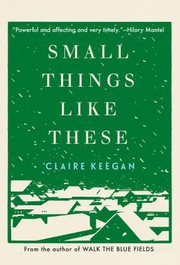
Small Things Like These
2,799-word summary 12 min read 128 pages in the book
- First published
- 2021
- Publisher
- Grove Press
- Pages
- 128
- ISBN
- 9780802158741
Reading options
What's inside (7 sections)
I picked up Small Things Like These because everyone kept calling it a Christmas book and I kept thinking that label had to be hiding something sharper. It is short enough to read in an afternoon. Claire Keegan's novella was first published in 2021 by Faber and Faber in the UK and by Grove Press in the US, about 128 pages in the Grove hardcover, and it went on to be shortlisted for the Booker Prize and to win the Orwell Prize for Political Fiction. There is also a film now with Cillian Murphy, which tells you how far a quiet story can travel.
I read it in two sittings on a grey weekend, and I have thought about the ending every day since. Not because it twists. It does not twist. Because it asks a plain question and refuses to dress it up. A man sees a wrong he was told to ignore. Christmas is coming. His family needs him steady. What does he do?
The prose is spare. Short sentences. Concrete objects. Coal dust, hot tea, cold chapels, a Christmas cake soaking in sherry. Keegan does not explain Ireland's Magdalene laundries in lectures. She lets you stand beside Bill Furlong while he carries coal into a convent laundry and notices girls with raw hands polishing floors. If you know the history, the chill arrives fast. If you do not, the story still works as a study of one decent man under pressure. Either way, you finish knowing more than when you started, and feeling it in your chest rather than your head.
Bill Furlong of New Ross
The book is set in New Ross, County Wexford, in December 1985. Bill Furlong is a coal and timber merchant, up early, out late, busy in the cold months when everyone needs fuel. He has a wife, Eileen, and five daughters. They are not rich, but they are getting by. The girls are in school and choir. The house is warm. Bills are paid with care. Eileen keeps the accounts with a practical eye and reminds Bill, often, that they cannot afford trouble.
Bill's own start was fragile. He was born to an unmarried teenage mother at a time when that marked a woman in a small Irish town. Her family cut her off. She kept work as a domestic for a kind Protestant widow named Mrs Wilson, who gave mother and child a roof and a measure of protection. Bill grew up in that house, fed and sheltered, aware that luck and one woman's kindness had saved him from the workhouse or worse. He never learned who his father was. That blank sits in him like a coal that never quite cools.
Keegan builds Bill through small acts. He tips a boy on the road who is gathering sticks. He remembers names. He pays his timber supplier on time. He notices when his daughters are tired. He drinks tea with customers and listens. He is not a hero in speeches. He is steady in motion. That steadiness is the whole engine of the book. When he starts waking at night and turning things over, you trust the worry because you have watched the man earn his calm.
Eileen is drawn with equal care and less softness. She loves her family fiercely and she reads the town correctly. The convent runs the school, the choir, the charity lists. The priests visit homes. The nuns place orders for coal. To cross them is to risk custom, schooling, and standing. Eileen tells Bill, in so many words, to keep his head down. It is not cruelty. It is arithmetic learned over years. A mother of five in 1985 Ireland knows what happens to families who make themselves conspicuous.
The town itself feels lived in. Frost on the river. Pub talk. Christmas lights going up while money stays tight. Men joking about work and avoiding talk about the girls behind the convent wall. Keegan never gives a guided tour. She drops a name here, a room there, a price, a hymn, until New Ross stands around you without announcement.
Deliveries to the convent
The trouble enters through work. Bill delivers coal to the Good Shepherd convent, a large building on a hill that runs what locals call a training school for girls. In truth, as readers now understand and as Bill comes to see, it is a Magdalene laundry, one of the church run institutions where unmarried mothers and other young women were confined, put to unpaid washing work, and cut off from the outside.
On an early visit, Bill sees a group of young women in the laundry, thin and quiet, polishing floors under watch. One of them speaks to him in a low voice and begs for help getting to the river to drown herself. The line is brief on the page and it stays with you. Bill does not know what to do with it. He finishes his delivery. He drives home. He tries to put it aside.
He cannot. On a later delivery, before dawn, he finds a girl locked in the coal shed outside, barefoot and shivering, left out all night in the cold. She gives her name as Sarah. She is upset about her baby, taken from her, and she asks Bill to find out where the child is. Bill opens the shed, speaks gently, and tries to calm her. Then the Mother Superior appears, composed and smooth, and takes charge of the scene.
That interview with the Mother Superior is the coldest passage in the book. She explains Sarah away as troubled, says the girl wandered out by mistake, thanks Bill for his care, offers tea, presses his Christmas tip into his hand with extra notes folded in, and asks after his daughters by name. She mentions his eldest singing in the school choir. She talks about enrollment and fees and goodwill. Every sentence is polite. Every sentence lands like a hand on his shoulder steering him to the door.
Bill takes the money at first. He tells himself it is his due. On the drive down the hill he feels sick about it. Keegan does not spell out the bribe. She does not need to. A tip, a mention of your child, a reminder of who controls the school place. Any small town reader recognizes the shape. Help us keep this quiet, and we will keep you comfortable.
He goes home and says little. Eileen senses something and warns him off. She has heard stories for years. Everyone has. Girls sent away. Babies adopted out. Families told not to ask. The town's silence is not ignorance. It is an agreement, worn smooth by use.
What it costs to look away
The middle of the book is Bill trying, and failing, to settle back into routine. He works hard. He helps a customer carry turf. He attends to his daughters' shoes and school letters. He eats Eileen's cooking and praises it. He walks the yard and checks the lorry. Ordinary life keeps offering him exits from thought. He keeps not taking them.
He thinks about Mrs Wilson, dead now, and what she did for his mother. Without that one woman's refusal to follow custom, he would not exist as he does. He thinks about his mother, young and alone, and how easily she could have ended behind a wall like Sarah. He thinks about his own five girls, safe in their beds, and what safety means when it rests on other girls being unsafe. These are not grand meditations on the page. They are short loops at 3 a.m., while Eileen sleeps beside him and the house ticks.
He seeks counsel without seeking it. He stops at the pub and hears the owner speak plainly for once. Do not make a stand against the convent, she says in effect. The church touches everything here. The school, the council, the loans, the jobs. People who speak up get marked. She is not unkind. She is trying to save him paperwork and pain. He thanks her and drinks up and feels more alone.
He drives out to the old Wilson farm, where Ned, the farmhand who was kind to him as a boy, used to live. The house has new owners. They tell him Ned is in hospital and not coming back. Then, in passing, one of them remarks how much Bill looks like Ned. The comment is casual. It rearranges Bill's past in a second. Could Ned be his father? The man who taught him to mend fences and feed hens, who treated him with quiet regard? There is no proof offered and Keegan offers none. Only the possibility, and the way Bill holds it, tenderly, like a warm sod of turf in cold hands.
I liked how Keegan refuses to turn this into a subplot with answers. Bill does not hire anyone. He does not dig through records. He just sits with the idea that his father may have been near all along, unclaimed and kind, and that his mother carried her secret to protect them both. It deepens his tie to Sarah and her baby without a single speech about fathers and daughters. Blood is not the point. Care is.
There is a Christmas cake thread that sounds small and does great work. Eileen bakes, or plans to bake, and the house smells of fruit and drink. Neighbors exchange bottles and jokes. The girls practice carols. Festive warmth keeps brushing against the convent cold, and Keegan lets the contrast do the moral math. How can a town sing about a child in a manger while locking girls in sheds? She never writes that sentence. She does not have to. You write it yourself on the bus after you close the book.
If there is a criticism to make of this middle stretch, it is that some readers will want more plot. Bill delivers coal. Bill worries. Bill delivers coal again. A man at the pub repeats the warning. Eileen repeats hers. The Mother Superior smiles. That is the design, not a flaw exactly, but it can feel airless if you came for incident. Keegan is after pressure, not events. I admired it on second thought more than on first read. The repetition is the point. This is how complicity feels from inside. Same road, same hill, same choice postponed.
The walk home
The end arrives without fanfare, which is why it hits so hard. Close to Christmas, Bill returns to the convent with another load. He finds Sarah again in the cold, locked out, in poor shape, frightened. This time he does not hand her back and accept tea. He gives her his coat. He takes her by the arm. He walks her down the hill toward his own house, through streets where people watch from windows and doorways.
Keegan stages the walk with care. It is daylight. People see. A neighbor calls out. Someone stares. Bill keeps walking. Sarah leans on him, unsteady in his big coat, her feet sore. He does not have a plan beyond the next street. He knows Eileen will be afraid. He knows the nuns will note who helped. He knows customers may leave. He walks anyway.
The final pages stay inside Bill's body as much as his mind. The weight of the girl. The cold biting his hands now that she has his coat. The sound of his boots. The thought of his daughters coming home to find a stranger by the fire. Fear sits beside a strange lift, something like relief that the waiting is over. He reaches his gate not sure what his wife will say, but sure he could not leave Sarah in that shed another night.
The book stops there, at the door, before Eileen answers. Some readers find that abrupt. I found it merciful and brave. Keegan denies us the domestic debate and the town meeting and the courtroom. She ends on the act, because the act is the claim. After weeks of small silences, Bill does one loud kind thing in public and lets the cost come later.
What makes the scene credible is how much Bill stands to lose, and how Keegan has priced it all along. This is not a rich man writing a check. This is a coal merchant with five girls, a mortgage of reputation, a business tied to church orders, in a town that remembers who steps out of line. When he walks Sarah home, he risks custom, credit, schooling favors, and Eileen's hard won peace. He does it with no promise that Sarah will be safe with him, or that her baby will be found, or that the convent will change. Small help, huge price. That ratio is the book's title made flesh.
I should say the book never shows the laundry's worst cruelties in graphic detail. There are no extended scenes of beating or punishment. The horror is in locked doors, missing shoes, chapped hands, a baby's absence, a mother's polished floor. Some may wish Keegan had borne fuller witness, named more, indicted louder. I understand that wish. But her restraint mirrors how such places worked in plain sight. Clean corridors. Polite nuns. Tidy accounts. Evil with tea and tips. By keeping the camera on Bill's shoulder rather than inside the dormitory, she shows how ordinary people accommodated it, which may be the harder truth.
Quiet, firm, and worth the fuss, with limits
So is it a Christmas book? Yes and no. It borrows the season's shape, a cold town, a child at risk, a man visited by his past and asked to change, and it earns the comparison to Dickens that many reviews mention. But there is no ghost, no conversion montage, no feast that fixes all. Bill does not become a new man. He was already this man. Christmas just shortens the distance between seeing and doing.
What I admired most is the prose. Keegan writes clean lines that carry weight without showing strain. A river in flood. Frost on coal sacks. A girl's breath in cold air. A hand on an oven door. Light does a lot of work here, thin winter light, kitchen light, chapel light, and Keegan uses it to mark where warmth is real and where it is staged. I also admired the refusal to explain Bill's father, to stage a big confrontation with the priest, to give Eileen a villain speech. Everyone acts from legible motives. Even the Mother Superior believes, or tells herself, that order requires silence.
What might put some readers off? The brevity can feel like a trick. At 128 pages, characters outside Bill get few scenes. Eileen is vivid but we meet her mostly at table and bedside. The daughters blur, sweet and largely unnamed in daily bustle. Sarah herself remains a figure glimpsed twice, not a full portrait. If you need interior access to the victims to feel the book's claim, you may find it tilted toward the rescuer's conscience rather than the girls' experience. That tilt is deliberate, and Keegan has spoken elsewhere about writing what she knows, but it is fair to name who the camera follows and who it leaves at the edge.
The other limit is political. The book indicts a system by showing one man's refusal, but it does not map reform, redress, or the church's later apologies. Readers who want history with dates and numbers will need to look elsewhere. Keegan gives you New Ross in 1985 and trusts you to read outward to the inquiries and testimonies that came later. I did that reading after, and the book grew in my memory for it. Still, on its own terms, it is a parable more than a record. That is strength and boundary at once.
Who should read it? Anyone who likes short fiction that behaves like a novel, anyone teaching conscience and community, anyone who loved Foster and wants Keegan's longer breath. Pair it with a history of the laundries if you want context, then sit with how little context Bill needed to act. He needed a coat, a road, and a door he was willing to open.
I finished feeling both warmed and unsettled, which seems right for December. The town will talk. Eileen may weep. Customers may drift. Sarah will need more than one walk. None of that is solved on the last page. What is solved is Bill's night question. Could he live with passing by again? No. He brings the girl home for Christmas, and the smallness of the act is the size of its courage. I will be pressing this into hands for years, with the warning that it reads fast and lingers long.
FAQ
Is Small Things Like These based on true history?
Yes, the convent laundry reflects Ireland Magdalene laundries, where young women were confined and put to unpaid work.
Do I need to know Irish history to read it?
No, Keegan keeps focus on Bill winter deliveries and choice, and the 1985 New Ross setting carries the rest.
Is it a Christmas novel?
Partly, it uses December lights and carols as contrast, but the ending is spare and leaves costs unresolved.
Similar books
Foster
A girl spends a summer with relatives on a Wexford farm and is cared for properly for the first time. A spare novella about family and what children notice…
2,043-word summary · 9 min read

What the Wind Knows
Annie scatters her grandfather's ashes on Lough Gill and is pulled into 1921 Ireland, where she becomes the missing Anne Gallagher and falls for Dr. Thomas…
2,056-word summary · 9 min read

Song of Solomon
Milkman Dead leaves Michigan to hunt for family gold and finds instead the old song of his ancestor Solomon.
2,465-word summary · 11 min read

The Signature of All Things
Botanist Alma Whittaker grows up in Philadelphia trade wealth, studies mosses, marries distant Ambrose Pike, and sails to Tahiti seeking how species change.
2,535-word summary · 11 min read

The Island of Missing Trees
A talking fig links 1970s Cyprus lovers Kostas and Defne with their grieving London daughter Ada years later.
3,172-word summary · 14 min read

The Bonesetter's Daughter
A ghostwriter translates her mother's hidden Chinese memoir and learns the truth about Immortal Heart, Precious Auntie, and a family curse.
2,720-word summary · 12 min read
Shuggie Bain
Sweet Shuggie loves his alcoholic mother Agnes through 1980s Glasgow poverty and pride.
2,081-word summary · 9 min read
The Cider House Rules
Homer Wells grows up in a Maine orphanage under Dr. Larch, who delivers babies and performs illegal abortions.
2,985-word summary · 13 min read

Life After Life
Ursula Todd dies and restarts through wars, flus, and bad marriages.
2,060-word summary · 9 min read

Hamnet
Agnes Hathaway holds her Stratford family together while her husband works in London, until plague takes eleven-year-old Hamnet in 1596.
3,164-word summary · 14 min read
Homegoing
Half sisters Effia and Esi lines span Ghana to America across centuries.
2,552-word summary · 11 min read

Violeta
A woman born in 1920 writes her life story to her grandson, from one pandemic to another, through wealth, ruin, passion, and dictatorship in South America.
2,555-word summary · 11 min read

The Long Winter
Dakota Territory, 1880: seven months of blizzards cut a town off from the railroad, and a family survives on twisted hay, ground wheat, and a dangerous wheat…
2,210-word summary · 10 min read

The Japanese Lover
A Polish refugee and the son of a Japanese gardener fall in love in San Francisco in 1939, then keep the affair secret for nearly seventy years.
2,286-word summary · 10 min read

This Winter
On one difficult Christmas Day, Tori, Charlie, and Oliver Spring try to hold their family together while Charlie's eating disorder makes every tradition a test.
2,034-word summary · 9 min read

The Shadow Sister
Star D'Apliese steps out of her sister's shadow and follows a bookshop clue into the Edwardian life of Flora MacNichol, a woman who gave up love for duty.
2,260-word summary · 10 min read

Little Town on the Prairie
In the spring after the Long Winter, fifteen-year-old Laura sews shirts, studies for a teaching certificate, and helps send her blind sister Mary to college.
2,071-word summary · 9 min read

Mrs. Everything
Two Jewish sisters in Detroit grow up, apart and together, across seven decades of American life, from the 1950s to the 2016 election.
2,362-word summary · 10 min read

Howards End
Forster's 1910 novel follows two families, a house in Hertfordshire, and a burned note, asking whether money and feeling can ever be connected.
2,187-word summary · 10 min read

Sophie's Choice
A young Southern writer in 1947 Brooklyn befriends a brilliant, unstable couple and slowly learns the story of the Polish Catholic woman at the center of their…
2,798-word summary · 12 min read

Fathers and Sons
Arkady brings the nihilist Bazarov home to his father's estate, and a generational argument turns into love, a duel, and an early death.
2,192-word summary · 10 min read

Unaccustomed Earth
Lahiri’s second story collection follows Bengali families in America and abroad, tracing the quiet distances between parents and children, spouses, and the…
2,333-word summary · 10 min read

The Age of Miracles
A California girl grows up while the Earth's rotation slows, and ordinary adolescence continues alongside slow catastrophe.
2,417-word summary · 11 min read

The Lowland
Two brothers grow up beside a marshy lowland in Calcutta, and the choices of the younger one draw the older into a life of duty, distance, and quiet grief that…
2,213-word summary · 10 min read

Peace Like a River
An asthmatic boy in the early 1960s narrates his family's search for his older brother, who is accused of two killings and has escaped custody.
1,969-word summary · 9 min read

We Are Okay
Marin fled San Francisco after her grandfather vanished and stopped answering anyone. When Mabel visits her college dorm, she has to say what happened.
2,253-word summary · 10 min read

The Chosen
A shattered pair of glasses in a 1944 Brooklyn softball game starts a friendship between a Hasidic boy and his Orthodox neighbor, and their fathers pull them…
2,443-word summary · 11 min read

The Storyteller's Secret
A New York journalist goes to India to learn why her grandmother loved a British officer, and why a family servant kept the truth for forty years.
2,270-word summary · 10 min read

Stones from the River
Trudi Montag is born a dwarf in a small German river town in 1915 and grows up to keep the town's library and its secrets, from the First World War to the…
2,818-word summary · 13 min read

Ivanhoe
A disinherited Saxon knight, a great tournament, a besieged castle and a trial by combat. Scott's most famous novel, set in England in 1194.
2,834-word summary · 13 min read