
Reading options
What's inside (8 sections)
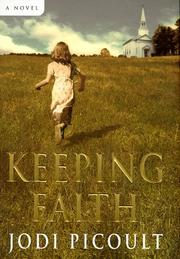
Jodi Picoult has built a career on taking a moral argument and giving it a heartbeat, then putting a courtroom around it. She had already written The Pact and Mercy before Keeping Faith appeared in May 1999 as her sixth novel. Reading it now, you can see the machinery she would keep refining for the next two decades: a family under pressure, a question with no clean answer, a legal fight that forces everyone to say the quiet part out loud. What makes this one unusual is the question. Instead of a medical choice or a crime, the dispute is about a seven-year-old girl who may be seeing God.
The book's title does double duty. Faith is the child's name, and faith is the thing the adults keep arguing about. That pun is doing a lot of work in a novel that runs to 432 pages in its first edition from William Morrow. Picoult is asking whether a miracle can survive a custody hearing, and she is asking whether a mother's love should count for more than a verified event. The answer she arrives at is warmer and less tidy than the question deserves, which is both the book's charm and its weakness.
The setting does a quiet share of the work. Most of the story unfolds in New Hampshire, where the Whites live within reach of neighbors who notice everything, with a stretch in Kansas City when Mariah tries to disappear. Picoult uses that small-town proximity well. There is no anonymous city to hide a miracle in, so every strange event travels from house to house before anyone has decided what to think of it. The setting also gives the custody case its texture. In a place where everybody knows everybody, a judge's ruling is never only a legal result. It is a verdict the neighbors will repeat, and the pressure of being watched helps explain why Mariah keeps making desperate choices.
A girl who quotes scripture
The story opens with a divorce. Mariah White catches her husband Colin having an affair with another woman, and it is not the first time. The second betrayal is the one that ends the marriage. Colin files for divorce and, in an arrangement that sounds generous until you see how it is used later, gives Mariah full custody of their daughter Faith. Mariah sinks into a deep depression. She is raising a seven-year-old alone, and the emotional floor has dropped out from under her.
Faith responds by inventing a friend she calls her Guard. At first this is ordinary childhood business, the sort of invisible companion parents learn to set a place for at the table. Then the girl starts quoting passages from the Bible, long ones, in language she has never been taught and from a book she has never read. Mariah, frightened that something is wrong with her daughter's mind, takes her to a therapist. The therapist's conclusion is not that Faith is inventing things but that she may actually be seeing God. That is the hinge on which the whole novel turns. A child's pretend friend becomes a claim about reality, and once the claim is out in the open, other people will want to test it.
The opening chapters are strong because Picoult keeps the scale small. Before there is a media circus or a lawsuit, there is a tired mother watching her child speak in a voice that does not sound like her own. The fear in those scenes is domestic and concrete: is my daughter all right, and if she is telling the truth, what does that make me? Mariah is not a believer looking for a sign. She is a woman who has just been left, trying to keep her house standing, and the last thing she wants is a supernatural explanation for her daughter's behavior.
The teleatheist at the door
Into this uneasy quiet walks Ian Fletcher, who describes himself as a teleatheist. He travels around the country investigating reports of miracles and explaining them away. He is not a priest or a scientist in the traditional sense. He is a man with a personal mission to prove that God does not show up in ordinary lives, and the Whites' house has become his next stop.
Ian's arrival sets off the chain of events that turns a private worry into a public case. He has a confrontation with Millie Epstein, Mariah's mother and Faith's grandmother. The exchange leaves Millie with a heart attack. She is taken to hospital and pronounced dead. About an hour later, Faith kisses her grandmother goodbye, and Millie comes back to life.
That single scene tells you what kind of book this is. Picoult does not offer a cool investigation or a measured weighing of evidence. She gives the reader a resurrection in the second act, then keeps going. The effect on the story is immediate. Strangers and reporters gather outside the house, and Faith and Mariah can no longer live anything resembling a normal life. The doubt that might have stayed inside a therapist's office is now on the evening news, and a child who needed a quiet room is being watched by people who want a demonstration.
I think this is where Picoult's skill and her impatience show up at the same time. The resurrection scene is written to be felt, and it works on that level. But it also tilts the book. Once a dead grandmother has been raised, the question of whether Faith's gift is real starts to feel rhetorical. A skeptic in the audience has already lost the argument, and the novel will spend hundreds of pages pretending the outcome is still in doubt.
Miracles multiply
The signs keep coming. Faith heals a baby who has AIDS. Her hands show what look like stigmata, wounds appearing without a cause she can explain. Each new event widens the circle of people who think they have a stake in the child. Neighbors, cameras, the curious, the desperate: all of them converge on the Whites, and Mariah's job as a parent becomes a kind of crowd control.
The sequence has a cumulative logic to it. A child who quotes scripture might be a clever imitation, the kind of thing a lonely seven-year-old could pick up in church or on television. A child who brings someone back from death is something else entirely. The healing and the stigmata arrive like escalating exhibits in a case, each one harder to explain away than the last. Picoult is clearly enjoying that escalation, and she makes sure the reader feels the same tightening sensation an investigator would feel when the facts keep refusing to fit. The trouble is that the book never lets a counterargument land with anything like equal force, so the escalation becomes less a debate than a procession.
The father, Colin, hears about the commotion and does what a parent in a custody dispute does. He sues Mariah for custody of Faith. His argument is implicit in the timing. A mother who is depressed, who has fled with the child, and who is presiding over a public spectacle is not, he implies, a fit parent. The law gives him a language for what is really a fight over belief and control. This is familiar territory for Picoult, and she handles the legal moves with the confidence of someone who knows exactly how many pages a motion should take.
What complicates the case is that Mariah's flight is understandable. She and Faith leave for Kansas City, trying to get out from under the attention. They run straight into Ian Fletcher, who is in town visiting his brother Michael, a man with autism. Ian offers them a place to stay and promises he will not betray them. For a while the three of them form a temporary household, and the tension shifts from the supernatural to the intensely human. Ian is the man who came to disprove the miracle, and now he is the man giving the miracle's mother a bed. Not surprisingly, he and Mariah fall in love.
The strain peaks when Faith tries to heal Michael. Ian, who has spent his life arguing against exactly this kind of hope, becomes enraged at the idea that his brother might be a test case for his daughter's claims. It is the best scene in the book because both people are right in a way that cannot be resolved. Faith believes she can help. Ian believes that using his brother as proof would be a violation. Nobody is being cynical, and nobody is being honest about what they are really afraid of.
The hospital and the custody fight
Word reaches Mariah that Colin is suing her, delivered through the improbable channel of Millie, the grandmother who was pronounced dead and came back. Mariah takes Faith home to face the case. Not long after, Faith is admitted to hospital again, and the court steps between mother and daughter, barring Mariah from seeing her own child. The girl's condition worsens until she is near death. The book holds this separation for as long as it can, then lets the two be reunited. Once Mariah is with her again, Faith's health improves sharply.
The custody ruling goes to Mariah. The holes in Faith's hands close. The Guard vanishes. Mariah and Ian begin a relationship, and the three of them eventually live together as a family. Picoult leaves one small door open: the narration never fully confirms that the Guard is gone for good, and the last pages allow for the possibility that the child's connection to whatever visited her was paused rather than ended.
It is hard to read this ending without feeling that the novel has stacked the deck. The court, which had been a cold institutional force, suddenly hands the mother exactly what she wants. The symptoms that resisted every doctor vanish the moment the family is reassembled. The skeptic becomes a lover and then a housemate. Every thread is gathered up, and the knot is tied. For a book that spent so long asking whether faith can be verified, the resolution is surprisingly willing to accept the answer on emotion alone. The effect is comforting, and it also undercuts the skeptical question the story spent so much energy raising.
What the book leaves unsettled
The first thing to say in fairness is that Picoult writes family pressure very well. Kirkus called the book a sweetly affirmative portrait of mother-daughter love that explores big questions while providing a gripping custody narrative, and Publishers Weekly pointed to her fluent, absorbing storytelling and her interest in the intricacies of motherhood. Both reviews identify the genuine strength here. The relationship between Mariah and Faith is the solid center, and the legal plot gives the novel a forward pull when the miracle plot starts to circle.
The weaker threads are the ones around that center. Ian's function as a debunker is more convenient than convincing. He exists to voice the doubt that the plot keeps answering with another wonder, so his skepticism never gets a fair hearing. When he gets angry about Faith trying to heal Michael, the anger is real, but the book frames it as the obstacle a loving household must absorb rather than a serious objection. A reader looking for a genuine examination of faith and evidence will find the deck stacked in a different direction than they expected.
The length is another issue. At 432 pages, the novel gives itself room to run, and the court sections in particular have the padding of a story written to a commercial length. The media swarm around the house goes on longer than it needs to, repeating a point already made. And the ending ties things up with a neatness that the middle of the book had earned the right to avoid. This is an early novel, and you can feel the writer still deciding how much of a courtroom drama she needs to justify the emotional payoff. Later books in her catalogue would handle the same balance more economically.
None of that makes Keeping Faith a failure. It makes it a book with a clear split between what it can do and what it pretends to be doing. As a story about a mother who will not give up her child, it succeeds. As a study of whether a miracle can be proved, it does not really want to know the answer.
Readers who come to Picoult for the courtroom will get what they came for, and readers who want a story about a mother's bond with a child in danger will find it in the hospital scenes. What they will not find is a detached inquiry into religious experience. The book has made up its mind about what matters, and it cares far more about who believes in Faith than about whether the belief can be proven. That is a legitimate choice for a novelist. It simply ought to be named, because the title and the premise promise a harder question than the plot is willing to keep asking.
The family that forms at the end
There is an epilogue of sorts in the author's wider world. In Picoult's 2008 novel Change of Heart, Ian Fletcher reappears, and Mariah and Faith turn up briefly too. Those pages reveal that Ian and Mariah married and had twin boys, while Faith seems to have lost her connection to the Guard. It is a satisfying coda for readers who want the household to hold together, and it confirms that the romantic turn at the end of Keeping Faith was meant to be permanent.
I finished the book uncertain about the miracle and quite certain about the people. That may be the point. Mariah begins as a woman who has been left twice and does not know how to steady her daughter, and she ends as the parent who fought a court and won. Faith begins as a little girl with an invisible friend and ends as a child whose holes closed and whose friend went away, or maybe did not. Ian begins as a man who wanted to disprove her and ends as the man who lives with her. The novel cannot settle what happened in the hospital or where the Guard came from. It can settle who stayed, and it does.
FAQ
Is Keeping Faith based on a real faith-healing case?
No. It is a work of fiction and Picoult's sixth novel, published in 1999. The premise is invented, though it draws on familiar reports of religious visions and stigmata.
Does the book say whether Faith's miracles are real?
It leans toward yes, showing a resurrection, a healing, and stigmata. The final pages still leave open whether the Guard is truly gone for good.
Do these characters appear in other Picoult novels?
Yes. Ian Fletcher returns in the 2008 novel Change of Heart, where Mariah and Faith also appear briefly and Ian and Mariah are married with twin boys.
Similar books

Perfect Match
A Maine prosecutor shoots the priest she believes abused her son, then faces a trial that questions what justice can mean.
2,241-word summary · 10 min read

Lone Wolf
A wolf expert lies in a coma after a crash, and the son who left home years ago returns to end his life support while his sister fights to keep him alive.
2,761-word summary · 12 min read

Hollow Bones
On 11 September 2001, two-month-old Molly Fitzgerald loses her mother at the World Trade Center. She grows up planning for disasters, until a crisis in her new…
2,703-word summary · 12 min read

Sing You Home
A music therapist, her new wife and an evangelical ex-husband end up in court over three frozen IVF embryos.
2,952-word summary · 13 min read
House Rules
Jodi Picoult's 2010 House Rules follows Jacob Hunt, a teen with Asperger syndrome accused in his tutor's death, as his mother Emma and brother Theo face police…
3,079-word summary · 14 min read
Plain Truth
An Amish teenager denies a hidden pregnancy after a newborn is found dead, and a city lawyer moves to the farm to defend her.
2,669-word summary · 12 min read
The Pact
After Emily Gold dies from a gunshot, her boyfriend Chris Harte says it was a suicide pact and faces trial for murder.
2,873-word summary · 13 min read
My Sister's Keeper
Thirteen-year-old Anna sues her parents for medical emancipation so she can refuse to give her dying sister Kate a kidney.
2,332-word summary · 10 min read
Palaver
A mother shows up uninvited at her estranged son's Tokyo apartment, and the two spend the weeks before Christmas talking their way toward something like…
2,465-word summary · 11 min read

Yellow Crocus
In 1837 Virginia, an enslaved wet nurse is separated from her own son to raise a planter's daughter, and the two women build a love the law says cannot exist.
2,094-word summary · 9 min read
The Litigators
Two Chicago ambulance chasers and a burned-out Harvard Law graduate take on a drug giant, only to find the case sliding toward disaster.
2,244-word summary · 10 min read

The Kitchen God's Wife
Amy Tan's second novel pairs a San Jose speech therapist with her Chinese mother, whose account of war, an abusive husband, and a narrow escape comes out in a…
2,896-word summary · 13 min read
The Children Act
A High Court family judge weighs whether a dying teenage boy can refuse a blood transfusion while her own marriage quietly comes apart.
2,399-word summary · 11 min read
Mother-Daughter Murder Night
A grandmother with cancer moves in with her estranged daughter and granddaughter, then turns detective when a body turns up on the family's kayak tours near…
2,762-word summary · 12 min read

Mother Mary Comes to Me
Arundhati Roy's memoir circles her mother, Mary Roy, a formidable Kerala school founder whose love and cruelty made her the writer she became and then resented…
2,413-word summary · 11 min read

All Adults Here
A widow in upstate New York reconsiders the parent she was after a neighbor's death, then gathers her three grown children for a season of uneasy truths.
2,171-word summary · 10 min read
The Mermaid Chair
Jessie Sullivan returns to her childhood home on Egret Island to care for her agoraphobic mother, then finds her marriage, her faith, and a monk's vow thrown…
2,237-word summary · 10 min read

Summer Island
A radio advice host hides a scandal, and the estranged daughter hired to write about it agrees to care for her at the family's island house.
2,325-word summary · 10 min read

Peace Like a River
An asthmatic boy in the early 1960s narrates his family's search for his older brother, who is accused of two killings and has escaped custody.
1,969-word summary · 9 min read

The Chosen
A shattered pair of glasses in a 1944 Brooklyn softball game starts a friendship between a Hasidic boy and his Orthodox neighbor, and their fathers pull them…
2,443-word summary · 11 min read

The Magnolia Story
How Chip and Joanna Gaines met, closed their first shop, nearly lost everything in a housing development, and built Fixer Upper.
2,994-word summary · 13 min read

Days at the Morisaki Bookshop
Heartbroken Takako moves into her uncle's tiny secondhand bookshop in Jimbocho, and the shop and its regulars slowly give her back her life.
2,011-word summary · 9 min read

How to Walk Away
Margaret Jacobsen has the job, the fiance, and the future mapped out, until a small-plane crash on Valentine's Day takes almost all of it in one afternoon.
2,012-word summary · 9 min read

The Tea Girl of Hummingbird Lane
A Chinese tea farming mother gives up a daughter who later seeks roots.
2,607-word summary · 12 min read

The Bonesetter's Daughter
A ghostwriter translates her mother's hidden Chinese memoir and learns the truth about Immortal Heart, Precious Auntie, and a family curse.
2,720-word summary · 12 min read

Sycamore Row
Jake Brigance returns to defend a contested will that leaves a fortune to a Black housekeeper in racially tense Clanton.
2,017-word summary · 9 min read
Transcendent Kingdom
A neuroscientist studies addiction in mice while mother prays at home.
2,020-word summary · 9 min read
Ordinary Grace
In 1961 Minnesota, thirteen-year-old Frank Drum faces a summer of deaths that tests his minister family and forces him to weigh truth, guilt, and mercy.
2,948-word summary · 13 min read
My Name Is Lucy Barton
Hospitalized for weeks, Lucy Barton is visited by her estranged mother, stirring memories of Amgash poverty, marriage, and becoming a writer.
2,934-word summary · 13 min read
Still Me
Lou spends a year in New York working for the Gopniks, torn between Josh, distant Sam, and the life she wants.
2,939-word summary · 13 min read