
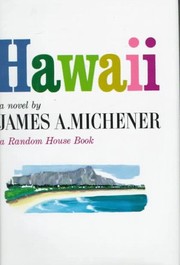
Hawaii
2,295-word summary 10 min read 937 pages in the book
- First published
- 1959
- Publisher
- Random House
- Pages
- 937
- ISBN
- 9780394427973
Reading options
What's inside (8 sections)
A friend of mine told me that reading this book is like watching a whole island grow in fast forward, and I think that is the best short description I have heard. It was published in 1959 by Random House, in the same year that Hawaii became the fiftieth state, and the first edition runs to 937 pages. That is a lot of pages, and I will not pretend I sailed through them. I read it slowly, a chapter at a time, and what struck me most was that Michener is not really writing about one person. He is writing about a place, and about the many groups of people who arrived there over centuries and decided to stay. Once I accepted that, the length stopped feeling like a burden and started feeling like the point.
The timing of the book is part of its identity. It appeared in November 1959, within weeks of Hawaii entering the Union as the fiftieth state, and it was translated into more than thirty languages. Two films were made from it: Hawaii in 1966, which concentrated on the missionary chapter, and The Hawaiians in 1970, which picked up the later arrivals. I have not seen either recently, but knowing they exist explains why certain scenes feel staged for a camera. Michener was writing at the moment when the islands were being reinvented politically, and the novel keeps looking backward and forward at the same time.
The book is built as six long sections, each one covering a different wave of arrival. The first section is short. The others are closer to short novels on their own. The story starts with the formation of the islands millions of years ago and ends in the mid 1950s, so the sweep is enormous. Some readers love that. Others find it cold. I landed somewhere in the middle, and I want to explain why.
How the book was built
Before I get into the story, it helps to know how Michener wrote it. He did real research for this book. He worked at the Hawaiian-Mission Historical Library and talked to specialists on volcanoes, botany, pineapples, and Chinese culture. His technical adviser was a Hawaiian scholar named Clarice B. Taylor, who explained customs, language, family names, and the small nuances of island life to him. Taylor told him that the things he wanted were not going to be found in books, and that the material he needed had to come out of her own head. That sentence explains a great deal about the finished novel. There is an enormous amount of observed detail here, and much of it is the kind of detail a library cannot give you.
Michener also based several characters on real people. The missionary Abner Hale is a caricature of Hiram Bingham, a real figure in Hawaiian history, and another missionary named Asa Thurston helped shape the character as well. The Chinese businessman Hong Kong Kee is widely thought to have been inspired by Chinn Ho, who was known as the Chinese Rockefeller. Knowing this changed how I read the book. It made the fictional families feel like doorways into actual history rather than inventions dressed up in period costume.
That structure is worth understanding before you begin. Except for the opening geological chapter, each section is roughly the length of a standalone novella, with its own setting, its own cast, and its own argument. Characters from one section occasionally turn up in the next, but nobody carries the whole book. This is why Michener can cover a thousand years without ever pretending that one family lived through all of it. He is writing a history of arrivals, and the form follows that decision. It also means you can put the book down for a week between sections without losing the thread, which is how I ended up reading it.
There is a caveat worth stating early. The sections about the earliest Polynesian inhabitants draw more on folklore than on anthropology, and some events are fictionalized. Michener was writing a novel, not a textbook, and he was writing in 1959, when the scholarly picture was thinner than it is now. I kept that in mind when the early chapters started to feel more like a legend than a record.
The island arrives, and the first voyage
The opening section, called From the Boundless Deep, is the shortest and in some ways the most beautiful. It describes lava pushing up out of the ocean, the slow creation of land, and the patient work of life taking hold. Michener writes about the first small organisms that can survive on bare rock, about lichens and ferns, about soil forming over an unimaginable stretch of time, until at last there is a forest and rain and a place where people might live. There are no characters in this section. It is pure description, and it works because the author clearly found the subject fascinating.
Then the book jumps to Bora Bora and the section called From the Sunswept Lagoon. King Tamatoa and his brother Teroro are unhappy with the neighboring islands. Tahiti and Havaiki are pressuring the Bora Borans to give up their old gods, Tane and Taaroa, and worship Oro instead, a fire god who demands human sacrifice. Tamatoa proposes that they simply leave and find a place where they can practice their own religion in peace. There is a wonderful stretch where the decision is argued over, agreed to, and then nearly undone by fear. Teroro, unable to let the insult pass, secretly sets fire to Havaiki on the way out.
The argument about leaving is one of the liveliest parts of the book, because it is really an argument about what a people owes to its gods and to its dead. Tamatoa is a king who has run out of patience with the demands coming from Tahiti, and Teroro is the hotter head who cannot let an insult go unanswered. Michener gives both men convincing reasons, which makes the voyage feel like a choice rather than an escape.
They sail for the Hawaiian islands in a canoe named Wait for the West Wind. Later, some of them return to Bora Bora to fetch women and children and an idol of the volcano goddess Pele. This is the part of the book that reads most like a founding myth, and I mean that as a compliment. Michener gives the voyage a physical reality: the cramped boat, the navigation by stars and swells, the exhaustion, the arguments about whether they will ever see land. By the time they arrive, I understood why these people would build a whole culture around the idea of a long journey.
The missionaries and the farm of bitterness
The third section, From the Farm of Bitterness, moves to the early 1800s and the arrival of American missionaries. This is the part of the novel that became the 1966 film starring Max von Sydow and Julie Andrews, which tells you something about where the drama sits. Abner Hale is a stern, narrow man who believes he is saving souls, and his wife arrives full of the same certainty. They set about changing daily life on the islands, and the book is careful to show both sides of that project. The missionaries build schools and write down a language that had until then been spoken. They also condemn ordinary customs and treat a proud culture as though it were a child needing correction.
I found this section uncomfortable in a way I suspect Michener intended. He is not writing a simple hero story. The Hales and the Whipples become founding families, and their descendants shape the islands for generations, but the cost of their certainty is written into every page. There is a scene in which the old ways are publicly renounced that is hard to read without thinking about how quickly a culture can be made to feel ashamed of itself. At the same time, Michener gives the missionaries real fears and real hardships. They die of disease, they bury children, and they never quite stop wondering whether they did more harm than good. That complexity kept the section from becoming a lecture.
Plantations, leprosy, and a kingdom lost
From the Starving Village is about the Chinese who came to work the pineapple and sugarcane plantations. The Kee family is at the center of it, and the patriarch eventually contracts leprosy, called the Chinese sickness in the book, and is sent to the leper colony at Molokai. That storyline is the emotional heart of the section. It shows how quickly a working life can turn into exile, and how a family holds together when one of its members is treated as untouchable. Michener also folds in a fictionalized version of the 1893 overthrow of the Kingdom of Hawaii, so the personal story and the political one keep intersecting.
I was surprised by how much I cared about the Kee family. Michener gives them ordinary ambitions and ordinary quarrels, which is his way of making a large historical shift feel close to the reader. When the patriarch is diagnosed and shipped off to Molokai, the book does not look away from the humiliation of that journey. It also shows the family arguing about what the diagnosis means and how much of their old life they are willing to give up. The overthrow of the kingdom enters the story in the same way, through its effects on people trying to run a business and keep a household together rather than through a formal account of the politics.
Then comes From the Inland Sea, which follows the Japanese workers brought in to replace Chinese laborers who had begun setting up their own businesses. Kamejiro Sakagawa is one of the figures here, a man whose family story runs through the section and into the next. Michener traces the shift from imported labor to settled communities, with all the friction that involves. The section also covers the bombing of Pearl Harbor, and it is striking how the war arrives in a book that has spent hundreds of pages building a world of plantations and family arguments. The attack is not treated as a surprise to the people living there. They had been watching the sky for a long time.
These two sections are the ones I would recommend to someone who wants to understand why the book has endured. Michener is at his best with the small mechanics of a community forming: who owns the land, who gets the contract, whose child marries whose, which language is spoken at home and which at school. He understands that history happens in those details more than in treaties.
The golden men and where it ends
The final section, The Golden Men, deals with intermarriage among the island's groups and the culture and economy that emerge from it. The title refers to the mixed-race descendants of these unions, and Michener treats them as the answer to the question the whole book has been asking: what does it mean to belong somewhere? By this point the story has moved into the twentieth century and then into the 1950s. The islands are no longer a kingdom, no longer a territory in quite the old sense, and on the edge of statehood.
I have to be honest that this was my least favorite section. It reads more like a summary of social change than a story. Where the earlier chapters gave me Teroro or Abner Hale or the Kee family to hold on to, this one kept pulling back to a wide angle and explaining. Some of that is the author's impatience to reach the present, and some of it may be that he simply had more lived material for the earlier waves of arrival. The book ends without a single triumphant note, which I respected. It stops in the mid 1950s with the islands changed forever and the people still arguing about what they are.
What I think now
I should say something about the sound of the prose, because it is a real part of the experience. Michener writes long, declarative sentences and repeats key phrases until they acquire the weight of a refrain. In the geological opening that patient rhythm is perfect, because he is describing processes that take an age. In the later chapters it can feel heavy, especially when he is listing the contents of a household or the details of a plantation contract. I found myself skimming a few of those passages and then going back, because the accumulated detail is the whole method. Strip it out and the book would be a much thinner thing.
Would I hand this to a friend? Yes, with warnings. It is long, it is episodic, and it asks you to care about a place rather than a hero. The early chapters lean on folklore, and the last one leans on exposition. There are stretches where Michener's research sits on the page a little too heavily, and the whole book carries the assumptions of its time about which cultures count as civilized.
But the ambition is real, and so is the result. I finished it knowing far more than I did before about how the islands were formed, why the missionaries arrived, what drew Chinese and Japanese workers across the ocean, and how a kingdom became a state. There is a 1970 sequel film called The Hawaiians that picks up the later chapters, but the novel is the fuller experience. The best way to read it is the way I ended up reading it: slowly, one wave of arrivals at a time, letting each group have its turn before moving on.
FAQ
When was Hawaii published?
It was published by Random House in November 1959, the year Hawaii became a state. The first edition runs 937 pages and carries ISBN 9780394427973.
Is Hawaii a historical novel?
Yes, though it is episodic. Six sections follow the islands from their volcanic formation to the mid 1950s, and the earliest Polynesian sections rely more on folklore than on strict anthropology.
Has the book been adapted for film?
Twice. The 1966 film Hawaii starred Max von Sydow and Julie Andrews and focused on the missionary chapter. The 1970 follow up The Hawaiians starred Charlton Heston.
Similar books

Ivanhoe
A disinherited Saxon knight, a great tournament, a besieged castle and a trial by combat. Scott's most famous novel, set in England in 1194.
2,834-word summary · 13 min read
The Last of the Mohicans
During the French and Indian War, Hawkeye and two Mohican warriors try to save two British sisters from a Huron chief whose revenge will end the Mohican line.
2,017-word summary · 9 min read
The Swiss Family Robinson
Shipwrecked Robinsons build treehouses and tame island beasts.
2,400-word summary · 11 min read
The Red Badge of Courage
Henry Fleming runs at Chancellorsville, then returns to stand.
2,486-word summary · 11 min read
News of the World
Captain Kidd carries captive Johanna home across 1870 Texas.
2,571-word summary · 11 min read
Anne's House of Dreams
Newlyweds Anne and Gilbert start in a seaside house with kind neighbors.
2,465-word summary · 11 min read
The Scarlet Pimpernel
A foppish baronet rescues aristocrats from the guillotine while his French wife hunts the hero she scorns.
2,980-word summary · 13 min read

Shogun
An English pilot wrecked in 1600 Japan becomes a pawn in Lord Toranaga's patient bid for power, and slowly becomes Japanese himself.
2,251-word summary · 10 min read

Lonesome Dove
Two retired Texas Rangers drive cattle from Texas to Montana in a harsh and tender western epic.
2,410-word summary · 11 min read
Robinson Crusoe
Shipwrecked near South America, Crusoe spends 28 years farming, building, praying, and facing who he becomes alone.
2,520-word summary · 11 min read

The Three Musketeers
Young dArtagnan joins Athos, Porthos and Aramis to recover the queens diamonds and face Milady.
2,569-word summary · 11 min read
The Adventures of Huckleberry Finn
Huck Finn fakes his death, floats the Mississippi with the runaway Jim, and tears up the letter that would betray him. Twain's river classic, its cons and…
2,605-word summary · 12 min read

The Alchemist
The Alchemist from start to finish: Santiago's dream, the Personal Legend, the crystal merchant, the desert, and the treasure that was never where he thought.…
2,166-word summary · 10 min read

The Arabian Nights: Alf Laylah Wa-Laylah
A frame story about a woman talking for her life holds jinn, sailors, caliphs, and tricksters.
2,338-word summary · 10 min read
North Sun, or, the Voyage of the Whaleship Esther
In 1878 New Bedford, a worn-out captain is sent north after a whaleship and the son-in-law of a powerful whaling family who chose to stay in Alaska.
2,314-word summary · 10 min read
I Must Betray You
In 1989 Romania, a seventeen-year-old is forced to inform on an American diplomat's family and records the truth in a hidden notebook.
2,258-word summary · 10 min read

Alive: The Story of the Andes Survivors
After a rugby team's plane crashes in the Andes in 1972, Piers Paul Read tells the survivors' 72-day fight to live, drawn from interviews with the men and…
2,179-word summary · 10 min read

Yellow Crocus
In 1837 Virginia, an enslaved wet nurse is separated from her own son to raise a planter's daughter, and the two women build a love the law says cannot exist.
2,094-word summary · 9 min read
Theft
Gurnah traces three linked lives in Tanzania, where a servant's accusation of theft opens a family history of love, duty and quiet betrayal.
2,454-word summary · 11 min read

The Secret of the Old Clock
The first Nancy Drew novel: a sixteen-year-old detective follows a clue hidden in a clock to overturn a will and restore a family's inheritance.
2,011-word summary · 9 min read
The Luminaries
Eleanor Catton's Booker-winning novel drops a young prospector into an 1866 New Zealand gold town where twelve men untangle a web of hidden gold, murder and…
2,949-word summary · 13 min read
The Book of Three
A restless assistant pig-keeper in mythical Wales chases his escaped oracle pig and finds himself beside Prince Gwydion in a war against the Lord of Annuvin.
2,019-word summary · 9 min read
The Beekeeper's Apprentice
In 1915 a bookish fifteen-year-old American girl stumbles across a retired Sherlock Holmes keeping bees on the Sussex Downs, and talks him into taking her on…
2,215-word summary · 10 min read

Possession: A Romance
A London Library discovery sends two scholars chasing a secret Victorian love affair, in a Booker-winning novel of invented letters, poetry and the race to own…
2,394-word summary · 11 min read
Pinocchio
A wooden puppet with a talent for trouble gets chance after chance to become a real boy. Collodi's 1883 original is stranger, darker and funnier than the…
2,600-word summary · 12 min read
Momo
A girl with a gift for listening takes on grey-clad thieves who persuade a city to save its time, in Michael Ende's 1973 fable about efficiency and attention.
2,275-word summary · 10 min read
Land
O'Farrell's tenth novel follows a Famine-survivor mapmaker who abandons the British Ordnance Survey to chart Ireland in Irish, as his family begins to scatter.
2,438-word summary · 11 min read
Hiroshima
In 1946 John Hersey followed six ordinary people through the atomic bombing of Hiroshima and its aftermath, using a plain style that made the reporting feel…
2,991-word summary · 13 min read
Circling the Sun
A fearless young woman raised in colonial Kenya becomes a racehorse trainer, then a bush pilot, and finally flies solo across the Atlantic.
2,237-word summary · 10 min read
By the Shores of Silver Lake
Twelve-year-old Laura leaves Plum Creek for Dakota Territory, rides a pony, mourns old Jack, and learns to be eyes for her blind sister Mary.
2,540-word summary · 11 min read