
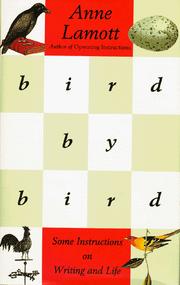
Bird by Bird
2,592-word summary 12 min read 239 pages in the book
- First published
- 1994
- Publisher
- Pantheon Books
- Pages
- 239
- ISBN
- 9780679435204
Reading options
What's inside (9 sections)
I came to Bird by Bird late, years after everyone else had already pressed it on me. I had avoided it because books about writing can turn into either a mirror or a lecture, and I was not in the mood for either. What surprised me is how quickly Lamott refuses both. The book was first published in 1994 by Pantheon Books as a 239-page hardcover, and it reads like a long conversation with a friend who happens to have published novels and happens to know exactly where you get stuck. The full subtitle is Some Instructions on Writing and Life, and that "and Life" is doing real work. She never pretends the two can be separated.
The title comes from a story in the introduction that everyone quotes, and it still lands when you read it in place. Lamott's older brother, ten years old, had three months to write a report on birds and had put it off. The report was due the next day. They were at the family cabin in Bolinas, and he sat at the kitchen table close to tears, surrounded by binder paper and pencils and unopened books on birds, frozen by the size of the job. Their father, a writer himself, sat down beside him, put an arm around his shoulder, and said: "Bird by bird, buddy. Just take it bird by bird." That is the whole method in miniature. You do not solve the enormous thing. You shrink the thing until you can do the next small piece.
The bird report and the one-inch picture frame
The first part of the book is called simply Writing, and its opening chapters are the most practical. "Getting Started" is where Lamott admits she does not sit down at a clean desk and wait for inspiration. She sits down and looks out the window and finds reasons not to begin, the same way the rest of us do. Her answer is to lower the stakes until beginning is possible. She describes keeping a one-inch picture frame on her desk, and the instruction is to look through it and write down only what you can see inside that frame. Not the whole novel. Not the whole chapter. One square inch of what is in front of you. You are allowed to do that much.
"Short assignments" makes the same point from another angle. She tells the reader to write about a single moment, a single memory, a single bird. The reason is not laziness. It is that the mind panics when it looks at the whole. When the assignment is small enough, the mind stops panicking and starts working. She returns to this idea throughout the book because she knows it is the one readers forget fastest. It is easy to nod at "bird by bird" and then go home and try to write the entire aviary in one sitting.
The section also has one of the book's best lines, and it is not a slogan. Lamott says that she has to remind herself, over and over, that the reason she is a writer is not that she was born knowing how, but that she kept showing up. The motivation is not a feeling that arrives before the work. The work tends to bring the feeling with it. If you wait to feel like a writer, you will wait a long time.
Shitty first drafts and the voice of the oppressor
If you have heard one thing about this book, it is probably "shitty first drafts." Lamott is blunt about it. Nobody writes a good first draft. She describes her own process in three stages. The first draft is the down draft, where you get everything down on paper, no matter how awful. The second is the up draft, where you fix it up and try to say what you actually meant. The third is the dental draft, where you check every tooth, going over sentences and details to make sure nothing is decayed. The point of the first stage is to stop being precious. You are not building a cathedral on the first pass. You are dumping sand into a box.
What makes the chapter stick is the confession underneath it. Lamott describes writing restaurant reviews she did not want to write, sitting in front of the screen, nearly weeping, because she was sure the draft was terrible. Then she would finish it, and the next day it would be fine. The lesson is that the revulsion is not information about quality. It is just fear wearing a costume. If you can survive the first draft, the second draft is where the book appears.
That fear has a name in the next chapter. Perfectionism, she says, is the voice of the oppressor, the enemy of the people. It tells you that if you cannot do something perfectly, you should not do it at all, and it keeps you cramped and afraid. Her antidote is not a lecture about high standards. It is the idea that a finished, flawed piece of writing teaches you more than a perfect piece you never finish. She wants the reader to accept mess as part of the method. The mess is not a failure of the process. The mess is the process.
Polaroids, character, plot, dialogue
The middle of the first part moves through craft problems one at a time, and this is where the book is most useful to someone actually working on a draft. The chapter called "Polaroids" offers the image of writing a story as developing a photograph. You do not see the whole picture when you start. You see a blur, then a face, then a background. That is normal, and if you insist on seeing the whole thing before you begin, you will never begin. Lamott uses the image to argue against outlining your way out of uncertainty.
"Character" and "Plot" are a matched pair, and Lamott insists they cannot be separated. She asks the writer to know the character deeply, to the point where you can put that person in a room, give them an action, and watch what happens. Once the character is real, the plot starts to arrange itself around what that person would actually do. She offers a structure she has used, a sequence of Action, Background, Development, Climax, and Ending, not as a formula that must be obeyed but as a way to keep a story from drifting. The rule is simple: the reader has to care about someone.
The chapters on "Dialogue" and "Set Design" sound smaller than they are. On dialogue, she tells you to listen to how real people talk, which is not how written dialogue reads. Real speech wanders and repeats. Better dialogue is edited speech that still sounds like a person. On set design, the idea is that the rooms a character lives in tell you who they are. A kitchen says something about a family. A car says something about a man. She wants the physical world of the story to carry information, so the writer is not stuck explaining everything through narration.
Looking around, broccoli, and Radio Station KFKD
The second part, The Writing Frame of Mind, is where the book stops being a manual and becomes something closer to a philosophy. "Looking around" describes writers as people who stand slightly to the side of a crowd, watching instead of joining. Lamott values what she calls compassionate detachment, the ability to look at the world clearly and tenderly without being swallowed by it. This is the chapter that turns observation into a habit, and it is the reason the book keeps being read by people who are not writing a novel.
"The Moral Point of View" is easy to misread as a religious argument, and it is not quite that. Lamott means that a piece of writing has to care about something, to hold a conviction about what is true or right. Without that, the work goes slack, and the writer loses interest. She is not asking for a sermon. She is asking for a center. If the writer does not care, the reader can feel the emptiness on the page.
Then there is broccoli, and this is the funniest chapter in the book. Lamott borrows a Mel Brooks routine in which a man goes to a doctor and is told to listen to his broccoli. The joke is about intuition. Lamott uses it to say that each writer has an inner signal, the horse she calls the broccoli, that knows what to do next if you stop shouting over it. The advice is to lower the volume of your own anxiety and let the small, quiet part of you speak. It sounds silly written down. It works on the page because she never treats it as mystical. She treats it as a practice.
"Radio Station KFKD" is the companion piece, and it names the problem that stops most writers. KFKD is the station playing in your head, and it broadcasts two programs at once. One host tells you that you are a genius, that this book will be a triumph, that the world is about to recognize you. The other host tells you that you are a fraud, that every sentence is worthless, that everyone will find out. Both voices are louder than your own. Lamott's point is that you do not win by arguing with them. You turn the volume down and get back to the work. The station keeps broadcasting. You just stop listening.
Jealousy, index cards, and the people who help
"Jealousy" is the last chapter in that part, and it is one of the most honest. Lamott admits to feeling envious of other writers, of their reviews and prizes and book deals, and she refuses to dress it up. The jealousy is real, and hiding it only makes it worse. Her advice is to notice it, name it, and then get back to your own page, because the only cure that works is the work itself. Envy tells you what you want. It does not tell you how to get it, and it does not deserve to run your life.
The third part, Help Along the Way, is the most generous section of the book. "Index Cards" describes a habit rather than a theory. Lamott keeps index cards around and jots down ideas, overheard lines, bits of scenes, anything that might matter later. She puts them in a box, and when she is stuck, she goes through the box. It is a small, unglamorous system, and that is exactly why it is useful. It lowers the cost of capturing an idea to almost nothing.
"Calling around" argues that writers should not pretend to know things they do not know. If you need to understand how a bakery works or what an oncologist actually says, you call someone and ask. Lamott makes research feel social rather than lonely. "Writing groups" lays out ground rules for the kind of group that helps, with time limits and one person speaking at a time and feedback that is specific rather than crushing. "Someone to Read Your Drafts" is about finding one trusted reader, not a committee. The theme running through all of it is that writing is solitary work that does not have to be done in isolation.
Letters, writer's block, and giving
The chapter on letters is where the personal and the practical braid together. Lamott describes writing letters as a way to keep the writing muscle moving when a big project has stalled. She also tells a story about writing to the friends of her late father while working on a novel, using those letters to learn a character she was struggling to render. The letters were not the book. They fed the book. It is a good reminder that not everything you write has to be the thing.
"Writer's Block" is the chapter that surprises people who expect sympathy. Lamott is suspicious of the term. What looks like a block is usually fear, or a demand that the writing be good on the first try, or a person who simply has not been given a small enough task. Her answer goes back to the beginning of the book: shrink the assignment until you can do it. Write one inch. Write one bird. If you can sit down and write something bad, you are not blocked. You are just early.
The fourth part, Publication and Other Reasons to Write, is where Lamott warns against the thing most beginning writers chase. "Writing a Present" suggests writing something for a specific person, with no market in mind, as a way to remember why the act matters. "Finding Your Voice" says voice is not something you find ready-made. It comes from writing so much, and so honestly, that your own way of seeing starts to show through. "Giving" makes the case that writing is a generous act, a gift of attention to a reader. "Publication" finally deals with the reality of the business, the rejections and the waiting and the fact that the book being published is not the same as the book being good.
The last class
The book closes with a single short chapter called "The Last Class," a piece with the tone of a meditation. Its argument is that the writing life and the rest of life are the same life, and that the small daily acts of paying attention are what add up. Lamott returns to the idea that showing up, again and again, is the whole thing. The chapter does not introduce new craft advice. It gathers everything else into a quiet closing note, which is why it works better as an ending than as a summary.
I do have some fair complaints. The self-help framing is real, and at times the advice is so simple that it can read as a shrug. Sit down. Write badly. Breathe. If you want a technical manual with exercises and rules, this is not that book, and chapters like the one on broccoli may frustrate you. The memoir digressions are another issue. Lamott tells stories about her son, her friends, her church, her drinking, and her father. For many readers those stories are the best part. For me a few of them wandered far enough that I had to remind myself what the chapter was supposed to be about.
Some of the references are dated, too. The book was written in the early 1990s, and the jokes about radio hosts and the way publishing worked then do not always travel. The world of book deals it describes has changed a great deal. None of this ruins the book. It just means a reader should come for the encouragement, not for a current map of the industry.
What I took from Bird by Bird in the end is smaller and more useful than its reputation suggests. The one-inch frame. The shitty first draft. The radio station you have to ignore. The idea that jealousy is normal and the work is the answer. Lamott is not a guru, and the book is better because she keeps admitting she still struggles with all of it. The advice is not that the struggle ends. It is that the struggle is survivable, one small piece at a time, and that the person telling you this has been down the same road. You take it bird by bird.
FAQ
Is Bird by Bird only useful for people writing a novel?
No. The craft chapters are aimed at fiction, but the book is widely read by anyone doing creative work because its ideas about small assignments, first drafts, and the inner critic apply to most projects.
When was Bird by Bird published and by whom?
It was first published in 1994 by Pantheon Books. The full title is Bird by Bird: Some Instructions on Writing and Life, and the first hardcover edition runs 239 pages.
Does the book teach a formula for plot?
Not really. Lamott offers one loose sequence, Action, Background, Development, Climax, Ending, but she presents it as a way to keep a story from drifting rather than a rule that must be followed.
Similar books
The War of Art
Pressfield names Resistance and urges daily professional work.
2,565-word summary · 11 min read
The Artist's Way: A Spiritual Path to Higher Creativity
A twelve week course with morning pages and artist dates to recover creativity.
2,345-word summary · 10 min read
Big Magic
Gilbert on creative living past fear: ideas that visit, permission without credentials, daily work, finished over perfect, and trust in curiosity.
2,984-word summary · 13 min read
Year of Yes: How to Dance It Out, Stand in the Sun and Be Your Own Person
Shonda Rhimes takes her sister’s accusation seriously and spends a year saying yes to the things that frighten her, from live television to her own reflection.
2,585-word summary · 11 min read

Dear Girls: Intimate Tales, Untold Secrets & Advice for Living Your Best Life
Ali Wong's debut collects fourteen letters to her daughters, covering sex, money, work, marriage, Vietnam, and being a working Asian American mother.
2,266-word summary · 10 min read
The Letters of Vincent van Gogh
Vincent van Gogh's letters to his brother Theo, in a Penguin Classics selection edited by Ronald de Leeuw, trace a decade of work, faith, and obsession.
2,611-word summary · 12 min read
Letters to a Young Poet
Rilke's ten letters to a young officer cadet refuse easy criticism and ask whether he must write, offering patience and solitude as a way of life.
2,530-word summary · 11 min read
Reasons to Stay Alive
Matt Haig's memoir of the breakdown that nearly killed him at twenty four and the three years of unglamorous recovery that followed.
2,065-word summary · 9 min read
10% Happier
An ABC newsman panics on air, then finds meditation without losing his edge.
2,590-word summary · 12 min read
Tiny Beautiful Things: Advice on Love and Life from Dear Sugar
Dear Sugar answers letters on love, grief, and work with tough empathy drawn from her own losses.
2,253-word summary · 10 min read
What I Talk About When I Talk About Running
Murakami connects daily running to writing novels, from his jazz club years to marathons and a 62-mile ultramarathon, with frank notes on aging. A quiet memoir…
3,100-word summary · 14 min read
The Happiness Project
Gretchen Rubin spends a year testing monthly resolutions on energy, marriage, work, parenting, and play, tracking small habits to build a happier ordinary…
3,516-word summary · 16 min read
Maybe You Should Talk to Someone
Therapist Lori Gottlieb counsels John, Julie and Rita while seeing her own therapist Wendell after a breakup.
2,234-word summary · 10 min read
Eat, Pray, Love
Eat, Pray, Love retold: divorce, Italy for pleasure, India for practice, Bali for balance.
1,962-word summary · 9 min read

Long Walk to Freedom
Mandela's account of a Thembu childhood, a law practice, a banned movement, twenty-seven years in prison, and the negotiation that ended apartheid.
2,454-word summary · 11 min read
What Happened to You?
Oprah Winfrey and psychiatrist Bruce Perry explain how early experience shapes the brain, and why asking what happened to someone works better than asking what…
2,238-word summary · 10 min read
The Courage to Be Disliked: The Japanese Phenomenon That Shows You How to Change Your Life and Achieve Real Happiness
A philosopher and an angry young man argue over five nights about Adlerian psychology, trauma, approval, and the freedom to be disliked.
2,054-word summary · 9 min read

In Order to Live: A North Korean Girl's Journey to Freedom
A young North Korean girl crosses the Yalu, survives trafficking in China, and rebuilds her life in Seoul in this unsparing memoir.
2,027-word summary · 9 min read

Too Much and Never Enough: How My Family Created the World's Most Dangerous Man
Mary L. Trump's 2020 memoir traces how a cold, zero-sum Queens household shaped her uncle, and uses family tax documents to challenge his self-made story.
2,059-word summary · 9 min read
Same Kind of Different as Me
An art dealer and a formerly homeless sharecropper tell the story of the friendship that began at a Fort Worth mission and the woman who insisted on it.
2,023-word summary · 9 min read
Moonwalking with Einstein: The Art and Science of Remembering Everything
A journalist spends a year training for the U.S. Memory Championship and discovers that extraordinary memory is mostly technique, attention, and a lot of…
2,027-word summary · 9 min read

Infidel
Ayaan Hirsi Ali's memoir of a Somali childhood, a forced marriage, a Dutch asylum claim, and the political fight that followed the murder of Theo van Gogh.
2,041-word summary · 9 min read
The Total Money Makeover: A Proven Plan for Financial Fitness
Dave Ramsey lays out seven Baby Steps, from a $1,000 starter fund to a paid-off house, with the debt snowball at the center.
2,663-word summary · 12 min read

Down and Out in Paris and London
Orwell's account of washing dishes in Paris hotels and tramping through London does not ask for pity, only for a clear look at how poverty actually works.
2,282-word summary · 10 min read

The Girl with Seven Names: A North Korean Defector's Story
Hyeonseo Lee crossed the frozen Yalu River at seventeen, spent years hidden in China, escaped to South Korea, and later returned to rescue her family.
2,404-word summary · 11 min read
Love Does
A lawyer and activist tells stories of saying yes, showing up, and loving people through ordinary, often ridiculous actions.
2,411-word summary · 11 min read
Don't Sweat the Small Stuff ... and It's All Small Stuff: Simple Ways to Keep the Little Things from Taking Over Your Life
Richard Carlson’s 1997 bestseller offers one hundred short chapters on lowering the volume on daily irritations, and it is more pragmatic than its title…
2,502-word summary · 11 min read
Made to Stick: Why Some Ideas Survive and Others Die
The Heath brothers break down why some ideas vanish on contact while others lodge in memory, tracing six traits that make a message stick.
2,527-word summary · 11 min read
Four Thousand Weeks: Time Management for Mortals
Oliver Burkeman turns the whole productivity project on its head, arguing that a human lifespan of roughly four thousand weeks is not a problem to optimize…
2,447-word summary · 11 min read
Breath: The New Science of a Lost Art
Journalist James Nestor investigates how modern humans learned to breathe badly, and what researchers, athletes, and breathwork practitioners have found about…
2,011-word summary · 9 min read