
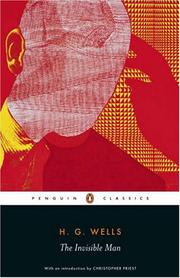
The Invisible Man
2,564-word summary 11 min read 208 pages in the book
- First published
- 1897
- Publisher
- C. Arthur Pearson
- Pages
- 208
- ISBN
- 9780141439983
Reading options
What's inside (8 sections)
I picked this one up because I had read The Time Machine and The War of the Worlds years ago and wanted to finish the early run. It is the shortest of the three. The Penguin Classics printing I read runs 208 pages, and I finished it in two sittings. What surprised me is how little of it feels like wonder and how much of it feels like a police chase. This is not a book about the magic of disappearing. It is a book about a man who cannot stand being seen and then learns he cannot stand being unseen either.
Wells first published the story in 1897. It ran as a serial in Pearson's Weekly and then came out in book form from C. Arthur Pearson in London the same year. That puts it right between his other two famous scientific romances, and you can feel him getting bolder with structure. The earlier books use a narrator who sits you down and tells you things. Here Wells mostly stands back and watches, like someone following events with a notebook. It makes the book colder. It also makes it faster.
The man with bandages walks in from the snow
The opening is one of the best setups Wells ever wrote. A stranger arrives at the Coach and Horses, an inn in the village of Iping in Sussex, in the middle of a snowstorm. He wears a wide hat and a heavy coat and gloves. His whole head is wrapped in bandages except for a false nose stuck on the front. He asks for a room and a fire and privacy, in that order.
Mrs. Hall, who runs the inn with her husband, does her best with him. He pays at first, so she puts up with the strangeness. He has crates of luggage delivered, and the crates turn out to hold hundreds of glass bottles. He sets up a rough laboratory in his room. He works all day with chemicals and goes out only at night. He snaps at anyone who knocks. The village starts talking, the way villages do, and the theories get wilder by the week.
What I like about these early chapters is that Wells plays them almost as comedy. The stranger is rude to the vicar. He terrifies the maid. He gets into rows about nothing. Mrs. Hall swings between fear of him and anger at him, and her husband mostly tries to stay out of it. You know something impossible is going on, because the title told you, but the villagers do not know, and watching them guess wrong is half the fun.
Then the money runs out. Griffin, for that is the stranger's name, cannot pay his bill. Mrs. Hall finally works up the nerve to confront him and demand payment or departure. He loses his temper. He unwraps the bandages. And Mrs. Hall's lodger turns out to be a man with no head at all, or rather a man whose head lets light pass straight through, so there is nothing to see.
Wells handles the reveal well because he keeps it physical. There is no speech about science yet. There is just an empty sleeve gesturing, a coat with nobody in it, and a village woman screaming. The police are sent for. They try to grab him. He strips off every stitch of clothing, which makes him fully invisible, fights his way free with invisible fists, and runs off naked across the snow. It is frightening and also, I have to admit, a little funny, which seems to be exactly the mix Wells wanted.
Bottles, bills, and why invisibility is miserable
One of the pleasures of the book is that Wells thought harder than most writers about what being invisible would actually be like, day to day. Clothes stay visible. Food stays visible until it is digested. Mud on your feet gives you away. Dogs smell you. In winter you freeze, because you cannot wear anything without looking like a walking suit. In summer you sweat and leave prints. Sleep is dangerous. Eating in company is impossible.
Griffin discovers all of this the hard way, and his bad temper makes everything worse. He cannot ask for help because his condition looks like madness or witchcraft. He cannot earn money because nobody will hire a voice with no face. So he steals and hides and runs, and every theft makes the next town more dangerous for him. Wells keeps the logic tight. Each chapter adds one more practical problem, and Griffin solves each problem with violence instead of patience, which shrinks his options further.
There is a burglary in Iping that nobody can explain. Things go missing from houses. Money disappears from a desk while a man sits beside it. Wells lets you see these scenes from the victims' side first, so you feel the confusion, and only later shows you Griffin's side. The effect builds a picture of a man who started out wanting knowledge and ended up wanting dinner and a coat, and who will knock down anyone standing between him and those things.
I found myself feeling sorry for Griffin in small flashes and then losing the feeling just as fast. He is brilliant and he is also, from very early on, a bully. The book never asks you to admire him. It asks you to watch what happens when a clever selfish man gets a power that removes every check on his behavior. No witnesses, no face, no name. Whatever restraint he had came from other people watching. Take the watchers away and there is nothing left.
Marvel, the notebooks, and the road to Port Burdock
After fleeing Iping, Griffin takes up with Thomas Marvel, a tramp he meets on the downs. Marvel is short, round, shabby, and talkative, and he is the first real comic character in the book. Griffin does not befriend him. He coerces him. He threatens him, shows him what invisible hands can do, and orders him to act as his visible helper: to carry things, to fetch the three notebooks Griffin left behind in Iping, to be his hands in the seen world.
The Marvel chapters give the book air. Marvel complains. Marvel tries to run. Marvel gets drunk when he can and tells his story to anyone who will buy him a drink, which is how the authorities start to piece things together. He is also the character who shows you what an ordinary person does with an impossible situation, which is to look for the nearest exit. There is something honest in that. Most of us would not try to master invisibility. We would try to get away from the invisible man.
Marvel eventually breaks away and flees toward the coast, to the town of Port Burdock, with the notebooks and, as it turns out, with Griffin's stolen money too. Griffin chases him. There is a struggle at an inn. Someone fires a shot and wounds Griffin. He gets away, hurt and furious, and takes shelter in the nearest house. The house belongs to a Dr. Kemp, and Kemp turns out to be someone Griffin knew at medical school. That coincidence drives the whole second half of the book.
A word on the notebooks, because they matter to the ending. They hold the records of Griffin's experiments: the chemicals, the doses, the process. Without them he cannot repeat or reverse what he did. With them he might. Everyone chases paper for a while, which keeps the middle of the book moving. Wells understood that a chase needs an object, not just speed.
Kemp gets the whole story in one sitting
The longest section of the book is Griffin's confession to Kemp, and it is also the slowest part, so I want to be fair about it. After so much running and hitting, Wells stops the action and lets Griffin talk for chapters. He tells Kemp who he is and how he got this way, and the story is worth hearing even if the telling goes on a bit.
Griffin was a medical student, an albino, poor and proud and bad with people. He left medicine for physics and chemistry, and became obsessed with optics: with how light moves through things, and whether a living body could be made to let light pass through it the way glass does. He worked out a process involving drugs and, I gather, some kind of radiation treatment, and he tested it first on a cat. The cat disappeared except for its eyes, which stayed faintly visible. Wells even pauses on this detail, and later writers have pointed out that it covers a real flaw in the idea, since eyes need to catch light to see. Wells knew enough to worry about it, which I liked.
Then Griffin tried the process on himself. It worked. He became invisible and found the result useless. He set fire to his boarding house to hide what he had done. He wandered London, stole food, got beaten by mistake in a crowd that could not see him to avoid him, stole clothes from a theatrical costume shop on Drury Lane, and finally made his way to Iping, where he hoped to work in peace on reversing the change. Peace never came, because he cannot pay for anything and cannot stop stealing, and each crime closes another door.
By the time he finishes telling Kemp all this, he has stopped talking about a cure. He has a new plan instead. He wants Kemp to join him as a visible partner, and together they will use terror to rule: invisible beatings, invisible murders, a campaign of fear across the district and then the country. He calls it a Reign of Terror, and he means the name. He tells Kemp that Kemp will be his first victim if he refuses. It is the moment when any leftover sympathy for Griffin should end, and Wells writes it plainly enough that it does.
The problem with this section is pace. The chase stops dead while one man talks in a locked room. Wells tries to keep tension up by letting you know, before Griffin does, that Kemp has already sent for the police. So you read the confession with one eye on the door. That helps. Still, I felt the book sag here, and I think a modern editor would cut twenty pages. The material is good. There is just a lot of sitting.
The Reign of Terror, and what it costs
The last part of the book moves fast and turns grim. Kemp has alerted Colonel Adye, the local police chief, and soldiers and constables close in. Griffin escapes the house, and the next day Kemp receives a letter: he will be the first man Griffin kills. From here on Wells writes a manhunt, and he writes it well, because he keeps reminding you of the strange rules. An invisible man can be heard, smelled, and felt. He leaves footprints in dust and mud. He cannot cross a locked room without opening the door. He can be caught in a net, shut in a house, tracked by dogs.
Kemp's plan is to use himself as bait. He sends a note about his movements, and Griffin steals the note from Kemp's servant, which tells you how completely Griffin now lives by interception and spying. There is a chase across country. Griffin picks up an iron bar and kills a man who gets in his way, a laborer with no part in any of this. He shoots Adye. He breaks into Kemp's house. Kemp runs for the town with Griffin behind him, and the whole district turns out: workmen, sailors, shopkeepers, police.
The end is brutal and I will not soften it. The crowd catches Griffin, holds him, and beats him to death. Kemp shouts at them to stop, and even tries to shield the body, but the mob has its blood up and fear does the rest. As Griffin dies, his body slowly becomes visible again: first faint outlines, then the bruised shape of a man lying in the road. Someone covers his face with a sheet. Wells closes the scene without triumph. Nobody feels like a winner. That restraint is one of the strongest things in the book.
I thought about this ending for a while. Wells could have let science save Griffin or let the police arrest him cleanly. Instead he lets ordinary frightened people do what frightened people do. The invisibility that made Griffin untouchable also made him something the crowd could kill without seeing a face. There is a point in there about power and about how thin the cover of civilization is, but Wells does not state it. He just shows you the road and the sheet and walks away.
The epilogue, and whether the book holds up
There is a short epilogue, and it is a strange pleasure. Marvel, the tramp, kept the notebooks and the money. He used the money to open an inn called, of course, the Invisible Man Inn, and he has grown fat and respectable telling his story to customers. Every evening he takes out the notebooks and tries to work out the secret, dreaming of becoming invisible himself. But some pages were damaged by water and washed blank, the rest is written in Greek and Latin codes, and Marvel never learned even basic mathematics. So the great secret sits in a drawer above a bar, guarded by a man who cannot read it. It is funny and sad at once, and it lands better than most last chapters in books of this period.
So, fair criticism, now that I have praised it. The women in the book barely exist. Mrs. Hall gets some life, and then she is gone. Nobody else female has more than a few lines. Kemp is decent but dull, a stand-in for normal society rather than a person. Griffin himself is more of a force than a character: brilliant, cruel, and empty, and Wells does not try to fill him in. The science is hand-waving, even for 1897, and the middle sags under the confession. If you need deep characters, this is not your book.
But if you want a short classic that moves, unsettles, and makes you think, it holds up well. The practical details of invisibility still feel fresh. The village scenes still play. The manhunt still works. And the central idea still bites: that being unseen does not free you, it traps you, because human life runs on being known by others, fed by others, and stopped by others. Take all that away and you do not get a god. You get a cold hungry man in a ditch, throwing stones at people who cannot see him coming.
I read it in the Penguin Classics edition, and the notes on the text and the introduction helped with the background: the serial, the 1897 book, the stage history, the films, including the well-known 1933 film version. You do not need any of that to enjoy the story. It runs on fear and chase and one man's refusal to turn back. Start it on a free evening and you will likely finish it before bed, checking, as I did, that your own doors are locked.
FAQ
When was The Invisible Man first published?
It was first published in 1897, serialized in Pearson's Weekly and then issued in book form by C. Arthur Pearson in London. The summary follows that text and keeps its facts aligned.
Who is the Invisible Man?
Griffin, an albino former medical student turned student of optics. He discovers chemicals that change the body's refractive index and tries them on himself, then cannot reverse the effect.
Is The Invisible Man a horror story or a science fiction story?
Yes, in the sense that it follows one man's collapse into violence and ends with his death. It is short and moves fast, so it suits readers who want classic science fiction without a long commitment.
Similar books
The Island of Doctor Moreau
Shipwrecked Prendick finds Doctor Moreau shaping beasts into men by pain on lost island.
2,137-word summary · 9 min read
The Time Machine
Wells sends a Victorian inventor to the year 802,701, where idle Eloi and blind Morlocks share a dark human fate.
2,335-word summary · 10 min read
The Day of the Triffids
Blinded survivors flee carnivorous plants after a meteor shower.
2,171-word summary · 10 min read
I Am Legend
Robert Neville holds one fortified house in empty Los Angeles by day, and faces what the plague left behind by night.
2,840-word summary · 13 min read
Journey to the Center of the Earth
A professor, his nephew, and a guide climb into an Icelandic volcano to reach the center of the earth.
1,902-word summary · 8 min read
Oliver Twist
An orphan flees the workhouse for London's thieves, and Dickens indicts a cruel society.
2,763-word summary · 12 min read
The Strange Case of Dr. Jekyll and Mr. Hyde
A London lawyer traces a violent stranger to his respectable friend in Stevenson's 1886 tale of two selves.
2,286-word summary · 10 min read
Frankenstein
Frankenstein retold: Victor builds, the creature wakes, Arctic letters, demand and refusal.
1,901-word summary · 8 min read
The War of the Worlds
A Surrey writer watches Martians land in cylinders, march on London in tripods, and fall to Earth's smallest life.
2,667-word summary · 12 min read
Silas Marner
A falsely accused weaver hoards gold in Raveloe until a stolen hoard and an abandoned child remake his narrow life.
2,699-word summary · 12 min read

Authority
The new director of the Southern Reach takes over an agency that is hiding the truth about Area X, and the building starts to change around him.
2,029-word summary · 9 min read

Wilder Girls
At a quarantined boarding school off Maine, three girls with strange mutations search for a missing friend and learn what the adults have hidden.
2,594-word summary · 12 min read

Devil in Winter
A shy heiress with a stammer proposes a marriage of convenience to London's most notorious rake, then makes him prove he can be faithful.
2,548-word summary · 11 min read
The Moonstone
A cursed yellow diamond vanishes on the night of a birthday party, and eight witnesses tell what they saw.
2,603-word summary · 12 min read
The Lottery
In Jackson's 1948 story, a village draws lots to keep the corn heavy, and the chosen person is stoned by her neighbors.
3,080-word summary · 14 min read

Her Body and Other Parties: Stories
Eight stories where bodies, medicine and old fairy tales get taken apart, with a green ribbon running through the whole book.
2,997-word summary · 13 min read
Out of the Silent Planet
A Cambridge philologist is kidnapped and taken to Mars, where the natives are civilized and the humans are the dangerous invaders.
2,612-word summary · 12 min read
We
In a city of glass ruled by the Benefactor, a state engineer building a spaceship falls for a woman who wants to tear the One State down.
2,247-word summary · 10 min read
The Memoirs of Sherlock Holmes
Doyle's second Holmes collection gathers twelve Strand stories, including the early case of the Gloria Scott and the confrontation with Moriarty at Reichenbach…
2,390-word summary · 11 min read
The Illustrated Man
A tattooed drifter's moving pictures retell eighteen Bradbury stories of children, rockets, Mars and the last night of the world.
2,791-word summary · 12 min read
The Twelve
The middle volume of the Passage trilogy braids the year America died, a picnic massacre decades earlier, and the survivors' war against the twelve master…
2,089-word summary · 9 min read
The Caves of Steel
Detective Elijah Baley must solve a Spacer's murder in a domed New York, partnered with R. Daneel Olivaw, a humaniform robot built in the victim's image.
2,445-word summary · 11 min read
A Connecticut Yankee in King Arthur's Court
Hank Morgan, a Connecticut factory man, wakes in King Arthur's England, rises to chief adviser, and rebuilds the kingdom until his own inventions turn on him.
2,193-word summary · 10 min read
Bleak House
Jarndyce and Jarndyce grinds through Chancery while Esther finds her family.
2,480-word summary · 11 min read

A Canticle for Leibowitz
After nuclear war, monks save books across centuries while the world rebuilds and falls again.
2,381-word summary · 11 min read
The Call of Cthulhu and Other Weird Stories
Seventeen tales from Dagon to Innsmouth, led by Cthulhu, the Colour, and the Whisperer, in S. T. Joshi careful Penguin edition with notes and corrected texts.
2,593-word summary · 12 min read
The Call of Cthulhu
A professor's papers link a sculptor's dreams, a Louisiana cult raid, and a sailor's voyage to a sleeping god under the sea.
2,530-word summary · 11 min read

Solaris
Kelvin reaches a silent station above Solaris and finds grief made solid when the ocean returns his dead wife Rheya, testing memory, science, and the limits of…
2,548-word summary · 11 min read
The Dispossessed: An Ambiguous Utopia
Physicist Shevek leaves anarchist Anarres for capitalist Urras to share time theory, finding walls both places.
2,288-word summary · 10 min read
Dream Country
Four Sandman shorts on muses, cats, Shakespeare, and a veiled heroine.
2,001-word summary · 9 min read