
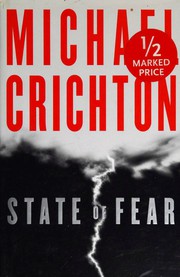
State of Fear
2,292-word summary 10 min read 641 pages in the book
- First published
- 2004
- Publisher
- HarperCollins
- Pages
- 641
- ISBN
- 9780007181599
Reading options
What's inside (8 sections)
I came to State of Fear expecting the usual Crichton ride: a smart thriller where some technology runs loose and a handful of people chase it across the map. I got that book, but I also got something I did not expect, which is a novel that stops every few chapters to hand you a graph and a footnote. It came out in December 2004 from HarperCollins, and it was his fourteenth novel under his own name. The first hardback runs about 641 pages, and it is a dense, argumentative book that wears its politics on its sleeve. By the time I finished, I had enjoyed the chase and distrusted the lectures, which I think is a fair way to feel about it.
A lawyer, a philanthropist, and a foundation with problems
The story starts with Peter Evans, a lawyer who works for a very rich man named George Morton. Morton is a philanthropist with a particular habit: he gives large sums of money to an environmental group called the National Environmental Resource Fund, or NERF. If that name sounds like a thinly disguised version of a real organization, that is the point. Crichton modeled NERF on the Natural Resources Defense Council, and he makes no secret of it. Evans's job is to manage the legal side of all that giving, which sounds like dull work until Morton starts asking awkward questions.
The trouble is with NERF's director, Nicholas Drake. Morton notices that some of his donated money has been misused, and once he starts pulling at that thread, he finds more than bad bookkeeping. Drake is charming and brisk and very good at his job, but he is also keeping secrets. Morton, it turns out, is not nearly as naive as he first appears. He is a millionaire who made his money through a dot-com sale, and he has the resources to play a long game.
At this point two men arrive on the scene. John Kenner and Sanjong Thapa introduce themselves as researchers connected to MIT, but that is a cover. They are international law enforcement agents, and they are tracking an eco-terrorist group called the Environmental Liberation Front, which everyone calls the ELF. The real-world model is obvious, since there was an actual Earth Liberation Front that used the same name. Crichton's version is far more lethal. These people do not firebomb buildings. They stage disasters that look natural, and they do not care who dies in them.
The ELF and its manufactured disasters
Here is the premise that drives the whole book. The ELF wants to convince the public that global warming is real and catastrophic, and it plans to do this by creating natural disasters that will dominate the news during a climate conference that NERF is sponsoring. The logic is monstrous but simple: if the world sees enough fires and floods and lightning strikes at exactly the moment the environmentalists warn of catastrophe, the message will land. Kenner and Thapa suspect that Drake is in on it, because a conference that showcases catastrophe is wonderful for donations. Drake's motive is money and influence, not ideology, which makes him a more interesting villain than a true believer would have been.
The methods are where Crichton's technical imagination gets its first real workout. One ELF operative kills with the venom of a rare Australian blue-ringed octopus, which causes paralysis and is very hard to detect after the fact. Another uses what the book calls lightning attractors, devices that draw a strike to a specific person during a storm, making an assassination look like an act of weather. These are not subtle tools. They are engineered to leave a natural story behind, and the people who deploy them treat human life as a prop in a media campaign. I found this part of the book genuinely unsettling, because the idea of a murder that looks like weather is a nasty hook.
Evans gets pulled in because he is already close to Morton and because his legal skills turn out to be useful. He is not an action hero. He is a lawyer who keeps getting asked to do things well outside his training, and his fear is usually the most honest reaction in the room. He is joined by Sarah Jones, Morton's assistant, who is sharp and capable and has her own reasons for wanting to understand what is happening. Kenner, the senior agent, is calm to the point of being unnerving, and he knows more than he lets on. Thapa is the quieter technical mind, the one who checks facts and tells Kenner when something does not add up.
Graphs in the margins
What makes State of Fear unusual is that the thriller keeps getting interrupted by an argument. The book is full of charts and footnotes and quotations from real scientific sources. There are two appendices and a bibliography that runs to 172 books and articles. The characters argue about temperature records and ice cores and the reliability of computer models, and Crichton sometimes steps in with an afterword to make his own position clear. That position is that the cause and the extent and the threat of climate change are all largely unknown, and that the science has been captured by politics.
The most memorable mouthpiece for this view is a professor named Hoffman, an eccentric academic who explains the idea that gives the book its title. He talks about a politico-legal-media complex, which he offers as a successor to the old military-industrial complex. His claim is that after the Berlin Wall fell, the people who had built careers on the threat of Soviet communism needed a new fear to keep the public obedient, and that climate science began using words like crisis and catastrophe and disaster for that reason. It is a sweeping claim, and the book presents it through a character who is meant to seem brilliant and slightly outside the mainstream. I enjoyed the scene as drama and distrusted it as argument, which is the split feeling the whole book produces.
The charts are used to support a specific line: that mean global temperature has actually been falling in recent decades, and that the places that show warming are mostly cities, where sprawl and deforestation create a local heat effect rather than a planetary one. This is where the novel's fiction and its author's beliefs merge most tightly, and it is also where the book is on its weakest ground. The characters explain away inconvenient data with a confidence that real climate scientists would not accept, and Crichton does not give the other side a fair hearing inside the story. The villains are all environmental extremists or greedy foundation executives. The scientists are either cautious allies or people with conflicts of interest. There is no serious advocate for the mainstream view who gets to make a strong case and walk away intact.
I want to be fair to the thriller, though, because when Crichton is telling a story he is very good at it. The group's investigations take them to a string of exotic locations: Paris and London and Vancouver and Iceland and Malaysia and Antarctica and Chile, among others. Each stop has its own small crisis, and the travel gives the book a breathless, international quality. There is a fine sequence involving a lab and a sample and a lot of careful work to establish that something in the data is wrong. The Antarctic leg, where Evans and Jones are nearly killed, is tense and well staged. Crichton understands that a threat is scarier when the characters can see the mechanism and still cannot stop it.
The island and the wave
The plot gathers toward a remote island in the Solomon Islands, where the ELF has built its centerpiece. The plan is to trigger a tsunami that will race across the Pacific and inundate the California coastline at the exact moment Drake is closing his conference on the coming catastrophe. It is a stunt on a monstrous scale, and the people who built it expect to be safely gone before the wave lands. Kenner's niece, Jennifer Haynes, a scientist with her own clear-headed standards of evidence, joins the team for this final leg. Her presence gives the book one more viewpoint on the debate, since she is written as someone who will accept a claim only when the evidence is genuinely overwhelming.
The island sequence has everything a Crichton climax is supposed to have. There are man-eating crocodiles in the water. There are cannibalistic tribesmen who capture and kill Ted Bradley, an environmentalist television actor whom Drake had sent to spy on Kenner's group, and who gets a grisly end. There is a final fight in which Haynes is nearly killed and Evans shoots one of the terrorists who had tried to kill him and Jones earlier. The wave itself is turned back by sabotage. Kenner's team alters the device just enough that the tsunami loses its force and the backwash destroys the ELF team that built it.
Then there is the matter of George Morton, who had let everyone believe he was dead. It turns out he faked his own death to get off Drake's radar and watch the ELF from the island while he waited for Kenner to arrive. He steps back into the story at the last moment and helps rescue the survivors. The ending returns everyone to Los Angeles, where Evans quits his law firm to work for a new organization that Morton is setting up. The idea is that environmental activism should be run like a business, free of the conflicts of interest that corrupted NERF, with Evans and Jones eventually taking over after Morton is gone. It is an oddly hopeful button for a book so suspicious of environmental groups, and it tells you that Crichton's real target was never the environment itself but the politics and money around it.
What the scientists said
Here is the part that matters most if you are deciding whether to read this now. State of Fear was a commercial success, with a large first printing and a run near the top of the bestseller lists, but it was sharply criticized by many climate scientists and science writers. The criticism was not only that Crichton had taken the wrong side of a political argument. It was that he had distorted specific research to make his case. Peter Doran, the lead author of a Nature paper on Antarctic cooling that the novel leans on, wrote publicly that his results had been misused as evidence against global warming. Myles Allen, writing in Nature, said the footnotes and appendices were clearly intended to give an impression of scientific authority and that the book was likely to mislead readers. James Hansen was blunter, and other researchers called the presentation error-filled and selective. Sixteen of eighteen climate scientists interviewed by one news service said Crichton was bending the data.
The book also found a second life as a political document. Senator Jim Inhofe, a prominent skeptic who chaired a Senate committee, made it required reading for his staff and called Crichton to testify. Al Gore later answered a question about climate with a line about a planet having a fever and not trusting a science fiction novel, which many people took as a jab at this book. The American Association of Petroleum Geologists gave it a journalism award in 2006, a decision that embarrassed some people in that organization and was later renamed. None of this is straight fiction criticism, but it explains why the book still provokes strong feelings. It was read as an argument, and people treated it like one.
Reading it now
So what do I say about State of Fear after finishing it? As a thriller, it works better than its reputation suggests. Crichton keeps a large cast moving across a lot of countries, the villains are genuinely nasty, and the set pieces, especially the Antarctic close call and the island climax, are built with real skill. Peter Evans is a likable everyman, and his legal background gives the investigations a procedural texture that I enjoyed. If you can accept the lectures as the price of admission, there is a solid adventure here.
The problem is that the lectures are not a small price. They are the reason the book exists. The thriller is a delivery system for an argument that many qualified people found misleading, and Crichton gave that argument more footnotes and appendices than he gave his characters inner lives. The women in particular are written as functions of the plot: the assistant who is smart, the niece who is rigorous, the girlfriend whose main job is to be threatened. The scientists are types rather than people. If you already know the climate debate well, you will likely be irritated by the selective use of data and the lack of any real counterargument. If you do not, you may come away with a distorted picture, which is exactly what the critics were worried about.
I would hand this to a reader who wants a fast, slightly old-fashioned international thriller and who is willing to treat the science as fiction. I would not hand it to someone looking for a fair introduction to the climate debate, because it is not that book and never pretends to be. It is a novel written by a man with a strong opinion, and the opinion keeps elbowing the story aside. That is frustrating, but it is also the most interesting thing about it. The chase is fun. The argument is the part you should argue with.
FAQ
Is State of Fear based on real events?
No. It is a 2004 novel by Michael Crichton, though its fictional groups and organizations are modeled on real ones, such as the Earth Liberation Front and the Natural Resources Defense Council.
What is the state of fear in the title?
It comes from a character named Professor Hoffman, who argues that after the Cold War, politicians and the media kept the public obedient by promoting new fears, including climate catastrophe.
Do scientists agree with the book's climate claims?
No. Many climate scientists said the novel cherry-picked and distorted research, and scientific organizations publicly criticized its presentation of the evidence.
Similar books
The Atlantis Gene
A geneticist and an intelligence operative chase two kidnapped boys through a global conspiracy about human evolution and a weapon built to cull humanity.
2,369-word summary · 11 min read
State of Terror
A new secretary of state and her team unpick a web of attacks across Pakistan, Afghanistan, and Iran in this 2021 political thriller.
2,307-word summary · 10 min read

The Camel Club
Four Washington misfits witness a murder on Roosevelt Island and stumble into a conspiracy that reaches the Oval Office, with a hostage president and a nuclear…
2,354-word summary · 10 min read
Sleeping Giants
A girl falls into a field and lands in a giant metal hand. Years later a secret team assembles the rest of the machine, and it chooses its own pilots.
2,466-word summary · 11 min read

The Broker
A disgraced Washington lobbyist is pardoned and hidden in Bologna, where the CIA uses him as bait to find out who wants a stolen satellite.
2,211-word summary · 10 min read
Nemesis Games
The Rocinante crew scatters across the solar system just as Marco Inaros and the Free Navy bombard Earth. The Expanse reaches its turning point.
2,506-word summary · 11 min read
Absolute Power
A thief watches the president kill, then runs with a lawyer who believes him.
2,401-word summary · 11 min read
The President Is Missing
President Jonathan Duncan faces impeachment over a secret call while a virus called Dark Ages threatens to erase American data in this 2018 Clinton and…
2,324-word summary · 10 min read
Leviathan Wakes
A destroyed ice hauler, a missing heiress, and an alien growth pull a crew and a tired detective toward war across the solar system.
3,653-word summary · 16 min read
Deception Point
A meteorite in Arctic ice may prove alien life, and analyst Rachel Sexton must verify it as killers close in.
1,923-word summary · 9 min read
Airframe
A quality assurance vice president has one week to explain a Pacific airliner crash, while a television producer and a corporate conspiracy close in on the…
2,436-word summary · 11 min read
The Lost World
Malcolm lives after all and returns to Site B where engineered herds eat themselves and Dodgson steals eggs.
2,075-word summary · 9 min read
Prey
Jack Forman takes a contract job at a Nevada lab in Michael Crichton's 2002 thriller Prey, where self replicating nanoparticle swarms have started hunting on…
2,959-word summary · 13 min read

Congo
In Crichton's 1980 jungle thriller, Karen Ross leads a Congo expedition to find lost Zinj and its diamonds, bringing Amy, a signing gorilla, into grey gorilla…
3,013-word summary · 13 min read
Sphere
A Navy team finds a centuries-old spacecraft on the Pacific floor, and psychologist Norman Johnson faces what its sphere wakes in minds.
2,275-word summary · 10 min read
Timeline
Historians testing a quantum fax get stuck in 1357 France and must survive siege and swords.
2,109-word summary · 9 min read
The Andromeda Strain
A town dies in seconds, and a sealed lab team races a germ that learns to eat seals.
2,013-word summary · 9 min read
Jurassic Park
Hammond clones dinosaurs on Isla Nublar and invites Grant, Sattler and Malcolm to certify safety before opening.
2,388-word summary · 11 min read
Wayward
With Ethan Burke now sheriff, Wayward Pines runs on cameras, fear and a founder's private plan, until a murder forces him to choose between order and the truth.
2,252-word summary · 10 min read
Shadow of the Hegemon
Battle School graduates return to Earth in 2197, where Achilles kidnaps Ender's Jeesh and Bean works to free them while Peter Wiggin plays for the title of…
2,093-word summary · 9 min read
MaddAddam
Toby and Ren rebuild a camp after the plague while Zeb reveals the past and the Crakers invent a religion around Oryx and Crake.
2,201-word summary · 10 min read
Zero Day
Army investigator John Puller is sent alone to a West Virginia coal town to solve a colonel's murder, and finds a much larger secret buried nearby.
3,434-word summary · 15 min read
Wake Up and Open Your Eyes
A Brooklyn father drives to Richmond to find his parents lost in a cable news trance, in Chapman's splatterpunk horror about possession spread through…
2,381-word summary · 11 min read

Vox
In a near-future America, women are fitted with counters that allow them a hundred spoken words a day. A linguist fights to reclaim her voice and save her…
2,434-word summary · 11 min read
The Secret of Secrets
Robert Langdon travels to Prague with Katherine Solomon, a scientist whose work on consciousness has made her a target. A dream, a bomb and a killer called the…
2,251-word summary · 10 min read
Red Mars
Kim Stanley Robinson's 1992 novel sends the First Hundred to Mars aboard the Ares, where a murder, a fight over terraforming and a struggle with Earth decide…
2,206-word summary · 10 min read
Nightmares and Dreamscapes
King's 1993 collection runs from a man buried alive in a Cadillac to a town of dead rock stars, mixing horror, science fiction and dark humor across 816 pages.
3,232-word summary · 14 min read
Gone Before Goodbye
Reese Witherspoon's first novel, written with Harlan Coben, follows a bereaved surgeon whose griefbot guides her into a medical conspiracy stretching from…
2,648-word summary · 12 min read
Abundance
Two journalists argue that rules written to fix the abuses of the 1970s now block the housing, energy and clean construction the 2020s need, and propose a…
2,306-word summary · 10 min read
The Regulators
A suburban Ohio street turns into a violent Western set in this Richard Bachman novel, a mirror to Desperation in which an autistic boy hosts a creature called…
2,259-word summary · 10 min read