
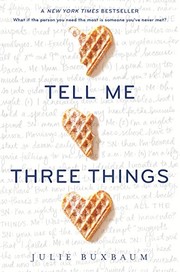
Tell Me Three Things
2,292-word summary 10 min read 336 pages in the book
- First published
- 2016
- Publisher
- Delacorte Press
- Pages
- 336
- ISBN
- 9780553535648
Reading options
What's inside (9 sections)
I picked up Tell Me Three Things expecting a light school-story, mostly because the cover and the title made a promise about secrets that I assumed would be girlish and small. Julie Buxbaum published it in 2016 with Delacorte Press, and the hardcover runs 336 pages. What I found was a book that keeps two stories going at once. On the surface it is a romance about a girl who moves across the country and gets mysterious emails from a stranger at her new school. Underneath, it is a careful account of what grief does to a sixteen year old who has no idea how to carry it. I retell the whole thing below, reveal included.
A house that is not hers
Jessie Knox is finishing up her life in Chicago when her father tells her he has remarried. The bride is Rachel, a wealthy widow he met online, and the news lands badly because Jessie's mother is dead and her father has not waited long enough for anyone's taste. Within weeks the family is moving into Rachel's large house in Los Angeles, where Jessie will start her junior year at a private school she has never seen. Rachel's son Ethan lives there too, and he wants nothing to do with the arrangement.
The early chapters are built out of small humiliations, which is the right choice. Jessie has to share a bathroom with a stepbrother who barely speaks to her. She has to learn the rhythms of a house where the cupboards are stocked by people she does not know and every room seems to judge her Chicago clothes. Her father is happy, or trying to be, and that happiness reads to Jessie as a kind of betrayal. Nothing dramatic has to happen for her to feel displaced. A new locker, a new bus route, a stranger's toothbrush by the sink, all of it does the work.
The school itself is described in pieces rather than in one sweeping passage, and that works. Jessie learns the social order the way any new student does, by sitting in the wrong place at lunch and watching who gets up to leave. The guide in her inbox tells her which tables to avoid, but knowing the rules and being able to follow them are two different things. Buxbaum lets her make the small mistakes that make a new kid visible, and then lets her recover from them slowly.
Rachel is an easy figure to dislike on paper, a rich widow with a perfect house and a ready smile, and the book knows it. What it does instead is give her ordinary moments that complicate the picture. She asks Jessie about her day and actually listens. She makes mistakes with the same clumsiness Jessie does. Her marriage to Jessie's father may be sudden, but the book does not treat it as a crime. The tension between them comes from what Jessie brings to every conversation, not from anything Rachel has done. That choice keeps the stepmother from becoming a cartoon, which is more than this kind of story usually manages.
Buxbaum gives Jessie a voice that is quick and defensive. She notices everything and assumes the worst, and the book lets her be wrong often enough that the voice stays interesting. She is not a saintly griever. She is rude to people who try to help and then ashamed of it a page later.
The stranger in her inbox
A few days into the term, an email arrives from someone who says he is a student at the school. He offers to act as her virtual spirit guide. He will tell her who is safe, who is not, which teachers to watch, and how to survive a place that seems designed to exclude her. The messages are signed with initials, and the sender refuses to say who he is. Jessie is suspicious. She answers anyway, because she needs the help.
This is the device that drives the plot, and it works because the emails are genuinely funny. The guide has opinions. He flags the kids who will be cruel, points her toward the ones who might become friends, and answers her questions with a mix of sarcasm and real concern. Jessie starts forwarding him details of her day and waiting for the reply. The anonymous stranger becomes the one person in Los Angeles she can be honest with, which is both the comfort and the problem. He knows everything about her and she knows nothing about him.
What keeps the emails from feeling like a gimmick is their tone. The guide never writes the sentence Jessie most wants to hear. He does not say that everything will be all right, or that her mother would be proud. He tells her which teacher has a soft spot for late work and which girl will turn a confidence into a rumor. The advice is small and usable, and its smallness is what makes Jessie trust it. She is not looking for wisdom. She is looking for someone who knows the map.
I should say that the book is ahead of the reader here in a way that may annoy some people. The identity of the guide is planted early, and a careful reader will work it out long before Jessie does. Buxbaum seems willing to trade suspense for the slower pleasure of watching Jessie miss what is in front of her. If you need your mysteries to stay hidden, that choice will grate.
School, study partners, and the bookstore
The school storyline fills in the rest of Jessie's days. Her first week is agonizing, as Kirkus noted, and then it slowly improves. She makes a small group of friends. She is picked as a study partner by the most popular boy in Advanced Placement English, Ethan, the same stepbrother who has been keeping his distance at home. Working beside him forces a truce. He is not the bully she expected, and the cracks in his own life start to show.
Jessie also takes a job in a bookstore, where she works alongside Liam, the owner's son. Liam is kind to her, and his girlfriend is not. The girlfriend bullies Jessie, which adds a second antagonist to a book that hardly needs one. The bookstore scenes are among the warmer passages, mostly because they give Jessie somewhere to be that is not Rachel's immaculate house or a school hallway. She handles books and learns the regulars and starts to feel like a person with a place again.
The romance develops along familiar lines. Jessie has a crush on her study partner, and the anonymous emails start to overlap with that crush in ways she refuses to examine. Buxbaum is good at the awkward physical comedy of Teenage attraction: the dropped pen, the wrong comment, the long pause in a hallway. She is less original with the surrounding furniture. The beautiful but clueless heroine, the jealous mean girl, the secret admirer whose identity is obvious, all of it has appeared in a hundred other books.
What grief actually looks like here
The reason to keep reading is not the romance. It is the way Buxbaum writes loss. Jessie's mother has been gone long enough that other people expect her to be functioning, and not long enough that Jessie has begun to function. The move to Los Angeles rips away the last places where her mother was still present. Her old room, her old school, the streets of Chicago, all of them held a version of the family that is now gone. In a new house with a new stepmother, there is nothing left to push against.
The book is interested in the strange forms grief takes. Jessie gets angry at her father for remarrying when what she really wants is for him to be as lonely as she is. She treats Rachel's kindness as an insult. She keeps pieces of her mother close, then avoids them for days at a time. She cannot tell which of her feelings are about the move and which are about the death, and Buxbaum does not sort them out for her. The emails matter because they let Jessie speak without having to manage anyone else's reaction. She can be messy in a way she cannot be in the kitchen with Rachel.
Her mother stays present in objects. There are clothes Jessie will not give away, a recipe card, a voice she remembers badly and tries to recover. Buxbaum handles these without turning them into symbols. They are just things a daughter cannot sort yet. When Jessie finally takes something out and uses it, the moment lands because the book has been patient about it.
Other characters carry losses of their own, and the book lets those sit alongside Jessie's rather than ranking them. This is where the writing earns its reputation. The grief is specific and unglamorous. It shows up in what Jessie refuses to say, in the clothes she will not unpack, in the way she flinches when someone mentions her mother in front of her. There is no single conversation that fixes it.
The reveal and what it means
The account behind the emails turns out to belong to someone close to Jessie, and the reveal points back to the person she has been studying with and falling for. Looking back, the clues are there in the timing of the messages and in what the guide knows about the house and the school. Jessie's frustration when she finally understands is believable. She had been describing her whole life to a stranger, and the stranger was standing a few feet away the whole time.
The reveal does more than solve the puzzle of the emails. It forces Jessie to ask whether she wanted the guide or the person, and whether the advice she trusted was honest. The anonymous messages gave her permission to be someone braver than she felt. Once the mask is gone, she has to decide whether she can be that person in a real conversation. The book handles this in a quiet way, through arguments and silences rather than a big confession. That restraint is one of its better instincts.
By the end, Jessie has not stopped missing her mother. What changes is her willingness to let other people in, including the father she has been punishing and the stepmother she has been testing. The last stretch is about accepting that a family can change shape without the dead being erased. It is a modest ending, and it fits a book that has been more interested in small shifts than in grand gestures.
Where the book slips
The limitations are real and worth naming. The romance follows a template that Buxbaum does not do much to freshen. The popular boy who turns out to be thoughtful, the girlfriend who exists to make trouble, the girl who has no idea she is attractive, all of it arrives on schedule. Readers who have spent time in this corner of young adult fiction will recognize the beats before Jessie does. The mystery of the emails is also too easy for a book that asks the reader to care about who the guide is.
The pacing also sags in the middle. There are a lot of scenes in which Jessie trades remarks with a classmate and nothing changes, and a tighter edit would have cut some of them. But the rhythm suits the subject. Grief time is slow, and the book's quieter passages mimic the way a person stuck in it experiences a day.
There is a narrower world here than the story needs. The school and the household are wealthy, polished, and mostly white, and the book does little with the one friend who has a Spanish surname. Los Angeles itself is barely present beyond the mansion and the school. A few paragraphs about the city, or about the people who work in Rachel's house, would have widened the frame. Buxbaum is writing about a privileged girl, and that is fine, but the choice makes the book's emotional claims feel smaller than they could have been.
Those complaints did not stop me from finishing it in a single evening. The dialogue is sharp, the pace is steady, and Jessie's bad decisions are recognisable ones. I would hand this to a teenager who has just moved, or to anyone who has had to share a home with a stranger while pretending to be fine. Read it for the grief and the emails, and forgive the rest.
Who it is for
This is a book for readers who like their romance with a steady beat underneath it. If you want a plot that never slows down, the middle chapters about school and study hall may try your patience. If you want a heroine who says the wrong thing and then thinks about it for a week, you will find plenty of that. Buxbaum is at her best when Jessie is alone with a memory of her mother or hunched over a keyboard writing to someone she thinks is a stranger. Those are the pages that make the title mean something.
The book also rewards a second look at the early emails. What reads as playful advice on the first pass reads like someone trying to reach her without saying who they are, and that changes the whole shape of the story. I finished it thinking less about the romance than about how hard it is to grieve in a house that has already been redecorated. That is a strange and specific thing to take from a book with this cover, and I mean it as praise.
FAQ
What is Tell Me Three Things about?
It follows Jessie Knox, a sixteen year old who moves from Chicago to Los Angeles after her father remarries, then gets anonymous emails at her new private school.
Who sends the anonymous emails?
The sender is a student Jessie already knows well, and the clues appear early. The reveal is about her failure to notice rather than a hidden stranger, which is why most readers arrive first.
Is Tell Me Three Things meant for younger teens?
Kirkus categorized it for readers aged twelve to sixteen. The focus is on grief, family change, and a school romance rather than adult subject matter.
Similar books

Someone Like You
Halley and her best friend Scarlett face a summer of grief, a surprise pregnancy, and Halley's dangerous first romance in Sarah Dessen's 1998 young adult novel.
2,218-word summary · 10 min read
Pumpkinheads
Deja and Josiah have worked the Succotash Hut together every autumn. On their last Halloween shift, she pushes him to chase a crush and they discover something…
2,409-word summary · 11 min read
Impulse
Three teenagers in a Reno residential hospital tell in free verse how they arrived there after suicide attempts and what recovery costs.
2,030-word summary · 9 min read

Girls in Pants: The Third Summer of the Sisterhood
The four friends face their last summer before college, with art school, an old flame, a guilty conscience and a new baby in the balance.
2,382-word summary · 11 min read

Today Tonight Tomorrow
On the last day of senior year, academic rivals Rowan Roth and Neil McNair team up for a citywide Seattle scavenger hunt and start seeing each other…
2,233-word summary · 10 min read

Dumplin'
Willowdean Dickson enters her town's beauty pageant as a protest and discovers that confidence is harder to keep once she lets someone close.
1,922-word summary · 9 min read

The First to Die at the End
On the night Death-Cast launches, a boy with a bad heart meets a model with everything ahead of him, and one of them gets the call.
2,908-word summary · 13 min read

The Second Summer of the Sisterhood
Four friends share the traveling pants through a summer of grandmothers, first loves, and mothers who are learning to let go.
2,209-word summary · 10 min read

Aristotle and Dante Dive into the Waters of the World
Ari and Dante return for senior year in El Paso, navigating first love, AIDS, family grief, and the cost of being openly gay in 1987 Texas.
2,188-word summary · 10 min read

Loveless
Georgia starts university sure she wants love, then learns she is aro-ace.
2,539-word summary · 11 min read

Since You've Been Gone
Shy Emily spends summer finishing her vanished best friend Sloane list of thirteen dares, finding Frank, Dawn, and courage.
2,566-word summary · 11 min read

You've Reached Sam
After Sam dies, Julie calls his phone to hear his voicemail and he answers, forcing her to face grief and learn how to say goodbye.
2,887-word summary · 13 min read

Me and Earl and the Dying Girl
A self-protective Pittsburgh senior is pushed to befriend a classmate with leukemia, and a clumsy film with Earl changes all three.
2,773-word summary · 12 min read

Stargirl
Leo Borlock likes blending in until homeschooled Stargirl Caraway arrives at Mica High with a ukulele, a pet rat, and kindness that tests them both.
2,980-word summary · 13 min read

Will Grayson, Will Grayson
Two Chicago teens with one name collide, with Tiny Cooper's musical stealing every scene.
2,742-word summary · 12 min read

If He Had Been with Me
Childhood friends Autumn and Finn drift apart in high school until one August night changes everything.
2,785-word summary · 12 min read

Looking for Alaska
Looking for Alaska retold: Miles at Culver Creek, Alaska Young, pranks, loss, before and after.
1,914-word summary · 9 min read

The Distance Between Us
Seventeen-year-old Caymen Meyers distrusts rich people, then a wealthy boy keeps proving her wrong while her mother's doll shop struggles to survive.
2,231-word summary · 10 min read
Wake
Seventeen-year-old Janie Hannagan is pulled into other people's dreams whenever they sleep near her. A nursing-home job, a secretive boy and a drug bust give…
2,488-word summary · 11 min read
The Collected Regrets of Clover
A death doula who writes down the last words of strangers keeps her own heart locked away, until a new neighbor, a dying photojournalist and a road trip to…
3,055-word summary · 14 min read

The Art of Hearing Heartbeats
When a New York lawyer vanishes, his daughter follows an old love letter to Burma, where a stranger narrates the story of the father she never knew.
2,950-word summary · 13 min read
Saving CeeCee Honeycutt
A twelve-year-old girl loses her mother and is packed off to Savannah, where a great-aunt, a housekeeper and a street of eccentric women teach her how to…
2,627-word summary · 12 min read

Nick and Norah's Infinite Playlist
Rachel Cohn and David Levithan trade chapters as two music-obsessed teenagers spend one long New York night together, from a five-minute fake date to something…
2,355-word summary · 10 min read

Marina
A fifteen-year-old boarder in 1979 Barcelona follows a singing voice into a ruined mansion and finds a girl, a watch, and a mystery the city has kept buried…
2,352-word summary · 10 min read

Just One Day
A carefully planned European tour unravels when a Dutch actor takes Allyson to Paris for one day and vanishes, leaving her a year of searching for answers.
2,561-word summary · 11 min read

Heart the Lover
Lily King's seventh novel revisits a 1980s college love triangle thirty years on, as a woman who once gave up a baby decides what to tell the lover who never…
2,441-word summary · 11 min read
Finding Audrey
A fourteen-year-old who cannot leave the house or remove her dark glasses finds her way back through therapy, a film project and a patient new friend.
2,559-word summary · 11 min read

Dear Martin
Nic Stone's debut follows Justyce McAllister, a scholarship student at a mostly white Atlanta prep school, who starts writing letters to Dr. King after a…
2,596-word summary · 12 min read
Counting by 7s
A gifted twelve-year-old who counts by sevens loses her parents in a car crash and gradually builds a new family with help from a counselor, a taxi driver, and…
2,306-word summary · 10 min read

13 Little Blue Envelopes
A seventeen-year-old follows thirteen letters from her dead aunt across Europe, with no phone, no journal and no spare cash, and learns who she is on her own.
2,515-word summary · 11 min read