
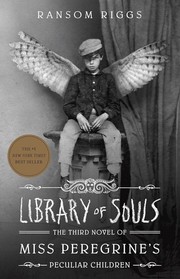
Library of Souls
1,989-word summary 9 min read 464 pages in the book
- First published
- 2015
- Publisher
- Quirk Books
- Pages
- 464
- ISBN
- 9781594747588
- Series
- Miss Peregrine's Peculiar Children (#3)
Reading options
What's inside (5 sections)
I had read Miss Peregrine's Home for Peculiar Children for the photos and stayed for Emma and Jacob, so Library of Souls, third in the series, first published in 2015, Quirk Books paperback edition running 464 pages, ISBN 9781594747588, felt like coming back to friends in trouble. Jacob Portman can see hollowgasts and control them a little. Emma Bloom makes fire. The group, peculiar children led by Miss Peregrine who turns into a bird, must rescue their captured ymbrynes from wights in London's loop ruins. It is darker than book one, funnier in banter, and it closes the original trilogy while leaving doors open.
Jacob is sixteen, from Florida, ordinary until he learns his grandfather Abe told truth about monsters. By book three he has left home, lived in loops where days repeat, fought hollows, and started dating Emma, who is technically much older because loops preserve. The group at the start is scattered. Miss Peregrine trapped as a bird. Other ymbrynes taken. The children, Emma, Olive, Millard the invisible boy, Bronwyn strong, Enoch who raises dead briefly, Hugh with bees, Claire, Horace who dreams true, all hiding in a menagerie loop and arguing about what to do. Jacob must choose to lead rather than follow.
Into London's ruins
The move to London shifts tone from island mystery to urban chase. Wights, the hollow turned human villains who want peculiardom's power, hold ymbrynes in a fortress inside a ruined loop of London bombed in the Blitz and never restored. To get there Jacob's group travels through loops, bribes peculiar hustlers, rides trains that do not appear on maps, hides in plain sight in modern London where phones track. Riggs uses real London geography with fantasy overlays. A phone box that is a door. A square that repeats the same pigeons. Those details reward readers who know the city and orient those who do not.
Millard gets great chapters here because invisibility means research. He reads wight documents, maps patrols, explains loop theory without info dumping too much. His banter with Emma, bossy and warm, carries travel pages that could drag. Olive, young and fiery? Actually Olive lights? She is sweet and brave about separation from her parents. Bronwyn carries literally and emotionally, lifting rubble and spirits. Enoch, creepy and loyal, uses his dead raising sparingly because it costs. Hugh's bees scout. Horace's dreams warn but vaguely. Each peculiarity gets one clear use in the heist, which keeps the large cast manageable. No one feels like luggage.
The wights are better villains here than in book two. Caul, Jacob's grandfather's brother and main antagonist, believes peculiars should rule normals and that hollows are tools. He talks like a reformer, not a monster, which makes him scarier. His lieutenants argue about method. One wants to harvest souls fast. Another wants to breed peculiars. Those disagreements give Jacob openings. A scene where Caul tries to recruit Jacob by praising Abe and offering family history shows grooming as tactic. Jacob listens because he wants grandfather answers, then refuses because he sees the price. That refusal is his coming of age more than any hollow fight.
For photos, Riggs integrates vintage found images as characters and places rather than decoration. A library with shelves to nowhere. A peculiar with a mouth on the back of head. Dogs in coats. I liked how the photos slow you down. You stop to study a face before reading what it does. Some images repeat poses from earlier books, which ties the trilogy visually. If photos gimmick bothers you, this volume leans less on them than book one. Story carries. Images accent.
Rescue and costs
The rescue middle is a heist with time pressure. Get into the Library of Souls, where stolen peculiar souls are stored in jars, free the ymbrynes before Caul uses them to raise an army of hollows, avoid patrols that see invisible boys through special lenses. Jacob must use his hollow control, which is new and frightening. He feels hollows as hunger and must dominate without becoming hollow himself. Those chapters, where he closes eyes and reaches into cold minds, are the best horror in the series. Not gore, but willpower as muscle that tears.
Emma and Jacob's relationship deepens under stress without taking over. They argue about risk. Emma wants to charge. Jacob wants to plan. She makes fire when angry and must learn to bank it. He learns to trust her fire rather than shield her. A quiet scene where they trade stories about Florida and Wales while waiting for a loop to open tells you they are teenagers in love, not just soldiers. Riggs lets them kiss and then interrupt with Horace's prophetic nightmare, which is very them. Romance always collides with peculiar duty.
Losses happen. Not everyone taken survives. A ymbryne dies. A child is hurt badly enough to need a loop to heal slowly. Jacob's parents, back in Florida, get a phone call that cannot explain. Those costs prevent the rescue from feeling like a game. When the group finally frees Miss Peregrine and others, relief is mixed with grief for what Caul already used. The Library itself, endless shelves of glowing jars each holding a soul's memories, is a devastating image. To save the living, Jacob must decide which jars to break, knowing each break erases someone. He hesitates, which is right. Heroes who smash without pause are less interesting.
For pacing, the London travel first hundred pages moves fast. The fortress infiltration middle slows with stealth. Two corridors in a row with whispered plans blurred for me. I skimmed one patrol description because the pattern, wait, signal, move, was clear. Then a chapter where Enoch must raise a dead wight to answer questions snaps it back. Necromancy as interrogation is creepy and clever, with rules about how long dead can speak. Those rules matter later and Riggs plants them without highlighting. Pay attention to Enoch's limits. They return.
Ending a trilogy without ending the world
The climax involves Caul's ritual, Jacob's hollow army against wight control, Emma's fire as signal, and Miss Peregrine choosing bird versus woman at a cost. Without giving moves, the fight works because peculiarities combine rather than overpower. Olive lights oil. Bronwyn throws debris. Hugh sends bees into masks. Horace shouts a dreamed warning just in time. Millard, unseen, pulls levers. It is teamwork, not chosen one blast. Jacob's contribution is to hold hollows back from friends while refusing Caul's offer to rule them. That refusal, witnessed by Emma, defines him more than bloodline. He is Abe's grandson who chooses differently.
Aftermath chapters handle return well. Can peculiars live in modern Florida. Can Jacob go to school after commanding hollows. Can Emma age normally now loops broke. Riggs does not pretend normalcy is easy. Parents need lies that hurt. Friends need goodbyes that may not hold. Miss Peregrine must rebuild a school with fewer ymbrynes. The final pages leave Jacob and Emma together but uncertain about future loops, which sets up later books without cliffhanger cruelty. It feels like graduation. Sad, proud, open.
For criticism, Caul's plan relies on Jacob arriving on schedule, which villains should not. A wight guard changes shifts exactly when needed. A door code is overheard just in time. Each alone is fine. Together they pile. Also, Horace's dreams are vague until useful, which can feel like foreshadowing on demand. And the large cast means Claire and some younger kids get little to do beyond being rescued. They matter emotionally but not plot wise here.
Still, at 464 pages it reads fast for its length. Short chapters, photo breaks, dialogue heavy. I finished in four evenings and immediately wanted Hollow City reread to catch hints. That is what a good third does. It makes the earlier books richer. Jacob seeing hollows in book one now reads as foreshadowing rather than luck. Emma's fire control issues now read as training for this night. Riggs planned, which is rarer than it should be in YA trilogies.
For who this is for. If you liked book one for photos and book two for travel, this pays off both with higher stakes. If you are new, start at Miss Peregrine's Home. You need Abe, the island, the hollow rules for this to land. If you want standalone horror, look elsewhere. This is team adventure with scares and heart. I closed it thinking about jars on shelves, each a life bottled, and about Jacob choosing to break some and carry others. That image of choosing what to save when you cannot save all stayed longer than any monster.
Miss Peregrine as a bird for so long deserves a final thought because Riggs uses it to talk about caretaking burnout. She can protect children only by not being human, by flying, watching, screeching warnings she cannot explain. When she finally returns to woman form, she is tired in a way no rest fixes. She snaps at children she loves, forgets names for seconds, needs tea and quiet before decisions. Those details make an immortal ymbryne feel like every tired mother and teacher. Jacob sees it and steps up without being asked, taking night watch, explaining plans to younger kids in simple words. That handoff, from guardian who cannot keep going to boy becoming guardian, is the trilogy's real ending more than Caul's fall. Peculiarity continues not through souls in jars but through someone willing to stay awake.
Caul's rhetoric as dark mirror of ymbryne talk deserves scrutiny because Riggs lets him sound reasonable for pages. He argues peculiars hid too long, that loops are cages, that normals waste the world peculiars could rule kindly. Jacob, who has seen normals be kind in Florida, and peculiars be cruel in wight halls, does not buy it, but younger peculiars waver. A scene where Caul shows a starving hollow and promises to end hunger by harvesting normals turns stomachs and tempts at once. Who would not want hunger ended. The cost, other people's souls in jars, is abstract until Jacob holds a jar with a name he knows. That concreteness defeats rhetoric better than speeches. Riggs trusts readers to feel the weight of one named jar over a thousand promised meals. It works because the series spent two books naming peculiar children one by one. You know what a jar erases.
Horace's dreams as burden rather than gift also deepen here. He sees deaths he cannot stop clearly enough to prevent, only enough to dread. He dreams Jacob bleeding and wakes screaming, then must eat breakfast with Jacob and act normal. That performance exhausts him more than any fight. When his warning finally arrives in time during the fortress, it is vague, a door and a color, and Jacob must interpret fast. They get it half right, which costs blood but saves lives. Prophecy as partial help feels honest to anxiety. You know something bad, not enough to stop it, enough to stay awake. Horace chooses to keep dreaming despite knowing the cost, which is quiet courage Riggs does not underline. He just shows Horace lying down again the next night.
The photographs as pacing tools deserve mention because Riggs spaces them to give breath. After a tense infiltration chapter, a full page image of an empty library lets you pause and look. After a loss, a portrait of a child who lived makes grief specific rather than general. I found myself slowing for images even when plot urged fast, which balanced the heist momentum. One photo of a corridor with doors ajar made me check my own hallway that night. That bleed, fiction into house, is what found photos do best. They claim this happened, even as story says otherwise. Riggs never claims truth, but the claim hovers and chills. For young readers, that hover teaches skepticism kindly. Look closely. Ask who framed. Wonder what was left out of the rectangle.
FAQ
Where does Library of Souls sit?
Yes. It is book 3 in Miss Peregrine's Peculiar Children, after Hollow City. Start at Miss Peregrine's Home for full rules.
When was Library of Souls published?
Quirk Books published it in 2015. The paperback cited runs 464 pages with ISBN 9781594747588.
Similar books
More from Miss Peregrine's Peculiar Children first, then related titles.
Miss Peregrine's Home for Peculiar Children
Jacob Portman finds his grandfather dead in the woods, follows a cryptic letter to a ruined orphanage in Wales, and meets children living inside a repeating…
2,331-word summary · 10 min read
Hollow City
Jacob leads the peculiars across broken loops to wartime London in 1940, hunting Miss Wren for a cure for bird-trapped Miss Peregrine.
2,373-word summary · 11 min read
The Thief
A boastful young thief is pulled from a prison to steal a legendary stone for the king's magus, and the story he tells about himself is not the whole story.
2,514-word summary · 11 min read

Inkdeath
The final Inkworld novel sends Mo into the land of the dead, leaves Meggie choosing between two boys, and ends the Adderhead's immortality with three written…
2,062-word summary · 9 min read

Vow of Thieves
Kazi and Jase return to Tor's Watch to find it occupied, and their marriage is tested by captivity, betrayal, and a war for the town of Hell's Mouth.
2,059-word summary · 9 min read

The Icebound Land
Captured and enslaved in Skandia, Will fights a drug that erases him while Halt and Horace cut a bloody road through Gallica to bring him home.
2,088-word summary · 9 min read

Lioness Rampant
Alanna searches for the Dominion Jewel with the Shang Dragon, then returns to Tortall to face Duke Roger at Jonathan's coronation.
2,478-word summary · 11 min read

Archenemies
Nova steals for the Anarchists while Adrian hides his Sentinel identity, and a serum that erases prodigy powers puts them both at risk.
2,485-word summary · 11 min read
The Time Paradox
When his mother falls ill with a fairy disease, Artemis Fowl travels back in time to find the extinct lemur that can cure her and confronts his younger self.
2,601-word summary · 12 min read
Dealing with Dragons
A princess who hates embroidery runs away to become the cook and librarian for a dragon, then has to outthink wizards, knights, and a plot against the dragon…
2,563-word summary · 11 min read

The Golem's Eye
Two years after The Amulet of Samarkand, Nathaniel is a rising bureaucrat, Bartimaeus is his unwilling servant again, and something made of clay is tearing…
2,299-word summary · 10 min read
The Chalice of the Gods
Percy needs three recommendation letters from three gods to apply to college, so his first quest is recovering a stolen chalice from the god of old age.
2,106-word summary · 9 min read
The Ship of the Dead
Magnus and his crew sail to the edges of the Norse worlds to stop Loki from launching Naglfar, the ship of the dead.
2,426-word summary · 11 min read

The Rose & the Dagger
Shahrzad is pulled from her Caliph husband and left in a desert camp of rebels, needing to break his curse and end a war before it ends her.
2,520-word summary · 11 min read

The Queen of the Tearling
Nineteen-year-old Kelsea leaves the woods to take her throne, ends a shipment of human captives, and draws the Red Queen's revenge.
2,357-word summary · 10 min read

We Hunt the Flame
In a fractured Arabia-inspired world, a disguised huntress and a prince-assassin race to find a magic-restoring book and confront an ancient evil.
2,195-word summary · 10 min read
The Magician
Sophie and Josh flee to Paris with Nicholas Flamel, where John Dee, Machiavelli, and an awakened god close in on the missing pages of the Codex.
2,162-word summary · 10 min read
The Burning Maze
Apollo, still trapped in a mortal teenager's body, follows a dangerous prophecy through the Labyrinth with Meg and Grover as the Triumvirate's grip tightens.
2,248-word summary · 10 min read

Lore
Lore Perseous, the last of a hunted bloodline, is pulled back into the Agon when a wounded Athena offers her revenge against the god who killed her family.
2,188-word summary · 10 min read

In the Hand of the Goddess
Alanna, still disguised as a boy, survives war, court plots, and a death duel as the Goddess's chosen warrior in the second Song of the Lioness book.
2,018-word summary · 9 min read
House of Salt and Sorrows
Annaleigh Thaumas investigates her sister's death in a cursed island manor where the balls are illusions and the sea god is always listening.
2,025-word summary · 9 min read
The False Prince
A nobleman buys four orphans and tells them only one will survive to impersonate the missing prince. The narrator, a defiant thief named Sage, has other plans.
2,044-word summary · 9 min read
The Battle for Skandia
Will and Evanlyn are still hiding in the Skandian mountains when Halt and Horace arrive with word of a Temujai invasion that could roll on to Araluen next.
2,248-word summary · 10 min read
Fable
Abandoned on a lawless island at fourteen, Fable spends four years diving for gems to buy passage off it, straight into the cutthroat trade of the Narrows.
2,320-word summary · 10 min read
La Belle Sauvage
Philip Pullman's prequel to His Dark Materials follows eleven-year-old Malcolm Polstead as a secret message, a hunted baby, and the flood of the century carry…
2,530-word summary · 11 min read
Emerald Green
Gwyneth must close the blood circle that will crown an immortal tyrant, and the prophecy says her death is the final lock.
2,044-word summary · 9 min read

The Winner's Curse
An aristocratic girl buys a slave who is secretly a prince plotting rebellion.
2,124-word summary · 9 min read

The Iron Queen
Meghan faces the Iron King past while Ash pays a winter price.
2,548-word summary · 11 min read
Furies of Calderon
Furyless Tavi defends Calderon Valley when the Marat return and lords scheme.
2,587-word summary · 11 min read
Anna Dressed in Blood
Ghost hunter Cas meets Anna, the ghost who kills back.
2,622-word summary · 12 min read