
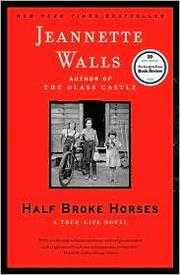
Half Broke Horses
2,580-word summary 11 min read 288 pages in the book
- First published
- 2009
- Publisher
- Scribner
- Pages
- 288
- ISBN
- 9781416586289
Reading options
What's inside (8 sections)
I came to this one backwards, the way a lot of people do. I read The Glass Castle first and could not shake Rose Mary Walls, the mother who would rather paint than buy groceries. Then I learned Walls had written a whole book about Rose Mary's mother, and I thought, oh, so that is where it started. Half Broke Horses is that book. Scribner published it in October 2009 as a 288-page hardcover, billed as a true-life novel, and it is Walls telling the life of her grandmother Lily Casey Smith in Lily's voice, from a dirt dugout in west Texas to a cattle ranch in Arizona.
Lily was born in 1901 and raised poor in a way that makes the Walls kids in The Glass Castle look almost settled. For the first ten years of her life her family lived in a dugout, basically a hole dug into the ground with a canvas roof, on the plains of Texas. Her father was a teacher who moved for work and her mother kept the family fed on very little. Lily grew up breaking horses with her father, doing chores before she could see over the saddle, and learning that if you wanted something done you did it yourself because there was nobody else coming.
A Solo Ride to a Schoolhouse
The part of the book everyone remembers comes early. Lily gets educated in fits and starts because her parents cannot afford to keep her in one school. She is bright, stubborn about books, and furious when money cuts her schooling short. At fifteen she hears about a teaching job in a tiny frontier settlement far from home. She goes after it.
She rides there alone. Twenty-eight days on horseback, carrying what she needs, sleeping rough, navigating by directions that would scare most adults now. Walls does not dress it up as a brave girl adventure with music playing. It is lonely and slow and Lily gets lost and hungry and has to talk her way through suspicious towns. When she arrives she has to prove she can run a one-room school when she is barely older than some of the pupils.
I loved these chapters because the details are so practical. Lily has to keep order among kids who test her, including big farm boys who think a fifteen-year-old girl cannot tell them what to do. She boards with local families, mends her own clothes, figures out how to stretch a tiny salary. She learns to bluff a little, to stand at the front of the room like she belongs there even when she is scared. There is a scene where she has to deal with a parent who thinks girls should not teach at all, and she just outlasts him. She stays polite and refuses to leave.
What I kept thinking about was how much of Lily's later life is already visible here. She does not complain about being young or female or poor. She notices the problem in front of her and fixes it with what she has. If a kid cannot read, she finds another way to teach him. If the roof leaks, she finds a bucket and then finds a ladder. It sounds simple and it is exhausting to live that way, and Walls lets you feel both sides.
The Husband Who Was Already Married
Lily's first marriage is the part she almost does not tell, which tells you something. As a young teacher she meets a handsome, smooth man who seems like a step up. He courts her properly. They marry. Then the truth comes out in pieces: he already has a wife.
Walls handles this without turning it into melodrama. Lily is humiliated and furious, not broken. She leaves him fast once she knows for sure, and she does not make a big speech about it. She just packs and goes. In Lily's telling, the shame is less about divorce itself and more about having been fooled, having missed the signs because she wanted the life to be true.
I appreciated that Walls leaves some gaps here. Lily does not offer a tidy lesson. She was a smart girl who made a bad call about a charming liar, and a lot of smart people do that. The book moves on the way Lily herself moved on, which is to get back to work. If you are looking for a long courtroom reckoning, you will not get it. She cuts him out and keeps riding.
This is also where you start to see the Walls family pattern that carries into The Glass Castle. The women in this family pick difficult men, then refuse to be pitied for it. Rose Mary will later do her own version with Rex. Lily does her version here. None of them ask for rescue.
Jim Smith and a Ranch That Barely Pays
The marriage that lasts is to Jim Smith, a rancher, a quiet man with his own rough past. He is not flashy. He works with his hands. He drinks more than he should at times. He loves Lily in a steady way that does not need announcing. Together they buy and build up ranches in Arizona, most famously the KC Ranch, and raise two kids: Rosemary, who becomes Rose Mary Walls, and Buster.
Life with Jim is not a love story in the movie sense. It is a partnership against weather, debt, sick cattle, broken fences, and neighbors who will cheat you if you let them. Lily runs the books, teaches school when they need cash, breaks horses, shoots straight, and tells off anyone who tries to push the family around. Jim handles stock and land and the endless repair work a ranch demands. They argue about money. They worry about the kids. They stay.
My favorite stretches are the small domestic ones. Lily trying to keep a garden alive in soil that wants to kill everything. Trying to get Rosemary to do chores when Rosemary would rather draw. Trying to keep Buster out of trouble when Buster has other plans. The kids are vivid without being cute. Rosemary in particular is already the person she will become: dreamy, artistic, allergic to routine, convinced that rules are for other people. Lily loves her and cannot understand her, and that tension hums under a lot of pages.
There is a lot of moving in this middle section, from one ranch to another as deals fall through or drought hits or a better lease opens up. If you get restless with books where people just keep relocating and starting over, this part will test you a little. I felt it around the two-thirds mark. Another dry year, another fence to mend, another school to charm. But that is ranch life, and Walls is honest about the grind instead of trimming it to make the story tighter.
Whiskey Under the Baby's Crib
Prohibition hits while Lily and Jim are trying to keep the ranch afloat, and they make a choice that still surprises me. They sell bootleg liquor. They hide bottles under the baby's crib when inspectors come around. Lily, the schoolteacher, becomes a bootlegger because the math is simple: cattle prices are bad, teaching pays almost nothing, and whiskey pays.
Walls tells these episodes with a kind of glee. Lily drives back roads at night, deals with customers who are drunks and liars, keeps a straight face for the law, and funnels the money straight into feed and mortgage payments. She does not moralize about it. In her view, a stupid law that starves your kids is not a law that deserves respect.
There are other jobs and schemes mixed in. Lily plays poker for real stakes and wins more than she loses because she watches faces and remembers cards. She breaks horses for neighbors. She takes in laundry and sewing. She teaches wherever there is a classroom that will have her, including schools for Mexican and Native children that other white teachers avoid. That last detail matters. Lily is blunt about prejudice and has no patience for it, partly because she has been looked down on herself as poor white trash and knows what it feels like.
One thing to know going in: Lily is good at almost everything. Riding, shooting, teaching, poker, flying (yes, she learns to fly a plane later), running a ranch, talking her way out of trouble. If you dislike capable heroines who rarely fail, you might roll your eyes once or twice. I did once, during a stretch where she wins at cards, calms a spooked horse, and puts a cheating businessman in his place within about thirty pages. It is a lot. At the same time, the historical record backs up the broad shape. Lily Casey really did teach at fifteen, really did run ranches, really did learn to fly. Walls may smooth the edges, but she is not inventing the spine.
What Arizona Asks of People
The Arizona chapters are harsh in a way that sneaks up on you. Drought. Floods that wipe out roads in an afternoon. A rattlesnake where you do not expect it. A horse that breaks a leg and has to be put down. A neighbor who loses everything and leaves in the night. A hailstorm that kills chickens and garden in ten minutes.
Lily meets all of it the same way. She buries what needs burying and gets up the next morning. There is a flood episode where she has to get her kids and animals to high ground and then rebuild fences for days after, and Walls writes the physical work so clearly you can feel it in your shoulders. No speeches about resilience. Just mud, wet blankets, a cough that will not quit, and then the sun again.
I found myself comparing Lily to Rex Walls without meaning to. Both can spin a story. Both are charming when they need to be. Both hate being told what to do. The difference is that Lily works. Rex waits for the big break. Lily makes the small break happen daily. When you read the two books back to back, Half Broke Horses reads almost like an explanation and a rebuke at once: here is where the toughness came from, and here is what happens when the next generation keeps the charm and drops the work ethic.
The relationship with Rosemary sharpens toward the end. Lily pushes her daughter to be practical, to train for something, to save money, to marry someone steady. Rosemary wants to be an artist and live freely. Lily sees waste. Rosemary sees control. Neither is entirely wrong. Knowing from The Glass Castle how Rosemary turns out, these scenes ache a little. Lily did everything right as she understood it and still raised a daughter who would let her own kids go hungry rather than take a job she hated. Walls does not spell out the moral. She just shows Lily watching her daughter walk away from the lessons and not knowing what else to try.
Why It Works and Where It Drags
Let me say what I think the book does best, because it is easy to miss under the adventure. Walls writes in Lily's voice, plain and dry and funny, and she sustains it for almost three hundred pages without slipping into her own journalist voice. Short sentences. Little asides. Observations about people that are sharp without being cruel. A line about a neighborPinching pennies until they screamed stuck with me. It feels like listening to a grandmother who has told these stories many times and trimmed all the fat.
The research sits lightly. You learn a lot about west Texas and Arizona in the 1910s through the 1940s, about one-room schools, about ranch economics, about what Prohibition looked like far from Chicago, about how women homesteaded and taught and flew planes when the history books say they stayed home. Walls never stops the story for a lecture. If you want dates and footnotes, look elsewhere. If you want to know what it felt like to cash a tiny teacher's paycheck and make it cover a month, this is your book.
Now the fair criticism. Because it is told as Lily remembering her life, the book sometimes skips over pain too fast. A death happens and Lily notes it and moves to the next job. A betrayal happens and she shrugs it off. After a while I wanted her to sit still for a minute and admit something hurt. Part of that is Lily herself, who clearly believed dwelling was self indulgence. Part of that is Walls choosing to honor her grandmother's style rather than push past it. Readers who want interior life, doubt, grief that lingers, may find Lily too armored.
The pacing sags in the middle ranch years, as I said. Episodes start to rhyme. Drought, debt, a clever fix, a brief relief, then another drought. I put the book down for a day around page 180 and was not in a rush to pick it back up. Then the flying lessons and the later Arizona years pulled me back. The final fifty pages are strong, especially as Lily ages and has to face that her body cannot do what her will still demands.
And one more honest note. This is billed as a true-life novel for a reason. Walls worked from family stories, interviews, letters, and her own memories of Lily, who died when Walls was ten. She fills gaps with imagined dialogue and scenes. She says so up front. If you need every conversation to be documented, read it as fiction based on fact. I read it as Lily as Walls needed to remember her, which is its own kind of truth, but it is not a sourced biography.
Still, I finished it fond of Lily in a way I was not expecting. She is racist against nobody, scared of almost nothing, sentimental about dogs and horses and not much else. She shoots a coyote threatening her chickens without flinching and then cries over a broken teacup her mother gave her. She tells a school board exactly what she thinks and then worries all night she was rude. She loves Jim without making a show of it. When he dies, she keeps going because going is what she knows.
If you loved The Glass Castle, read this. It will change how you see Rose Mary and Rex, not by excusing them but by showing the hard code they inherited and bent. If you did not love The Glass Castle, this might still work for you because Lily is easier company. She does not ask for pity and she does not offer excuses. She just tells you how she broke horses, taught kids, hid whiskey, flew a plane, raised two wild children, and kept a ranch standing through weather that wanted it flat.
I closed it thinking about that dugout where she started. Dirt walls. Canvas for a roof. A little girl watching her father shoe a horse and deciding she would learn to do it herself. Everything Lily becomes is there already, just smaller. By the end she owns land, owns horses, owns her story. The horses in the title are half broke, not fully tame, and that is Lily too. Useful, strong, never quite gentled. I mean that as praise.
FAQ
When was Half Broke Horses published?
Scribner published it on October 6, 2009 in a 288-page hardcover. Walls calls it a true-life novel based on her grandmother Lily Casey Smith.
Is Half Broke Horses a sequel to The Glass Castle?
No, it is a standalone account of Walls's grandmother, Lily Casey Smith, who is Rose Mary Walls's mother. It reads well alongside The Glass Castle but has no series order.
Did Lily Casey Smith really teach at fifteen?
Yes, that is the documented spine of the book. She rode to a remote frontier school and ran a one-room classroom, then later ranched, broke horses, bootlegged during Prohibition and learned to fly.
Similar books
Open
Tennis star Andre Agassi recalls hating tennis, falling to No. 141, and rebuilding his life on his own terms.
2,352-word summary · 10 min read
The Storyteller: Tales of Life and Music
Foo Fighters frontman recalls Nirvana, drumming, fatherhood, and life on the road.
2,307-word summary · 10 min read
Finding Me
Viola Davis traces her path from poverty in Rhode Island to Oscar night with blunt honesty about race and family.
2,823-word summary · 13 min read
The Glass Castle
Jeannette Walls's memoir of a childhood spent hungry and moving, from a stove fire at three to a Bronx apartment and parents on the street.
2,255-word summary · 10 min read

The Long Winter
Dakota Territory, 1880: seven months of blizzards cut a town off from the railroad, and a family survives on twisted hay, ground wheat, and a dangerous wheat…
2,210-word summary · 10 min read

Long Walk to Freedom
Mandela's account of a Thembu childhood, a law practice, a banned movement, twenty-seven years in prison, and the negotiation that ended apartheid.
2,454-word summary · 11 min read
Brown Girl Dreaming
Jacqueline Woodson retells her childhood in verse, moving from Ohio to South Carolina to Brooklyn while the civil rights movement reshapes the world around her.
2,727-word summary · 12 min read

Little Town on the Prairie
In the spring after the Long Winter, fifteen-year-old Laura sews shirts, studies for a teaching certificate, and helps send her blind sister Mary to college.
2,071-word summary · 9 min read
Too Much and Never Enough: How My Family Created the World's Most Dangerous Man
Mary L. Trump's 2020 memoir traces how a cold, zero-sum Queens household shaped her uncle, and uses family tax documents to challenge his self-made story.
2,059-word summary · 9 min read

Infidel
Ayaan Hirsi Ali's memoir of a Somali childhood, a forced marriage, a Dutch asylum claim, and the political fight that followed the murder of Theo van Gogh.
2,041-word summary · 9 min read

Fathers and Sons
Arkady brings the nihilist Bazarov home to his father's estate, and a generational argument turns into love, a duel, and an early death.
2,192-word summary · 10 min read

The Girl with Seven Names: A North Korean Defector's Story
Hyeonseo Lee crossed the frozen Yalu River at seventeen, spent years hidden in China, escaped to South Korea, and later returned to rescue her family.
2,404-word summary · 11 min read
Beautiful Boy: A Father's Journey Through His Son's Addiction
David Sheff recounts watching his son Nic slide into meth addiction, and his own desperate, humbling search for how to help without destroying them both.
2,076-word summary · 9 min read
The Magnolia Story
How Chip and Joanna Gaines met, closed their first shop, nearly lost everything in a housing development, and built Fixer Upper.
2,994-word summary · 13 min read
Life
The Rolling Stones guitarist tells his own story: a Dartford childhood, the band's first gigs, the drug raids, the tax years and Patti Hansen.
2,761-word summary · 12 min read
The Letters of Vincent van Gogh
Vincent van Gogh's letters to his brother Theo, in a Penguin Classics selection edited by Ronald de Leeuw, trace a decade of work, faith, and obsession.
2,611-word summary · 12 min read
The Stranger Beside Me
Ann Rule's classic memoir of her friendship with Ted Bundy, written by the true-crime author who knew him long before the world learned what he had done.
2,481-word summary · 11 min read
On the Banks of Plum Creek
The Ingalls family trades their horses for a dugout on Plum Creek and bets a single wheat harvest on a house above ground, in Wilder's fourth Little House book.
2,090-word summary · 9 min read
Born Standing Up: A Comic's Life
Steve Martin's memoir of how a shy Disneyland magician's assistant built a strange avant-garde act, and why he walked away from stand-up at his peak.
2,034-word summary · 9 min read
Wild Swans
Three generations of women survive warlords, revolution, and the Cultural Revolution in Jung Chang's family memoir.
2,356-word summary · 10 min read
The Tenant of Wildfell Hall
Helen flees a cruel marriage, hides as Helen Graham at Wildfell Hall, and tells her full story through a long diary young Gilbert Markham must read before…
2,838-word summary · 13 min read
The Color of Water
A Black journalist presses his white mother about her hidden past, from a Virginia store to twelve college degrees.
2,457-word summary · 11 min read
Moloka'i
Seven-year-old Rachel Kalama is sent to Kalaupapa leprosy settlement in Hawaii, growing into a full life of love and loss.
2,190-word summary · 10 min read

Lady Tan's Circle of Women
Ming physician Tan Yunxian treats bound feet and births with midwife Meiling, defying male medicine rules.
2,330-word summary · 10 min read
Holidays on Ice
Six Christmas pieces, from a Macy's elf stint to a feral family newsletter. Sedaris at his sharpest and most sentimental.
2,410-word summary · 11 min read
Hidden Valley Road: Inside the Mind of an American Family
The Galvin family raises twelve children while six sons develop schizophrenia across decades of shifting science.
2,492-word summary · 11 min read
Beyond the Wand: The Magic and Mayhem of Growing Up a Wizard
Tom Felton looks back on ten years as Draco Malfoy, from schoolboy auditions to fame, music, and getting sober.
2,267-word summary · 10 min read
American Sniper: The Autobiography of the Most Lethal Sniper in U.S. Military History
Navy SEAL sniper Chris Kyle recounts Texas roots, SEAL training, four Iraq tours, and the strain combat placed on his marriage and health.
2,011-word summary · 9 min read
Maus II: A Survivor's Tale: And Here My Troubles Began
Vladek survives Auschwitz and the death march while Art struggles with success, guilt, and his father's aging stubbornness.
2,111-word summary · 9 min read