
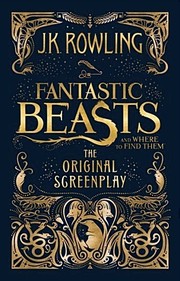
Fantastic Beasts and Where to Find Them: The Original Screenplay
2,092-word summary 9 min read 293 pages in the book
- First published
- 2016
- Publisher
- Scholastic
- Pages
- 293
- ISBN
- 9781338109061
- Series
- Fantastic Beasts (#1)
Reading options
What's inside (11 sections)
I read the screenplay because the film left me wanting Newt's lines on paper. J.K. Rowling published it in 2016, her screenwriting debut, with the US edition from Scholastic that November. My reading follows the 293 page hardcover. Magizoologist Newt Scamander loses his case in 1926 New York while dark wizard Grindelwald hides in plain sight. It is adventure packed storytelling in script form, lighter than Potter and looser than the textbook it grew from.
Newt arrives in New York meaning a brief stopover. His case holds fantastic beasts for research and return. At a bank he meets Jacob Kowalski, a No-Maj factory worker dreaming of a bakery, and their cases get swapped by accident. Creatures escape across the city. A Niffler robs jewels. An Erumpent rampages through Central Park. A Demiguise named Dougal turns invisible at the worst moments. An Occamy grows or shrinks to fit available space. Newt, with help from disgraced Auror Tina Goldstein and her mind reading sister Queenie, scrambles to recapture them before No-Maj eyes notice.
New York wizards and No-Majs
The American wizarding world differs sharply from Hogwarts Britain, which gives the book fresh texture despite familiar bones. MACUSA, the Magical Congress, enforces Rappaport's Law segregating wizards from No-Majs with severity born of Salem memories. President Seraphina Picquery rules briskly. Percival Graves, security chief with a sharp suit and sharper stare, demands order at any cost. Tina, demoted for defending a No-Maj from a bad spell, seeks redemption through Newt's chaos. Queenie reads minds with flirtatious ease that unsettles men used to guarding thoughts. Jacob, the only No-Maj in the gang, reacts with working class wonder that grounds every marvel. His delight at Bowtruckle Pickett picking locks mirrors the reader's own.
Newt himself charms as a different kind of hero. Awkward with people, fluent with beasts, expelled from Hogwarts yet trusted by Dumbledore. He prefers creatures because they do not lie about motives. Eddie Redmayne's performance lives in the script's parentheticals, all averted eyes and sudden gentleness. Those stage directions make the screenplay read warmer than bare dialogue would. A shrug described. A hand extended to an Erumpent in mating dance. Action lines carry the book's heart where novels would use interiority. Read them slowly. They are the story.
The 1920s setting adds jazz, coats, and casual prejudice that the book handles with period honesty. Segregation laws. Speakeasy energy. Anti magic pamphlets from the New Salem Philanthropic Society, run by Mary Lou Barebone with her adopted children. Those fanatics preach wizard extermination while real evil wears Auror robes nearby. That dramatic irony structures the middle. Crowds cheer witch hunters. Readers watch Graves. Both hunts miss their true target until creatures force attention. New York holds its breath through a very long week.
Credence and the Obscurus
The story's dark center belongs to Credence Barebone, Mary Lou's adopted son, beaten and caged for any flicker of strangeness. He is an Obscurial, a child whose suppressed magic became a parasitic force, the Obscurus, that bursts out in destruction. His arc gives the adventure its tragedy. While Newt chases beasts, Credence breaks apart under cruelty that no Thunderbird can outfly. Ezra Miller's film performance haunts the script's sparse lines. A flinch described. A silence held. Those beats land harder for understatement. Pain needs no adjectives here.
Graves takes special interest in Credence, promising belonging while using him to find the Obscurial child. That grooming dynamic reads as the book's most uncomfortable thread, deliberately so. An adult with power offering a starved boy the only kindness he ever knew, priced in betrayal. When the reveal comes that Graves is Gellert Grindelwald in disguise, Polyjuiced and patient, the grooming gains continental stakes. The mighty dark wizard spent months courting one broken boy to weaponize him. That patience terrifies more than any duel. Evil as caseworker. Kindness as leash.
The climax griefs and dazzles together. Credence unleashed. Aurors firing. Newt trying to save rather than kill. The Thunderbird Frank released with memory rain that obliviates the city while Jacob, who loves Queenie truly, watches memories dissolve he chose to forget for safety. Keep the bakery scene general here beyond saying occamy shells seed a happy ending the participants can not fully remember. Joy with holes. That is the book's final spell. Wonder costs continuity. Pay gladly.
Tina, Queenie, and Jacob's bakery warmth
The Goldstein sisters deserve emphasis as the book's emotional counterweight to spectacle. Tina, by the book Auror demoted for doing right, pursues Newt with warrant paperwork and growing admiration she will not name. Her rigidity softens across arrests that go sideways. Queenie, legilimens with bedroom eyes and kitchen warmth, reads Jacob's gentle mind and loves what she finds. Their romance, mind reader and baker, gives the story its sweetest thread. She knows his every thought. She stays anyway. That acceptance transcends the memory wipe tragedy their love faces. Knowing all and choosing still is the book's quiet definition of love. Remember it when rain falls.
Jacob's bakery epilogue, seeded with occamy shell silver he can not explain, lands as earned grace note rather than cheat. He builds something with his hands after losing everything including memory. When Queenie walks in smelling bread, recognition flickers past potion. Some loves survive obliviate. That hope suits a series about preserving wonder in hostile cities. Bake daily. Remember slowly. The script's final stage direction about silver shells winks at attentive readers. Magic leaves residue that bureaucracy can not wash. Keep looking in batter.
MACUSA's politics repay attention as American wizarding history with teeth. Rappaport's Law segregating magic from No-Maj life reads as allegory that 2016 audiences felt sharply. Picquery enforces with pragmatism. Graves exploits with cruelty. Tina navigates between as career woman in sexist institution. Those layers give rereads depth beyond creature chases. Laws shape lives more than wands do. The book knows and stages hearings to prove it. Watch gavel scenes closely. They predict later films' larger battles over secrecy and exposure.
Beasts as characters, not props
Each escaped creature earns personality that justifies Newt's devotion and the chase structure. The Niffler loves shiny things with kleptomaniac joy that bank vaults can not resist. Pickett the Bowtruckle suffers separation anxiety and picks locks when nervous. Dougal the Demiguise sees futures and hides from them. The Erumpent, massive and amorous, needs mating dance, not force. Frank the Thunderbird carries weather and rescue both. Those characterizations lift pursuits past fetch quests. Each recapture requires understanding species, not overpowering it. Dance with Erumpent. Croon to Occamy. That empathy first method defines Newt against Aurors who stun first. Knowledge beats wands when applied kindly.
What the beasts cost in plot logic, they repay in wonder that 1926 New York desperately needs. Bankers meet Nifflers. Housewives meet Occamies. Those collisions play as comedy with melancholy edges. Ordinary lives brush magic briefly, then forget by rain. Readers feel both delight and loss in that bargain. Wonder visits. Memory erases. Jacob keeps bakery shells as residue. We keep books. The exchange feels fair enough to accept while aching a little. Magic taxes continuity. Pay in forgetting.
Grindelwald in plain sight
Graves as Grindelwald reveal deserves discussion as dramatic irony engine that rewards rereads enormously. Every harsh order, every lingering look at Credence, gains double meaning once disguise is known. The mighty dark wizard spent months as security chief hunting himself through bureaucracy. That patience terrifies more than duels could. Evil as middle management with perfect paperwork. Readers who guessed will feel clever. Those surprised will admire planting. Clues sat visible throughout. Sharp suits. Silver tongue. Interest in Obscurials exceeding duty. Reread his scenes with knowledge and menace doubles. Polyjuice as patience. Power waiting.
What the reveal costs Newt personally matters more than plot shock. He trusted authority enough to cooperate, handing creatures and testimony to enemy wearing badge. That betrayal teaches the magizoologist that human monsters exceed animal dangers. Beasts bite when threatened. Men smile while steering orphans toward ruin. Newt's later wariness in sequels roots here. Innocence lost in MACUSA halls, not on moors. The book marks his education without cynicism. He keeps trusting individuals while doubting institutions. That distinction will define his war conduct going forward. Trust faces. Audit badges.
New Salem fear in 1926 mirrors
Mary Lou Barebone's crusade deserves attention as period bigotry with contemporary echoes that 2016 audiences felt sharply. Orphanage matron preaching wizard extermination, she abuses adopted children while collecting donations from frightened neighbors. Her pamphlets and rallies mirror real moral panics where fear monetizes. Credence suffers most under her roof, internalizing shame that literally explodes. Those dynamics give fantasy villains human roots deeper than dark lords. Muggles, er, No-Majs can be monsters without wands. Barebone proves it through belt and pulpit. Evil needs no magic, only certainty plus audience.
What her movement costs wizards hiding in plain sight parallels queer and immigrant histories the book handles with light but real touch. Passing as normal to survive. Meetings in basements. Fear of exposure ruining lives built carefully. Those resonances enrich rereads beyond creature fun. MACUSA's own segregation laws, meant to protect, trap their people in parallel closets. The book critiques both persecutors and protectors who control through hiding. Safety purchased with invisibility still costs. Pay attention to who demands hiding and why. Answers indict broadly.
Graves as Grindelwald in plain sight
The reveal that Graves is Grindelwald rewards rereads enormously and deserves discussion as dramatic irony engine. Every harsh order, every lingering look at Credence, gains double meaning once disguise is known. The mighty dark wizard spent months as security chief hunting himself through bureaucracy. That patience terrifies more than duels could. Evil as middle management with perfect paperwork. Readers who guessed will feel clever. Those surprised will admire planting. Clues sat visible throughout. Sharp suits. Silver tongue. Interest in Obscurials exceeding duty. Reread his scenes with knowledge and menace doubles. Patience as weapon. Power waiting.
What the reveal costs Newt personally matters more than plot shock. He trusted authority enough to cooperate, handing creatures and testimony to enemy wearing badge. That betrayal teaches the magizoologist that human monsters exceed animal dangers. Beasts bite when threatened. Men smile while steering orphans toward ruin. Newt's later wariness in sequels roots here. Innocence lost in MACUSA halls, not on moors. The book marks his education without cynicism. He keeps trusting individuals while doubting institutions. That distinction will define his war conduct going forward. Trust faces. Audit badges.
What soars and what script constrains
What soars is imagination at full stretch with new beasts, 1920s New York, and a beating tragic core. The screenplay form moves fast across 293 pages with white space doing pacing work novels achieve through chapters. MinaLima design in print editions adds marginalia that rewards physical copies. The cast charms. Jacob steals every scene through decency. Queenie dazzles. Tina steadies. Newt tends. That ensemble carries goodwill past plot creaks into genuine affection.
What constrains is thinness inherent to scripts read cold. Interiority arrives only through parentheticals. Subplots like the Goldstein sisters' past get lines where novels would give chapters. Grindelwald's plan, grand in later films, reads here as setup with payoff deferred to series entries that stumbled theatrically. Readers wanting Potter depth may find it breezy. Film lovers wanting storyboards will find exactly their book. Know which shelf holds you before judging weight. This is blueprint, not building. Beautiful blueprint though.
Length suits the form. No bloat possible when dialogue dominates. A few action sequences blur on page that film clarified through motion. Read with the movie fresh in mind for best effect, or let imagination stage its own Erumpent dance. Either works. The script invites both readings generously. Stage or screen. Newt accommodates.
Who should open the case
Give the screenplay to Potter fans who want Rowling's 1920s expansion, to film lovers who enjoy reading what they watched, to teens needing fast adventure with beasts. It suits travel reading with short scenes and clear type. Do not give it to readers wanting novelistic depth or standalone closure from a five film plan. Pair it with the 2001 textbook for Newt's scholarly voice against his scripted awkwardness.
At 293 pages I read it in one sitting, marking Pickett pages. Newt starts stopping over briefly and ends staying to fight for beasts and broken boys alike, choosing care over itinerary. That stay, awkward and absolute, is why the debut screenplay charms past blueprint limits. Cases open. Creatures escape. Kindness recaptures. Mind the Niffler.
FAQ
When was the screenplay published?
Scholastic published the US edition in November 2016. The hardcover runs 293 pages and the ISBN is 9781338109061.
Is it the same as the textbook?
No. It is a different work from the 2001 Hogwarts textbook, telling Newt's New York adventure as Rowling's screenwriting debut.
Is it part of a series?
Yes. It opens the Fantastic Beasts screenplay series continued in The Crimes of Grindelwald.
Similar books
More from Fantastic Beasts first, then related titles.
Fantastic Beasts and Where to Find Them
Newt Scamander's Hogwarts textbook catalogues 85 magical beasts across five continents.
2,669-word summary · 12 min read
The Tales of Beedle the Bard
Five wizard fairy tales from Hermione book, with Dumbledore notes, including the Three Brothers and the Hallows.
2,663-word summary · 12 min read

The Blinding Knife
Kip trains to join the Blackguard while the Prism hides his true identity, loses his colors, and fights a war against a rogue drafter who wants to birth a god.
2,049-word summary · 9 min read

Inkdeath
The final Inkworld novel sends Mo into the land of the dead, leaves Meggie choosing between two boys, and ends the Adderhead's immortality with three written…
2,062-word summary · 9 min read
Dawnshard
Rysn sails toward forbidden Akinah to save her dying larkin and finds a Dawnshard guarded by the Sleepless.
3,229-word summary · 14 min read

The Field Guide
Three siblings move into a creepy Maine estate, anger a brownie, and find a forbidden guide to the fairy world in the first Spiderwick book.
2,033-word summary · 9 min read

Secrets of the Dragon Sanctuary
Kendra is replaced by a plant copy and held by the Society, while Seth steals a unicorn horn so the family can enter a dragon sanctuary.
2,590-word summary · 12 min read

Lioness Rampant
Alanna searches for the Dominion Jewel with the Shang Dragon, then returns to Tortall to face Duke Roger at Jonathan's coronation.
2,478-word summary · 11 min read
Witches Abroad
Three Lancre witches fly to Genua to stop a fairy godmother from forcing a servant girl into a storybook marriage, and find a city arranged around a happy…
2,651-word summary · 12 min read
The Time Paradox
When his mother falls ill with a fairy disease, Artemis Fowl travels back in time to find the extinct lemur that can cure her and confronts his younger self.
2,601-word summary · 12 min read

The Golem's Eye
Two years after The Amulet of Samarkand, Nathaniel is a rising bureaucrat, Bartimaeus is his unwilling servant again, and something made of clay is tearing…
2,299-word summary · 10 min read

Magician's Gambit
Garion and his companions cross haunted Maragor and the caves beneath Rak Cthol to recover the Orb of Aldur.
2,391-word summary · 11 min read

Homeland
Drizzt Do'Urden is born into the cruel drow city of Menzoberranzan, where his father teaches him to fight and to doubt everything his family believes.
2,303-word summary · 10 min read
Enchanters' End Game
Garion marches toward Torak while Ce'Nedra leads the West's army in the final Belgariad volume, where prophecy and war meet.
2,557-word summary · 11 min read
Nettle & Bone
Marra, a princess in a convent, leaves to save her abused sister, but first she must finish three impossible tasks: a bone dog, a nettle cloak, moonlight in a…
2,061-word summary · 9 min read

Grip of the Shadow Plague
A plague turns Fablehaven's creatures of light into shadows while Kendra hunts an artifact in Arizona and Seth races to find the cause.
2,131-word summary · 9 min read

The Rose & the Dagger
Shahrzad is pulled from her Caliph husband and left in a desert camp of rebels, needing to break his curse and end a war before it ends her.
2,520-word summary · 11 min read

The Queen of the Tearling
Nineteen-year-old Kelsea leaves the woods to take her throne, ends a shipment of human captives, and draws the Red Queen's revenge.
2,357-word summary · 10 min read
Fool's Errand
FitzChivalry Farseer has lived in exile for fifteen years. When Prince Dutiful vanishes before his betrothal, Fitz returns to Buckkeep to find him, with a wolf…
2,606-word summary · 12 min read

We Hunt the Flame
In a fractured Arabia-inspired world, a disguised huntress and a prince-assassin race to find a magic-restoring book and confront an ancient evil.
2,195-word summary · 10 min read
The Sword of Shannara
A young half-Elf and a company of companions set out to recover a magic sword before the Warlock Lord destroys the Four Lands.
2,474-word summary · 11 min read
The Magician
Sophie and Josh flee to Paris with Nicholas Flamel, where John Dee, Machiavelli, and an awakened god close in on the missing pages of the Codex.
2,162-word summary · 10 min read
Magician: Apprentice
An orphan kitchen boy and a smith's son grow up in a frontier castle just as invaders from another world open a rift and begin a war that will change both of…
2,114-word summary · 9 min read

In the Hand of the Goddess
Alanna, still disguised as a boy, survives war, court plots, and a death duel as the Goddess's chosen warrior in the second Song of the Lioness book.
2,018-word summary · 9 min read
A Fate Inked in Blood
In Norse-inspired Skaland, a fish gutter hiding a goddess's blood is claimed by a jarl, bound by oath, and guarded by the son she cannot want.
1,971-word summary · 9 min read
The Stonekeeper
After their father's death, Emily and Navin chase a monster into a hidden world to save their mother, and Emily's great-grandfather's amulet offers power at a…
2,753-word summary · 12 min read
When the Moon Hatched
An assassin who hears air takes a job that throws her to dragons and a hunter.
2,083-word summary · 9 min read
The Tower of the Swallow
Ciri flees as a bandit while Geralt gathers allies to find her.
2,580-word summary · 11 min read
The Indian in the Cupboard
Omri learns a key turns plastic Little Bear into a live Iroquois man.
2,228-word summary · 10 min read
The Emperor's Soul
Forger Shai must stamp a new soul for the dying emperor in 100 days.
2,313-word summary · 10 min read