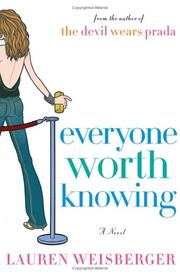
Everyone Worth Knowing
2,360-word summary 10 min read 367 pages in the book
- First published
- 2005
- Publisher
- Simon & Schuster
- Pages
- 367
- ISBN
- 9780743262293
Reading options
What's inside (8 sections)
I came to this book with the wrong expectations, which is probably the fairest thing I can say about how I first heard of it. A friend handed it to me after I finished The Devil Wears Prada and said, here is the follow-up, same author, another New York girl in a job she does not understand. That is roughly true. Everyone Worth Knowing is Weisberger's second novel, published by Simon & Schuster in 2005, and it does put a twenty-seven-year-old woman into a glossy industry she is not prepared for. The difference is that Andrea Sachs was dragged into fashion by a boss she feared, while Bette Robinson walks away from a perfectly good job because her best friend gets engaged to the wrong man. I keep coming back to that opening decision, because it tells you a lot about the book that follows. Bette is not looking for a career. She is running from a feeling, and the glamour finds her by accident.
The girl who walked out of UBS
Bette Robinson has spent five years at UBS, the investment banking firm she joined after graduating from Emory University with her friend Penelope. She is twenty-seven, single, living in Manhattan, and stuck in a routine that looks fine from the outside and feels airless from the inside. The push comes at a dinner or a party, when Penelope, known as Pen, announces that she is engaged to Avery Wainwright. Avery is a longtime family friend, the kind of man whose family is in New York society, and neither Bette nor Pen's other friends think he is right for her. He has no real plans beyond applying to law school to put off the question of what he will do with his life. Bette hears the news and quits her job almost on impulse. The book never pretends this is sensible. It treats it as the first honest thing she has done in years.
What I liked here is that Weisberger gives Bette a specific inward life before the parties start. She secretly loves trashy romance novels, with titles like The Very Bad Boy and Her Royal Bodyguard, and she belongs to a reading group of women who share the habit. This is the person who will end up on the guest lists: a smart woman with a guilty pleasure and a stubborn streak, not an empty head in a nice dress. Her parents are former radicals who met at Berkeley in the 1960s. Her father Robert teaches ecology at Vassar and her mother works at the college health center. They do not celebrate Thanksgiving, and the family was once wanted by the FBI. That background matters later, in a scene I will get to, because it explains why Bette can move through high society without ever quite believing in it.
Penelope deserves a better account than the book gives her. She is Bette's friend from Emory and a coworker at UBS, and the two come from very different backgrounds, which is one of the reasons the friendship has lasted as long as it has. When she gets engaged, the people around her treat it as a social triumph. Bette sees a woman settling for a man who has not earned her. The engagement is the novel's first example of a crowd agreeing that something is fine because everyone else has agreed, and it sets up the pattern Bette will later find in the public relations world. She cannot quite accept a decision made by committee, even when the committee is made up of her own friends.
Her uncle Will is the bridge to the new life. He writes a once-popular syndicated entertainment column called Will of the People, which has drifted into conservative rants, and he lives with his partner Simon, who remains devoted to him despite their political differences. Will introduces Bette to Kelly, an event planner who runs one of the hottest public relations firms in the city. Bette goes to work for Kelly & Co. because she has nothing better to do, and because the money is good. That is the whole mechanism of the plot. One decision made in a mood, and suddenly she is being paid to know people.
Thirty-five thousand names
The line that explains the title comes from Kelly, describing her business to Bette. She says she has an office full of people whose job it is to know everyone worth knowing, that there are thirty-five thousand names in their files, and that they can reach any of them at any time. It is a clean piece of self-description, and it is also a threat. Once you work for a woman who thinks of people as entries in a database, you start to see yourself the same way.
Bette's duties are absurd and oddly pleasant. She plans parties, stands in fashionable nightspots, eats and drinks on the company tab, and learns which restaurants and clubs matter. Weisberger fills these scenes with real names, and the effect is strange because the famous people are treated as set dressing. Hugh Hefner, Jay-Z, James Gandolfini, Ashanti and Jerry Seinfeld all drift through the book. At the time this felt like a trick to make the world seem real. Reading it now, the parade of celebrities has the opposite effect, because nobody in the room ever seems to have a thought of their own. Bette is more alert than the people she is paid to flatter, and the book keeps asking whether that makes her smarter or merely more useful.
The story is set in the mid-2000s. The Iraq War is mentioned in passing, and the 2004 election is discussed as something recent. There are departures from New York to Istanbul and to Poughkeepsie, but most of the novel happens in a narrow world of clubs, benefits and private parties. Weisberger knows the geography of that world well. She knows what it feels like to be the woman at the door who is suddenly on the list, and she knows how quickly the novelty wears off when the same room keeps producing the same conversations.
The column and the playboy
The fun in the middle of the book comes from a gossip column called Ellie Insider, published on a fictional website called New York Scoop. The writer is Abby Abrams, an acquaintance from Emory who is ostensibly just another freelance writer. Abby is cruel in a particular way: she never says anything directly, she arranges facts so that other people do the damage, and she seems to enjoy the pain she causes. The column begins linking Bette romantically to Philip Weston, a wealthy British playboy who is nominally a lawyer. Bette finds him attractive and his attention is very good for her standing at Kelly & Co. The rumor makes her more interesting to the very people who were ignoring her a month ago.
Philip is not a prize. He has a cruel streak and a condescending attitude toward women, and Bette keeps noticing these things and then explaining them away. The moment that ends the fantasy is not a grand confrontation but a discovery: she finds him having sex with another man. It is one of the sharper scenes in the novel, because Weisberger lets the embarrassment do the work. Bette does not become a different person overnight. She simply stops being able to tell herself the story she was telling about him.
There is a second source of trouble at Kelly & Co. Elisa, a coworker, is a cocaine addict who secretly passes information about Bette to Abby out of jealousy over the supposed relationship with Philip. Davide, another employee, has a vaguely defined Italian background and enough family money to carry an American Express black card. These people are drawn broadly, almost as types, but the office politics they create are convincing. Bette is new, she is being watched, and every mistake she makes is available to someone else. The public relations firm that trades in secrets turns out to run on them internally too.
Sammy and the kitchen
The relationship that gives the book its heart is with Samuel Stevens, known as Sammy, a bouncer at Bungalow 8. He is from Bette's hometown of Poughkeepsie, and she knew him in high school, though not well. He has ambitions of being a chef, and he is tied to a wealthy socialite whose money complicates his plans. He wants out of the high life and into a small restaurant of his own. This is the kind of dream the novel treats with respect, which is more than it gives most of the people at the parties.
Bette and Sammy connect on a trip to Istanbul. The trip is partly work and partly escape, and it gives Weisberger a chance to move the characters out of Manhattan and see how they behave when the guest list disappears. On the flight to Istanbul, the characters pass the time watching Quentin Tarantino's Pulp Fiction, and the small detail does more than a page of description to place the book in its moment. What follows is the scene I remembered longest after finishing. On a Thanksgiving visit back to Poughkeepsie, Sammy cooks for Bette's parents, and his food impresses them. This matters because her father is a committed organic vegetarian and a man who has spent a lifetime being suspicious of comfort. The night before the holiday, he secretly compliments Sammy on the best meal he has had in ages, even though it is not strictly organic or vegetarian. It is a small, quiet scene, and it does more for Sammy than any amount of banter in a club.
I found myself wanting more of this part of the book. The kitchen, the hometown, the parents who do not fit the cocktail party world, all of it feels lived in. Whenever the novel stays with Sammy and with Bette's family, the glossy machinery slows down and something real can happen. Whenever it returns to the parties, the prose gets very sure of its own cleverness.
What the new life costs
Weisberger calls the book a kind of morality play, and that is fair. Bette is an unglamorous young woman who is suddenly at home in a glamorous industry, keeping a distance she tells herself she means to maintain. The cost is measured in the people she leaves behind. She grows distant from Penelope and her other friends, and the woman who once walked out of a job over a friend's engagement starts missing the calls she used to get. The book is clear that the career has been bought with something. It is less clear about whether Bette would make the same choice again, and that uncertainty is one of its better qualities.
The other cost is the atmosphere. Everyone Worth Knowing depicts far more decadent behavior than The Devil Wears Prada did. There is casual sex, frequent illegal drug use, and women starving themselves to the point of fainting from hunger. Elisa's cocaine habit is one thread of this, but the book keeps returning to the idea that the beautiful rooms are built on unhappiness and self-harm. Bette watches all of it and keeps going to work. That is the moral position of the novel: not that she is corrupted, but that she is willing to look away for a while.
Her final choice is to reject the life she has built and go after something she actually needs. The ending is not a triumph so much as a correction. Sammy offers the possibility of a quieter life with real work and real affection, and Bette has to decide whether she can accept it without the audience. I liked that the book does not dress this up as a victory lap. She gives up a job that made her feel important, and the last pages are about being ordinary with someone who sees her clearly.
The reception, and a fair complaint
The reviews were rough, and I think it is worth being honest about why. The New York Times Book Review called the novel fatuous and clunky. USA Today called it a lackluster imitation, and Entertainment Weekly said it was a ho-hum rehash. All three reviews were comparing it to The Devil Wears Prada, and all three found it wanting. The comparison is not entirely fair. This is a different book about a different temptation, and Bette's story is less about a boss from hell than about a young woman learning how much of herself she is willing to spend to be wanted. Still, the critics had a point about the execution. The middle drifts, the same party scenes repeat, and the people who populate them are often drawn too thinly to carry the jokes.
The sales tell a similar story. The novel debuted on the New York Times Best Seller List at number ten and dropped off after two weeks, which was a disappointment for a book whose publisher reportedly paid Weisberger a million dollars. Overseas, it was repackaged under titles that tell you how the book was sold: Gossip and Gucci in parts of Europe, The Queen of Parties in Greece, People or Not People in France. Those titles promise the froth, and the book does deliver it. What they do not promise is the small, steady friendship plot that runs underneath, and that is the part I would defend.
I would hand this to someone who wants a fast, funny book about a woman making a mess of her life in New York. I would warn that reader that the mess is more interesting than the parties. Weisberger can write a scene where a father quietly compliments a young man's cooking, and she can write a friendship that survives a bad engagement and a long absence. She is less convincing when she is asking us to care about a guest list. The title tells you what the PR firm sells. The book is best when it notices what that kind of knowing leaves out.
FAQ
Is Everyone Worth Knowing part of the Devil Wears Prada series?
No. It is Weisberger's second novel and a standalone story about Bette Robinson, a young woman working in public relations. The connection to the earlier book is the author and the New York setting, not a shared cast.
What does the title mean?
It comes from Kelly, Bette's boss, who says her firm employs people whose job is to know everyone worth knowing. She claims thirty-five thousand names in her files and says they can reach any of them at any time.
Why did the book get poor reviews?
Critics at The New York Times Book Review, USA Today and Entertainment Weekly found it clunky and too close to The Devil Wears Prada. It debuted at number ten on the New York Times list but fell off after two weeks.
Similar books
When Life Gives You Lululemons
Emily Charlton leaves Runway for Hollywood and ends up in Greenwich, where a supermodel's DUI and a senator husband's ambitions draw three women into a…
2,028-word summary · 9 min read
Chasing Harry Winston
Three friends turn thirty in Manhattan and make a wild pact: Emmy will sleep her way around the world, Adriana will settle down, and Leigh watches from the…
2,185-word summary · 10 min read
The Distance Between Us
Seventeen-year-old Caymen Meyers distrusts rich people, then a wealthy boy keeps proving her wrong while her mother's doll shop struggles to survive.
2,231-word summary · 10 min read
The Vacationers
A New York family's two-week stay in Mallorca turns into a comedy of exposed secrets when a magazine editor's affair and a son's debts come to light.
2,324-word summary · 10 min read
The Rachel Incident
A funny, sharp novel about two twenty-somethings in recession-era Cork whose bookshop friendship, tangled romance and a married professor's lie leave a secret…
2,346-word summary · 10 min read
Rachel's Holiday
Rachel Walsh calls her cocaine use recreational until an overdose and a stay at a Wicklow rehab clinic force her to hear what her family and boyfriend have…
2,792-word summary · 12 min read

Nick and Norah's Infinite Playlist
Rachel Cohn and David Levithan trade chapters as two music-obsessed teenagers spend one long New York night together, from a five-minute fake date to something…
2,355-word summary · 10 min read
Watermelon
A woman left by her husband on the day their daughter is born retreats to her chaotic Dublin family, then slowly learns to stop believing his version of the…
2,295-word summary · 10 min read
Last Night in Brooklyn
A copywriter in 2005 Fort Greene trades a scripted engagement for a bar crowd, a rising designer, and a neighborhood being remade around her.
2,540-word summary · 11 min read

Size 12 Is Not Fat
Former teen pop star Heather Wells investigates two dorm elevator deaths while juggling her ex, her crush, and a size-12 wardrobe.
2,805-word summary · 12 min read
Mr. Maybe
Libby Mason wants a rich husband, but the wealthy man who proposes is dull and the broke writer she cannot forget is not offering forever.
2,322-word summary · 10 min read
Bet Me
A sharp actuary agrees to dinner with a charming serial bettor, then spends the next month pretending the wager does not matter.
2,710-word summary · 12 min read

Big Swiss
A transcriptionist for a sex coach falls for one of his clients, the tall Swiss gynecologist she calls Big Swiss, in a funny novel about work and secrets.
2,523-word summary · 11 min read
Wedding Night
Lottie marries an old flame days after a breakup, then flies to a Greek island while her sister quietly works to sabotage the honeymoon. A farce about memory,…
2,213-word summary · 10 min read
Dash & Lily's Book of Dares
Two lonely New York teenagers trade dares in a red notebook left at the Strand, falling for each other on the page before they meet.
2,228-word summary · 10 min read
One of Us Is Dead
In Buckhead, Atlanta, five women narrate a murder among manicures, fundraisers, and social warfare. Jeneva Rose's 2022 thriller is a gossipy revenge fantasy…
2,471-word summary · 11 min read

Bridget Jones: The Edge of Reason
Bridget doubts Mark, takes a job with Daniel, and lands in trouble in Thailand.
2,198-word summary · 10 min read
The Bromance Book Club
A Nashville pitcher joins a secret romance book club to save his marriage after his wife Thea asks for divorce. He trades pride for listening, chores, and…
2,932-word summary · 13 min read
Survivor
Tender Branson, last Creedish survivor, confesses into a flight recorder as his plane dives, from servant to agent-made celebrity messiah in Palahniuk's 1999…
2,683-word summary · 12 min read
Jemima J
Overweight London journalist Jemima Jones invents a slim online self for a California lover, starves to match the photo, then faces betrayal and learns to…
2,883-word summary · 13 min read
Ghosts
At 32, food writer Nina Dean faces ghosting by Max and her father's dementia in London.
2,677-word summary · 12 min read
Twenties Girl
Dumped and flailing, Lara Lington is haunted by her great-aunt Sadie, a 1920s ghost who wants her lost necklace back.
2,938-word summary · 13 min read
The Nanny Diaries
NYU student Nan nannies four-year-old Grayer X on Park Avenue, caught between a demanding Mrs. X, an absent Mr. X, and a lonely child who needs her more than…
2,233-word summary · 10 min read
Can You Keep a Secret?
Emma blurts every secret to a stranger on a turbulent flight, then finds him running her company.
3,114-word summary · 14 min read
Something Borrowed
Good girl Rachel loves her best friend's fiance through a summer of weddings and lies.
2,100-word summary · 9 min read
Universality
Natasha Brown's short second novel turns a lockdown fracas over a gold bar into a sharp satire of money, identity and public argument.
2,302-word summary · 10 min read

The Wilderness
Four Black women move through twenty years of friendship in Angela Flournoy's discontinuous, widely praised second novel.
2,141-word summary · 10 min read
The Rest of Our Lives
A law professor drives his daughter to college, then heads west instead of home, testing a private promise he made twelve years ago.
2,238-word summary · 10 min read
The Long Haul
Greg Heffley's summer road trip goes sideways with a towed boat, a live pig, and a family in a purple van.
2,311-word summary · 10 min read