
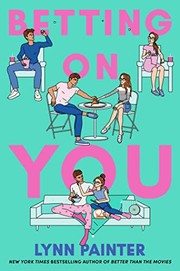
Betting on You
2,293-word summary 10 min read 432 pages in the book
- First published
- 2023
- Publisher
- Simon & Schuster Books for Young Readers
- Pages
- 432
- ISBN
- 9781665921237
Reading options
What's inside (9 sections)
I began Betting on You knowing almost nothing about it except that people on book websites kept arguing about the fake dating. That turned out to be a useful way in, because the argument is really about the whole book: whether the romance is sweet or whether the two leads are simply mean to each other for four hundred pages. I finished it in two sittings and came down somewhere in the middle. Lynn Painter's novel was published by Simon & Schuster Books for Young Readers on November 28, 2023, and runs 432 pages in the edition I read. It is a young adult romance that takes its time, which is both a virtue and the source of most of my complaints.
The set-up is a plane ride. Fourteen-year-old Bailey is moving from Alaska to Omaha with her mother after her parents' divorce. She is careful, well-behaved, and determined to make the move go smoothly. Seated next to her is Charlie, a boy her age with a sharp tongue and a habit of commenting on everything. He is dealing with a family change of his own, and he has decided that most things are ridiculous. They disagree immediately, and the argument that sticks is about whether boys and girls can be "just friends." Charlie says they cannot. Bailey, who is about to start over in a new city, says they can. The flight ends and they go their separate ways.
Three years and a waterpark
The novel jumps ahead three years. Bailey is seventeen and needs a summer job, so she takes a position at a hotel waterpark in Omaha. She arrives for her first shift and finds that one of her new coworkers is Charlie. He has not softened. He is still quick with a joke that lands somewhere between funny and irritating, and he still treats her insistence on platonic friendship as a personal challenge. The job gives the book its whole world: the pool floor, the locker rooms, the break room, the guests who behave badly, and the coworkers who gossip about each other.
Painter is good at this setting. A waterpark is a place where teenagers are asked to be cheerful in public and exhausted in private, and the book uses that split well. Bailey and Charlie spend their shifts watching the people around them, especially two coworkers who keep flirting in ways that are obvious to everyone except, apparently, the people involved. The observation gives them something to do together that is not simply arguing, and it gives the novel its central bet. Charlie insists the flirting pair will never actually get together. Bailey bets against him, because she wants to believe that a friendship can turn into something more without ruining itself.
That wager is the engine of the plot. It lets the two of them talk about other people while avoiding their own feelings, which is the oldest trick in the romance genre and still an effective one. Charlie tracks the coworkers' progress with the seriousness of a man building a case. Bailey defends the possibility of innocent friendship with more energy than the question deserves. Their banter runs fast, and for the first half of the book it is genuinely funny. Both of them are clever enough to hear what the other one is really asking, and both of them are cowardly enough to answer with a joke.
The people around the pool
The waterpark is populated by people who are mostly there to be seen. The guests provide a constant stream of small dramas: families arguing over towels, children testing the limits of the lifeguards, teenagers trying to look unimpressed by everything. Bailey and Charlie watch all of it with the same mixture of superiority and fascination. Their habit of commenting on strangers is not the nicest trait, but it is funny, and it gives Painter a way to keep the pair together for a whole summer without forcing a confession. They always have someone else to discuss.
The two coworkers who keep flirting are the most important of those distractions. We never learn much about them beyond the progress of their flirtation, which is a deliberate limitation. They function as a mirror. Bailey wants their story to end well because she wants her theory about friendship to hold; Charlie wants it to fail because he wants to be right about people. Neither of them is truly watching the couple. They are watching each other watching the couple. Painter gets a lot of mileage out of that small displacement, and it is the clearest sign that she understands her characters.
Bailey's mother is a different matter and a more serious one. The divorce has left both women adjusting to a smaller household and a new set of rules. When Scott appears, Bailey reads his presence as an intrusion, and she is not entirely wrong. Her scheme with Charlie is funny on the surface but it comes out of a real fear of being displaced. The book treats that fear with more respect than I expected. There are scenes between mother and daughter in which neither one is trying to win, and those are the ones that make Bailey feel like a person rather than a rom-com lead.
The mother, the boyfriend, and the fake dating
The emotional plot arrives through Bailey's mother. Her mother has a new boyfriend named Scott, and Bailey feels that his presence has changed the rhythm of their relationship. She is not pleased about sharing her mother's attention, and she is not shy about making her discomfort known. Charlie, who has his own reasons to want time with Bailey that he will not admit, agrees to a scheme: they will pretend to be a couple in order to scare Scott off. It works about as well as such schemes usually do, which is to say it creates more problems than it solves while forcing the two of them into situations where they have to act like a couple in front of people who know them.
This is where Painter's book is at its best and at its most conventional. The fake dating gives her permission to write a lot of small, close scenes: a hand on a shoulder that lasts a second too long, a look across the pool, the awkward silence after a joke that landed wrong. These are the moments readers come to this genre for, and Painter knows how to stage them. The trouble is that the scheme also delays everything. Bailey and Charlie are so busy performing for Scott and observing their flirting coworkers that their own feelings have to be announced rather than discovered, and the book is long enough that you notice the delay.
There is a second bet, one that Charlie is keeping from Bailey, and it is revealed in the later chapters. Painter is careful about the timing of that reveal, and it gives the final stretch a jolt it badly needs. Without it, the book would coast on the same dynamic for too long. With it, the ending has to answer whether Charlie's feelings can survive the thing he did. The publisher's description hints that he may have doomed the relationship before it could start, and the novel takes that possibility seriously enough to make the last chapters feel different from the ones before them.
What a wager is for
A bet is a useful device in a romance because it gives two people permission to discuss their feelings without naming them. Bailey and Charlie can argue about another couple's relationship for pages, and every argument is actually about their own. Painter understands this and uses the device patiently. The wager has rules, a timeline, and a scorekeeper, which makes it feel like a game even when the emotional stakes are obvious. That framing is also why the reveal of Charlie's private bet lands as hard as it does. He has been turning everything into a contest, and the book finally asks what happens when the contest was never consensual.
This is the best version of the premise, and it explains why When Harry Met Sally was the right reference point. That film also built a friendship out of a question that could not be settled by evidence, and it let two people circle each other while insisting they were only debating. Painter's addition is the physical closeness of a shared workplace, where every shift puts them together and every joke has an audience. It works more often than it fails, though the length of the novel means some of the debates go on past the point of usefulness.
The case for the book
Painter has said she was inspired by When Harry Met Sally and wanted to write a young adult version of that argument about men and women as friends. You can see the skeleton of the film here, right down to the question that starts the disagreement on the plane. What she adds is the waterpark, the divorced parents, and the sense that both teenagers are trying to build a stable place for themselves while the adults around them rearrange their lives. Bailey's relationship with her mother is not a subplot so much as a second story running alongside the romance, and it gives the book more weight than the cover might suggest.
The book was a commercial hit. It spent weeks on the New York Times young adult hardcover list and then months on the paperback list, and it was nominated for a Goodreads Choice Award. Reviewers were split in an interesting way. Publishers Weekly praised the banter and called the result entertaining, a low-conflict romp that gives a familiar premise some new life. Other critics were less kind. Kirkus felt some of the exchanges were more aggressive than playful and called the plot circuitous. School Library Journal objected that the characters' emotions did not always fit their personalities and that the strong language sat oddly beside a fairly tame romance.
I see both sides. Bailey and Charlie are quick and funny, but they also goad each other with a consistency that can feel less like chemistry than like a refusal to grow up. When they are observing other people, the book has a generous, amused energy. When they are circling their own feelings, the same jokes start to feel like a wall. The 432-page length does not help. A tighter version of this story would have kept the best exchanges and cut the ones that repeat the same beat with different vocabulary.
Where it slips
The biggest problem is Charlie. He is allowed to be cruel in the name of being funny, and the narrative keeps assuring us that there is a good heart underneath. That is a difficult balance, and Painter does not always hold it. At times his need to win the argument matters more to him than Bailey's feelings, and the book treats that as a charming flaw rather than something he has to answer for. Bailey is better drawn. Her frustration with her mother is specific and recognizable, and her belief in friendship across genders feels like a real conviction rather than a position she took to annoy Charlie.
The secondary storyline with the flirting coworkers is fun but thin. They exist to be watched and wagered on, which is a little unkind to them as characters, though it does reflect how Bailey and Charlie are using other people to avoid themselves. The book is aware of that, I think, but it never pushes the idea very far. Scott, the mother's boyfriend, is mostly a plot device too. He is there to be resented and then dealt with, not to be understood. If you want a novel about a blended family, you will find more substance in the mother-daughter scenes than in anything involving Scott.
Still, I understand the appeal. This is a book built for readers who like the rhythm of a rom-com: two people who are obviously right for each other and obviously unable to say so, a bet that turns into a trap, a scheme that collapses at the worst possible moment. Painter writes that rhythm cleanly, and she understands how much of romance is timing. The scenes at the waterpark have a physical ease that makes the longer conversations work. You believe these two would end up talking after closing time because the book has earned the silence between them.
What I would tell a friend
The last pages do something I appreciated: they let the scheme collapse without humiliating anyone. Bailey and Charlie are both made to look foolish, but neither is destroyed by it, and the book leaves them with a friendship that has survived the performance. That is a modest claim for a romance to make, and it is more mature than the banter sometimes suggests.
If you want a fast, funny read that will not ask much of you, Betting on You delivers. If you want the sharpest version of this premise, go in knowing that the middle drags and that Charlie's jokes do not always land as kindly as the book thinks they do. I liked Bailey most, and I would have happily read a shorter novel that spent more time on her and less on the wager. The fake dating is fun, the coworkers are amusing, and the final reveal gives the story a reason to end when it does. It is a competent, warm book about two teenagers who are terrible at saying what they mean, and it is at its best when it stops performing and simply lets them sit together after a long shift.
FAQ
Is Betting on You part of a series?
No. It is a standalone young adult romance set in Omaha, with two seventeen-year-olds working at a hotel waterpark.
When was Betting on You published?
Simon & Schuster Books for Young Readers published it on November 28, 2023. The hardcover runs 432 pages with ISBN 9781665921237.
What is the bet about?
Bailey and Charlie wager on whether two flirting coworkers will get together, using the question to avoid their own feelings. Charlie also hides a second bet.
Similar books
Today Tonight Tomorrow
On the last day of senior year, academic rivals Rowan Roth and Neil McNair team up for a citywide Seattle scavenger hunt and start seeing each other…
2,233-word summary · 10 min read
The Do-Over
Emilie relives awful Valentine Day with cheating boyfriend until Nick helps fix it.
2,071-word summary · 9 min read

Better than the Movies
A rom com obsessed senior hires her annoying next door neighbor to win her crush, then finds real love is messier and kinder than any movie plot.
2,438-word summary · 11 min read
The Distance Between Us
Seventeen-year-old Caymen Meyers distrusts rich people, then a wealthy boy keeps proving her wrong while her mother's doll shop struggles to survive.
2,231-word summary · 10 min read
Wrecked
A reckless Formula 1 driver meets the PR specialist hired to shadow him, and both are forced to face the grief they have been outrunning.
2,329-word summary · 10 min read
Game On
Tyler Neumann blackmails tattoo artist Stella McCormick into fake dating as a route to his father, and this trilogy closer turns revenge into something harder…
2,395-word summary · 11 min read
Finding Audrey
A fourteen-year-old who cannot leave the house or remove her dark glasses finds her way back through therapy, a film project and a patient new friend.
2,559-word summary · 11 min read

Rules of Attraction
Carlos Fuentes moves from Mexico to Boulder to live with his brother Alex, then falls for a car-loving tomboy while a gang from his past closes in.
2,345-word summary · 10 min read

What Happened to Goodbye
Mclean has reinvented herself in four towns since her parents divorced. In Lakeview she uses her real name, and for the first time staying put becomes a choice.
2,796-word summary · 12 min read

Dumplin'
Willowdean Dickson enters her town's beauty pageant as a protest and discovers that confidence is harder to keep once she lets someone close.
1,922-word summary · 9 min read
The Ex Talk
Two rival public radio producers pretend to be exes for a dating show, then fall for each other while the lie grows.
2,389-word summary · 11 min read
I Kissed Shara Wheeler
Shara Wheeler kisses her rival Chloe Green at prom and disappears, leaving a scavenger hunt that forces Chloe to rethink everything she knew about her.
2,083-word summary · 9 min read
Amy & Roger's Epic Detour
Amy Curry has not driven since the crash that killed her father. With Roger at the wheel and a box of maps between them, a cross-country trip becomes a slow…
3,034-word summary · 13 min read

Dash & Lily's Book of Dares
Two lonely New York teenagers trade dares in a red notebook left at the Strand, falling for each other on the page before they meet.
2,228-word summary · 10 min read
These Hollow Vows
Brie trades with the Unseelie to save her sister and steals for a prince.
2,384-word summary · 11 min read

The Winner's Curse
An aristocratic girl buys a slave who is secretly a prince plotting rebellion.
2,124-word summary · 9 min read
Every Last Word
A girl with OCD finds poetry and friends who know her secrets.
2,434-word summary · 11 min read
The Upside of Falling
Two teens fake-date for a summer dare and end up facing grief, family secrets, and first love.
2,274-word summary · 10 min read

Since You've Been Gone
Shy Emily spends summer finishing her vanished best friend Sloane list of thirteen dares, finding Frank, Dawn, and courage.
2,566-word summary · 11 min read
You Deserve Each Other
Engaged and miserable, Naomi and Nicholas wage a prank war to force a breakup, then face money, mothers, and truth in Sarah Hogle's funny romance with a tender…
2,415-word summary · 11 min read

The Takeover
An arrogant CEO and the sharp employee forced to staff his deal trade insults, trips and late nights across a long push-pull, until pride and jealousy force…
2,580-word summary · 11 min read
Isla and the Happily Ever After
Shy Isla Martin finally dates longtime crush Josh Wasserstein after a Manhattan summer and senior year at SOAP Paris, then learns love needs honesty to last.
2,293-word summary · 10 min read
The Statistical Probability of Love at First Sight
Hadley misses a flight, meets Oliver to London, and faces her father wedding in one day.
2,002-word summary · 9 min read
Heartless Hunter
A witch hiding as a socialite courts a witch hunter for secrets, while he courts her back on suspicion, in this romantic fantasy opener.
2,366-word summary · 11 min read
Nick and Charlie: A Heartstopper Novella
Nick is off to university and Charlie is staying behind. One last summer to decide if first love can survive distance.
2,329-word summary · 10 min read
Holding Up the Universe
Libby Strout reclaims high school after loss while Jack Masselin hides face blindness, until a cruel prank forces them to see each other.
2,979-word summary · 13 min read
Boyfriend Material
A tabloid-haunted charity worker fakes a romance with a straitlaced barrister in this funny 2020 London rom-com.
2,325-word summary · 10 min read
Lola and the Boy Next Door
Costume maker Lola must choose between older Max and inventor Cricket while her two dads hold home steady.
2,045-word summary · 9 min read
Dance of Thieves
Queen's thief Kazi infiltrates Ballenger lands while young leader Jase plays her right back.
2,005-word summary · 9 min read
Fix Her Up
Party clown Georgie fakes a romance with ex ballplayer Travis to earn respect, and their act turns real in Port Jefferson.
2,368-word summary · 11 min read