
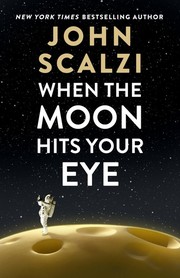
When the Moon Hits Your Eye
2,002-word summary 9 min read 336 pages in the book
- First published
- 2025
- Publisher
- Tor Books
- Pages
- 336
- ISBN
- 9780765389091
Reading options
What's inside (9 sections)
The moon is cheese
At Ohio's Armstrong Air & Space Museum, an executive director named Virgil Augustine finds that the moon rock sample has become cheese. Space Center Houston confirms it. The Moon is now larger, brighter, unstable and geysered, though its mass has not changed. Scientists at the White House give the phenomenon a name: Caseus. President Brett Boone's administration insists there is no immediate threat while admitting that nobody has any idea what happened.
That is the premise of John Scalzi's 2025 novel, and the book never tries to make it more plausible. NASA suspends its space program and delays a lunar landing. Cheese shops boom. Faith institutions struggle to explain what it means that the Moon is now a dairy product. A man named Dayton Bailey, who wrote a jokey book predicting exactly this contingency, becomes a celebrity as people search for a deeper explanation.
The discovery scene is written like a workplace comedy. Augustine is not a scientist. He runs a museum, and his first task is to work out whether the sample in his care has been vandalized or replaced. When Houston confirms that the change is real and global, the problem shifts from a local embarrassment to an international incident. Scalzi understands how institutions respond to the impossible: they call other institutions, and they wait for someone senior to tell them what to say.
The physical description of the new Moon is oddly specific. It is larger and brighter, it has geysers, and its mass has not changed. That last detail is the book's one concession to scientific thinking, and it is enough. A writer who tried to explain why the Moon became cheese would have produced a different and worse book. Scalzi simply states the fact and then asks what people will do about it.
The book runs to 336 pages and is built from a series of mostly independent stories united by that one absurd event. It is not a novel with a single protagonist, and that is its most noticeable formal quirk. Scalzi moves from one person to another, sometimes for only a chapter, and the effect is closer to a radio show or a very long sketch than a conventional comic novel.
I picked it up because the title promises nonsense and the reviews promise something smarter. Both are true. The book is extremely silly and also genuinely thoughtful about how people behave when the world changes in a way they cannot explain.
The public reaction
The real subject of the book is what people do with a crisis. BancUsonia starts offering high-limit, low-interest credit cards to customers who think they have little time left. "Flip Off the Moon" rallies spread. Outside a Wisconsin cheese shop, a protest nearly turns violent until the owner's estranged brother drives off the attackers with a baseball bat. That incident becomes the beginning of a reconciliation between the brothers and a romance between their employees.
The economic consequences are sketched with the same dry precision. Cheese shops boom because people want a physical connection to the new Moon, and the demand is both serious and ridiculous. The credit card offer is probably the book's sharpest single joke. A financial institution decides that an apocalypse is a good time to acquire customers, and the terms are better than usual because death makes people poor credit risks. That is the tone throughout: the institutions are absurd, but the absurdity is recognizably familiar.
Those vignettes are the book at its best. Scalzi is interested in the small, practical ways a person decides to live when the future has become uncertain. A credit card company sees an opportunity. A protest turns into a family argument. A man with a baseball bat becomes a local hero for about twenty minutes. None of these stories resolves the crisis, and that is the point. The Moon is a screen onto which people project what they already are.
The title of the Moon's new name matters. Caseus is Latin for cheese, and giving the phenomenon a scientific-sounding label is the administration's way of pretending to control it. The president says there is no threat while conceding that nobody understands what happened. That is a familiar political posture, and Scalzi writes it without needing to name a real party or politician.
The billionaire
Jody Bannon is a billionaire running PanGlobal Aerospace. He needs a lunar landing to satisfy a government contract, and when NASA delays, he lobbies Congress to put pressure on the agency. When that fails, he launches his own unauthorized lander, Major Tom. He dies when a geyser erupts during the landing, and it happens live on television.
That episode is the book's sharpest satire. Bannon has the money to do something impossible and the impatience to do it badly. His death is not treated as a tragedy. It is a consequence, and the press moves on. Scalzi is very good on the way a wealthy man's ambitions become everyone else's problem, and he does not give Bannon a redemption or a deathbed realization.
An explosion later hurls a fragment called Lunar One toward Earth. Scientists warn of a slow apocalypse in a little over two years. That deadline gives the book whatever momentum it has, but it is telling that the deadline is never really the point. The stories keep returning to ordinary lives rather than to the mechanics of the approaching fragment.
The small stories
Scalzi fills the book with people facing the end in private ways. Clyde Ramsey, a retired professor, invites Dave and Alton to face it together. Lessa Sarah Cirrincione, a fantasy author, decides to finish her novel for her husband Hector. Jackie Hyland inherits a guitar and the music rights to her dying ex-husband's work; the musician was Ian Smythe. Pastor James counsels his congregation while a skeptical man named Caleb challenges him. A congressional scandal involves a NASA jumpsuit and cheese. An episode of Saturday Night Live collapses.
These stories vary in quality. Some are very funny. The congressional scandal and the talk-show collapse are broad comedy, and they work. The quieter stories about less predictable people are more affecting. A man finishing a novel for his wife is not a punchline, and Scalzi gives that decision the space it needs. The book's range is its strength. It can move from a joke about a jumpsuit to a husband's grief without changing tone too abruptly.
I found the vignette structure frustrating in places. Just as I wanted to spend more time with Jackie or Lessa, the book moved on. That is the cost of the form. A novel with a cast this large can either give everyone their due or keep a brisk pace, and this one chooses pace.
The reveal
At a White House eclipse watch, Dayton Bailey and astronaut LeMae Anderson realize that the eclipse is annular, not total. That means the original Moon, now called Luna, has returned, and Lunar One is gone. President Boone declares the crisis over.
The eclipse scene is also a small triumph of character. Dayton Bailey has been a celebrity because he predicted the event in a joke book, and LeMae Anderson is an astronaut who has been sidelined by the collapse of the space program. Neither is in a position of authority. They simply notice something that the people running the crisis have missed. Scalzi gives them the moment without fanfare, and it lands because the book has spent its length showing how little the experts actually know.
It is a wonderfully anticlimactic resolution. The book has spent hundreds of pages on public panic, a billionaire's death and an approaching fragment, and the solution turns out to be a astronomical observation at a public event. The apocalypse did not need to be stopped. It needed to be noticed. Scalzi is making a point about how much of a crisis is made by the institutions that claim to be managing it.
The aftermath is even better. A year later, conspiracy forums call the whole thing a hoax. By the tenth anniversary, a third of Americans doubt that Caseus ever existed. A century later, the official story is "The Caseusian Hoax." That final movement is the book's sharpest observation. A event that happened to everyone becomes a thing nobody believes happened, because disbelief is more comfortable than accepting what actually occurred.
I want to say a word about the religious thread, because it is handled with more care than the comedy suggests. Pastor James is trying to give his congregation something to hold onto, and Caleb keeps asking the questions that make that difficult. Scalzi does not settle the argument. He lets both men be sincere. The book's larger point is that a change in the sky does not create new beliefs so much as reveal the ones people already had.
The congressional scandal with the NASA jumpsuit and the cheese is the book at its broadest. It is a very silly scene, and it works because the surrounding stories have given the reader reasons to care about the institution being mocked. A book that only mocked government would get old. This one spends enough time with ordinary people that the satire has somewhere to land.
What the reviewers said
The reception was glowing. Kirkus starred the book and described it as a ridiculous concept imbued with gravity, charm, humor, plausible cynicism and pathos. Publishers Weekly praised the cleverly entertaining sci-fi romp and its balance of scathing satire with heartfelt optimism. Marlene Harris in Library Journal called it frequently absolutely hilarious and insightful.
Those descriptions fit. The book is funny in a way that is rarely mean. Even the billionaire and the scheming political professionals are treated as absurd rather than evil. The warmth comes from the ordinary people who keep making coffee, writing novels and reconciling with their brothers while the sky changes color.
What I finished with
A note on the form before I close. The book's lack of a single protagonist is a deliberate choice, and it is the thing reviewers single out most often. Scalzi has written plenty of novels with a clear central hero, so this is not a limitation of his craft. He chose a structure that resembles a town meeting, where everyone gets a turn to say what the Moon means to them. That structure is also why the ending lands. A book about a shared event needs a shared point of view.
I finished the book impressed by how much Scalzi gets out of a single joke. The Moon turning into cheese is the kind of premise that could support one good chapter and then collapse. Instead it becomes a way of looking at corporate ambition, political language, religious uncertainty, marriage, grief and the strange speed with which a fact becomes a rumor and then a conspiracy theory.
The title is from a nursery rhyme, and the book keeps returning to childhood language. A cheese Moon is funny because it is the kind of thing a child would invent. The adults in the book spend their time trying to make it respectable, profitable or believable, and the children, when they appear, are the only ones who get it right. I closed the book wanting to reread the Wisconsin cheese-shop scene, which contains more genuine feeling than most novels manage in their entire final chapters.
The ending's final joke is aimed at the reader, too. We know Caseus happened because we read about it. A hundred years later, nobody will. That is the funniest and most unsettling thing in a book that has a lot of competition.
The title comes from a nursery rhyme, which is a clue to the book's tone. Scalzi takes a line that children sing and asks what happens if the nonsense in it becomes real. The answer, in this book, is that adults will spend months producing serious documents about it.
FAQ
Does the book have a single main character?
No. It is built from mostly independent stories united by one event, which reviewers identified as its most notable formal quirk. Scalzi moves from one person to another, sometimes for only a chapter.
What is Caseus?
It is the name the White House scientists give the cheese Moon, from the Latin for cheese. The label is the administration's way of pretending to control a phenomenon nobody understands.
How is the crisis resolved?
At an eclipse watch, Dayton Bailey and astronaut LeMae Anderson realize the eclipse is annular rather than total: the original Moon has returned and Lunar One is gone.
Similar books
Redshirts
Ensigns realize they die to serve a bad TV show's narrative.
2,152-word summary · 10 min read
Mostly Harmless
Arthur makes sandwiches on Lamuella while Ford steals a Guide Mk II that wipes Earths across realities.
2,059-word summary · 9 min read
We Are Legion (We Are Bob)
A dead software engineer wakes up as a self-replicating space probe, clones himself into a squabbling fleet of Bobs, and tries to keep a ruined Earth alive.
2,357-word summary · 10 min read
The Zombie Survival Guide: Complete Protection from the Living Dead
Max Brooks's deadpan survival manual explains the Solanum virus, the only ways to destroy the living dead, fortifying a home, and the outbreaks history quietly…
2,650-word summary · 12 min read
A Connecticut Yankee in King Arthur's Court
Hank Morgan, a Connecticut factory man, wakes in King Arthur's England, rises to chief adviser, and rebuilds the kingdom until his own inventions turn on him.
2,193-word summary · 10 min read
Severance
Candace keeps office routine as fever empties New York, then joins survivors.
2,340-word summary · 10 min read
Seveneves
Stephenson 880-page William Morrow epic, May 2015: the Moon shatters, the Cloud Ark fails, seven women restart humanity, and heirs meet survivors on Earth.
2,389-word summary · 11 min read
Life, the Universe and Everything
Arthur in slippers must stop cricket robots from rebuilding the Wikkit Gate.
2,216-word summary · 10 min read
Breakfast of Champions
A Pontiac dealer breaks down while a broke sci-fi writer brings the book that tells him others are robots.
2,013-word summary · 9 min read
The Restaurant at the End of the Universe
Arthur Dent flees Vogons, dines at Milliways at the end of time, and strands on prehistoric Earth in Adams' sharp 1980 sequel.
2,749-word summary · 12 min read

The Martian
Mark Watney is stranded on Mars after his crew leaves him for dead, and survives with botany, repairs, and stubborn humor.
2,271-word summary · 10 min read
The Hitchhiker's Guide to the Galaxy
Douglas Adams' Hitchhiker's Guide retold: Earth's end, Ford, Zaphod, Marvin, and the answer 42.
2,253-word summary · 10 min read
Shadow of the Hegemon
Battle School graduates return to Earth in 2197, where Achilles kidnaps Ender's Jeesh and Bean works to free them while Peter Wiggin plays for the title of…
2,093-word summary · 9 min read
Gemina
A commander's daughter and a crime boss's son team up when BeiTech attacks a remote station, told through chats, reports and redacted files.
2,221-word summary · 10 min read
Still Life with Woodpecker
An environmentalist princess and an outlaw bomber fall in love, then argue about freedom, sacrifice, and a pack of Camel cigarettes.
2,061-word summary · 9 min read
Soul Music
A harpist from Llamedos brings rock music to Ankh-Morpork, and a primordial force takes hold of the city, pulling Susan Sto Helit and Death into a fight over…
2,406-word summary · 11 min read
Shadow Ticket
Pynchon's tenth novel, his first in twelve years, sends a Milwaukee detective across 1932 Europe after a cheese heiress, a clarinetist, and a very strange lamp.
2,348-word summary · 10 min read
Red Mars
Kim Stanley Robinson's 1992 novel sends the First Hundred to Mars aboard the Ares, where a murder, a fight over terraforming and a struggle with Earth decide…
2,206-word summary · 10 min read
Lords and Ladies
The elves are coming and Lancre is not ready. Pratchett's 1992 novel sends Granny, Nanny and Magrat into a cruel, glittering invasion that spoofs A Midsummer…
2,476-word summary · 11 min read
I Am America (And So Can You!)
Stephen Colbert's 2007 debut extends his Colbert Report pundit into print, a mock-conservative tour of American life with margin notes, stickers and Fun Zones.
2,635-word summary · 12 min read
Everyone Worth Knowing
A young woman quits her banking job after a friend's engagement and lands in a New York PR firm where everyone is paid to know everyone.
2,360-word summary · 10 min read
A Parade of Horribles
The eighth Dungeon Crawler Carl book drops Carl and Princess Donut onto a deceptively simple tenth floor of races, upgrades and glitches, with a comic tone…
2,670-word summary · 12 min read
Pyramids
A prince raised by assassins comes home to a desert kingdom where the high priest rules and a spitefully huge pyramid starts bending time.
2,441-word summary · 11 min read
Feet of Clay
A clay golem goes mad and a Patrician is poisoned as Vimes and the Watch untangle a murder plot in the nineteenth Discworld novel.
2,308-word summary · 10 min read

Dead Souls
A charming stranger buys the rights to serfs who have died but remain on the census rolls, and a whole province turns against him.
2,255-word summary · 10 min read
Babylon's Ashes
Three months after the Free Navy's strikes, the Rocinante crew returns as Earth, Mars, and the Belt unite to retake the Ring station of Medina.
2,245-word summary · 10 min read
Go the Fuck to Sleep
A rhyming bedtime book for adults in which an exhausted father narrates the fourth hour of a toddler's stalling, one profane couplet at a time.
2,291-word summary · 10 min read
Prelude to Foundation
A young Hari Seldon arrives on Trantor with a theory he cannot yet prove, and a hunt through the planet-city forces him to turn psychohistory into a real…
2,013-word summary · 9 min read
Starsight
Spensa Nightshade goes undercover aboard the Superiority space station Starsight to steal a hyperdrive, and finds a frightened bureaucracy where she expected…
2,568-word summary · 11 min read
Network Effect
Murderbot's contract job turns into a rescue mission when a hijacked research ship and a colony of corrupted colonists appear.
2,256-word summary · 10 min read