
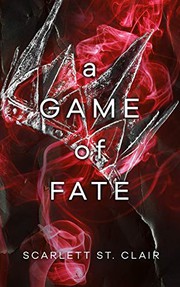
A Game of Fate
2,373-word summary 11 min read 371 pages in the book
- First published
- 2020
- Publisher
- StarSeed Press
- Pages
- 371
- ISBN
- 9781735771915
- Series
- Hades Saga (#1)
Reading options
What's inside (9 sections)
I picked this up assuming it would be more of the same. I had read the A Touch of Darkness books, and the names on the cover suggested another pass at Hades and Persephone with modern gods, a slick nightlife scene, and a romance built out of bargains. A Game of Fate is related to those books, but it is not a continuation of them. It opens a different series called the Hades Saga, set in a different version of the myth, and the first real surprise is that the story belongs to Hades rather than to Persephone. If you are arriving from the other books, leave your assumptions at the door.
A different Underworld
This book was first published in 2020 by StarSeed Press, and it is the first entry in the Hades Saga. The world it builds will feel familiar in its broad strokes and strange in its details. Hades is the god of the dead and the ruler of the Underworld, but he is also described as a man known for inflexible rule, luxurious night clubs, and impossible bargains. That combination tells you a lot about the tone. This is a myth retelling where the god of the dead has excellent taste in interior design and a reputation for driving a hard deal.
St. Clair sets up a conflict that is older than either of her leads. The Fates have decided that Hades will take a wife, and that the woman chosen to be his queen is Persephone, the Goddess of Spring. Hades is used to control. He is not prepared for the news that his future has been decided somewhere else, and a large part of the early momentum comes from his resistance to the idea. He is a being who makes other people sign contracts, and now he is being handed one.
It helps to know what this book is not. The A Touch of Darkness novels put Persephone at the center of a story about contracts and favors in a city called New Athens. This one builds a separate version of the myth, with its own rules and its own history, and it was originally released through StarSeed Press before wider editions followed. The paperback I read runs 371 pages, and the whole thing moves with the faster, hotter rhythm of a romance that knows exactly what it is selling. There is no slow build toward the supernatural here. The gods are already in place, the Fates have already spoken, and the characters are reacting to a decision made before the first page.
That premise gives the title its bite. A game is being played, but Hades is not the one dealing the cards. The Fates have made their move, and the question the book asks is what a man who bends everyone else to his will does when he is the one being bent.
The threat on the first page
The book opens on a line of pure menace, spoken by someone who understands what is at stake better than the people hearing it:
Take her, and I will destroy this world. Take her, and I will destroy you. Take her, and I will end us all.
That is a strong way to begin. It tells you the romance is going to be a fight, and that the people around these two expect the arrangement to end badly. The voice behind the threat is one of the forces that want to keep Hades and Persephone apart, and the line sets the scale of the problem before the emotional work has even started. This is not a story about an awkward meeting at a party. It is a story about a marriage that powerful beings are willing to break the world over.
The speaker is making a claim about ownership, about what will happen if the wrong person takes Persephone away. That possessive edge is worth noticing from the start, because the book will spend a lot of time asking whether Hades' feelings for her are genuinely his or simply the result of a decree. A threat like this, arriving before the romance has begun, makes the reader suspicious of every later declaration. Is this love, or is this a god defending a decision that was handed to him?
Placing that warning first also does something clever with the reader's sympathies. You start out knowing the match is dangerous, which makes every later moment of attraction feel like a risk rather than an inevitability.
Persephone has her own agenda
The Persephone of this book is an ambitious journalism student, and this is where the retelling takes its biggest liberty with the source myth. She is not a kidnapped bride waiting to be rescued or a passive prize in a contest of gods. She has a career, a temper, and a purpose. Despite finding herself drawn to Hades, she is determined to expose him for his cruel and ruthless ways.
The choice of profession is doing real work. A journalism student has a reason to dig, a set of instincts about power, and a practical skill set that does not depend on being a goddess. Persephone investigates because that is what she does, not because the plot needs her to wander into the Underworld. It makes her a more active lead than the myth usually allows, and it gives the romance a built-in conflict: the man she is drawn to is exactly the kind of subject a reporter wants to expose.
That decision drives much of the relationship. She defies him at every turn, and the attraction between them grows in the spaces between those acts of defiance. St. Clair is working in a genre where the line between antagonism and desire is thin, and she keeps stepping across it on purpose. Every argument carries a charge, and every moment of honesty costs somebody something. The push and pull is the engine of the book.
What I appreciated is that Persephone's suspicion is not presented as a misunderstanding that a few good kisses will solve. Hades really does have a reputation. He really is used to getting his way. When she digs, she is doing the job she set out to do, and the book lets her be right about him even while it asks the reader to root for them. That tension is more interesting than a simple enemies-to-lovers arc where one of them was wrong all along.
The bargains and the club
Hades' world is built on deals. The description of him as a man of impossible bargains is not throwaway wording; it is the rulebook for this version of the Underworld. People who come to him want something, and the price is rarely stated up front. He is comfortable with that arrangement because he is usually the one holding the power.
The bargains also give the book its chapter endings. St. Clair knows that a romance thrives on a question left open, and a deal whose price is not yet named is a very good question. Hades offers, Persephone counts the cost, and the reader waits to see who blinks first. It is a reliable machine, and the book runs it often enough that you start to anticipate the terms before they are spoken aloud. When the pattern finally breaks, it means something, because you have learned the rules.
The night clubs matter for the same reason. They give the story a public face, a place where gods and mortals can be seen together and where a reputation can be made or damaged. St. Clair uses that setting to keep the myth feeling current without turning it into a costume drama. The gods here are old, but the social machinery around them is recognizably modern, and the contrast is part of the appeal.
The energy of the book comes from watching Hades try to apply his usual methods to a woman who refuses to be handled. He makes offers. She refuses them. He withdraws. She follows. Neither of them gets a clean win, and the chapters work best when the power keeps shifting rather than settling into a pattern.
Proving her wrong
At the center of the plot is an impossible assignment. Hades has to prove his future bride wrong about him. She believes he is cruel and ruthless, and the book spends its middle asking whether that reputation is the whole truth or only the part that reaches the surface. This is a familiar romance structure, but it is given a sharper edge by the fate element. He is not trying to win a date. He is trying to change the verdict of people who decided the outcome before either of them had a say.
The forces arrayed against the match give the story its external pressure. Some want the marriage for what it will secure, and others want it stopped for what it would cost them. Hades has to deal with both, and his growing realization is that he will do anything for this forbidden love, including defying Fate itself. That is the point where the book stops being a political bargain and becomes a declaration. He chooses her over the arrangement that was supposed to deliver her to him.
This is also where the title pays off a second time. To defy fate is to refuse the role you were assigned, which is the one thing a god of the Underworld is not supposed to do. Hades spends most of the book as the person who enforces rules on others. His decision to break this one is a character change rather than a plot twist, and it arrives after enough small shifts in his behavior that it feels earned instead of sudden.
I found that turn satisfying because it respects the premise. If the Fates chose her, then the only way for the relationship to mean anything is for Hades to reject the idea that it was chosen for him. The book understands that a love dictated by destiny is not much of a love, and it makes him earn the choice.
The heat, and what it costs
This is an adult romance, and it does not hold back. The attraction between Hades and Persephone is described as explosive, and the scenes that carry it are explicit. St. Clair writes desire as a form of confrontation, which fits the wider design. These two do not fall into bed because they have misunderstood each other; they do it with their eyes open, and the aftermath never erases the problems that were there before.
That approach will not be for everyone. Readers who want a gentle slow burn or a closed-door love story should look elsewhere, because the physical intensity is a feature here rather than a seasoning. The age gap and the power imbalance are also real. Hades is an ancient god with a reputation for impossible bargains, and Persephone is a student with an agenda. The book knows this, and part of the tension comes from whether their relationship can survive those unequal starting terms.
St. Clair also understands the appeal of the forbidden angle. These two are not simply from different social circles; they are on opposite sides of a cosmic arrangement that other beings are fighting to preserve. Every obstacle has a mythic weight behind it, even when the immediate problem is a conversation in a club or a bargain that cannot be taken back. That is what lifts the book above a standard contemporary romance, and it is the reason the heat works as well as it does. The stakes are not only about two people getting together.
The fair criticism is that the prose sometimes leans too hard on the same notes. Defiance, attraction, and more defiance can start to feel repetitive when the external plot is thin, and there are stretches where the bargaining and the banter do the same work twice. The myth retelling is also loose. If you came for a faithful version of the Hades and Persephone story, you will find the names and a few of the shapes, but the journalism student angle and the club-owning god are inventions of this series, not of antiquity.
Where it fits and who it is for
A Game of Fate is book one of the Hades Saga, with the story continuing in later books. It stands on its own well enough, since the central bargain and the question of whether these two can choose each other are both resolved in ways that make sense here. But it is clearly written as an opening move, and the forces opposing the match are left in place for the sequels to deal with.
The book also benefits from being read in sequence within its own saga. Clues about the forces opposing the match are planted early, and the closing chapters clearly position several threads for the next installment rather than closing them. On a first read that creates momentum; on a reread it probably looks more calculated. Either way, it is honest about what it is, an opening move in a longer story rather than a self-contained romance.
For readers who know St. Clair's A Touch of Darkness series, the useful thing to know is that this is a different continuity with a different feel. The focus shifts to Hades, the world is built differently, and Persephone arrives as a journalism student rather than the version of her in those books. It is possible to enjoy both, but it is a mistake to read one expecting the other.
For readers new to the author, this is a reasonable place to start if the idea of a powerful, difficult hero being outmaneuvered by a woman with a notebook appeals to you. The writing is direct, the stakes are clear, and the central dynamic has enough bite to carry the pages. It is not a subtle book, and it does not try to be. It is a romance about a god who learns that being chosen by fate is not the same as choosing, and it makes that point with heat and a good deal of attitude.
FAQ
Is A Game of Fate the first book in a series?
Yes. It is book one of the Hades Saga, first published in 2020 by StarSeed Press, with the story continuing in later installments.
Is this the same Hades and Persephone as A Touch of Darkness?
No. It is a different continuity with its own rules. Hades takes the leading role and Persephone is a journalism student, rather than the characters and setup of the A Touch of Darkness series.
How explicit is the romance?
It is an adult romance with frequent explicit scenes. Readers who prefer closed door love stories or a gentle slow burn should look elsewhere.
Similar books
More from Hades Saga first, then related titles.

A Touch of Malice
Engaged Hades and Persephone face gods who vote on their marriage.
2,562-word summary · 11 min read
A Touch of Ruin
Persephone and Hades go public, tragedy shatters trust, and she bargains toward queenship through grief.
2,085-word summary · 9 min read
A Touch of Darkness
Persephone bargains with Hades in New Athens nightclub deal.
2,545-word summary · 11 min read
Glow
In the fourth Plated Prisoner book, Auren escapes Midas's death only to stand trial for it, while Slade fights to keep her and their world from tearing apart.
2,667-word summary · 12 min read
Percy Jackson's Greek Gods
Rick Riordan's illustrated 2014 companion: Percy Jackson retells the Greek myths, from Chaos and the Titans to the Twelve Olympians, with sarcastic asides and…
2,709-word summary · 12 min read
Daughter of the Moon Goddess
The daughter of Chang'e hides in the Celestial Court, trains as an archer, and risks everything to free her mother from the Emperor's punishment.
2,146-word summary · 10 min read

Electric Idol
Psyche wears a camera deal to dodge Aphrodite and falls for Eros.
2,332-word summary · 10 min read
Gleam
Captive Auren finds power in gold touch while Slade hunts her across kingdoms in Plated Prisoner book three.
2,073-word summary · 9 min read
Glint
A gold-skinned captive of Midas falls to Fourth Kingdom troops and learns to fight with the ribbons she hid.
2,969-word summary · 13 min read
Gild
A gold-skinned woman kept as Midas favored learns her cage is a bargain, then war drags her onto the road.
2,755-word summary · 12 min read
Neon Gods
Promised to Zeus, Persephone flees to Hades and trades fake dating for real choice in Olympus.
2,002-word summary · 9 min read
Norse Mythology
Gaiman retells the Norse myths in order, from the creation of the world to Ragnarok, with Odin, Thor and Loki at the center.
4,647-word summary · 21 min read
Circe
Exiled witch Circe masters plant magic on Aiaia, faces gods and monsters, loves Odysseus, and chooses a mortal life.
2,957-word summary · 13 min read

The Sandman, Vol. 4: Season of Mists
Dream travels to Hell and is handed the key to its gates, then every god and demon arrives to argue who should rule.
2,351-word summary · 10 min read
The Tyrant's Tomb
Apollo, still trapped in a mortal teenager's body, carries Jason Grace's coffin to Camp Jupiter and must learn what a hero is before the emperors destroy it.
2,292-word summary · 10 min read

Magic Bleeds
The fourth Kate Daniels novel finds Kate investigating a magical plague in Atlanta while her relationship with Curran fractures and an ancient enemy tied to…
2,236-word summary · 10 min read

Magic Strikes
Drafted into the Order of Merciful Aid, Kate Daniels investigates the beating of her friend Derek and finds a hidden tournament where rakshasas fight in human…
2,012-word summary · 9 min read

Magic Burns
A magic flare hits Atlanta, and mercenary Kate Daniels must recover stolen maps, find a missing witch, and keep a teenage girl alive while Celtic gods try to…
2,021-word summary · 9 min read

The Siren
Saved from a shipwreck in 1930, Kahlen becomes a siren who sings men to their deaths for the Ocean, until a boy in a college library makes her want a life she…
2,369-word summary · 11 min read

Cruel Beauty
A girl raised to kill the demon prince who rules her cursed land instead falls in love with him, in a retelling that mixes Beauty and the Beast with Bluebeard…
2,669-word summary · 12 min read

Fantasy Lover
A New Orleans sex therapist summons a cursed Spartan general from an ancient book and gets one month to break his spell.
2,315-word summary · 10 min read
The Chalice of the Gods
Percy needs three recommendation letters from three gods to apply to college, so his first quest is recovering a stolen chalice from the god of old age.
2,106-word summary · 9 min read

The Rose & the Dagger
Shahrzad is pulled from her Caliph husband and left in a desert camp of rebels, needing to break his curse and end a war before it ends her.
2,520-word summary · 11 min read

The Burning Maze
Apollo, still trapped in a mortal teenager's body, follows a dangerous prophecy through the Labyrinth with Meg and Grover as the Triumvirate's grip tightens.
2,248-word summary · 10 min read

Stars Above: A Lunar Chronicles Collection
Nine Lunar Chronicles stories fill in the histories of Cinder, Wolf, Thorne, Cress, Winter, and Jacin, and end with a wedding after the war.
2,230-word summary · 10 min read

Lore
Lore Perseous, the last of a hunted bloodline, is pulled back into the Agon when a wounded Athena offers her revenge against the god who killed her family.
2,188-word summary · 10 min read

The Magician King
Quentin rules a peaceful Fillory until a golden key strands him on Earth, while Julia's brutal road from hedge witch to demigod rewrites the whole story.
2,431-word summary · 11 min read
A Fate Inked in Blood
In Norse-inspired Skaland, a fish gutter hiding a goddess's blood is claimed by a jarl, bound by oath, and guarded by the son she cannot want.
1,971-word summary · 9 min read

The Dark One
Winnie trades with Hook while Peter Pan turns cruel in Neverland.
2,596-word summary · 12 min read

Half-Blood
Half-blood Alex trains at the Covenant while gods stir and rules close in.
2,601-word summary · 12 min read