
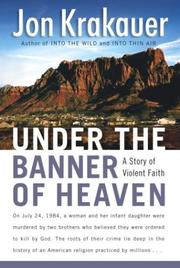
Under the Banner of Heaven: A Story of Violent Faith
2,590-word summary 12 min read 372 pages in the book
- First published
- 2003
- Publisher
- Doubleday
- Pages
- 372
- ISBN
- 9780385509510
Reading options
What's inside (8 sections)
I came to this book from Krakauer's mountain writing. Into Thin Air and Into the Wild had taught me to expect high places and young men testing limits. This one stays mostly in Utah living rooms, courtrooms, and archives. Jon Krakauer published it in 2003 with Doubleday, in a 372-page first edition with ISBN 9780385509510. It is about belief carried past every guardrail. I read it slowly, a chapter at a time, because the history chapters kept sending me back to the crime chapters with new questions.
The crime at the center happened on July 24, 1984, in American Fork, Utah. Two brothers, Ron and Dan Lafferty, entered the home of their youngest brother Allen and killed his wife Brenda and her fifteen-month-old daughter Erica. The brothers did not hide what they had done for long. They said God had told them to do it. They called it a removal ordered by revelation. They were arrested weeks later in Reno, Nevada, and they were tried separately and convicted.
Krakauer braids that case with a second history. He tells the story of The Church of Jesus Christ of Latter-day Saints from Joseph Smith through the trek west, then follows the smaller groups that broke away when the mainstream church gave up plural marriage. The two threads take turns. A chapter on the Laffertys gives way to a chapter on prophets and schisms, then back again. Readers who know Krakauer only as a climber may be surprised by how much of this book is archival. Readers who know the 2022 television adaptation should know the book came first and ranges wider than any single investigation.
The question that holds it together is plain. How do ordinary people come to treat violence as obedience. Krakauer does not answer it with one cause. He follows family pressure, charismatic teachers, personal grievance, and a theology of direct revelation, and he shows how each one fed the others.
The brothers
The Laffertys were a large Latter-day Saint family, and Allen was the youngest of the brothers. Ron was older, forceful, and used to being in charge. Dan was intense and searching, drawn to strict readings of doctrine. For years they lived inside the mainstream church. Then both men moved toward fundamentalism, the loose set of groups and independent believers who hold that the church went wrong when it abandoned plural marriage and other early practices. Both men were excommunicated from the mainstream church in the early nineteen eighties.
In that period the brothers fell in with a small sect called the School of the Prophets, led by a man named Robert Crossfield, who went by the name Prophet Onias. The school taught that men could receive direct revelations from God and live by them. Ron rose quickly in the group and took a leadership role in its Provo area meetings. Dan looked up to him and urged him further along. Work, marriage, and church standing all began to slip as the two men gave more of their time to meetings, study, and claimed messages from heaven.
In the spring of 1984 Ron said he was receiving a series of revelations. One of them named four people to be removed. The list included Brenda Lafferty and her small daughter, along with two other people connected in Ron's mind with his divorce proceedings and his break from the church. Ron shared the message with others in the school. Some members rejected it outright. The dispute helped break the group apart. What unsettles me still is that several people heard the threat and did not warn the targets. Brenda's husband heard talk and did not take it as a real danger. Nobody told Brenda that her name was on a list.
Dan later said he accepted his brother's message as genuine. He admired figures in scripture who obeyed hard commands, and he treated Ron's certainty as proof. Whether Dan followed from conviction or from loyalty or from guilt over his part in Ron's troubles, the record shows he went along. The two men began to plan, and then they acted.
Brenda and Erica
Brenda Wright Lafferty was in her twenties, a young wife and mother with a strong mind. People who knew her described a woman who spoke up and held her ground. She had no sympathy for plural marriage, and she said so. When Ron's wife Diana decided to leave him, Brenda supported her. That loyalty mattered. It placed Brenda between Ron and the control he wanted over his own household, and Ron came to see her as an obstacle set in his path by unbelief.
Erica was fifteen months old, Allen and Brenda's daughter. She figures in the book briefly and tenderly, as she should. Krakauer does not turn her into a symbol. She was a child in her own home, cared for by parents who loved her, caught in a quarrel she could not have understood. I am keeping this account brief on purpose. The facts are terrible enough without detail, and the book itself, for all its bluntness, keeps the focus on the decisions before and after rather than on the act.
On the day of the killings Allen was away. Ron and Dan traveled to the house with two companions and forced their way in. They killed Brenda and Erica and left. Allen came home to the aftermath and called for help. Police work, family interviews, and the brothers' own statements soon pointed to Ron and Dan, who had already fled the state. When caught, they admitted the killings and framed them as obedience to God. There was no mystery about who had done it. The mystery, if that word fits, was how they had come to believe they should.
Krakauer gives Brenda real attention across several chapters instead of treating her as a plot point. He traces her marriage to Allen, her friction with her brothers-in-law, and her defense of Diana. That choice shapes the whole book. Because we know Brenda as a person with views and courage, the removal language of the brothers reads even colder. Revelation, in their telling, was holy. In the light of Brenda's life, it reads as a way to dress grievance in sacred clothes.
From Joseph Smith to Utah
To explain the brothers, Krakauer reaches back nearly two centuries. Joseph Smith published the Book of Mormon in 1830 and gathered converts with remarkable speed. The new church taught that Smith was a prophet, that ancient scripture had been restored, and that God still spoke to the living. Those claims drew devoted followers and fierce opposition. Moves from New York to Ohio to Missouri to Illinois each ended under pressure, with mobs, arrests, and an extermination order in Missouri driving the Saints from their homes.
Conflict peaked in Illinois. Smith ordered the destruction of a dissenting newspaper press in Nauvoo, was jailed with his brother, and was killed by a mob in Carthage in 1844. Leadership passed after struggle to Brigham Young, who led the main body west. The trek to the Salt Lake Valley in 1847 became the founding journey of Mormon history. Settlement followed across a wide region. Church authority governed land, water, marriage, and trade. Federal officials watched with suspicion, and the practice of plural marriage, announced publicly in the eighteen fifties, became the sharpest point of dispute.
Violence marks this history, and Krakauer does not soften it. He recounts attacks on Mormon settlements, including killings of Saints by mobs, alongside violence ordered or excused by church leaders. The Mountain Meadows episode of 1857, in which a wagon company of emigrants was destroyed in southern Utah with local Mormon participation, gets sustained attention. Krakauer presents it as the product of war panic, harsh sermons, and obedience to local command. Historians debate blame up and down the chain, and Krakauer notes the argument while keeping his own view that the culture of obedience made the outcome more likely. Readers new to this past may find these chapters the hardest. They show a young faith under siege learning to close ranks, and closing ranks becoming a habit that outlived the siege.
The manifestos and the break
The hinge of the book is the church's surrender of plural marriage. Under intense federal pressure, with property and leadership at risk, church president Wilford Woodruff issued the Manifesto of 1890 advising against new plural marriages. Utah moved toward statehood, granted in 1896. A Second Manifesto in 1904 tightened the ban and set excommunication as the penalty. The mainstream church moved on, growing into a global faith with strict order and public respectability. A minority refused to follow.
Fundamentalists hold that the manifestos were a betrayal, forced by politics against God's standing command. Small groups kept plural marriage alive in scattered settlements across the West and in Mexico and Canada. Short Creek, on the Utah Arizona border, became the best known of these places. In 1953 Arizona authorities raided the community and took children into custody. Images of crying mothers and jailed fathers turned public sympathy against the state, and the raid failed as policy. The settlement endured and grew into Colorado City, linked with Hildale across the line, governed in practice by its own prophet.
By the time Krakauer wrote, the largest of these groups was the Fundamentalist Church of Jesus Christ of Latter Day Saints under Rulon Jeffs, succeeded by his son Warren Jeffs. Krakauer describes closed communities where a prophet assigned marriages, controlled property, and preached near term judgment. He cites large counts of plural wives for some leaders and marriages involving girls in their teens. He also notes the wider picture given by publishers of the time, that tens of thousands of people practiced polygamy in scattered groups. Alongside the settled groups stood independents like the Laffertys, men without a prophet above them who claimed revelation for themselves. Krakauer links this world to then recent headlines, including the 2002 abduction of Elizabeth Smart, as evidence that the pattern had not stayed in the past.
These chapters carry the book's most disputed move. Krakauer treats the fringe as a window into the whole, suggesting that the same habit of obedience runs through both. Mainstream readers and church leaders objected that most Latter-day Saints live nothing like the fundamentalists and condemn their crimes. The church issued a public response around the book's publication in 2003 making that case. I think the objection has force. Still, the history Krakauer gathers on the break itself, the manifestos, Short Creek, the Jeffs settlements, stands as a useful primer for readers who knew none of it.
Revelation on trial
The legal chapters turn on one idea. Ron claimed God spoke to him directly, and Dan agreed. American law had to decide whether that claim was religion, delusion, or excuse. Prosecutors pointed to Ron's journals and to witnesses who had heard him describe the removal message. They argued the killings were planned, targeted, and followed by flight, all marks of people who knew their acts were forbidden. Defense arguments raised Ron's mental state and whether he could grasp the proceedings against him.
The brothers were tried separately in 1985. Dan was convicted of capital murder and related charges and received concurrent life terms without the possibility of parole. Ron was convicted on murder and conspiracy counts and sentenced to death. The conspiracy counts involved the two other named targets who were never harmed. Ron's case then moved through years of review. A federal appeals court ordered a new trial over how the first court had handled his competence to stand trial. At a retrial in 1996 he was convicted again and sentenced to death once more.
Krakauer attends closely to the second trial and its experts. Psychiatrists and lawyers argued over where sincere but extreme belief ends and illness begins. The court had to weigh visions, voices, and journals against organized planning and clear motive. Krakauer, who sat through proceedings and interviewed participants, presents the debate without pretending it resolves cleanly. He is plainly troubled by a system in which revelation can license murder and then serve as a defense against its penalty. He is also careful to show that the juries, faced with the full record, found the brothers responsible for chosen acts.
At the book's publication the outcomes stood as the courts had left them. Dan was serving life in Utah. Ron remained under sentence of death after the retrial. Krakauer closes this thread less with triumph than with fatigue. Trials can punish and restrain. They cannot repair a family split by murder or settle which voices count as God's.
How Krakauer builds the case
The reporting method is visible on every page. Krakauer interviewed Dan Lafferty in prison at length and quotes his reasoning in detail. He drew on court transcripts, police records, Ron's journals, newspaper files, and a wide shelf of Mormon histories and memoirs. He traveled to fundamentalist towns and spoke with believers, exiles, lawyers, and relatives. The alternating structure lets documents do different work. Trial records carry the crime chapters. Nineteenth century histories carry the background chapters. The seams show at times, and that honesty helps. When sources conflict, he usually says so and lets the reader weigh the gap.
That method has limits worth naming. Much of the early Mormon history comes through secondary works rather than new archival finds, so specialists found little fresh material there. The reliance on Dan as a talkative source gives one brother's voice more room than the victims' voices can ever have. And the frame that joins a double murder to a whole faith can feel stretched. A fair reader can accept Krakauer's history of fundamentalism while rejecting the suggestion that mainstream worship leads by a straight path to the same place. The church's 2003 response pressed exactly this point, and later reviewers across the spectrum have repeated it.
Pacing is another fair criticism. The history chapters are dense with names, dates, and schisms, and readers who came for a crime narrative may bog down midway. I did in one stretch, then found the trial chapters paid back the effort. People who want a warm portrait of Latter-day Saint life should look elsewhere. This book studies the edges of a tradition, not its ordinary center. People unsettled by accounts of violence against women and children should also take care. Krakauer keeps description restrained, but the subject itself is grim and the grief of the surviving family is never far off.
A word on the adaptation may help new readers. A television miniseries released in 2022 dramatized the case with invented investigators and composite scenes. The book has no such characters. It follows the recorded people and the paper trail. Anyone coming from the screen should expect fewer chases and more church history, and a slower, steadier kind of tension.
What stayed with me was Brenda. Not the murder, which the book rightly refuses to stage for effect, but the small acts before it. Befriending a sister-in-law who wanted out. Arguing about doctrine at a family table. Refusing to bend when powerful men told her to be quiet. Krakauer honors that record by pairing it with the full weight of the history that surrounded her. I closed the book thinking less about revelation as mystery and more about it as responsibility. Anyone can claim a voice from heaven. The test is what the claim costs other people, and who is asked to pay.
FAQ
When was Under the Banner of Heaven published?
It was published in July 2003 by Doubleday in a 372-page first edition with ISBN 9780385509510. A 432-page paperback edition followed from Anchor in 2004.
What crime is at the center of the book?
Ron and Dan Lafferty killed their sister-in-law Brenda and her fifteen-month-old daughter Erica in American Fork, Utah, saying God had ordered the removal. Dan received life terms and Ron was sentenced to death after a 1996 retrial.
Is it part of a series?
No. It stands alone. Readers who want more of Krakauer's reporting often turn to Into Thin Air or Into the Wild, which share his interest in risk and motive.
Similar books
The DaVinci Code: A Quest for Answers
A short 2006 dialogue in which three friends test Dan Brown's claims about Jesus, Mary Magdalene, Nicaea, and the canon.
2,088-word summary · 9 min read

Infidel
Ayaan Hirsi Ali's memoir of a Somali childhood, a forced marriage, a Dutch asylum claim, and the political fight that followed the murder of Theo van Gogh.
2,041-word summary · 9 min read
Columbine
Ten years of reporting on the 1999 school massacre, including a journalist's correction of the myths he helped create in the first hours.
2,232-word summary · 10 min read

Bury My Heart at Wounded Knee: An Indian History of the American West
Dee Brown's 1970 retelling of the American West from the point of view of the people it destroyed.
2,233-word summary · 10 min read
Red Notice
An American financier in Moscow exposes a $230 million tax fraud, watches his lawyer die in prison, and turns the case into an international human rights law.
2,008-word summary · 9 min read
Catch and Kill: Lies, Spies, and a Conspiracy to Protect Predators
Ronan Farrow recounts how NBC killed his Harvey Weinstein reporting, then how The New Yorker published it and helped ignite #MeToo.
2,057-word summary · 9 min read

The Stranger Beside Me
Ann Rule's classic memoir of her friendship with Ted Bundy, written by the true-crime author who knew him long before the world learned what he had done.
2,481-word summary · 11 min read
The Fire Next Time
Baldwin writes his nephew and faith on race in America.
2,463-word summary · 11 min read

God Is Not Great
Hitchens argues religion poisons life across history and texts.
2,545-word summary · 11 min read

The Hot Zone
Ebola and Marburg move from African outbreaks to a Virginia monkey house and an Army response in suits.
2,291-word summary · 10 min read
Empire of Pain: The Secret History of the Sackler Dynasty
How the Sackler family sold OxyContin and shaped an overdose crisis while giving to museums.
2,048-word summary · 9 min read

Blue Like Jazz
Donald Miller leaves youth group faith in Texas for Portland and Reed College, where a confession booth and shared house life reshape his view of Christian…
2,366-word summary · 11 min read

The Library Book
Susan Orlean investigates the 1986 Los Angeles Central Library fire and suspect Harry Peak while tracing library history, her mother's influence, and the…
2,319-word summary · 10 min read

Say Nothing
Patrick Radden Keefe traces Jean McConville's 1972 disappearance through the Price sisters, Brendan Hughes, and Gerry Adams, using Boston College tapes to…
2,846-word summary · 13 min read

The Amityville Horror
The Lutz family flees 112 Ocean Avenue after 28 days of cold spots, voices, and flies, following DeFeo murders.
2,088-word summary · 9 min read

A Stolen Life
Kidnapped at eleven in 1991, Jaycee Dugard survived eighteen years in an Antioch backyard and tells her own story of endurance and motherhood.
2,807-word summary · 12 min read

The Wager: A Tale of Shipwreck, Mutiny and Murder
Thirty starved men reach Brazil as heroes in 1742, then three more land in Chile calling them mutineers, and Grann sorts the wreck.
2,995-word summary · 13 min read
The Case for Christ
An atheist journalist cross-examines scholars on the Gospels, the tomb, and the resurrection to test the evidence for Jesus.
2,882-word summary · 13 min read

Helter Skelter
Prosecutor Bugliosi builds Tate-LaBianca case against Manson Family.
2,838-word summary · 13 min read

Orange Is the New Black: My Year in a Women's Prison
A Smith graduate serves a year in Danbury for an old drug crime and learns how women share, fight and survive inside.
2,583-word summary · 11 min read

Know My Name
Chanel Miller reclaims her story after the Stanford assault case, tracing family support, trial strain, her viral 2016 statement, and leaving Emily Doe for her…
3,092-word summary · 14 min read

I'll Be Gone in the Dark
Michelle McNamara hunted the Golden State Killer for years; she died in 2016, and her team finished this book before his 2018 arrest.
2,155-word summary · 10 min read

Bad Blood
How Theranos sold finger prick miracles, faked tests, and silenced staff who knew patients were at risk.
2,021-word summary · 9 min read

Midnight in the Garden of Good and Evil
Berendt spends five years in Savannah and gets drawn into the Jim Williams murder trials, among eccentrics and root doctors.
3,123-word summary · 14 min read
If You Tell
Three sisters survive fear in a Raymond farmhouse and help police face long hidden murders.
3,166-word summary · 14 min read

Killers of the Flower Moon: The Osage Murders and the Birth of the FBI
In 1920s Oklahoma, Osage oil wealth makes tribal members targets for murder, forcing the young FBI under Tom White to expose the conspiracy behind the Reign of…
2,403-word summary · 11 min read

The Devil in the White City
Architect Burnham builds the 1893 Chicago Fair while H.H. Holmes builds his murder hotel nearby.
2,020-word summary · 9 min read

In Cold Blood
Capote reconstructs the Clutter murders and the killers' flight in the book that invented true crime.
1,965-word summary · 9 min read

Into Thin Air
Krakauer's account of the 1996 Everest disaster: a guided summit push, a sudden storm, and the choices that left eight dead above 26,000 feet.
2,447-word summary · 11 min read
Into the Wild
Jon Krakauer traces Chris McCandless from Emory graduation to an abandoned bus on the Stampede Trail in 1992, asking what drove him to seek a spare life in…
2,526-word summary · 11 min read