
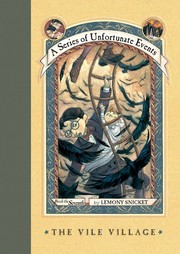
The Vile Village
2,971-word summary 13 min read 256 pages in the book
- First published
- 2001
- Publisher
- HarperCollins
- Pages
- 256
- ISBN
- 9780064408653
- Series
- A Series of Unfortunate Events (#7)
Reading options
What's inside (8 sections)
I picked up The Vile Village because book six left me annoyed in a good way. The Baudelaires had survived the penthouse and the stairs and the auctions, and I wanted to see if Snicket would finally give them a break. He does the opposite. This is book seven in A Series of Unfortunate Events, first published in 2001 by HarperCollins, 256 pages in the hardcover edition, ISBN 9780064408653. It is the middle book in a thirteen book run, and it reads like one. The rules change here. The safety nets fall away. What was miserable before turns criminal, in the sense that the kids themselves get treated as criminals.
If you have not read the earlier books, you can still follow this one, but you will feel the weight more if you start at The Bad Beginning. Violet Baudelaire invents things. Klaus Baudelaire reads and remembers. Sunny Baudelaire, still a baby, bites hard and watches everything. Their parents died in a fire. Count Olaf wants their fortune. Mr. Poe, the banker in charge of them, keeps placing them with terrible guardians. By the end of book six they are tired and sharp and less willing to trust adults. That matters here, because this book is about trusting a whole town and learning why that can be worse than trusting one bad guardian.
The setup leans on a familiar saying. Mr. Poe gets a brochure for a program built around the idea that it takes a village to raise a child. Villages have signed up to raise orphans together. The Baudelaires choose a village called V.F.D. They choose it because Duncan and Isadora Quagmire, their friends from boarding school, tried to pass those initials to them while being kidnapped. The kids hope the letters point to something useful. Hope, in these books, usually points to trouble.
They arrive with Poe and find a place that looks tidy and friendly until you hear the rules.
Crows, Rules and the Council of Elders
The village calls itself the Village of Fowl Devotees. That is what V.F.D. stands for here, though Snicket keeps playing with those three letters across the series. The devotion is to crows.
Thousands of crows live around the village. In the morning they fly off in one direction. At sunset they return and settle in the Nevermore Tree, a huge tree outside the handyman house. The tree name nods to Poe, the poet, not Poe the banker, and the book lets that joke sit without explaining it to death. The villagers love the crows. Harming one is treated as the worst crime. There are songs about them. There are hats shaped like them. Kids recite poems about them at school.
People, meanwhile, live under the Council of Elders. The Council makes rules. Lots of rules. Hundreds of them, written in tiny books and quoted at every chance. You cannot murder a crow. You cannot wear bright clothes that might upset crows. You cannot build certain things. You cannot say certain things. New rules appear when the Elders feel nervous. One new rule bans villains from town, which is supposed to keep Count Olaf away. It works about as well as you would expect.
I found this part funny and then sour, which I think is the point. At first the rules read like satire of small town boards and homeowner associations. Then you see how they work on orphans. The Baudelaires are assigned chores by almost every household. Sweep this porch. Paint that fence. Wash those windows. Carry that load. Each chore comes with a rule attached and a scolding if you pause. The adults take the labor and skip the parenting.
The Council itself is old, slow and proud of being slow. They speak in a flat official tone. They love procedure. When real danger shows up, they reach for another rule instead of common sense. Snicket clearly enjoys mocking them, but he also shows why mobs like rules. Rules let people avoid thinking about who is actually cruel.
The crows carry the mood. They are loud, everywhere, oddly organized. The Baudelaires learn their schedule because they have to. Morning departure. Evening return. Droppings on laundry. Feathers in water buckets. The village treats this as holy. The kids treat it as weather they must live inside. That gap, between worship and daily mess, gives the book a lot of its texture.
Hector and the House That Flies
The one kind adult in town is Hector. He is the handyman, which means he fixes everything and gets respect from no one. He lives a little outside the center, near the Nevermore Tree. He is nervous, warm, thin, always wiping his hands on a rag. The Council dislikes him because he thinks for himself. The other villagers treat him as useful but embarrassing.
Hector takes the Baudelaires in. His house is small and cluttered with tools and half finished projects. He feeds them. He apologizes for the village. He warns them about the Elders without quite daring to break with them openly. Sunny likes him at once, which in these books is a reliable sign. Babies in Snicket have good judgment about adults.
In his barn Hector hides his real project. He is building a self sustaining hot air mobile home. Think of a large basket house lifted by balloons, with gardens and tanks so it can stay aloft a long time without landing. He wants to float away and live in the sky, far from rules and scolding. Violet, who loves invention, lights up around it. Those scenes gave me a small lift in a grim book.
Hector also knows the village is not as safe as it claims. He has found scraps of poetry under the Nevermore Tree. He does not know who leaves them. He kept them because they sounded like a cry for help. He shows them to the Baudelaires. That choice pulls the plot forward.
Hector is not brave in the usual way. He shakes. He delays. But he keeps helping. When the story turns toward fire and shouting, his shaking hands still pass food through a jail window and keep working on the balloons.
His mobile home matters for another reason. It is the only true escape in a book full of false ones. The village promises safety. The Council promises justice. The police promise protection. All three fail. A patched balloon house built from scrap, illegal under local law, turns out to be more honest than every official promise.
Fountain Poems and Finding the Quagmires
Duncan and Isadora Quagmire were taken at the end of book five. They are triplets, though their brother Quigley was thought lost in the fire that killed their parents. Like the Baudelaires, they lost everything. Like the Baudelaires, they keep records. They carry commonplace books where they write facts and quotes and observations. Klaus respects that habit. Violet respects their loyalty. Sunny, in her own way, misses them too.
In the village, the Baudelaires start finding short rhymed messages. Hector found the first under the tree. More appear overnight. The style feels like Isadora, who loves rhymed couplets. The poems do not name a place. They hint. Klaus, who solves most paper puzzles in this series, starts copying them carefully and reading the first letters of each line in order.
I will not spell out the messages line by line, because the pleasure is in watching Klaus work. The method is simple once you see it. Take the first letter of each line. Put them together. Read what they spell. The answer points to the crow shaped Fowl Fountain in the center of town.
The fountain deserves a paragraph. It is large, ugly and proud, built to honor crows, with a big beak and staring eyes. Villagers gather around it for announcements. Children are told to clean it. Under the grime and bird mess, it has joints and seams. Violet notices what those seams suggest. A thing built to look solid can still open.
The Baudelaires realize their friends are hidden inside the fountain, in the hollow of the beak. Duncan and Isadora have been living there, cramped and hungry, slipping notes onto crows in the morning and hoping the birds drop them near the Nevermore Tree. From inside they can hear announcements and gossip. They cannot come out without being seen.
The rescue scene is physical and tense. The fountain is tall and slick. Violet and Klaus form a base. Sunny climbs, because she is smallest and strongest for her size in a very specific way. She uses her teeth, as she has since book one, to work a small crow eye that serves as a latch. The beak opens. The Quagmires crawl out, stiff and blinking, hugging and crying and talking fast.
Their reunion is short, which makes it land harder. They compare notes about fires and initials. They confirm that V.F.D. means more than birds. They do not have time to explain everything, because the village is already turning against the Baudelaires.
For readers who care about the larger mystery, this section moves needles. The Quagmires have learned things on the road. They hint at a split in V.F.D., at volunteers and villains, at a history that touches both families. The book does not resolve those hints. It stacks them. If you came for answers, you will leave with better questions and a stronger urge to read book eight.
Dupin, Jacques and the Jailbreak
Trouble arrives in uniform. Officer Luciana, the new Chief of Police, announces she has caught Count Olaf. The prisoner has a single eyebrow and an eye tattoo on his ankle. The villagers cheer. The Baudelaires look closer and see the problem. The man is not Olaf. He says his name is Jacques. He is calm and tired and scared. He tries to explain. The Council will not listen. Breaking a rule means burning at the stake, and they have already decided he broke one.
This is one of the angriest sections Snicket has written. Jacques is clearly innocent of what they claim, and clearly connected to the deeper plot, and the village prefers a show to the truth. The Baudelaires try to argue. Adults pat their heads and quote rules. Poe, who brought them here, is no help. He trusts procedure. Procedure says the man with the tattoo must be the villain.
Then the real Olaf arrives, calling himself Detective Dupin. He wears a disguise that fools the Elders and nobody else. He speaks in a smooth helpful tone. He offers to investigate. With Luciana at his side, he takes charge of the case. By morning Jacques is dead. Olaf blames the children. The Council believes him. The Baudelaires are thrown in jail to be burned the next day.
Snicket stages the jail chapter with care. The cell is small and damp. The meal is bread and water in the oldest sense. Klaus realizes it is his thirteenth birthday, which lands without cake or song, just a quiet fact among stones. Violet, instead of despairing, studies the wall. The mortar between bricks is old. Water can soften it if applied slowly and repeatedly. Bread can soak it back up so the guards do not notice a puddle.
They spend the night working. Pour water from the pitcher along the bench so it seeps into the wall. Wait. Soak it up with bread. Repeat. It is boring and painful and slow, which is why it feels true. Violet directs. Klaus keeps count. Near dawn they use the wooden bench as a ram. A section gives. They squeeze through.
Hector helps from outside, at great risk, passing another poem through the window. That scrap confirms the fountain answer and gives them a place to run. They do not waste time thanking him yet. They run for the fountain while the village wakes.
Olaf, meanwhile, plans to smuggle one Baudelaire away to get at the fortune. He does not care which one. He talks about it like packing luggage. Luciana backs him, sharp and vain and cruel. The book makes clear they are partners now, not just allies of convenience. That pairing will matter in later books.
The jailbreak works as adventure and as argument. The village that loves rules breaks its own moral law to kill three children on false evidence. The children that are called criminals act with patience and care and refuse to hurt anyone on the way out. Snicket does not underline this. He lets the actions sit side by side.
Fire, Escape and What Drags
The last third moves fast. The Baudelaires free the Quagmires from the fountain. Villagers gather with torches and shouting. Hector, overhead in his finished mobile home, lowers a rope ladder. The sky craft actually flies, balloons straining, garden boxes swaying, pipes knocking. It is absurd and beautiful after so much gray stone.
The Quagmires climb first. Then the Baudelaires start up. Luciana, who is really Esme Squalor, Olaf girlfriend from book six, fires a harpoon gun at the balloons. She misses the balloons and hits the ladder. The Baudelaires must climb back down to avoid falling.
What happens next hurts. The Quagmires, safe for a moment above, throw down their commonplace books so the facts they gathered will not be lost. Luciana fires again. The harpoons tear through the notebooks. Pages scatter. Fragments flutter over the crowd. Klaus drops to his knees gathering scraps while Violet and Sunny stand in wind and ash. The final illustration shows that image, Klaus in front picking up paper, his sisters behind him walking toward empty land, a newspaper page nearby hinting at the next stop. Sunny takes her first unaided steps in this stretch, a small milestone Snicket refuses to turn into triumph. She walks because they must leave on foot.
One harpoon also strikes a crow. That changes everything and nothing. The villagers, who were ready to burn children, gasp at an injured bird. Their most sacred rule has been broken. They turn on Luciana. She and Olaf drop the act and flee by motorcycle, laughing and furious. The mob that wanted blood shuffles off to tend the crow. The Baudelaires pick up what paper they can and walk out of town alone.
It is a bleak ending even by this series standards. No guardian. No home. No notebooks intact. Friends floating away. A birthday spent in jail. A village that chose birds over kids without seeing the shame in it.
So where does the book sag? For me, the middle chore section runs a bit long. The Council is so stupid, so consistently deaf, that frustration can tip into fatigue. Snicket wants you angry at them, but anger needs variation to stay sharp.
I also wish Jacques had more room. He is important to the larger story, and his death should hit harder. Because the village sees him as a type and the book rushes past his attempts to speak, readers new to the series may not grasp what was lost.
Those are quibbles next to what works. The crow system is well built, strange but consistent. Hector is memorable. The water and bread escape is one of the best problem solving set pieces in the series, right up there with Violet inventions from earlier books. The harpoon climax is chaotic without becoming confusing. And the turn in the series structure feels real. After this, Poe cannot place them. After this, they are wanted. Olaf no longer needs careful disguises because the authorities have stopped looking closely. The story shifts from guardians to flight, and this book is the bridge.
Who should read it? Kids around eight to twelve who like mysteries with jokes and bite, and who have read books one through six. It is middle grade in reading level but dark in theme, with talk of burning and mob cruelty. Sensitive readers may want a grownup nearby for the jail and fire chapters. Adult fans of gothic humor and wordplay will find plenty to enjoy, especially in Snicket definitions and asides. If you dislike repetition and bleakness without relief, stop before this one. If you like watching kind children stay kind under pressure, keep going.
I closed it thinking about Hector in the sky and Klaus on his knees in paper. One man escaped by rising. Three kids escaped by walking. Both escapes cost something. That feels honest for this series. The village wanted children raised neatly by rule. What it got was proof that rules without attention turn vile. The title, which first sounded like wordplay, sounds like judgment by the end.
Why This One Matters in the Series
Book seven sits at the hinge. Before it, each book gave the Baudelaires a new guardian and a new version of Olaf in disguise. After it, they are on their own, pursued rather than placed. Snicket signals that by removing Poe as a helper and by letting the Council condemn the innocent.
It also deepens V.F.D. without solving it. The initials meant Village of Fowl Devotees here, but the Quagmires and Jacques point to other meanings and older fights. The book feeds those threads through poems and notebooks, then tears the notebooks and kills the witness.
I do. The next book, The Hostile Hospital, picks up on the road with scraps and rumors. The mobile home floats somewhere with two friends aboard. The Baudelaires walk with torn paper and sore hands. The crows circle back to their tree. For a book about a place that loves birds and rules, what stays with me is not the crows or the rules. It is bread turned to sponge, water turned to tool, a baby first steps on ash, and a handyman waving from the sky while a town looks down.
FAQ
Who looks after the Baudelaires in the village?
Hector, the village handyman, houses them near the Nevermore Tree while the Council of Elders assigns endless chores.
When was The Vile Village published?
HarperCollins published it in 2001. The hardcover runs 256 pages and the ISBN is 9780064408653.
Where does it sit in the series?
Yes. It is book seven of A Series of Unfortunate Events, after The Ersatz Elevator and before The Hostile Hospital.
Similar books
More from A Series of Unfortunate Events first, then related titles.
The Bad Beginning
After a fire kills their parents, the Baudelaire orphans are sent to Count Olaf, who plots to steal their fortune.
2,759-word summary · 12 min read
The Reptile Room
Baudelaires find kind Uncle Monty until Olaf returns as assistant Stephano.
2,005-word summary · 9 min read
The Wide Window
The Baudelaires brave Aunt Josephine, Captain Sham and leech-filled Lake Lachrymose.
2,459-word summary · 11 min read
The Miserable Mill
Sent to work at the Lucky Smells Lumbermill, the Baudelaires face harsh labor, strange hypnotism, and a familiar villain in a new disguise.
2,662-word summary · 12 min read
The Austere Academy
The Baudelaires endure Prufrock Prep, meet the Quagmires, and face Olaf as Coach Genghis in book five.
2,175-word summary · 10 min read
The Ersatz Elevator
Orphans climb endless stairs while a stylish guardian sides with Olaf.
1,961-word summary · 9 min read
The Hostile Hospital
The Baudelaires hide in half-built Heimlich Hospital, uncover a thirteen-page file hinting a parent survived, and flee Olaf's surgery trap through fire.
2,658-word summary · 12 min read
The Carnivorous Carnival
Baudelaires hide as carnival freaks to find V.F.D. clues, facing lions, Olaf, and a fateful cliff split.
2,027-word summary · 9 min read
The Slippery Slope
Violet and Klaus climb icy peaks to rescue Sunny while Quigley and V.F.D. ruins change what they know.
2,678-word summary · 12 min read
The Grim Grotto
Snicket eleventh Baudelaire book, Sept 2004 HarperCollins, 323 pages: the Queequeg crew, Gorgonian Grotto fungus, Fiona choice, and Sunny wasabi cure that…
2,789-word summary · 12 min read
The Penultimate Peril
Baudelaires as concierges in a hotel sort friends from foes before the end.
2,234-word summary · 10 min read
The End
Baudelaires wash on an island where others decide what safe means.
2,320-word summary · 10 min read
Holes
Stanley Yelnats digs holes at Camp Green Lake while a broken promise, a buried outlaw, and a boy named Zero close in around him.
2,456-word summary · 11 min read
What Moves the Dead
Alex Easton arrives at the Usher house to find Madeline dying, the tarn full of fungus, and the local hares refusing to stay dead.
2,586-word summary · 11 min read

Size 12 Is Not Fat
Former teen pop star Heather Wells investigates two dorm elevator deaths while juggling her ex, her crush, and a size-12 wardrobe.
2,805-word summary · 12 min read

First Grave on the Right
Charley Davidson is a private investigator in Albuquerque and the grim reaper. When three murdered lawyers come back as ghosts, her two jobs collide.
2,770-word summary · 12 min read

Bone, Vol. 1: Out from Boneville
Three cartoon cousins are run out of Boneville, separated by locusts, and dropped into a valley where rat creatures and an old grudge are waiting.
2,155-word summary · 10 min read

Anatomy: A Love Story
In 1817 Edinburgh, a noblewoman who wants to be a surgeon disguises herself to study anatomy and falls for the grave robber who supplies her with bodies.
2,031-word summary · 9 min read

Hard Luck
Rowley has a girlfriend, so Greg turns to a Magic 8 Ball, a family Easter hunt and the school yearbook for answers.
2,586-word summary · 11 min read

Night Film
A disgraced journalist investigates the death of a reclusive horror director's daughter, following a red coat through hospitals, secret clubs, and a family…
2,690-word summary · 12 min read
Finger Lickin' Fifteen
Lula sees a celebrity chef decapitated and talks Stephanie into entering a barbecue contest to lure the killers, while Ranger hires her to find a security leak…
2,248-word summary · 10 min read

Heist Society
A teenage art thief gets expelled from boarding school, then has two weeks to steal five paintings back from a London museum and clear her father.
2,781-word summary · 12 min read
Once Upon a River
A wounded man stumbles into a riverside inn carrying what appears to be a drowned child who is not quite dead, and the story braids the guesses of everyone who…
2,173-word summary · 10 min read

The Moonstone
A cursed yellow diamond vanishes on the night of a birthday party, and eight witnesses tell what they saw.
2,603-word summary · 12 min read
Fearless Fourteen
Bounty hunter Stephanie Plum babysits a teenager, guards a fading singer, and hunts nine stolen million dollars under her boyfriend's basement.
2,466-word summary · 11 min read
The Third Wheel
Greg tries to find a date for the Valentine's dance, ends up the third wheel in his own plan, and watches Rowley get the girl.
2,019-word summary · 9 min read
The Thief Lord
Orphaned brothers join a gang of Venice street kids and a masked Thief Lord, chasing a magic merry-go-round that can change a person's age.
2,040-word summary · 9 min read
Lean Mean Thirteen
Stephanie Plum's ex-husband disappears after she attacks him, leaving her suspected of murder and chasing a forty-million-dollar secret through Trenton.
2,100-word summary · 9 min read
Killers of a Certain Age
Four sixty-year-old assassins discover their retirement cruise is a trap and turn their skills on the agency that trained them.
2,014-word summary · 9 min read
Finlay Donovan Knocks 'Em Dead
Someone has put a contract on Finlay Donovan's ex-husband, and the novelist and her nanny have to find the hitman before the school pickup.
1,990-word summary · 9 min read