
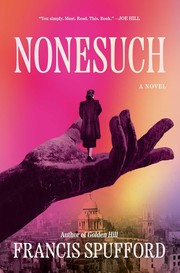
Nonesuch
2,197-word summary 10 min read 496 pages in the book
- First published
- 2026
- Publisher
- Scribner
- Pages
- 496
- ISBN
- 9781668214374
Reading options
What's inside (15 sections)
- Iris in 1939
- Geoff and the Watcher
- Lady Cunningham's design
- Angels and bridges
- The cliffhanger problem
- Why it works
- Spufford's range on display
- The Narnia game, played straight
- London as a character
- For whom the bridge opens
- Angels, seriously considered
- The war outside the magic
- Why the cliffhanger stings less
- Key takeaways
- FAQ
I went into Nonesuch on the strength of Cahokia Jazz and found something quite different: a wartime fantasy about angels, fascists, and one stubborn young woman. Spufford takes 1939 London seriously as history and then drops genuine magic into it. The combination should wobble. Most of the time it sings.
The setup is Narnia for adults, as several reviewers noted, but the book earns the comparison rather than coasting on it. Iris Hawkins wants a life bigger than the office she works in. War plus magic gives her one, at a cost the book never stops counting.
Iris in 1939
Iris works as a secretary at a City brokerage and knows she is smarter than the men who outrank her. She can run the mysterious teleprinter nobody else understands. She wants to be a stockbroker, an impossible ambition for a woman in her position. Spufford writes her frustration without turning her into a speech.
London in August 1939 feels thick and specific: heat, sunbaked streets, a West End out for pleasure while the news darkens. Iris moves through it in a slinky dress, spending money she should save, picking up a date because standing still feels like surrender. The early chapters are social comedy with dread underneath.
Her night out pairs her with Geoff Hale, a young BBC engineer, and with Lalage Cunningham, an icy aristocratic beauty with fascist connections. Both encounters change her life. One gives her an ally. The other marks her as someone worth watching, in the worst way.
Geoff and the Watcher
Geoff lives with his elderly father in a house stuffed with stranger things than either admits at first. His father occupies himself with magic and the occult, and the ramshackle archive of the Order fills rooms Iris was not meant to see. Geoff is decent, clever with his hands, out of his depth socially. His affection for Iris grows in a sweet, awkward register.
The Watcher arrives as the book's first real horror: a creature of ancient newspapers bound to protect the house, sent after Iris. Spufford describes it with horrible relish. To banish it, Iris has to work with powers she does not understand and may not survive touching. Her success marks her to everyone watching, human and otherwise.
This middle stretch is where the book is most fun. Magic has rules here, or at least prices, and Iris learns them the way she learned the teleprinter: fast, under pressure, resenting every teacher. Geoff's father makes a magnificent reluctant mentor. His archive scenes glow with the pleasure Spufford clearly takes in occult Victoriana.
Lady Cunningham's design
Lalage Cunningham, called Lall, wants to change history. Her scheme centers on keeping Churchill from power so Britain folds to Germany, and she has the magical backing to attempt it. Spufford makes her genuinely frightening rather than cartoonish. She believes her own vision completely, which makes her polite about monstrous things.
The fascist material is handled with unusual care for fantasy. Mosley's movement, aristocratic sympathizers, the casual antisemitism of Iris's office: all present, all specific. Lall's magic serves her politics rather than decorating it. The book argues, without preaching, that authoritarianism is itself a kind of dark enchantment, promising order at any price.
Iris's opposition to Lall starts personal and becomes principled. She has seen what the Order protects and what Lall would burn. The choice costs her the career plans she started with. Spufford does not pretend otherwise. Wanting to be a stockbroker was a real dream, and history plus magic takes it away.
Angels and bridges
The metaphysics deepen as Iris learns what the Order guards: bridges between times, statues that talk, beings that may or may not be angels. Spufford, a Christian writer, treats the question with unusual honesty. The powers might be holy. They might be something older wearing holiness like a coat. Iris must act without knowing, which is the book's real subject.
A late sequence involving a bridge and a choice about who gets to cross delivers the novel's best pages. Time travel here is not tourism. Every crossing costs, and the costs fall on people Iris loves. The find-your-own-miracle structure could feel mechanical. Instead it feels mournful, because Iris understands exactly what she is trading.
Geoff's role grows past sidekick in this stretch. His engineer's mind finds the flaw in a ritual the occultists missed, which is a lovely beat. The romance between him and Iris stays secondary to survival, which suits them both.
The cliffhanger problem
Yes, it ends on a cliffhanger, with a sequel planned. The main plot resolves enough to satisfy: Lall's immediate scheme fails, Iris survives changed, London keeps burning. But several large questions stay open, and one final twist reframes characters we thought we understood.
Readers allergic to unfinished stories should wait for book two. I minded less than expected, because Iris's arc within this volume feels complete. She wanted a bigger life and got one, with the bill attached. Whether she pays it further is the sequel's business.
The pacing also sags once, about two-thirds through, when archive exposition piles up. A ten-page trim would have helped. But the final hundred pages move like nothing else Spufford has written.
Why it works
Spufford writes sentences worth underlining and machinery worth admiring. Blitz London feels researched down to the blackout curtains. The Narnian echoes give emotional shape to genuinely strange material. Iris is prickly, ambitious, sometimes wrong, always alive.
For fantasy readers tired of farm boys and thrones, this is a genuine alternative. For Spufford readers, it is his most purely entertaining novel, wearing its learning lightly. I will be first in line for the sequel, cliffhanger and all.
Spufford's range on display
It helps to know what Spufford has done before. Golden Hill was a historical novel of old New York. Light Perpetual imagined lives for Blitz children killed in reality. Cahokia Jazz went full alternate-universe noir. Nonesuch borrows from all three modes: period precision, counterfactual daring, and a detective-like heroine piecing hidden systems together.
The throughline is his fascination with how people live inside history rather than above it. Iris is not a great-woman protagonist steering events. She is a secretary who stumbles into machinery bigger than her and refuses to be ground up. That ground-level view of the extraordinary runs through all his fiction, and it suits fantasy especially well.
His nonfiction background shows in the texture. The brokerage office, the BBC workshops, the occult bookshops: each milieu arrives with telling details that suggest deep reading worn lightly. Nothing feels info-dumped. The worldbuilding hides inside Iris's perceptions, so learning the rules feels like living them.
The Narnia game, played straight
The Narnian parallels deserve a closer look because Spufford plays them seriously rather than winking. Wardrobes become archives. Talking beasts become talking statues. A child entering magic becomes a young woman entering it, with adult consequences the children's books never faced. The wonder stays, but the bill comes due.
Lewis's Deep Magic concept, the idea of a rightness woven into creation, gets tested against fascism and war. Can order be trusted to win? The book's answer is qualified. Order needs defenders, and defenders get hurt. Iris's courage matters precisely because the outcome is not guaranteed by genre. Narnia promised Aslan. Nonesuch promises only that fighting matters.
Religious readers will find plenty to chew on. Spufford's own faith informs the angel question without dictating answers. Are these beings holy or merely powerful? The book lets Iris, a skeptic by temperament, decide what reverence means under fire. Secular readers need not worry about preaching. The theology serves the story, never the reverse.
London as a character
Blitz London gets the full treatment, and it is magnificent. Blackout routines, barrage balloons, office fire watches, markets carrying on: the city under strain feels alive on every page. Spufford clearly loves this London and fears for it in equal measure, which mirrors exactly how Iris feels about her own life.
Class runs through everything. Iris's ambition to be a stockbroker collides with accents, schools, and connections she lacks. Geoff's engineering cleverness gets dismissed by men with better tailoring. Lall's aristocracy opens doors that stay shut for everyone else. The fantasy plot literalizes these barriers as magical ones, which sharpens rather than softens the point.
The office scenes deserve special mention. Spufford captures mid-century workplace sexism with reportorial accuracy and real anger. Iris calculating exactly how much competence she can display without punishment will resonate with plenty of modern readers. History changes costumes. The dynamics rhyme uncomfortably.
For whom the bridge opens
Pacing caveats aside, this is the rare literary fantasy that satisfies both camps. Plot readers get spies, creatures, and a ticking clock. Sentence readers get prose that rewards rereading. History buffs get a Blitz that smells of cordite and tea. Romance readers get a slow, sweet connection built on mutual respect.
The 480 pages justify themselves. Subplots about Geoff's father, the Order's internal factions, and Iris's family all pay off rather than padding. Compare this to fantasies twice as long with half the content. Spufford's editor earned their fee, cliffhanger aside.
Start here even if Spufford is new to you. No prior book feeds into this one. Then read Cahokia Jazz for his noir mode and Golden Hill for his historical mode. You will have found one of the most versatile English novelists working, operating at full stretch.
Angels, seriously considered
Fantasy angels usually sort into warriors or wallpaper. Spufford's are stranger and more interesting: bureaucratic, bound, dangerous in the way large institutions are dangerous. The Watcher made of newspapers sets the tone. Holiness here looks like accumulated print and procedure as much as radiance. It is a very English vision of the celestial.
The question of what the beings want drives the middle of the book. Protection? Worship? Something colder? Iris tests them the way she tests everything: practically, with attention to costs. Her interactions with the Order's archive read like labor negotiations with heaven. What are the terms? Who enforces them? What happens when someone defaults? The answers satisfy and disturb in equal measure.
Lewis hovers over all of this, acknowledged and argued with. Spufford clearly loves Narnia and clearly thinks its moral universe needs stress-testing against real history. Can Deep Magic survive contact with fascism, Blitz, and modern doubt? The book's answer is that it can, but only carried by flawed people making costly choices. Grace needs hands.
The statues that talk deserve mention as a highlight. Stone voices delivering riddles with geological patience make for scenes of high weirdness grounded by Iris's exasperated responses. She treats a talking statue the way she treats a difficult supervisor: listen, probe, do not show fear. Practicality as spiritual discipline is quietly the book's funniest running idea.
The war outside the magic
Spufford never lets the fantasy obscure the history. The Blitz builds across the book from threat to reality, and the bombing chapters hit hard precisely because the characters were established in peacetime pettiness first. We watched Iris worry about promotions. Now she watches the sky. The contrast does political work no speech could.
The fascist plot gains menace from its historical plausibility. Aristocratic Nazi sympathizers, press barons hedging bets, officials looking away: all documented history woven into Lall's scheme. Her magic accelerates real plans rather than inventing them. That grounding makes the fantasy stakes feel heavier, not lighter. History was already bad enough.
Ordinary Londoners fill the margins memorably. ARP wardens, pub crowds, office girls, bus conductors: a whole city holding its breath. Spufford's nonfiction eye for social texture serves the novel constantly. You learn how blackout curtains worked, what fire-watching involved, how people dated during bombardment. The research never shows as research.
Geoff's engineering background pays off thematically here too. His faith in things that can be fixed meets a war that breaks faster than anyone repairs. His arc from tinkerer to someone who understands unfixable loss mirrors Iris's journey from ambition to responsibility. The book grows both of them up without either noticing until late.
Why the cliffhanger stings less
Most cliffhangers feel like withheld goods. This one feels like a stopped clock mid-chime. Iris has completed the transformation the book promised: office girl to someone who acts in history. What remains is consequence, which properly belongs to another volume. The pause lands on meaning rather than mere suspense.
Compare it to series fantasies that end mid-battle for commercial reasons. Here the break comes at a thematic resting point. Iris knows who she is now. What she does with that knowledge is the sequel's question. Readers can sit with the completed portrait while wanting the next canvas. That is legitimate serial storytelling, closer to chronicles than to chopped novels.
Still, the frustration is real and fair to name. One terrible twist in the final pages reframes a relationship central to the book, then stops. Waiting months or years for resolution tests goodwill. Spufford earns the wait with the quality preceding it, but the wait remains a wait. Plan accordingly and you will enjoy the book on its own considerable terms.
FAQ
When was Nonesuch published?
Scribner published it in March 2026. It runs 496 pages with ISBN 9781668214374; Faber published the UK edition in February.
Is it part of a series?
No. It opens a new sequence and ends on a cliffhanger, with a sequel planned, but this volume stands alone.
Who are the main figures?
Secretary Iris Hawkins, BBC engineer Geoff Hale, fascist Lady Cunningham, and the hidden Order with its angels and statues.
Similar books
Days of Blood and Starlight
Karou takes up Brimstone's resurrection work while Akiva breaks with his empire as war burns Eretz.
2,866-word summary · 13 min read
House of Sky and Breath
Bryce and Hunt want normal love but rebels and Asteri pull them to war and portals.
2,204-word summary · 10 min read

The Blinding Knife
Kip trains to join the Blackguard while the Prism hides his true identity, loses his colors, and fights a war against a rogue drafter who wants to birth a god.
2,049-word summary · 9 min read
Leviathan
In an alternate 1914, a prince on the run and a girl disguised as a soldier meet aboard a living airship.
2,406-word summary · 11 min read

Best Served Cold
Left for dead by the duke she served, mercenary general Monza Murcatto recruits a broken crew and works through a list of seven men who owe her a debt of blood.
2,108-word summary · 9 min read
The Battle for Skandia
Will and Evanlyn are still hiding in the Skandian mountains when Halt and Horace arrive with word of a Temujai invasion that could roll on to Araluen next.
2,248-word summary · 10 min read
A Reaper at the Gates
The Martial capital falls to an army of ghosts, Elias becomes the Soul Catcher, and Laia and Helene pay brutal prices as the Nightbringer moves to free the…
1,991-word summary · 9 min read
World After
Penryn wakes from near-death to find her altered sister Paige hunted as a monster, and follows her into the angels' scorpion factory and Uriel's coup.
2,213-word summary · 10 min read
His Majesty's Dragon
When Captain Will Laurence's crew captures a French frigate carrying a dragon egg, the hatchling chooses him, and he trades the Navy for Britain's Aerial Corps.
2,405-word summary · 11 min read
The Tower of the Swallow
Ciri flees as a bandit while Geralt gathers allies to find her.
2,580-word summary · 11 min read
The Burning God
Rin burns south and bargains with the Phoenix as the Republic splits.
2,381-word summary · 11 min read
Dreams of Gods & Monsters
Karou and Akiva unite chimera and seraphim against empires invading Earth.
2,179-word summary · 10 min read
Chain of Gold
Cordelia and James hunt demons in Edwardian London while hearts tangle.
2,364-word summary · 11 min read
Fire & Blood
Archmaester Gyldayn chronicles Aegon the Conqueror through the Dance of the Dragons, with Doug Wheatley art across 752 pages.
3,268-word summary · 15 min read
Unearthly
Part-angel Clara moves to Wyoming to fulfill a vision of a boy and a forest fire.
2,241-word summary · 10 min read

The Island of Sea Women
On Jeju island, haenyeo divers Young-sook and Mi-ja share decades of friendship strained by war and massacre.
2,204-word summary · 10 min read
The Eyre Affair
Literary detective Thursday Next chases a villain who kidnaps Jane Eyre from her own novel in an alternate 1985 England.
1,929-word summary · 9 min read
The Black Prism
Dying Prism Gavin Guile hides a secret son while war brews over color magic in the Seven Satrapies.
2,169-word summary · 10 min read
Gardens of the Moon
Empire, gods, and mages collide over Darujhistan as Bridgeburners bleed for Empress Laseen.
2,188-word summary · 10 min read
Baptism of Fire
Wounded Geralt crosses war country with odd allies to find Ciri after the Thanedd coup.
2,076-word summary · 9 min read
Winter's Heart
Trapped in Far Madding without the Power, Rand baits his betrayers while Mat plots escape from Ebou Dar and Elayne fights for Caemlyn.
2,906-word summary · 13 min read
The Time of Contempt
Geralt and Yennefer shelter Ciri as mages split and war breaks over the Thanedd coup.
2,355-word summary · 10 min read
The Red Winter
In 1785 France, aging monster-slayer Sebastian Grave and his heart-eating demon return to hunt the Beast of Gevaudan as revolution brews.
2,578-word summary · 11 min read
The Path of Daggers
Rand wields Callandor against Seanchan while Elayne and Egwene maneuver.
2,492-word summary · 11 min read
The Dragon Republic
Rin survives the last war only to join the Dragon Warlord against the Empress, trading one brutal fight for another.
2,810-word summary · 12 min read
Lady Tremaine
A widowed stepmother fights for her daughters when a royal ball hides a dark secret.
2,023-word summary · 9 min read
Knife of Dreams
Rand sets a Seanchan trap while Mat weds Tuon, Perrin storms Malden, Elayne takes Caemlyn, and Egwene defies Elaida.
2,988-word summary · 13 min read
A Memory of Light
Rand faces the Dark One at Shayol Ghul as all armies join the Last Battle.
2,165-word summary · 10 min read
Towers of Midnight
Perrin faces Whitecloak judgment and the wolf dream while Mat enters the Finns' tower for Moiraine.
2,099-word summary · 9 min read