
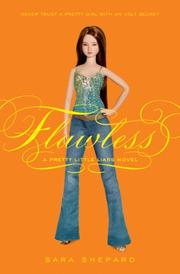
Flawless
2,811-word summary 12 min read 330 pages in the book
- First published
- 2007
- Publisher
- HarperTeen
- Pages
- 330
- ISBN
- 9780060887339
- Series
- Pretty Little Liars (#2)
Reading options
What's inside (10 sections)
I picked up the second Pretty Little Liars book because the first one ended with a body in the gazebo and a text that promised worse. Flawless came out on March 27, 2007, from HarperTeen, a 330 page hardcover with ISBN 9780060887339. It is book two of the series, and it gathers up the four girls exactly where the first novel dropped them, except the pressure has climbed and the adults have become even less useful. Shepard does not bother reintroducing Rosewood. You land back in the hallways and the cars and the locked bathrooms where secrets get traded, and the phone that never stops buzzing is already lit up.
The whole book turns on one question: who is A? When we last saw Aria, Spencer, Hanna, and Emily, they assumed the texter was Alison DiLaurentis, the beautiful and cruel queen bee who vanished in seventh grade and whose corpse was found buried in her own yard. Here that theory starts to come apart. A keeps bringing up The Jenna Thing, the old incident that split their circle, and Alison is dead. The only other person who was present besides the four of them is Toby Cavanaugh. The spotlight swings onto him. That shift gives the book its engine. For most of these pages the girls, and the reader, study Toby through the wrong end of a telescope, convinced he is the one typing the messages.
The phone keeps buzzing
The messages arrive with the same horrible intimacy as before. A knows what each girl did, knows who she kissed, knows which lie she told at home, and knows it before anyone else could have found out. The difference in this book is desperation. In the first novel the texts were a nasty game. Here they feel like a countdown. The girls compare screens in bathroom stalls and in the parking lot outside school, and every new line of text narrows the circle of people who could know this much.
That circle keeps pointing at Toby. He is Jenna Cavanaugh's stepbrother, he was around the night of the fire that blinded her, and he has never explained himself in a way that satisfies anyone. Spencer is the one who insists there is more to the story, because Spencer is the one who remembers what really happened. Nobody wants to hear her. Her sisters and parents are busy with their own hierarchies, and her friends are too frightened to listen closely. Watching Spencer try to say, in effect, that the convenient suspect is the wrong suspect, is one of the better threads here. She is right for reasons she cannot fully share, and the partial knowledge makes her lonely in a way the book understands well.
A fair warning about the first chapters. Shepard writes in short, blunt scenes that jump between four viewpoints, and if you have not read book one recently you may spend fifty pages sorting out who is dating whom and which secret belongs to which girl. The prose is plain on purpose. There is no foggy description to lean on. It is what happened, what was worn, who was in the room. That plainness suits teenagers narrating under stress, and it is also why the early chapters can feel like a checklist. Give it a little time. Once the threats get specific, the voices separate and the pace tightens.
What really happened to Jenna
The central backstory concerns the night Jenna Cavanaugh was blinded, and the book finally lays it out. Alison set off a firework in a treehouse belonging to Toby, Jenna's stepbrother. The plan was revenge. Toby had spied on the Liars while they were changing, and Alison decided to teach him a lesson. The firework ignited the treehouse, and nobody knew Jenna was inside. She was permanently blinded in the fire.
Afterward Alison framed Toby for the blaze. He took the blame and never said why. That is the version everyone carries around: Toby the troubled kid, Toby the one who should have known better, Toby who pays for a prank that went horribly wrong. Only Spencer knows the real reason he keeps quiet, and the book uses that gap to build dread. Every time another character says his name, you can feel Spencer sitting on a fact she cannot safely hand over.
The reason he took the blame is the ugliest part, and Shepard saves it for the end. Toby raped Jenna when they were in middle school. Alison knew, and so did Spencer. That is how Alison forced him to accept the guilt for the fire. The fire was a weapon aimed at a boy who was already dangerous, dressed up as a prank that went wrong. Jenna's blindness becomes a cover for an older crime, and the Liars have been living inside that cover for years without understanding what they were looking at. Reading it back, the pieces were always there, tucked into the way Toby avoids certain rooms and the way Jenna will not say his name. The book does not play fair with every clue, but it does make the final reveal feel earned rather than pulled from a hat.
Emily, Maya, and the boy next door
Emily's storyline carries the most weight in this volume. She is still in love with Maya St. Germain, the girl who moved into Alison's old house, and she is still terrified of what that love means in Rosewood. Her parents watch her closely. Her mother in particular treats faith as a kind of surveillance. A sends Emily a message that makes plain the texter knows about her and Maya, and threatens to tell the whole school. For Emily the fear goes well past embarrassment. It is about losing home. She has built a small, careful life around swimming and a few stolen hours with Maya, and A is holding a match to it.
What complicates things is that Emily starts spending time with Toby. He is gentle with her in a way she does not expect, and she drifts toward him partly because he seems outside the rules everyone else is enforcing. They go together to a benefit party. At some point she tells him she thinks she might be gay. This is a brave, unsteady moment, and Toby does not pull away. That small act of acceptance is what makes the later scenes hurt. Shepard lets Emily trust him for a while before she lets the reader see why that trust is complicated.
The book is good on the physical details of being closeted at sixteen. A hand held too long under a table. The way Emily measures the distance between the car and the front door. The calculation of who might be watching from a window. These are quiet scenes in a loud plot, and they are the ones I remember. Emily's chapters are the most tender thing in Flawless, and they are also the reason her final confrontation lands hard. She has spent the whole book being told, by texts and by parents, that her truth is dangerous. Then she is the one holding a truth about someone else, and it nearly destroys her.
Aria and the ultimatum
Aria's plot runs through her father's affair. Byron Montgomery has been seeing one of his students, Meredith Gates, and Aria has known for months. In book one she carried that knowledge alone to protect her family, and A used it against her. In this book A stops hinting and issues an instruction: get rid of the problem, or tell your mother the truth about your father and Meredith.
The phrase is deliberately ugly. A does not say expose him or stop him. The texter says get rid of the problem, as if Meredith were an object to be removed, and Aria is frightened enough to try. She goes to confront the other woman. Meredith does not crumble. She tells Aria plainly that she and Byron are in love. The scene has a cold clarity to it, because Meredith has heard the same story from Byron that Aria has been defending, and neither girl has much power in the room where the man is not.
The fallout arrives at home. Ella finds out about the affair and throws Byron out. Aria expects, in some confused way, to be relieved. Instead her relationship with her mother shatters, because Ella now knows Aria knew and kept it from her. That is the sharper wound. The affair itself is Byron's betrayal. The silence is Aria's, and A has engineered a situation in which telling the truth and hiding it both punish her. It is a nasty bit of design and one of the better plotted arcs in the book, because the damage comes from a real contradiction rather than from a coincidence.
There is an older problem running underneath this thread, carried over from the first novel. Aria's relationship with her teacher Ezra Fitz is still treated as a romantic line with a brooding, forbidden glow. In 2007 that passed as tension. It reads differently now, and the book does not examine the power gap between a grown adult and a student. I found those chapters hard to take seriously on reread, and the fact that A's threat is about a different affair does not excuse the one the book keeps romanticizing. Read this thread with clear eyes.
Hanna's confession and the party at Foxy
Hanna has replaced Alison as the social force at Rosewood, but the crown sits uneasily. She is thin now, popular now, and still shoplifting and purging to keep the picture intact. Her friendship with Mona Vanderwaal is the same mixture of comfort and danger it was in book one. Mona knows how to build Hanna up and how to make her feel small, often in the same afternoon.
A leaves Hanna a note that forces a public humiliation. Hanna has to tell Naomi Zeigler and Riley Wolfe, Alison's old friends and now the gatekeepers of Rosewood cool, that she makes herself throw up and that Sean Ackard broke up with her. These are precisely the two facts she has worked hardest to bury. Naomi and Riley are not kind listeners. They are the audience that makes the confession a punishment rather than a release. Shepard writes the scene without softening it, which is both brave and a little cruel to the character. Hanna's eating disorder is treated as a shameful secret that A can weaponize, and there is not much room here for the illness itself to be understood.
Later a text tells Hanna that Sean is at Foxy with another girl. She goes, and what she finds is worse in a different way. Sean, who made a public show of joining a virginity club, is ignoring his own vows and is nearly having sex with Aria. The collision of Aria's thread and Hanna's is one of the neater pieces of plotting in the book. Two girls who have been carrying separate secrets end up in the same room, each exposed by the other's behavior, with A somewhere nearby pulling the strings. Hanna realizes the texter is at the party and tells Spencer and Aria. All three settle on the same guess: it must be Toby.
Spencer, Wren, and the wrong suspect
Spencer's arc is built around Wren Kim, the man her older sister Melissa used to date. She keeps seeing him. She loses her virginity to him, which she treats as both a victory and a risk, and then discovers Melissa is sleeping with him as well. The sister rivalry that powered book one is still the main engine of Spencer's chapters. She wants what Melissa has, and when she gets it she cannot decide whether she has won or made a mess.
This is also where the book's suspicion of Toby becomes a trap. Because Spencer alone knows why Toby took the blame for the fire, the others read her reluctance to accuse him as guilt by association. She knows a fact they do not, but she cannot share it without revealing the rape and the bargain Alison made. So she watches her friends build a case against the wrong person while she holds the one piece of evidence that would change their minds. That is a strong position for a character, and Shepard keeps Spencer sharp and frustrated rather than simply right.
The Foxy sequence pulls everyone together. Hanna has seen Sean with Aria. Aria is reeling from the confrontation with Meredith and the collapse of her mother's marriage. Spencer is tangled up with Wren and with her own silence. A text brings them to the same place, and the three of them decide the texter is Toby. They are wrong in a way that matters, because the person they should have been watching was standing closer to all of them than they knew. The book is less interested in the identity of A than in how much damage people can do while everyone around them is looking in the wrong direction.
The drive home
The ending arrives through Emily. Her ex-boyfriend Ben tries to rape her at the party, and she leaves with Toby instead of staying. In the car she is overwhelmed and talks too much. Toby listens for a while and then starts ranting about Alison, saying he is happy she is dead. The words land badly on Emily, who has spent the book learning that Alison's death is not a clean ending for anyone. Frightened, she gets out of the car and runs home.
Toby follows. He shows up at her house banging on the door, shouting that he needs to talk to her. Spencer calls, and Emily hangs up on her when she sees him at the door. Then she says the thing she should not say. She tells Toby she knows what he did to Alison. It is not a precise accusation. She does not know the full story, only that he took a blame that was not his and that Alison held something over him. It is enough. Toby panics and begs her not to go to the police.
The next day he is found dead on the road leading to Emily's house, and the death is ruled a suicide. The book then gives up the secret it has been guarding. Toby raped Jenna in middle school. Alison knew, Spencer knew, and Alison used that knowledge to force him into confessing to the fire. Emily understands that Toby died believing she knew the truth about him and Jenna, and that her frightened sentence at the door may have killed him. The book leaves that guilt exactly as messy as it is. Shepard lets Emily carry it, and the last stretch of the novel is quieter and heavier than the texting thriller that came before.
What holds and what strains
Flawless is a solid second book, and its best material is the way old secrets rot into new ones. The Jenna Thing is not a puzzle box. It is a crime everyone has agreed not to name, and the book is at its strongest when it shows how a whole town can organize itself around a thing nobody will say. Spencer's position, knowing enough to be right and not enough to be believed, gives the plot a human center. Emily's chapters are careful and moving, and Toby's death is handled with a seriousness that the earlier prank narrative had not earned on its own.
The strains are real. The four viewpoints can blur in the early going, and the mystery leans on a run of coincidences and withheld facts that a patient reader may see coming. The book also asks us to accept that adults will miss almost everything in front of them, which is a familiar YA device and here sometimes tips into absurdity. Hanna's storyline uses her bulimia as a source of embarrassment for A to exploit, and the treatment leaves little space for the illness itself. The Aria and Ezra relationship, inherited from book one, still reads as glamorous when it should read as a warning. These are not small complaints, but they sit alongside chapters that are genuinely good at showing how fear makes girls quiet.
I would hand this to someone who has read the first book and wants the story to get darker before it gets stranger. Readers coming from the ABC Family show should leave that version at the door, because the adaptation is loose and this series is meaner and smaller than what television made of it. Keep in mind who is doing the looking. In Rosewood the person with the phone is not always the person with the power, and the most dangerous secret in Flawless is the one everybody already knows and nobody will speak aloud.
FAQ
When was Flawless published and where does it sit in the series?
HarperTeen published it on March 27, 2007, as the second Pretty Little Liars novel, after 2006's Pretty Little Liars and before Perfect. The first edition hardcover runs 330 pages with ISBN 9780060887339.
Who do the girls think A is in this book?
They become convinced the texter is Toby Cavanaugh, because the messages keep referring to the fire that blinded Jenna. They are wrong, and the real identity is left for later books in the series.
Why does Toby die at the end?
Toby is found dead on the road near Emily's house after she tells him she knows what he did to Alison. The book reveals he had raped Jenna years earlier, and Emily is left blaming herself for his death.
Similar books
More from Pretty Little Liars first, then related titles.
Pretty Little Liars
Four girls get texts from dead Alison a year after she vanished, and secrets start leaking.
1,922-word summary · 9 min read
Reconstructing Amelia
A grieving lawyer mother reopens her teen daughter's alleged suicide at an elite Brooklyn school, uncovering bullying and secrets.
2,032-word summary · 9 min read
The Moonlight Child
On a cold January night, Sharon Lemke sees a child washing dishes in a neighbour's kitchen and decides she cannot ignore it.
2,169-word summary · 10 min read
You Are Not Alone
A lonely New Yorker witnesses a subway suicide and falls in with the dead woman's friends, where a makeover and a framed murder hide a hidden mastermind.
2,588-word summary · 12 min read
The Lies I Tell
A con artist returns to Los Angeles to ruin the man who took her family's home, while a journalist who has hunted her for ten years closes in.
2,201-word summary · 10 min read
The Cellar
Abducted in her small English town, sixteen-year-old Summer is locked in a cellar with three other girls. Their captor calls himself Clover and wants a perfect…
2,551-word summary · 11 min read
The Silent Sister
Returning to New Bern to clear out her late father's house, Riley MacPherson finds proof that the sister she believes drowned decades ago is alive under…
2,706-word summary · 12 min read

Six Years
A professor who promised to forget the woman he loved sees her husband's obituary and discovers that the wedding, the marriage, and the woman herself may never…
2,076-word summary · 9 min read

Heist Society
A teenage art thief gets expelled from boarding school, then has two weeks to steal five paintings back from a London museum and clear her father.
2,781-word summary · 12 min read
The Girls in the Garden
Clare moves her daughters to a gated London garden where the community feels safe; at the midsummer party, twelve-year-old Pip finds her sister bleeding in the…
1,973-word summary · 9 min read

The Best of Friends
Three lifelong friends discover their teenage sons were hiding more than anyone knew after a night that leaves one dead, one in a coma and one silent.
2,040-word summary · 9 min read

Girl, Forgotten
A rookie US marshal guards a judge with a stalker and ends up reopening the 1982 prom-night murder of the judge's pregnant daughter.
2,111-word summary · 9 min read

The Boy from the Woods
Wilde, found feral in a New Jersey forest in 1986, hunts for a missing teenager while a senator's secrets tear a wealthy town apart.
2,270-word summary · 10 min read
The Reappearance of Rachel Price
Bel films a doc when her missing mother walks back after years.
2,254-word summary · 10 min read

Keep It in the Family
Mia and Finn renovate a long empty house and find seven children hidden in the attic.
2,270-word summary · 10 min read
Radio Silence
Head girl Frances loves a secret podcast made by shy Aled, and both crack under A-levels in Oseman's warm 2016 story of friendship, fandom, family and choosing…
2,778-word summary · 12 min read
Kill Joy
Pip hosts a 1920s murder mystery party with her friends, solves the fake case, and feels a real scare that points toward A Good Girl's Guide to Murder.
2,537-word summary · 11 min read
Every Last Secret
A wealthy wife tracks a possible affair, but dinners, therapy, and a sudden death expose buried secrets across two polished suburban marriages and force her to…
2,687-word summary · 12 min read
Bring Me Back
Finn lost Layla at a French rest stop twelve years ago. Now engaged to her sister Ellen, he faces sightings, emails and Russian dolls that reopen everything.
2,912-word summary · 13 min read
We Were Never Here
Best friends Emily and Kristen hide a backpacker death in Chile, then face another in Vietnam with trust cracking.
2,076-word summary · 9 min read
The Other Mrs.
A Chicago family inherits a house on a Maine island, then a neighbor is found murdered. Kubica's 2020 thriller builds to a final reframe.
2,267-word summary · 10 min read
The Cousins
Three cousins work at their rich grandmother island resort while digging into why their parents were cut off.
2,565-word summary · 11 min read
Solitaire
Gloomy Tori Spring hunts school prank group Solitaire with odd Michael Holden while brother Charlie heals.
2,068-word summary · 9 min read
Pieces of Her
After her mother kills a mall shooter with shocking skill, Andy Oliver uncovers a hidden 1980s past of radicals and wealth.
2,791-word summary · 12 min read
What Lies in the Woods
Naomi returns after Olivia vanishes to face what happened in the woods at eleven.
2,213-word summary · 10 min read
The Raven King
Gansey's fated death nears as Glendower wakes and the ley wakes hungry.
2,477-word summary · 11 min read
The Last House Guest
A year after her best friend dies in Littleport, Maine, a local woman finds a hidden phone that reopens the case.
2,596-word summary · 12 min read
Reckless Girls
Six young travelers chase paradise on remote Meroe Island, where old lies, smashed radios and hidden cash turn sun and sand deadly.
2,703-word summary · 12 min read
Anatomy of an Alibi
Two Louisiana women swap lives for twelve hours to spy on a husband, then he turns up murdered and only one of them has an alibi.
2,278-word summary · 10 min read
All the Little Houses
In 1980s Longview, Texas, social queen Charleigh and daughter Nellie guard mean-mom secrets when a new family threatens their empire.
2,206-word summary · 10 min read