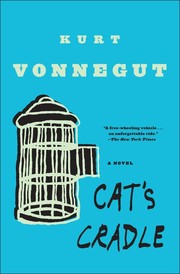
Cat's Cradle
2,583-word summary 11 min read 304 pages in the book
- First published
- 1963
- Publisher
- Holt, Rinehart and Winston
- Pages
- 304
- ISBN
- 9780385333481
Reading options
What's inside (8 sections)
I picked up Cat's Cradle because a friend told me it was the funny one about the end of the world. That sounded wrong to me. How do you make the end of the world funny without being cruel about it. The book is short, 304 pages in the Holt, Rinehart and Winston edition from 1963, and I finished it in two sittings with a lot of staring out the window in between.
The narrator calls himself Jonah at first. Then he says you can call him John. He wanted to write a straight book about what important Americans did on the day Hiroshima was bombed. That plan falls apart fast. What he finds instead is a dead scientist, three strange kids, a made up religion, and a little island that ends up holding the end of everything. By page fifty I stopped caring about his first book idea. I wanted to follow him to see how bad it could get.
This is a friend retelling, so here is the short shape. John chases the story of Felix Hoenikker, one of the fathers of the atom bomb. He meets Hoenikker's three children. He learns they each hold a piece of something called ice-nine. He follows a trail to the island of San Lorenzo. There he meets a saint in hiding, a dying dictator, a beautiful girl everyone wants to marry, and a whole country pretending to believe in a religion that admits it is lies. Then the world freezes. I laughed a lot. I also felt sick at the end, which I think is the point.
The day the bomb dropped and the man who made it
John starts with mail. He writes to people who knew Felix Hoenikker, asking where they were when the bomb went off over Hiroshima. He gets back odd small answers. One man was playing horseshoes. Someone else was listening to the radio and did not quite get it. The replies feel flat on purpose. A city vanished and life in Ilium, New York kept going with lunch and errands.
Felix Hoenikker is dead before the story starts, but Vonnegut builds him so clearly you feel you met him. Felix was a Nobel type, brilliant with physics and hopeless with people. He worked on the Manhattan Project. His idea of play was to wonder if he could make turtles or atoms do something new. His wife died giving birth to their third child. After that he left the raising to his daughter Angela, who was barely grown herself.
The famous cat's cradle scene comes from Felix's son Newt. Newt remembers his father trying to play cat's cradle with string on the day of the bomb. Newt was tiny. He saw his father with string looped around his fingers, making a shape and saying, look at the cat, look at the cradle. Newt hated it. To him there was no cat and no cradle, only string and grown men lying. That image sticks through the whole book. People make shapes with strings and call them true. Science. Religion. Politics. Love. Sometimes it is only string.
Vonnegut does not paint Felix as evil. That is what makes him scary. Felix was not plotting murder. He just did not think about people at all. When a Marine general complained that Marines could not move fast in mud, Felix took it as a fun puzzle and started thinking about a kind of ice that would freeze mud solid. He was not trying to end the world. He was trying to solve a clever problem put to him at a party. The moral gap there gave me chills. No anger. No plan. Only curiosity with no brakes.
The three Hoenikkers
Angela, Frank, and Newt each got a piece of their father and none of them got a whole parent.
Angela is the oldest. She is tall, played clarinet, and practically raised her brothers. She married a man who seems decent until you learn why he married her. She keeps a secret for years and tells herself it is loyalty. I felt sorry for her and also frustrated. She knows what ice-nine can do and she still trades it for a normal life. Vonnegut lets you see how tired she is. She wanted someone to take care of her for once after years of taking care of boys who never grew up.
Frank is the middle kid. He is handsome in a blank way and good with models and gadgets. He ran away, worked odd jobs, and ended up on San Lorenzo as Major General Franklin Hoenikker, minister of science and progress. He is the kind of smart kid who can fix a radio and cannot tell when he is being used. On the island everyone treats him as important. Back home he was mostly lost. Power suited him because he never asked what it was for.
Newt is the youngest, a midget in the language of the time, a tiny man who paints and loves women who do not love him back. He gives John the cat's cradle memory and some of the saddest letters in the book. He also gives away his piece of ice-nine for a Soviet dancer and a few nights of feeling wanted. It sounds stupid until you sit with it. If your father never saw you, and the world only stared at your size, you might trade a chip of the end of the world for someone holding your hand.
John meets them one by one, drinks with them, flies with them. None of them think they did anything big. Each transfer looked small. A gift, a bribe, a price for love. Put together, three small deals spread the stuff wide enough to kill oceans.
Ice-nine in a thermos
Ice-nine is simple to explain and hard to forget. It is a different way for water to freeze. Normal ice melts above freezing. Ice-nine stays solid at room temperature and, once it touches liquid water, it teaches that water to become ice-nine too. One seed crystal in the sea would chain through every river, lake, and puddle. Vonnegut has Felix cook it up in a kitchen setup and keep the proof in a little thermos.
The science is fake. Vonnegut knew that. He had worked in public relations for General Electric and had a brother who knew real science. What matters is how careless the handling is. Felix leaves it around. His kids split it after his death on Christmas Eve. No guards. No vault. Only a thermos and family sentiment.
I kept thinking about passwords and guns while I read this part. Most disasters I know about did not start with a villain speech. They started with someone leaving something where someone else could grab it. Felix dies in his sleep with ice-nine nearby. His kids find him and divide the stock instead of calling the government. That quiet choice sets the clock.
John learns about ice-nine slowly. A former lab man hints at it. By the time John sees it for real on San Lorenzo, the dread is built. A chip the size of a fingernail looks harmless. Later a dog licks it and freezes stiff. Later a man touches it to his mouth and dies pointing. Vonnegut writes those deaths fast. No explosion. Only stillness spreading.
If you read this with kids in the house, that dog scene will bother you. It bothered me. I had to put the book down and feed my own dog a treat like that would fix anything.
Bokonon, karass, and foma
Half the book is not about bombs at all. It is about religion, and this is where Vonnegut is at his funniest and meanest.
On San Lorenzo people follow Bokononism, though it is banned on pain of death by impalement on a giant hook. The founder is Lionel Boyd Johnson from Tobago who washed up with a white deserter named Earl McCabe. They tried to run the island with plain sense and failed. People were poor and sick. So Johnson turned himself into Bokonon, a holy man in hiding, writing little books of jokes and telling everyone not to believe a word he says.
Bokonon calls his lies foma. Harmless untruths that make life bearable. He says we all belong to a karass, a team put together by God to do His will without knowing it. The opposite is a granfalloon, a false group like a nation or a college that makes you feel proud for no reason. He even gives a word for touching feet sole to sole with someone you love, boko-maru. It sounds silly. People in the book treat it as holy.
The Books of Bokonon are quoted all through the novel. Live by the foma that make you brave and kind and healthy and happy. Busy, busy, busy is what humans say when they do not know what they are doing. I laughed at some of these. Then I felt caught, because I do the same thing. I repeat lines that help me get through the day even if I know they are thin.
McCabe became Papa, the ruler who outlawed Bokonon at Bokonon's own suggestion. A banned religion would grow stronger while a state one would go soft. So the hook killings are theater. Papa orders them. Bokonon writes about them. Everyone plays along while the roads stay bad and the medicine runs out.
John falls for this fast. He likes feeling chosen for a karass with Mona and the Hoenikkers. The verses are catchy. The foot rite sounds sweet. Then Vonnegut shows the cost. If every truth is foma, you stop fixing drains and hospitals because stories feel better than plumbing. Comfort is good. Comfort as policy is rot.
Busy, busy, busy is what we Bokononists whisper whenever we think about how strange and short life is.
I love that line and I distrust it, which is exactly how Bokonon wants it.
San Lorenzo, Papa, and Mona
San Lorenzo is tiny, poor, rocky, and run down. One road. One hotel. One castle. One hook by the square. About half a million people with almost nothing, ruled by Papa Monzano, a sick man in a castle who hates Bokonon in public and reads him at night.
Frank Hoenikker is Papa's right hand. He came to the island years before John and charmed everyone with gadgets. Papa made him a general and a minister. When John arrives stranded with the Hoenikkers and some tourists, Frank offers him the presidency. He does not want the job. He wants to keep tinkering. John says yes mostly because of Mona.
Mona is Papa's adopted daughter, beautiful and kind in a way that feels holy to John. Many men propose to her daily. She believes Bokonon with a full heart. John falls hard the moment he sees her. I will be blunt. Mona is more symbol than person. She has little want of her own except to love everyone and serve the island. She exists to test John, to show what desire does to judgment.
Papa is dying of cancer when John lands. Frank gives him ice-nine to end it cleanly. Papa freezes solid in bed, grinning. Then comes one of the worst scenes Vonnegut ever wrote. Others touch the frozen body, freeze themselves, break. A dog carries the chain to the sea. What matters is the sea freezes. Rivers stop. Rain turns to gritty crystals and falls wrong.
John, Mona, Newt, Angela, Frank, and a couple of survivors hide in a bunker and climb out into a white world. Tornadoes of ice dust move across dead oceans. People froze mid step by the thousands. Vonnegut gives you a frozen band mid note, a whole city paused. It is quieter than Hiroshima and somehow just as cruel, because this time there was no war to blame. Only carelessness and want.
My notes say: Frank wanted love. Angela wanted rest. Newt wanted touch. Papa wanted peace. John wanted Mona. Everyone got a piece and broke the world. Small hungers, big physics.
The end and what it leaves
The last chapters walk through ruins without fire. John and Mona wander. They meet survivors who have gone mad or holy or both. Bokonon shows up at the end, tired, ready to write the last sentence of his books. He tells John to climb Mount McCabe and thumb his nose at Something up there.
Bokonon wants his final line to be this. If I were younger, I would write a history of human stupidity. Then I would climb Mount McCabe and lie down with my history for a pillow, and I would make a statue of myself, lying on my back, thumbing my nose at You Know Who. It is funny and bleak.
What stayed with me was not the ice. It was the talk. John chats on planes. Tourists chat about beaches. Officials chat about progress while the clinic has no aspirin. Bokonon chats in verse while children go hungry. Felix asks what if and never asks should we. Talk can be a way to avoid looking at the thermos on the shelf.
Now the fair criticism, because the book earns some knocks.
First, women get short shrift. Angela cooks and cries. Mona glows and comforts. The American wives nag and sunburn. None have the inner mess that John, Newt, or even Papa get. You could argue Vonnegut is satirizing male fantasy, since John admits he wants Mona more than he knows her. That helps a little. It still leaves two major women as helpers in a story about fathers and sons.
Second, the middle sags if you do not like aphorisms. There are 127 short chapters. Many end with a verse or a punch line. After a while I felt the rhythm too much. When it works, it sings. When it tires, you skim to get back to plot. I skimmed a few and had to go back.
Third, San Lorenzo can feel like a set. The islanders get little voice beyond singing and smiling. Papa gets pain and fear. The crowd stays backdrop. Victims with faces would have cut deeper. Compare Slaughterhouse-Five, where even minor prisoners get a tic that sticks. Here many islanders blur.
None of that broke the book for me. Felix and ice-nine make a clean fable about knowledge without care. Bokonon makes a harder fable about lies we need and lies that kill effort. Put them together and you get a country that can freeze the sea while reciting poems.
Should you read it. If you like dark comedy that still has a heart, yes. If you want hard science fiction with rules and ships, this is not that. It is closer to satire with a physics prop. Read it fast and let the verses wash over you. Do not try to map every karass link on first pass. I tried and got tangled.
I closed it late, with ice rain in the forecast here. I checked my freezer, stupid I know, and thought about thermoses. Then I thought about my small daily trades. What am I keeping on a shelf without asking what it teaches the water around it. That question is why Cat's Cradle still belongs next to the serious books about bombs. It asks it with a grin and leaves frost on the grin.
FAQ
What is ice-nine in Cat's Cradle?
Ice-nine is a crystal that stays solid at room temperature. Once it touches liquid water, that water becomes ice-nine too, so a chip can freeze seas, rivers, and rain.
Who is Bokonon?
He is Lionel Boyd Johnson, a shipwrecked adventurer who becomes a holy man in hiding. He writes the Books of Bokonon, which admit they are lies, and Papa Monzano bans them while reading them.
Is Cat's Cradle only for science fiction fans?
No. It is a 1963 satire about bombs, religion, and power with a science prop. Readers who like dark comedy will feel at home, while hard science fiction fans should expect fable, not rules.
Similar books
More like Cat's Cradle →
Slaughterhouse-Five
Billy Pilgrim slips through time from Dresden to Tralfamadore in Vonnegut's short antiwar classic.
2,722-word summary · 12 min read

Scythe
Citra and Rowan become apprentice scythes who must glean one another.
2,574-word summary · 11 min read

Klara and the Sun
Solar robot Klara loves Josie and bargains with the Sun to save her.
2,251-word summary · 10 min read

Cress
Imprisoned hacker Cress joins Cinder Scarlet Wolf Thorne to stop Levana's wedding to Kai.
2,534-word summary · 11 min read

Scarlet
Scarlet searches for her grandmother with Wolf while escaped Cinder fights Levana in the Lunar Chronicles sequel.
2,756-word summary · 12 min read

Northanger Abbey
Naive Catherine Morland mixes gothic novels with real Bath society and love.
2,650-word summary · 12 min read