
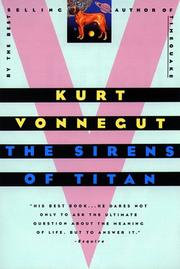
The Sirens of Titan
2,663-word summary 12 min read 319 pages in the book
- First published
- 1959
- Publisher
- Dell
- Pages
- 319
- ISBN
- 9780385333498
Reading options
What's inside (8 sections)
The richest man and the man who sees tomorrow
I picked this one up because Cat's Cradle had left me grinning and a little unsettled, and I wanted to see where Vonnegut started to sound like himself. The Sirens of Titan first came out in 1959 from Dell, 319 pages in that first edition, and you can feel a young writer deciding he would rather be funny about big questions than solemn about them. What surprised me was how much of the book is about being pushed around, and how gentle it is about that.
The setup is simple and strange. Malachi Constant is the richest man in America in a near future that Vonnegut calls the Nightmare Ages, the stretch between the Second World War and a coming depression. Malachi did not exactly earn his luck. He inherited money from his father Noel and then watched it grow through a run of chances so steady that he takes it as proof that somebody upstairs favors him. He throws parties and drifts through affairs. He is not cruel in a planned way. He is worse in the ordinary way. He never has to think about anyone else.
Then Winston Niles Rumfoord invites him to Newport.
Rumfoord is rich in the older style, New England money, a big house, a beautiful wife named Beatrice who despises sloppiness. He used his fortune to build a private spaceship and fly it with his dog Kazak. Somewhere between Earth and Mars the ship flew into what the book calls a chrono-synclastic infundibulum. The name is a mouthful and the idea is simple enough for the story. In certain places, the book says, all the different kinds of truth fit together, and a person who flies through one stops being solid. Rumfoord and Kazak become a kind of wave stretched along a spiral from the Sun out to Betelgeuse. Whenever a planet crosses that spiral, they appear there for a while, solid and talking, and then they thin out again.
There is one place where Rumfoord can stay solid all the time. That place is Titan, the large moon of Saturn.
The catch is that Rumfoord now sees the past and the future the way you and I see a street. He tells Malachi exactly what will happen to him. Malachi will travel to Mars. Then to Mercury. Then back to Earth. Then to Titan. He and Beatrice, who has never met Malachi and wants nothing to do with him, will have a son named Chrono. The boy will carry a small lucky object all the way to Titan. Malachi tries to wriggle out of it by selling the companies that could take him to space. It does not work. The future Rumfoord describes keeps arriving anyway.
Beatrice is furious about the whole business, and I liked her at first for that reason. She is sharp and proud of her manners, and she tells Rumfoord his prophecies are a cheap trick. She does not want to be bred on Mars or exiled anywhere.
The richest man loses his name
Mars is where the book stops kidding around.
Malachi and Beatrice are both tricked onto a ship. Two recruiters get Malachi to sign up for what he thinks is an adventure, and Beatrice is taken without ever agreeing. On the way to Mars something violent happens between them, and Beatrice later bears his son. The book handles this briefly and coldly. As far as I could tell, Vonnegut wanted us to feel how little choice either of them had, but the cost falls mostly on her.
On Mars their memories are cleared. Malachi becomes Unk. Beatrice becomes Bee. She teaches breathing exercises to new soldiers because the air is thin. Their son Chrono is eight and plays games at school and wants nothing to do with the confused man who claims to be his father.
Unk lives in barracks under radio control. He has an antenna in his head. When he disobeys, or even thinks too hard about disobeying, pain knocks him flat. The army uses him the way you might use a tool. Early on, after yet another memory wipe, he is ordered to kill his best friend Stony Stevenson in front of a crowd. He does it. He does not know who Stony is at that moment. Just before he dies, Stony manages to pass a hint about a blue stone and a barrack number and a letter.
That letter matters. Unk finds it. It is in his own handwriting from an earlier stretch when he remembered more. It warns him that his squadmate Boaz is secretly one of the real commanders, a man without an antenna who hands out the pain to others. It tells him about Bee and Chrono in the city of Phoebe. It urges him to resist even though resistance hurts.
So Unk tries. He and Stony had tried before, more than once, and the hospital kept wiping them clean. This time Unk decides he will be the first deserter in the history of the Martian army. He goes to Phoebe to fetch Bee and Chrono. They stare at him like he is a stranger, which he is to them now. Bee teaches her classes. Chrono plays with his friends. Nobody wants rescue from a man they do not know.
Meanwhile Rumfoord is running both sides of the coming war. Mars has built a huge invasion fleet out of kidnapped and brainwashed humans. Rumfoord has also started a new faith on Earth, the Church of God the Utterly Indifferent, which teaches that God does not care about people either way, so people should stop begging for favors and take care of each other instead. The Martian attack is meant to fail in a spectacular way. The slaughter will frighten Earth into unity. It works.
If I have the timeline right, Unk misses the actual battle. Rumfoord puts him and Boaz on a ship that is supposed to head for Earth but is really aimed at Mercury. That detour saves their lives and ruins them in a different way.
Three years inside Mercury
Mercury is the quietest part of the book, and the strangest.
The ship drops Unk and Boaz deep into caves on the dark side of the planet, more than a hundred miles down, and there they sit for three Earth years. The only living things around them are harmoniums, small yellowish creatures that cling to cave walls and live off vibrations. Boaz falls for them completely. He plays tapes from the ship, lets his favorite ones feed from the beat in his own wrists, and slowly stops caring about rank or escape. Unk keeps trying to solve the puzzle of how to get out, which is very much in character. He was a rich man who fixed problems by buying answers. Now he has no money and no pull in the usual sense, only patience he never learned on Earth.
Rumfoord arranges the harmoniums now and then into letters, so the cave walls spell out short instructions. The last message tells them to turn the ship over, since the sensors on its underside can find the way out through the rock. Boaz refuses to leave. He has found a place where he can do some good without hurting anyone, tending small singing things that ask for nothing but rhythm. Unk goes alone.
I found this section slow on a first read and better on reflection. Almost nothing happens for a long time. But that slowness does real work. Mars showed what happens when men are controlled by antennas and orders. Mercury shows what happens when control is taken away and there is nowhere to go. Boaz chooses care. Unk chooses motion.
There is a small detail I kept thinking about. The harmoniums do not judge. They eat music and heartbeats with the same attention. After all the speeches on Mars about glory and all the sermons on Earth, these blind cave creatures are the first group in the book that simply receives what is offered.
Back on Earth as the Space Wanderer
Unk returns to Earth famous and doomed.
Rumfoord has been preaching that a traveler from space will arrive, and here comes Unk on schedule, filthy and confused. The Church makes him its Space Wanderer, a living symbol. Then Rumfoord stages a ceremony and tells Unk the truth about Stony in front of everyone, that Unk strangled his only friend with his own hands while under control. It breaks him. Shortly after, his real identity comes out. He is Malachi Constant, the selfish rich man from before the war. People who cheered him as a symbol now vote to send him away.
He is pilloried in a public square in a way that feels old and deliberate, meant to shame the past more than punish the man. Then he is exiled.
Beatrice and Chrono are exiled with him. Beatrice is now in her fifties, still proud and sharp. Chrono is a teenager who trusts animals more than people. Malachi is somewhere between Unk and his old self, remembering enough to feel sick about what he did and not enough to explain it.
Titan itself is cold and lovely, wide flat plains and strange blue birds and a small house where they are expected to live. Rumfoord is there, solid at last, with Kazak beside him. Waiting with them is a robot named Salo.
The place is named for three figures called the Sirens. They stand on the surface, tall and calm. Malachi, Beatrice, and Chrono walk out to see them early in their exile. They are beautiful and they do not explain themselves. That felt right after Mars and Mercury, where every message came with pain attached.
Life on Titan settles into a pattern that is almost domestic. Beatrice plants a garden in poor soil. Chrono runs off to the birds. Malachi tries to be useful and mostly fails. Rumfoord grows thinner in a way that has nothing to do with food. A dark spot on the Sun keeps cutting across his spiral and scattering him.
Beatrice writes a long account of what she thinks it all means. Chrono spends his days with the birds. Malachi and Beatrice, who hated each other on Earth and barely knew each other on Mars, start to be gentle with each other late and without fuss.
Beatrice dies at seventy four after more than thirty years on Titan. Chrono stays with the birds by choice. Malachi is left with Salo and an old machine that needs fixing.
Salo and the long errand from Tralfamadore
This is where the book drops its biggest idea, and I want to lay it out plainly because it reframes everything before it.
Salo is from Tralfamadore, a far planet that shows up in Vonnegut's later books too. He is a machine, but he is also a person in the ways that count here. Long ago his people sent him across the universe carrying a message. His ship runs on what the book calls the Universal Will to Become, a force that wants things to exist. A tiny part broke. He landed on Titan for repairs and never left.
He asked home for help. Home answered in the most roundabout way possible.
The Tralfamadorians decided to steer the whole rise of human civilization so that people would one day build the spare part Salo needed and bring it to Titan. Stonehenge, the Great Wall of China, the Kremlin, all those huge projects were messages in their geometrical language, progress reports to Salo saying keep waiting, the part is coming.
That boy is Chrono. The lucky object he picked up on Mars and carried for years is the replacement piece. Malachi and Beatrice brought it without knowing. Rumfoord, who thought he was the author of the plan, was only another courier who could see further down the road than most.
Rumfoord cannot stand this. When Salo finally opens the message he carried for ages, after all the waiting and all the deaths, they argue about what it says. Then a sunspot scatters Rumfoord and Kazak before the argument can end. Salo, left alone with the humans he has come to love and the friend who vanished mid sentence, pulls himself apart in grief. He leaves Malachi, Beatrice, and Chrono stranded with a broken ship and no way home.
Years pass. Beatrice dies. Chrono chooses the birds for good. Malachi, old and stiff, puts Salo back together piece by piece. He uses the strip Chrono carried to fix the Tralfamadorian ship.
Salo offers to take Malachi anywhere. Some pleasant place with games and mild weather. Malachi asks for Indianapolis.
The last pages follow him home. He lands on a winter night, walks through snow, and waits for a bus that is late. He dies of cold on a bench. Salo slips a kind vision into his mind at the end so the old man feels warm and welcomed instead of alone.
The point Malachi reaches is plain and has stayed with me. Since no one was ever really steering, not Rumfoord with his prophecies and not the Tralfamadorians with their geometry, the only decent move is to love the people who happen to be near you. He does not say it as a slogan. He lives it too late, with Bee in a garden on Titan, and that lateness gives the line its weight.
What drags and what holds up
I should be honest about the sags, because there are a few.
Mars goes on a bit. The memory wipes happen again and again, each time with Unk waking confused in a hospital bed and pain when he pushes back. The repetition is the point. Brainwashing is boring and cruel. Still, on a first read I skimmed some of those hospital scenes.
Beatrice deserved more interior life. Vonnegut grants her witty lines and a backbone of steel, and her late chapters on Titan are moving, yet for much of Mars she is mostly a role in other men's plans. A modern reader will notice this fast. I did.
The science is soft in ways that will bother some readers. The infundibulum is a device for seeing the future, not a system with rules you can test. If you come wanting careful worldbuilding in the current style, with maps and timelines that line up, you will be annoyed.
What holds up is stronger than those faults for me.
The Titan chapters are beautifully paced. Short scenes, plain sentences, long silences between people who have run out of speeches. The reveal about the spare part could have felt cheap, but it lands because the book has earned its pettiness. Of course the meaning of history was a mail delivery.
The comedy still works too. Rumfoord's church, with its hymns to a God who is not listening, is satire that bites without cruelty. Boaz on Mercury, feeding his pulse to blind singers in a cave, is absurd and sweet at once. And Salo is one of the most lovable robots I have met on the page, precise and polite and completely out of his depth with humans.
Who should try it. If you like Cat's Cradle or Slaughterhouse-Five, this is an easy yes, earlier and looser and in some ways warmer. If you need tight plots or a romance that takes center stage, start elsewhere and circle back later.
I finished it late at night and sat with the last image for a while, snow and a bench and a man who had owned half a city waiting for a bus. I thought about Boaz staying in the dark to feed small singers, and Bee keeping her garden alive in bad soil, and Salo learning how to be sorry. None of them chose the shape of the story. They chose how to act inside it.
FAQ
Is The Sirens of Titan part of a series?
No. It is a standalone novel from 1959, though the planet Tralfamadore returns in Slaughterhouse-Five.
Do I need to like hard science fiction to enjoy it?
No. The science is comic and simple, with wave effects and robots serving a satire about free will and purpose.
Which edition should I look for?
The first Dell edition from 1959 runs 319 pages. The Dial Press reissue with ISBN 9780385333498 is widely available.
Similar books

Cat's Cradle
Jonah researches the atom bomb and finds ice-nine and Bokononism on San Lorenzo.
2,583-word summary · 11 min read
Breakfast of Champions
A Pontiac dealer breaks down while a broke sci-fi writer brings the book that tells him others are robots.
2,013-word summary · 9 min read
Slaughterhouse-Five
Billy Pilgrim slips through time from Dresden to Tralfamadore in Vonnegut's short antiwar classic.
2,722-word summary · 12 min read
Infinite Jest
A film that kills its viewers, a tennis academy, a halfway house for addicts, and a future America where corporations name the years, all tangled together.
2,084-word summary · 9 min read
The Sisters Brothers
Two hired killers ride from Oregon to Gold Rush California to murder a prospector, and find their trade, their brotherhood, and the frontier myth coming apart.
2,095-word summary · 9 min read
Lullaby
A reporter discovers that a poem in a children's book kills anyone who hears it, and his attempt to destroy every copy turns into a road trip through grief,…
2,147-word summary · 10 min read

A Connecticut Yankee in King Arthur's Court
Hank Morgan, a Connecticut factory man, wakes in King Arthur's England, rises to chief adviser, and rebuilds the kingdom until his own inventions turn on him.
2,193-word summary · 10 min read

Ubik
A psychic agency crew dies in a blast and reality decays unless a spray called Ubik saves them.
2,674-word summary · 12 min read
Severance
Candace keeps office routine as fever empties New York, then joins survivors.
2,340-word summary · 10 min read

Redshirts
Ensigns realize they die to serve a bad TV show's narrative.
2,152-word summary · 10 min read

Haunted
Writers lock in for three months and trade worse stories as food runs out.
2,576-word summary · 11 min read

White Noise
Jack Gladney teaches Hitler studies, flees a chemical cloud with his family, and chases a drug for dread in DeLillo's funny and bleak 1985 novel of…
2,768-word summary · 12 min read
Survivor
Tender Branson, last Creedish survivor, confesses into a flight recorder as his plane dives, from servant to agent-made celebrity messiah in Palahniuk's 1999…
2,683-word summary · 12 min read
Mostly Harmless
Arthur makes sandwiches on Lamuella while Ford steals a Guide Mk II that wipes Earths across realities.
2,059-word summary · 9 min read
The Running Man
Out of work in a broken 2025, Ben Richards enters a televised manhunt where each hour alive pays cash.
2,922-word summary · 13 min read

Invisible Monsters Remix
A veiled model, a bold friend, and a scam-filled road trip remake Palahniuk's 1999 satire of beauty in shuffled Remix order.
2,665-word summary · 12 min read
Dragonflight
A kitchen drudge with hidden mind talent Impresses a golden queen and must unite a starved dragon Weyr against Thread. First of Pern.
2,821-word summary · 13 min read

The Circle
Hired by the world most powerful internet firm, Mae trades privacy for praise until dissent turns fatal.
2,092-word summary · 9 min read

The Canterbury Tales
Pilgrims riding to Canterbury trade bawdy, holy, and sly tales while the Host keeps score at the Tabard Inn.
2,002-word summary · 9 min read

Life, the Universe and Everything
Arthur in slippers must stop cricket robots from rebuilding the Wikkit Gate.
2,216-word summary · 10 min read
The Restaurant at the End of the Universe
Arthur Dent flees Vogons, dines at Milliways at the end of time, and strands on prehistoric Earth in Adams' sharp 1980 sequel.
2,749-word summary · 12 min read
Snow Crash
A hacker and a teenage courier cross a fractured America and its virtual Metaverse to stop a virus that infects minds and machines.
3,293-word summary · 15 min read

Oryx and Crake
Snowman lives alone after the plague with Crake's green-eyed Children, remembering Jimmy, Crake and Oryx.
3,026-word summary · 13 min read
Don Quixote
A poor gentleman maddened by knight romances rides out as Don Quixote with Sancho Panza, until the world answers back.
3,785-word summary · 17 min read

Candide
Voltaire's Candide follows a sheltered boy across earthquakes, wars, and Eldorado as his tutor's sunny optimism falls apart. Short, savage, and still funny.
2,614-word summary · 12 min read

American Psycho
Patrick Bateman hides violent urges behind suits and reservations in Ellis's 1991 satire of 1980s Manhattan wealth, brands, and moral blankness.
2,837-word summary · 13 min read

2001: A Space Odyssey
A black slab nudges apes to tools, calls Floyd to the Moon, and pulls Bowman past HAL toward Saturn and a strange rebirth.
2,982-word summary · 13 min read

Northanger Abbey
Naive Catherine Morland mixes gothic novels with real Bath society and love.
2,650-word summary · 12 min read

The Hitchhiker's Guide to the Galaxy
Douglas Adams' Hitchhiker's Guide retold: Earth's end, Ford, Zaphod, Marvin, and the answer 42.
2,253-word summary · 10 min read
Brave New World
Huxley's Brave New World retold: hatcheries, soma, Bernard and Lenina, John the Savage, and the lighthouse.
2,513-word summary · 11 min read