
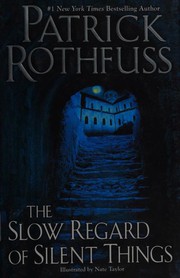
The Slow Regard of Silent Things
2,491-word summary 11 min read 159 pages in the book
- First published
- 2014
- Publisher
- DAW Books
- Pages
- 159
- ISBN
- 9780756410438
- Series
- The Kingkiller Chronicle (#2.5)
Reading options
What's inside (8 sections)
I picked this up because I missed Kvothe and wanted something short before tackling the big books again, and instead I got 159 pages about a girl arranging lost buttons like they were church offerings. The Slow Regard of Silent Things by Patrick Rothfuss was first published in 2014 by DAW Books, ISBN 9780756410438, and it sits inside The Kingkiller Chronicle as a side story, order 2.5 if you like numbers. It follows Auri, the strange small woman who lives under the University and trades Kvothe strawberries for riddles. There is almost no dialogue, almost no plot in the normal sense, and almost no Kvothe until the end. Seven days pass. Auri walks, cleans, names, and tries to find the right gifts for him.
If you came here expecting Name of the Wind part three, reset that hope now. This is a portrait of one person keeping her own order in the dark. It is lyrical, fussy, tender, and at times trying. I liked it more than I expected to, and I also rolled my eyes a couple of times. Both reactions feel honest.
Who Auri is and where she lives
Auri used to be a student at the University, and something broke her along the way. The main books hint at it. She knows sympathy and naming, she flinches at crowds and questions, and she chose the Underthing over rooms with people in them. Here Rothfuss shows her life from the inside, and she does not feel like a puzzle to solve. She feels like someone managing a condition with ritual.
The Underthing is the maze of old rooms, tunnels, pipes, and forgotten workshops under the University. Auri has named its parts the way sailors name coasts. There is Mantle, where she sleeps on soft things. There is the Tumbrel, the Cleft, the Black Door she will not open, and long halls full of broken gearwork, bottles, pipes, and furniture left by centuries of students and staff. She knows which corridor breathes cold and which grate sings when the wind hits it. She keeps paths clear, carries trash out, and leaves offerings of order.
What struck me is how physical her world is. She washes in a rain barrel. She mends a dress. She counts candles and saves oil. She eats what she has stored and what the surface gives her, like the food Kvothe brings. Her feet get sore. Her hands get cut. She talks to objects, not in a cute Disney way, but the way lonely people keep manners alive. A cracked gear is not junk to her. It is something waiting for its proper place, and she considers herself the person whose job is to learn that place.
A point worth making early: she is not simple. She understands chemistry, pressure, currents of air, and the true names of things. Rothfuss gives her a sharp mind running on private tracks. She solves problems all day, just not the problems novels usually reward. Where should this brass button live so it is happy. Which room wants this bit of honeycomb. What does Foxen need.
Foxen deserves an introduction. Foxen is the small secret light Auri keeps, a bottle or lamp with a foxlike brightness that follows her through the dark rooms. Other readers may picture it differently, but to me Foxen read as part pet, part nightlight, part proof she is not fully alone. She worries over Foxen the way you worry over a candle in a drafty hall. She shields it, praises it for bravery in tight passages, and grieves a little when it dims. If that sounds precious, it is. It also works, because the Underthing is genuinely dark and dangerous, and one small light matters a lot down there.
Seven days with a secret at the end
The book covers seven days, and Auri knows Kvothe will visit at the end of them. That coming visit is the only deadline, and it shapes everything. She wants to greet him properly, which for her means finding three gifts that fit him exactly. Not expensive gifts. Right gifts. Something he needs, something he wants without knowing it, something that answers a lack he carries.
She also knows something else is coming, a turning she feels in the air and in the pipes. Rothfuss writes this as sensitivity rather than prophecy. Drains smell different. Dust hangs longer. A door drafts cold. She decides to spend the days getting the Underthing ready, the way you tidy a house before weather. She washes, sorts, mends, carries, and listens. Each day she wakes, checks Foxen, eats a little, and sets her circuit.
The lack of normal stakes took me a chapter to accept. Nobody chases her. Nobody sends letters. The University above goes on with classes and quarrels and never looks down. Kvothe is off having his louder life. Auri moves through empty rooms and decides what matters. Will she find the third gift. Will the pipes hold. Will she be clean and ready and settled when he comes.
Walking the days and hunting the gifts
The middle of the book is day by day work, and I will walk through it because that is really all there is, and the pleasure sits in the detail.
Early on Auri tends the living parts of her routine. She checks traps of water, shakes out bedding, eats sparingly, and makes rounds to see what the Underthing offers. She finds things where water or drafts left them. A bead. A bit of cloth. A feather. She carries each to a central place and studies it. Her rule is plain: nothing should sit where it does not belong, and she must learn belonging by attention, not force. She holds objects, turns them, smells them, sets them down in trial spots to see if they look settled. It reads like someone tuning instruments by ear.
One thread is soap. She wants proper soap for washing before Kvothe comes, and the search takes her through stores and old washrooms. She finds lye soap too harsh, scented stuff too loud, and keeps looking until she finds a bar that feels right, then rations it with care. Another thread is food and gear for the deeper trips. She packs bread and cheese, checks her shoes, wraps her feet, and plans routes so she does not get caught by dark or damp.
The gift hunt gives the days their spine. She needs three gifts, and she refuses to rush them. The first comes easier, a thing she already half knows belongs to him. The second takes listening and tradeoffs, giving up something she likes because he needs it more. The third hides until late, and finding it means going farther than comfort allows, into wetter and older parts where the tunnels narrow and the air changes. I will not list the exact objects here because unwrapping them is half the fun, but none are grand. A bit of wax and wick. A small useful thing. A thing of beauty with no practical use except that it makes the bearer feel known. She tests each by holding it and thinking of Kvothe hands, his habits, his hunger, his songs. When one fits, her relief is physical. She laughs out loud in an empty room, and I laughed with her.
Around these hunts she does constant maintenance. She clears a choke in a pipe, oils a hinge with saved fat, and sweeps dust out so the rooms can breathe. She avoids the Black Door, checks its seal, and moves on without drama. Rothfuss does not explain the door. He lets her fear stand.
By the last day she is tired in a clean way. She bathes, dresses in her best repaired clothes, sets out the gifts where they will be seen in the right order, and waits in Mantle with Foxen bright. When Kvothe finally arrives, he brings his noise and hunger and music into her quiet, and the scene lands because we have spent a week learning what quiet costs. He does not fix her. He receives her. That distinction matters a lot to this book.
Naming, shaping, and the weight of true names
Under the daily work sits the magic system, and this is where Kingkiller fans will perk up. In the main books, naming is the deep art. Sympathy moves heat and force with will and words. Naming calls the true name of a thing and asks or commands it. Auri is far better at it than her fragile manner suggests.
She practices a gentler version. She listens until a thing tells her its name, then she places it where that name sings. A gear wants a certain shelf. A room wants a certain scent. A passage wants to be left alone. This is not command magic with shouting and wind. It is housekeeping raised to power. Rothfuss suggests that knowing is a kind of shaping, and shaping done with love steadies the world.
There is also a harder edge. Auri knows that forcing a name can break things. She remembers students who pulled at names for pride and left cracks behind. She will not do that. When she must move something stubborn, she coaxes, waits, returns later. Once or twice she speaks firmly and the air answers, and those moments carry real force because she spends the rest of her time refusing force. A dropped bottle stops rattling. A draft stills. It feels earned, not showy.
Music threads through too, which fits the series. Kvothe is music to her, all motion and bright sound, and her rooms hold tones. She taps pipes to hear their notes. She hums while sorting. She times steps to drips. I liked how Rothfuss rhymes her listening with Kvothe lute playing without stating it flatly. Both find the note that lets a thing open. He performs for crowds. She performs for empty rooms, and the empty rooms are stricter judges.
If you want lore answers, you will not get many. We learn a little more about how the University sits on older ruins, and how much life continues below notice. We learn nothing firm about Auri past, her family name, or what exactly sent her down. Rothfuss guards those facts. I respect the choice even as part of me wanted one clear memory. Mystery suits her better than a case file.
How it is written, line by line
The prose is the point here, so let me talk about it plainly. Rothfuss writes short, clean sentences mixed with longer rolling ones, lots of present tense observation, lots of naming of things by shape and stuff. Brass. Lye. Tallow. Damp wool. Cold iron. He repeats words on purpose, especially proper names of rooms, until they feel like friends. Mantle. Foxen. Underthing. The repetition is doing work. It builds a small liturgy out of housework.
He also withholds in a careful way. Auri does not explain herself. The narrator stays close to her thoughts but does not translate everything. When she says a thing is not ready or not right, we accept it on her authority. That trust builds slowly and then holds. By day four I stopped asking for reasons and started watching for signs the way she does. A smudge. A draft. A wrong smell. Reading becomes a bit like her work, which is either immersive or irritating depending on your mood.
There is also grief tucked under the tidying. She remembers failure and unkindness in flashes, then folds the memory away and washes something. The book never stages a big trauma scene. It lets avoidance speak.
Formally, the book uses white space and day breaks to pace the labor. Some pages hold a single paragraph. Some hold lists of stores. It reads fast in minutes and slow in feeling, a neat trick. At 159 pages it never overstays by much, though two stretches in the middle sag when sorting follows sorting with no new find. Rothfuss tries to vary with deeper excursions and small scares, a slip, a dark stretch, a cold seep, and mostly succeeds. My attention dipped once around the fifth day and came back when the third gift trail warmed.
What shines and what strains
Let me be direct about both sides, because this book splits readers hard.
What shines first is Auri herself. She could have been a quirk bundle, the mad girl who loves shiny things. Instead she reads as competent, ethical, and tired. Her rules hold through the week, and the final scene with Kvothe works because of that goodness. I put the book down feeling oddly cleaned out, like after sweeping a room.
Now the strains. There is no getting around that little happens. Seven days of tidying and gift hunting is the whole plot. If you need conflict between people, you will be hungry. Kvothe appears briefly. No Chandrian. No Denna. No University politics except as faint noise above. I missed that texture by day three and had to adjust my appetite. Friends I would hand this to divide cleanly: the ones who love Tom Bombadil will adore it, the ones who skip those chapters will want to throw it.
It can also feel precious. Objects get feelings. Rooms get moods. Auri apologizes to a lot of furniture. Taken in sips it charms. Binged, it can cloy. I caught myself thinking, it is a button, just put it down, during one long placement passage. Then two pages later a placement made me tear up. The line between tender and twee is thin here, and Rothfuss steps over it both ways.
There is a larger worry some readers raise about illness and romance. The book treats Auri perception as both wound and gift, and Kvothe kindness as healing without cure. I think Rothfuss mostly avoids turning her into a mascot. She has agency, skill, and boundaries. She chooses when to see him. But if stories that aestheticize fragile girls trouble you, this one will trip that alarm. Go in knowing the gaze is fond and close, and decide for yourself.
Who should read it. Kingkiller readers who love Auri and want time with her should read it now. Fantasy readers who like quiet books, station keeping, and craft over plot should try it. Readers waiting on book three who fear more delay should know this will not advance that wait at all. It is a side chapel, not the main road. I mean that fondly. Sometimes the side chapel is where you actually catch your breath.
I closed it thinking about my own drawers and shelves, which is a funny result for a fantasy book. I tidied my desk that night, set three small things in order, and left a gap for something missing. Auri would approve of the gap. She knows missing things have their own proper places, and that waiting well is also work.
FAQ
When was The Slow Regard of Silent Things published?
DAW Books published it in 2014. It runs 159 pages and the hardcover ISBN is 9780756410438.
Is it part of The Kingkiller Chronicle?
Yes. It is a companion to The Kingkiller Chronicle, set as order 2.5, and it follows Auri below the University while Kvothe appears only briefly.
Do I need to read the main books first?
Readers who love Auri, quiet process writing, and naming lore will enjoy it. Readers who need chases and twists may find seven days of tidying too slow.
Similar books
More from The Kingkiller Chronicle first, then related titles.

The Name of the Wind
Kvothe the Bloodless tells Chronicler how a clever Ruh boy survived loss, street life and the University to chase the Chandrian.
2,281-word summary · 10 min read
The Wise Man's Fear
Kvothe leaves the University to serve Maer Alveron in Vintas, then survives Felurian, the Adem and a trial back home.
2,788-word summary · 12 min read

The Hazel Wood
Alice Proserpine has spent her life running from bad luck. When her mother vanishes, she follows a trail of fairy-tale clues to her grandmother's estate and…
2,064-word summary · 9 min read

Ghost Story
Dead but not gone, Harry Dresden returns as a spirit to find his killer, protect the friends he left behind, and learn why the afterlife gave him a second…
1,978-word summary · 9 min read

Cold Days
Back from the dead as the Winter Knight, Harry Dresden must follow Mab's order to kill an immortal and defend Demonreach on Halloween night.
2,361-word summary · 10 min read
Turn Coat
Morgan asks Harry for sanctuary as the Council calls him traitor.
2,590-word summary · 12 min read

Small Favor
Harry owes Mab a favor and must find Marcone while Denarians hunt a holy girl.
2,741-word summary · 12 min read

White Night
Wizard Harry Dresden hunts fear-feeding White Court killers preying on Chicago's minor talents, reunites with Elaine Mallory, and faces a coup at Chateau Raith.
2,521-word summary · 11 min read

Changes
Harry Dresden learns he has a seven-year-old daughter Maggie, hidden for years. The Red Court seizes her for a bloodline rite, forcing him toward Chichen Itza.
2,855-word summary · 13 min read

Proven Guilty
Warden Harry defends teen Molly from White Council while fear phages stalk con.
2,068-word summary · 9 min read

Dead Beat
Wizard Harry Dresden hunts the Word of Kemmler through necromancers to stop a Halloween godmaking rite.
2,883-word summary · 13 min read

The Bands of Mourning
Wax and Wayne hunt a mythical metalmind while southern visitors and the Set close in.
2,461-word summary · 11 min read

Hell Bent
Alex Stern risks Yale and Lethe to pull Darlington from Hell through a hidden gate.
2,994-word summary · 13 min read

Shadows of Self
Wax and Wayne hunt a rogue kandra through Elendel as labor riots rise and old grief returns.
2,643-word summary · 12 min read

Blue Lily, Lily Blue
Blue searches for her missing mother while the Raven Boys wake a sleeper in the caves who is not the king they sought.
2,983-word summary · 13 min read

The Starless Sea
A graduate student finds a book that retells his childhood and follows its clues to an underground Harbor of stories.
2,582-word summary · 11 min read

The Alloy of Law
Wax and Wayne chase Vanishers by rail in a gunpowder Mistborn city 300 years later.
2,535-word summary · 11 min read

Ninth House
Dropout Alex Stern sees ghosts and monitors Yale secret societies after a townie murder.
2,271-word summary · 10 min read

Harry Potter and the Chamber of Secrets
Chamber of Secrets: Dobby's warning, the flying car, polyjuice potions, and the diary of Tom Riddle. What the second Harry Potter book does differently and how…
2,172-word summary · 10 min read

Harry Potter and the Prisoner of Azkaban
Prisoner of Azkaban, the mature third book: Sirius Black on the run, dementors at the gates, Remus Lupin's secrets, and the time-turner finale that rewrites…
2,053-word summary · 9 min read

The Blinding Knife
Kip trains to join the Blackguard while the Prism hides his true identity, loses his colors, and fights a war against a rogue drafter who wants to birth a god.
2,049-word summary · 9 min read

Inkdeath
The final Inkworld novel sends Mo into the land of the dead, leaves Meggie choosing between two boys, and ends the Adderhead's immortality with three written…
2,062-word summary · 9 min read

Hounded
A two-thousand-year-old druid runs a bookshop in Arizona, hides from an Irish god who wants his sword back, and talks to his dog.
2,159-word summary · 10 min read

Dawnshard
Rysn sails toward forbidden Akinah to save her dying larkin and finds a Dawnshard guarded by the Sleepless.
3,229-word summary · 14 min read

The Field Guide
Three siblings move into a creepy Maine estate, anger a brownie, and find a forbidden guide to the fairy world in the first Spiderwick book.
2,033-word summary · 9 min read

Magic Burns
A magic flare hits Atlanta, and mercenary Kate Daniels must recover stolen maps, find a missing witch, and keep a teenage girl alive while Celtic gods try to…
2,021-word summary · 9 min read

Year One
A plague released in Scotland kills most of humanity, and the survivors discover magic, build a town, and wait for a child who may save them.
2,029-word summary · 9 min read

The Once and Future Witches
Three estranged sisters bring witchcraft back to an 1893 city where magic hides in nursery rhymes and the fight for the vote is also a fight for power.
2,132-word summary · 9 min read

Secrets of the Dragon Sanctuary
Kendra is replaced by a plant copy and held by the Society, while Seth steals a unicorn horn so the family can enter a dragon sanctuary.
2,590-word summary · 12 min read

Lioness Rampant
Alanna searches for the Dominion Jewel with the Shang Dragon, then returns to Tortall to face Duke Roger at Jonathan's coronation.
2,478-word summary · 11 min read