
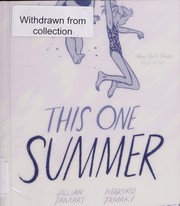
This One Summer
2,324-word summary 10 min read 320 pages in the book
- First published
- 2014
- Publisher
- First Second
- Pages
- 320
- ISBN
- 9781596437746
Reading options
What's inside (8 sections)
I read This One Summer on a rainy weekend and found myself slowing down to the speed of the pages, which is exactly what the book asks of you. Mariko Tamaki wrote it and her cousin Jillian Tamaki drew it, and First Second published it in 2014. The cover credits often list only Mariko, which is how it is filed in some catalogs, but the art is half the story and Jillian's name deserves to be spoken in the same breath. This is a graphic novel about two teenage girls, Rose and Windy, who spend another summer at a cottage in a small lake town called Awago. It is also about a mother who cannot go into the water, and a secret the girls are not ready to understand.
Another summer at Awago
Rose has been coming to Awago for as long as she can remember, and she brings Windy with her every year. Rose is about eighteen months older and tells the story, looking back on a summer that felt endless while it was happening. The two of them drift through days that have no schedule: the cottage, the lake, the convenience store, the road, the houses of other summer people and the locals who live there year round. Mariko's dialogue is spare and funny, full of the small talk teenagers use to say bigger things without saying them.
The town itself is a character. Awago is a place of rental cottages and year round houses, of a general store where the kids buy snacks and loiter, of paths and docks and a beach that the summer families treat as theirs. Rose and Windy know its rhythms better than any adult does, and they move through it with the freedom of kids who have been released into the same landscape every August. Mariko gives them long stretches of time with nothing to do, and the book trusts that boredom is part of what a summer feels like when you are on the edge of growing up.
The local teenagers drift in and out, and the girls watch them with a mixture of envy and fear. These are the kids who live here when the tourists leave, and they seem to Rose to possess a knowledge that she and Windy lack. The book is alert to the small hierarchies of a place like this: who has a job, who has a car, who is old enough to be trusted and who is not. Rose's narration notices all of it while pretending to notice nothing. That double vision is what makes her such a good guide.
The summer is different this time because Rose and Windy are old enough to notice the adults. They watch the older kids at the lake, they talk about boys, they talk about girls, and they begin to understand that the people around them are not the solid figures they once seemed. Leonard Marcus, writing in Horn Book, called the grownups a "rogues' gallery of sad and burnt-out would-be role models," and that phrase sticks. The parents and teenagers in Awago are all carrying something they cannot put down.
Jillian's art is the reason the book feels like a real place. She draws in deep purples and blue shades, with wide panels of sky and water and moonlit trees. The human figures are often less detailed than the landscapes, so you feel the heat and the insects and the long evenings before you feel the characters' faces. When the girls talk about a scary movie they have seen, the drawings let that imaginary threat bleed into the ordinary streets. Nothing is announced. The color does the work.
Alice and Evan
The central worry of the book belongs to Rose's mother, Alice. She is depressed, and she will not go to the beach. Her husband Evan tries, loses patience, and eventually leaves for the city for a few days after yet another argument. Rose watches this from the position of a child who is old enough to be angry and too young to understand. She lashes out at Alice one night, blaming her for the fighting and for refusing to come into the water. It is a brutal scene because Rose is both right and wrong. She sees the effect of the silence without knowing its cause.
That cause is revealed only at the end, and it changes the shape of everything that came before. The summer before, Alice suffered a miscarriage in the lake at Awago. The beach is not a beach to her. It is the place where she lost a pregnancy, and the grief has settled into the marriage as distance and fights. When Rose finally learns this from Windy's mother, the earlier scenes rearrange themselves. The arguments were not about the dishes or the car. They were about a loss nobody knew how to name.
Windy's mother becomes important here, because she is the one who eventually tells Rose what happened. She is not a dramatic figure. She is a parent who has known Alice for years and who decides, late in the summer, that Rose deserves an explanation. The scene is small and a little awkward, which is why it works. Real explanations of adult grief are usually delivered by the wrong person at the wrong time, and Mariko knows it. Rose does not respond with a breakdown. She takes it in, and you can see her rearranging the summer in her head.
Mariko handles this without a speech. There is no parent who sits Rose down to explain. The information arrives sideways, in conversation, and Rose has to piece it together. That restraint is the book's great strength and also, for some readers, its frustration. The revelation is quiet, almost offhand, and if you are looking for a climactic confrontation you will not get one. The climax is a girl understanding why her mother has been gone all summer.
Jenny in the water
The other thread follows Jenny, a teenager who has become pregnant. The father of her child ignores her and the baby, and Jenny spirals. After an argument with him she drinks, and she ends up in the lake in a state where she might drown. Alice, who cannot bear to go near the water, is the one who reaches her. It is the most direct action Alice takes in the whole book, and it tells you what the author thinks about courage: not a speech, not a decision, just a body moving when someone else needs it.
Rose and Windy are witnesses to this. They are old enough to be curious about sex and pregnancy and old enough to be frightened by the consequences. The book lets them be spectators for most of it, which is honest. Teenagers often learn about adult disaster by watching from a distance and pretending to understand. When Jenny's story and Alice's story meet at the lake, the two threads finally speak to each other. A woman who lost a pregnancy pulls a pregnant teenager out of the water. The image is heavy, and Jillian draws it without squeezing it.
Jenny's situation is handled without much commentary from the adults around her. The father who ignores her is barely a presence, which is itself the point. He has walked away, and the town is left to manage the consequences. Rose and Windy hear the fragments, the arguments, the rumor, and they fill in the rest with the half understanding that teenagers have. When Jenny drinks and walks into the lake, the scene is not presented as a lesson about responsibility. It is presented as a girl in pain doing something dangerous because no one has offered her another option.
What the cousins do with the form
Mariko and Jillian Tamaki worked together before, on Skim in 2008, and they would reunite later for Laura Dean Keeps Breaking Up with Me. Their method here is unusually clean. Mariko writes the dialogue almost like a play, and Jillian sketches the whole book before the final art goes down. The result is a graphic novel with very little wasted space. A page can turn on a glance, a pause, or a panel of empty water. The quiet panels are where the feeling lives.
The purple palette also does something subtle with desire. Rose and Windy's closeness is written in small gestures and long looks, and the book refuses to label it. They talk about boys, they talk about girls, they share a bed and a summer and a private language. Queer readers have long seen themselves in this, and the book's many challenges in schools have often been about exactly this refusal to keep desire tidy. Mariko has said that removing such books erases queer lives, and you can feel her protecting these two girls from a world that would simplify them.
The art has a horror streak that keeps the coming-of-age story honest. The scary movie the girls watch turns up in the shapes of shadows, and the lake that should be a place of fun becomes a place where things disappear. Jillian lets the panels stretch out until a normal summer night feels huge and unsafe. It is a smart match of form and subject. Growing up is the slow discovery that the world is bigger and less caring than your parents suggested, and these drawings make that discovery physical.
The lettering deserves a note too. Dialogue sits in hand drawn bubbles that feel casual, and the captions in Rose's voice are placed like thoughts rather than explanations. Jillian varies the size and shape of panels to control time. A conversation that matters can take six pages, while a whole week passes in a single row of small images. That control is the reason the slow pace never felt like stagnation to me. The book is not refusing to move. It is deciding, panel by panel, what deserves to last.
Why it kept getting pulled from shelves
This One Summer was honored widely and attacked loudly. It won a 2014 Ignatz Award for Outstanding Graphic Novel, a 2015 Eisner Award, and both a Caldecott Honor and a Printz Honor in 2015, the first graphic novel to be honored by a Caldecott committee. In the same stretch it landed on the American Library Association's list of the ten most challenged books, number one in 2016 and number seven in 2018. The objections were profanity, sexual references, certain illustrations, drug use, and LGBT characters.
In 2016, libraries in Henning, Minnesota and Longwood, Florida removed it after parents complained. The National Coalition Against Censorship and the Comic Book Legal Defense Fund challenged those removals, and in Henning the book went back with parental permission for students in grades ten through twelve. In 2022 it was among the titles pulled by Utah's Alpine School District under a state law about sensitive materials. A film adaptation arrived in 2023, directed by Eric Lartigau. The arguments have never really gone away, and the book keeps being discovered by a new group of teenagers who recognize themselves in it.
Mariko's own response to the challenges was direct. She pointed out that the book is listed for readers roughly between twelve and eighteen, that it shows young people dealing with adult subjects, and that taking it off shelves erases queer experience rather than protecting anyone. The Comic Book Legal Defense Fund and the National Coalition Against Censorship both took up the Henning case, and the compromise that returned the book to grades ten through twelve with parental permission satisfied nobody completely. That is often how these fights end, and the book has lived in that uneasy middle ever since.
Where it falls short
The pace will not work for everyone. Nothing much happens in the first half in the way a plot-driven novel defines happening, and readers who want a clear problem and a clear fix may close it early. The adult storyline is also where the book is strongest and where it slightly unbalances itself. Rose and Windy begin as the whole world of the story, then Alice's grief and Jenny's pregnancy take over the emotional center. That is arguably the point, since children watching adults is the subject, but it means the girls themselves get less interior time by the end.
The ending is deliberately unresolved. Rose understands more, but understanding does not repair her mother's marriage or undo Jenny's situation. Some readers find that honest; others find it abrupt after so many quiet pages. I wanted a few more pages of Rose reacting to what she has learned, and the book gives her almost none. It ends on an image rather than a conclusion, which is a graphic novelist's privilege and, here, a small loss.
A few of the supporting figures never get fully fleshed out. Windy's family, the local kids, and Jenny's absent father all function mainly as parts of Rose's observation, which is a defensible choice for a first person story but leaves the world a bit thin at the edges. Jenny in particular is so central to the late chapters that I wanted more of her interior life before the crisis arrives. The graphic novel form gives her silence, and silence can be powerful, but here it sometimes reads as the author keeping a character at arm's length.
Read it for the art, for the long blue evenings, and for two friends who talk about everything and nothing. Read it if you remember being thirteen and sensing that the adults around you were secretly falling apart. Do not read it if you want a tidy arc or a lesson delivered at the end. Mariko and Jillian Tamaki trust you to sit with a summer that does not resolve, and that trust is the most generous thing about a book that has been called dangerous more times than it deserves.
FAQ
Who wrote and illustrated This One Summer?
Mariko Tamaki wrote it and her cousin Jillian Tamaki illustrated it. First Second published the graphic novel in 2014, and the two had worked together earlier on Skim.
Why was This One Summer challenged or banned?
It appeared on the American Library Association's Top Ten Most Challenged Books list in 2016 and 2018, with objections citing profanity, sexual references, certain illustrations, drug use and LGBT characters. Libraries in Minnesota and Florida removed it in 2016.
What happens at the end of This One Summer?
Rose learns that her mother Alice suffered a miscarriage in the lake at Awago the previous summer, which explains her fear of the beach. The book ends without resolving the marriage or Jenny's situation.
Similar books
Girls in Pants: The Third Summer of the Sisterhood
The four friends face their last summer before college, with art school, an old flame, a guilty conscience and a new baby in the balance.
2,382-word summary · 11 min read

The Second Summer of the Sisterhood
Four friends share the traveling pants through a summer of grandmothers, first loves, and mothers who are learning to let go.
2,209-word summary · 10 min read
Pumpkinheads
Deja and Josiah have worked the Succotash Hut together every autumn. On their last Halloween shift, she pushes him to chase a crush and they discover something…
2,409-word summary · 11 min read

Aristotle and Dante Dive into the Waters of the World
Ari and Dante return for senior year in El Paso, navigating first love, AIDS, family grief, and the cost of being openly gay in 1987 Texas.
2,188-word summary · 10 min read

Someone Like You
Halley and her best friend Scarlett face a summer of grief, a surprise pregnancy, and Halley's dangerous first romance in Sarah Dessen's 1998 young adult novel.
2,218-word summary · 10 min read
The DUFF
Bianca Piper hates Wesley Rush for calling her the DUFF, until a secret arrangement during her parents' divorce forces both teens to grow up.
2,323-word summary · 10 min read

Along for the Ride
Insomniac Auden spends a beach summer with her dad and learns biking, parties, and love from Eli.
1,938-word summary · 9 min read
Are You There God? It's Me, Margaret
Twelve-year-old Margaret navigates puberty in New Jersey while trying to choose a religion on her own.
2,178-word summary · 10 min read
The Sisterhood of the Traveling Pants
Four best friends share one magical pair of jeans through the summer that changes everything.
2,092-word summary · 9 min read

Aristotle and Dante Discover the Secrets of the Universe
Two Mexican American boys in 1987 El Paso become inseparable and learn what love asks of family.
2,093-word summary · 9 min read
Saving CeeCee Honeycutt
A twelve-year-old girl loses her mother and is packed off to Savannah, where a great-aunt, a housekeeper and a street of eccentric women teach her how to…
2,627-word summary · 12 min read
Impulse
Three teenagers in a Reno residential hospital tell in free verse how they arrived there after suicide attempts and what recovery costs.
2,030-word summary · 9 min read
Finding Audrey
A fourteen-year-old who cannot leave the house or remove her dark glasses finds her way back through therapy, a film project and a patient new friend.
2,559-word summary · 11 min read
El Deafo
A deaf girl in a world of rabbits turns her bulky Phonic Ear hearing aid into a superhero identity while searching for a true friend.
2,515-word summary · 11 min read
Dreamland
A teenager slips out of her perfect sister's shadow and into a relationship that turns from thrilling to dangerous, in Sarah Dessen's dark 2000 novel about…
2,823-word summary · 13 min read
Dear Martin
Nic Stone's debut follows Justyce McAllister, a scholarship student at a mostly white Atlanta prep school, who starts writing letters to Dr. King after a…
2,596-word summary · 12 min read
Counting by 7s
A gifted twelve-year-old who counts by sevens loses her parents in a car crash and gradually builds a new family with help from a counselor, a taxi driver, and…
2,306-word summary · 10 min read
Today Tonight Tomorrow
On the last day of senior year, academic rivals Rowan Roth and Neil McNair team up for a citywide Seattle scavenger hunt and start seeing each other…
2,233-word summary · 10 min read
The Boston Girl
Eighty-five-year-old Addie Baum tells her granddaughter how she grew up in Boston's North End, chased education and love, and became the woman she is.
2,439-word summary · 11 min read
Tell Me Three Things
A grieving Chicago teen lands in her new stepfamily's Los Angeles mansion, then gets anonymous emails promising to guide her through a brutal private school.
2,292-word summary · 10 min read
Kristy's Great Idea: A Graphic Novel (The Baby-Sitters Club Graphic Novels #1)
Raina Telgemeier adapts Ann M. Martin's first Baby-Sitters Club novel into a full-color graphic novel about four Stoneybrook friends who start a babysitting…
2,373-word summary · 11 min read

What Happened to Goodbye
Mclean has reinvented herself in four towns since her parents divorced. In Lakeview she uses her real name, and for the first time staying put becomes a choice.
2,796-word summary · 12 min read
Anya's Ghost
A lonely Russian immigrant falls into a well, befriends the ghost trapped there, and discovers that the ghost's help comes with a dangerous price.
2,001-word summary · 9 min read

Dumplin'
Willowdean Dickson enters her town's beauty pageant as a protest and discovers that confidence is harder to keep once she lets someone close.
1,922-word summary · 9 min read
Ms. Marvel, Vol. 1: No Normal
Kamala Khan, a Jersey City teenager and Carol Danvers fan, gains shapeshifting powers and has to decide what kind of hero she wants to be.
2,579-word summary · 11 min read

We Are Okay
Marin fled San Francisco after her grandfather vanished and stopped answering anyone. When Mabel visits her college dorm, she has to say what happened.
2,253-word summary · 10 min read
On the Come Up
Bri Jackson, a sixteen-year-old rapper in Garden Heights, chases a record deal while a viral song turns her into a symbol she never wanted to be.
2,034-word summary · 9 min read
American Born Chinese
Three stories, a monkey king, a Chinese-American boy and a sitcom cousin, converge in a graphic novel about shame, assimilation and learning to accept yourself.
2,107-word summary · 9 min read
Paper Girls, Volume 1
Four paper girls in 1988 Ohio chase a stolen walkie-talkie into a basement and stumble into a time war, flying dinosaurs, and an older version of themselves.
2,235-word summary · 10 min read
Clap When You Land
Two half sisters, one in Sosúa and one in Queens, discover each other after their father dies in a plane crash, in Elizabeth Acevedo's novel in verse.
2,890-word summary · 13 min read