
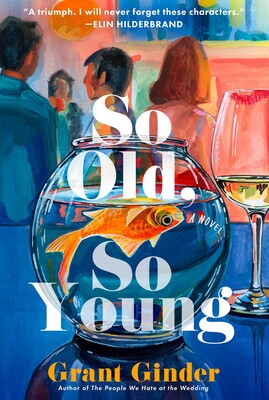
So Old, So Young
2,457-word summary 11 min read 384 pages in the book
- First published
- 2026
- Publisher
- Gallery/Scout Press
- Pages
- 384
- ISBN
- 9781668051771
Reading options
What's inside (8 sections)
I picked up So Old, So Young because a friend described it as the Big Chill for millennials and I immediately felt both attracted and suspicious. The comparison is right there on the cover copy, with Elin Hilderbrand quoted as saying Ginder wrote the Big Chill of our times and possibly did it better. That is a heavy promise to put on a 384 page novel from Gallery/Scout Press, published February 17, 2026, ISBN 9781668051771. Ginder is the author of The People We Hate at the Wedding, which became a film with Allison Janney, Kristen Bell, and Ben Platt, and he teaches writing at NYU, where he took his MFA. So he knows his way around an ensemble and a set piece. The question was whether six friends and five parties across twenty years could carry a whole book, or whether the structure would feel like a trick. Having finished it, I would say the structure both makes the novel and limits it, and the making outweighs the limiting by enough that I read the last hundred pages in one sitting.
The setup is clean. Six college friends, three couples: Marco and Mia, Sasha and Theo, Richie and Adam. Five parties over twenty years bring them together, from an East Village apartment party in their twenties through a disastrous destination wedding, a fortieth birthday, and a suburban backyard barbecue, with one more gathering I will leave undescribed to protect the ending. Between parties, years pass in jumps. Jobs change. Cities change. Spouses and children arrive. The one thing they assumed would hold steady is the friendship itself, and time tests that assumption the way time does, slowly and then all at once. Ginder calls it part love story and part tragic comedy, and that hyphenated description is accurate. The book is funny about its people and serious about what happens to them.
My honest take, stated up front so you can calibrate: this is a warm, well built commercial novel with real feeling in it, not a difficult book and not trying to be one. The dialogue snaps. The parties are staged with confidence. Two of the six friends are drawn with genuine depth and the rest shade in and out of focus depending on whose chapter needs them. Readers who want every thread tied will find some frayed ends. Readers who enjoy spending time with flawed people at catered events will have a very good weekend. I laughed out loud three or four times and got unexpectedly wet eyed near the end, which is more than most novels manage.
Six friends, five parties
The cast needs introducing because the book lives or dies on whether you can keep them straight and care about each. Marco and Mia are the closest thing the group has to an anchor couple, together since college, the ones who host and remember birthdays and hold the group chat of obligations together. Sasha and Theo are flashier and more volatile, the pair whose marriage gives the novel most of its dramatic fuel. Richie and Adam are the couple whose steadiness looks enviable from outside and costs more than it appears. Ginder rotates attention among all six without breaking them into heroes and villains, which I appreciated. Even at their worst, each gets at least one scene that explains the behavior without excusing it.
The five party structure is the novel's central bet, and for the first two gatherings it pays off beautifully. The East Village apartment party is the best thing in the book, twenty something chaos rendered with total recall: the too small kitchen, the ambitious playlist, the guest who was not invited but came anyway, the conversation on the fire escape that two characters will remember differently for years. Ginder writes rooms full of drunk young people extremely well. Bodies, noise, overlapping talk, the sudden pockets of honesty that open at midnight and close by morning. If you came of age going to parties in walk ups, you will feel a small shock of recognition here.
The time jumps between parties do specific work. We do not watch anyone's career advance meeting by meeting. We see them at twenty five, then at thirty one, and the gap itself tells the story. Someone has a child now. Someone has moved. Someone who was funny at the first party is brittle at the second. This snapshot method keeps the page count honest and the pace quick, and it mirrors how friendships actually feel in adulthood, long silences punctuated by intense weekends where everyone performs an updated self. My one structural complaint, which I will return to, is that the jumps occasionally strand a storyline. A crisis mentioned at one party resolves off page before the next, and you have to accept the summary. Mostly I accepted it. Once or twice I resented it.
Weddings, birthdays, and backyard barbecues
The middle parties show Ginder's range. The destination wedding is a comic disaster in the classic mode, travel logistics curdling into old grievances, toasts going wrong, weather misbehaving, one guest behaving much worse. It is the funniest section and also the cruelest, because weddings force comparisons. Whose marriage looks happy. Whose career paid for the flight without wincing. Who brought a plus one and who brought a warning sign. Ginder understands that his generation experiences weddings as reunions with ranking systems, and he stages the ranking without mercy. I recognized people I know in these pages, and possibly myself, which is uncomfortable in the way good comedy often is.
The fortieth birthday party shifts the register. Bodies have started sending signals. Parents are aging or gone. The jokes about hangovers land differently when recovery takes three days. This is where the novel's title starts to resonate, that millennial condition of feeling culturally young and physically middle aged at the same time. Ginder does not belabor it. A bad back here, a fertility conversation there, a quiet admission that the career ladder looks more like scaffolding. The generational detail is well chosen throughout: the early jobs with absurd titles, the moves between cities for someone else's opportunity, the slow sorting into parents and non parents and the new tenderness and strain that sorting creates. Readers under thirty may find some of this remote. Readers around forty will find it almost too close.
The suburban barbecue is the riskiest section and my favorite after the opening. Daylight, children, paper plates, a host trying too hard. The social physics of a backyard are harder to dramatize than a late night kitchen, and Ginder pulls it off by letting small slights accumulate. A comment about schools. A glance at a phone. Someone drinking faster than the afternoon warrants. Nothing explodes, which is the point. Adult friendship often ends not with betrayal but with a series of afternoons after which you stop calling. The dread in this section is quiet and, to me, more affecting than the wedding fireworks.
Love, envy, and the math of friendship
At its heart this is a novel about three marriages under the observation of the other four people, and Ginder is perceptive about how coupled friendship warps intimacy. You cannot be fully honest with your best friend about their spouse. You cannot tell your spouse everything your friend confided. Loyalties triangulate. Marco learns things about Mia through other people's eyes. Adam keeps a confidence that poisons his own evenings. Sasha says the unsayable at exactly the wrong dinner. These knots are the novel's real subject, more than any single romance, and the best scenes are two handers where someone almost tells the truth and then chooses, for good or bad reasons, not to.
Envy gets a full and fair hearing. Professional jealousy runs through the book like a current, one friend's success arriving at the moment another's stalls, and Ginder refuses to make anyone noble about it. There is a stretch in the middle where two characters orbit the same opportunity, and the pettiness on display is exquisite and a little shameful to enjoy. Misplaced longing gets its chapters too, the old crush that never quite died, the road not taken embodied by someone else's spouse. Ginder handles this without turning anyone into a villain. Wanting is just weather in this novel. Acting on it is where trouble starts, and several people act.
What elevates the book above competent ensemble fiction is its attention to how love changes shape over decades without necessarily shrinking. The long married couples in these pages do not feel the way they felt at twenty five, and the novel insists that is not failure. Affection becomes management, management becomes ritual, ritual occasionally cracks open into something raw and new. One late scene between a husband and wife in a parked car, talking without looking at each other, struck me as the truest thing Ginder has written. No grand declarations. Just two people deciding, again, to stay in the same story. I sat with that scene for a while after closing the book.
Jokes, tears, and the Ginder touch
Readers of Ginder's earlier novels will recognize the comic machinery. He writes banter with sitcom timing, and the one liners come fast enough that you forgive the occasional clunker. A wedding speech gone sideways. A disastrous toast. A group thread vibe rendered in dialogue. The humor is rarely mean for its own sake, which matters, because these characters spend a lot of pages embarrassing themselves. The comedy says: I like these people anyway. That generosity keeps the tragic half of tragic comedy from curdling. When bad news arrives, and it does, the tonal shift feels earned rather than imposed, because the jokes were never armor. They were just how these friends talk.
The tears, when they come, are tied to the book's frankest theme, which the publisher copy names plainly: the ways we run from our friends and cling to them in love, life, and death. Grief enters the novel in the later sections, and Ginder writes about it without his usual deflective wit. A hospital scene. A eulogy drafted and redrafted. The particular guilt of mourning someone you had drifted from. I found these passages moving, though a cooler reader might call them engineered. The novel wants you to cry at specific moments and pulls familiar levers to get there. I cried anyway. Levers work when the machine is well built, and this one is.
A note on craft for the writers reading: Ginder's exposition is worth studying. He slips years of backstory into party chatter without visible seams, a toast that summarizes a divorce, a kitchen complaint that explains a move. Point of view moves freely among the six, and Ginder mostly avoids confusion by anchoring each shift in a strong voice. Sasha's sections read different from Adam's. That sounds basic and is actually hard.
What sags in the middle
Honest criticism, as promised. The novel's middle dips. The wedding section, for all its comedy, runs long, and one subplot about a professional rivalry repeats its beats. A certain character's bad behavior at the wedding is telegraphed chapters early, so the payoff lands soft. The birthday section introduces a new figure who absorbs pages without repaying them, and I wondered whether a shorter cast would have served the story. Six friends plus spouses plus new partners plus children is a lot of names for 384 pages, and the least served characters occasionally feel like furniture that talks.
There is also a thinness to the world beyond the group that some readers will notice and others will welcome. Workplaces are sketches. Politics barely intrudes. Money matters enormously but is discussed in the embarrassed shorthand of people who have it. This is a novel about friendship, not society, and I mostly accepted the boundary. But the millennial specificity Ginder claims, the growing pains of a generation, sometimes narrows to the growing pains of six attractive graduates with good apartments. Readers whose twenties looked different may feel like guests at someone else's reunion. That is a real limitation, even if the emotions on display travel widely.
Finally, the ending. Without spoiling it, I will say the final party gathers everyone for an occasion that reframes the earlier ones, and the last thirty pages push hard for uplift. Love shifts, stumbles, grows bigger than imagined, per the cover copy. I found the landing sweet and a touch too neat, one reconciliation arriving faster than the groundwork supports. But I also turned the final page feeling fond of all six, which is the effect the book wants. Neatness bothered me less on reflection than thinness would have. I prefer a warm ending I half believe to a bleak one I fully do.
Who will enjoy it
This is a book club book in the best sense, built for argument. Which couple would you be. Who behaved worst at the wedding. Whether the final gathering redeems or excuses. The publisher chose it as a book club pick, and the choice makes sense. There is little here that will confuse or offend a general reader. Content is adult but not explicit, grief but not despair, comedy but not cruelty. Readers who loved the film version of The People We Hate at the Wedding will find the same blend of shine and ache. Readers who want formal daring should look elsewhere. Ginder is not reinventing the novel. He is hosting a very good party inside it.
Comparisons will follow the book everywhere, so let me address the Big Chill question directly. Yes, the DNA matches: old friends, compressed reunion time, music and food and buried history, someone dead or changed enough to count as gone. But Ginder's twenty year span does something the film's weekend could not, showing how people revise their twenties in their thirties and their thirties in their forties. Each party rewrites the previous one. That is the novel's smartest idea, and it belongs to fiction rather than film. Memory as palimpsest, friendship as the hand doing the writing. For that idea alone, I am glad I read it, and I will press it on friends approaching their own milestone birthdays with the usual mix of dread and appetite.
Facts for the record: Gallery/Scout Press published the hardcover on February 17, 2026, 384 pages, ISBN 9781668051771. It hit bestseller lists and gathered the anticipated book mentions and best new book nods that now crowd every February release. Ginder lives in the world he describes, a California native turned New York writing teacher, and the classroom shows in the best way. If your group needs a February pick with laughter, argument, and at least one scene that quiets the room, this one will do the job well.
FAQ
When was So Old, So Young published?
Gallery/Scout Press published the hardcover on February 17, 2026. It runs 384 pages with ISBN 9781668051771.
Is it really like The Big Chill?
The ensemble reunion premise matches, and the cover carries an Elin Hilderbrand blurb saying so. The twenty year party structure gives it its own shape.
Who are the six friends?
Three couples from college: Marco and Mia, Sasha and Theo, and Richie and Adam. The novel follows them from their twenties to forty.
Similar books

The Interestings
Meg Wolitzer follows Jules Jacobson from 1974 arts camp into middle age, as friendship with Ethan and Ash turns into envy, money gaps, marriage strain, and…
2,990-word summary · 13 min read
Summer Sisters
Vix and Caitlin share Martha's Vineyard summers from age twelve into adulthood, through first love, grief, marriage, and a disappearance that still haunts Vix.
3,633-word summary · 16 min read

Crux
Two broke Mojave teens chase pro climbing dreams as friendship, class gaps, and family strain pull Dan and Tamma apart.
2,489-word summary · 11 min read

The Elegance of the Hedgehog
A Paris concierge hides her brilliant mind while a gifted girl plans her death, until a new tenant sees through them both.
2,248-word summary · 10 min read

Colorless Tsukuru Tazaki and His Years of Pilgrimage
At thirty six, Tsukuru revisits four old friends to learn why they cut him off at twenty.
2,765-word summary · 12 min read
A Prayer for Owen Meany
John Wheelwright believes in God because of Owen Meany, the tiny friend whose foul ball killed his mother.
3,046-word summary · 14 min read
The Perks of Being a Wallflower
Chbosky's Perks retold: Charlie's letters, Sam and Patrick, first year of high school in Pittsburgh.
1,951-word summary · 9 min read
The Kite Runner
Khaled Hosseini's The Kite Runner retold: Amir and Hassan in Kabul, the alley, the escape to America, and the return to find Sohrab.
2,584-word summary · 11 min read

The Idiot
A Turkish-American freshman at Harvard falls in love through email with a Hungarian math student and spends a summer in Hungary trying to turn correspondence…
2,019-word summary · 9 min read

Anya's Ghost
A lonely Russian immigrant falls into a well, befriends the ghost trapped there, and discovers that the ghost's help comes with a dangerous price.
2,001-word summary · 9 min read
The Power of One
A boy in apartheid South Africa decides to become welterweight champion of the world, and the novel follows every mentor, fight, and loss that gets him there.
2,145-word summary · 10 min read

Less Than Zero
Clay returns to Los Angeles for Christmas and drifts through parties, drugs, and old friends, including one who is selling himself to survive.
1,926-word summary · 9 min read

Dumplin'
Willowdean Dickson enters her town's beauty pageant as a protest and discovers that confidence is harder to keep once she lets someone close.
1,922-word summary · 9 min read
Five Point Someone: What Not to Do at IIT
Three friends at IIT drift to a five-point GPA, mock the system, and break into a professor's office for an exam paper.
2,458-word summary · 11 min read

The Age of Miracles
A California girl grows up while the Earth's rotation slows, and ordinary adolescence continues alongside slow catastrophe.
2,417-word summary · 11 min read
Peace Like a River
An asthmatic boy in the early 1960s narrates his family's search for his older brother, who is accused of two killings and has escaped custody.
1,969-word summary · 9 min read

We Are Okay
Marin fled San Francisco after her grandfather vanished and stopped answering anyone. When Mabel visits her college dorm, she has to say what happened.
2,253-word summary · 10 min read

The Chosen
A shattered pair of glasses in a 1944 Brooklyn softball game starts a friendship between a Hasidic boy and his Orthodox neighbor, and their fathers pull them…
2,443-word summary · 11 min read

Big Swiss
A transcriptionist for a sex coach falls for one of his clients, the tall Swiss gynecologist she calls Big Swiss, in a funny novel about work and secrets.
2,523-word summary · 11 min read

The Second Summer of the Sisterhood
Four friends share the traveling pants through a summer of grandmothers, first loves, and mothers who are learning to let go.
2,209-word summary · 10 min read

Aristotle and Dante Dive into the Waters of the World
Ari and Dante return for senior year in El Paso, navigating first love, AIDS, family grief, and the cost of being openly gay in 1987 Texas.
2,188-word summary · 10 min read

The Story of Edgar Sawtelle
A mute boy on a Wisconsin dog-breeding farm relives Hamlet as his uncle returns, his father dies in the barn, and the dogs inherit what is left.
2,392-word summary · 11 min read
Harriet the Spy
Eleven year old Harriet Welsch fills notebooks with honest, often cruel observations about her neighbors, until her classmates read one and turn her spy route…
2,510-word summary · 11 min read

Someone Like You
Halley and her best friend Scarlett face a summer of grief, a surprise pregnancy, and Halley's dangerous first romance in Sarah Dessen's 1998 young adult novel.
2,218-word summary · 10 min read

Paper Girls, Volume 1
Four paper girls in 1988 Ohio chase a stolen walkie-talkie into a basement and stumble into a time war, flying dinosaurs, and an older version of themselves.
2,235-word summary · 10 min read
Luster
Edie, twenty-three and adrift in New York, falls into an affair with an older white archivist in an open marriage, and into the orbit of his wife and adopted…
2,049-word summary · 9 min read
Foster
A girl spends a summer with relatives on a Wexford farm and is cared for properly for the first time. A spare novella about family and what children notice…
2,043-word summary · 9 min read
Loveless
Georgia starts university sure she wants love, then learns she is aro-ace.
2,539-word summary · 11 min read
I Capture the Castle
Cassandra journals six months of love and money trouble in a castle.
2,402-word summary · 11 min read