
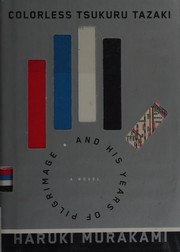
Colorless Tsukuru Tazaki and His Years of Pilgrimage
2,765-word summary 12 min read 386 pages in the book
- First published
- 2013
- Publisher
- Alfred A. Knopf
- Pages
- 386
- ISBN
- 9780385352109
- Original title
- Shikisai o motanai Tazaki Tsukuru to, kare no junrei no toshi
Reading options
What's inside (7 sections)
I picked up Colorless Tsukuru Tazaki and His Years of Pilgrimage after a gap in my Murakami reading. I had read Norwegian Wood in college and Kafka on the Shore a few years later, and I wanted something shorter and closer to the ground. A bookseller told me this one was quiet, sad, about friendship rather than parallel worlds. That sounded right for a slow week. Haruki Murakami first published the novel in Japan on 12 April 2013 as Shikisai o motanai Tazaki Tsukuru to, kare no junrei no toshi with Bungeishunju, and Philip Gabriel translated it into English for Alfred A. Knopf in 2014 in a 386 page hardcover with ISBN 9780385352109. The Japanese title is sometimes romanized with wo instead of o, which reflects different romanization styles rather than a different book.
The setup is simple on purpose. Tsukuru Tazaki is thirty six, single, living in Tokyo, designing train stations for a railway company. He loves stations the way some people love harbors. He likes timetables, platforms, the way crowds sort themselves. As a teenager in Nagoya he belonged to a tight group of five friends who did everything together. Each of the other four had a color hidden in the family name. Red. Blue. White. Black. Tsukuru name had no color. He thought of himself as the empty space that let the rest shine. Then, in his second year of college in Tokyo, the four cut him off in one phone call. No reason given. No meeting. Just gone.
That cut shapes his adult life. He drifts through his twenties, works hard, dates little, feels flat inside. He thinks of himself as colorless in character as well as name. Then he meets Sara Kimoto, two years older, who works for a travel agency. She is practical, warm, direct. She likes him and tells him plainly that he cannot move forward with her until he learns why his friends left. She will even help him find them, since he barely uses the internet. He agrees because he trusts her judgment more than his own hope.
I read this in three sittings and found it tender rather than gripping. There are no chases, no alternate histories like 1Q84, little of the wild comedy from The Wind Up Bird Chronicle. The tension comes from small meetings in cafes and living rooms, and from Tsukuru dread that the answer will confirm his worst view of himself. If you want Murakami at his strangest, this may feel thin. If you want him writing about shame and late apology, it has a clear pull.
Five friends and one phone call
The Nagoya chapters build the group with care. Tsukuru meets the four in high school and they bond fast. Kei Akamatsu, called Aka for red, is sharp and driven, good at study, already thinking about business and training. Yoshio Oumi, called Ao for blue, is athletic and open, a rugby boy who becomes a car dealer. Yuzuki Shirane, called Shiro for white, is tall and fine boned, quiet, gifted at piano. Eri Kurono, called Kuro for black, is quick and funny, good with words, later drawn to craft. They volunteer together, travel together, sit in each other kitchens. Tsukuru, who loves trains, feels useful when he plans their trips.
Murakami gives their nicknames without fuss. In Japanese the color sits inside the surname, so the short names feel natural rather than cute. Tsukuru name means to build or make, which fits his later job, but as a boy he hears only the lack. He tells himself his role is to be empty, to listen, to keep peace. The others seem to accept that story. They tease him gently. They rely on his calm. He does not see how much they need his steadiness until it is withdrawn.
The break itself takes only pages. Tsukuru is in Tokyo for college. Calls go unanswered. Then one call connects and a voice says do not call again, do not write. He flies home to ask in person and no one will meet him. He returns to Tokyo and falls into months where he thinks often of death. Not plans, exactly. More a sense that life has thinned and might stop. He keeps attending classes because routine holds him. He eats. He sleeps badly. He stops playing tennis. A friend from that time later says Tsukuru looked like a house with the lights off.
What I liked here is how Murakami refuses a villain. No one shouts. No one explains. The silence does the harm. Tsukuru, who already sees himself as blank, fills that silence with blame toward himself. He decides he must be at fault in some deep way that needs no proof. That decision, made at twenty, still runs his friendships at thirty six. He keeps people at arm length. He works. He maintains his apartment. He does not ask for much. Sara sees this pattern before he names it, which is why her push to revisit Nagoya feels kind rather than cruel.
Haida, Liszt, and a strange winter
Before Sara sends him back, the book pauses for Tsukuru college friendship with Fumiaki Haida. Haida is two years younger, tall, reserved, with gray in the family name meaning. He loves records and books. He and Tsukuru swim together, cook simple meals, listen to Franz Liszt Years of Pilgrimage, especially the Swiss volume with the piece Le mal du pays, which means homesickness. The music becomes their private marker. Haida lends Tsukuru a boxed set. They talk late.
One night Haida tells a long story he says comes from his father. As a young man, his father took leave from college and worked at a small hot spring inn. There he met a jazz pianist named Midorikawa, green river in the name, who claimed he had accepted a death token and had two months left unless he passed it on. The pianist said the near prospect of death had opened his senses so he could see people colors. He played beautifully, placed a small bag on the piano, spoke calmly about dying. Haida father listened, unsettled, and left the inn changed.
Later that same night, Tsukuru has a vivid erotic dream involving Shiro and Kuro from his old group. In the dream their faces shift and merge with Haida. He wakes unsure what was dream and what was half waking, with physical traces that embarrass him. When he next looks for Haida, the younger man has vanished from college without notice, leaving only the Liszt records behind. No note. No forwarding address.
I found this middle section the most Murakami like and also the most divisive. On one hand, the Midorikawa tale has the flat ghost story tone he does so well, strange events told plainly, a bag on a piano, talk of tokens, color auras, quiet dread. On the other, it sits oddly inside a book that is otherwise realistic. Some readers will love the wobble. Others will wish Murakami had stayed with the Nagoya friends. I landed in between. The Haida chapters show how Tsukuru bonds with men who leave, which matters for the later trips, but the dream and the sudden exit never get explained and the book does not try hard to tie them to the main answer.
The Liszt motif stays useful even if the mystery does not. Pilgrimage years. Homesickness. A young man far from home listening to old piano music about travel. When Tsukuru later boards trains and planes to meet his old friends, that music hums underneath without Murakami having to point at it.
Ao and Aka in Nagoya
Sara does the research Tsukuru cannot do himself. She finds addresses, writes careful messages, books tickets. Tsukuru first returns to Nagoya to see Ao, the former rugby boy now selling Lexus cars. They meet in a cafe. Ao is thicker now, friendly in a tired way, quick to apologize. He says he went along with the cutoff at the time and has regretted the cowardice since. Then he gives the fact Tsukuru waited sixteen years to hear. Shiro told the group Tsukuru had raped her. That claim was why they cut him. No police. No trial. Just belief and fear and a decision to protect her by removing him.
Ao also tells the harder news. Shiro became a piano teacher in Hamamatsu. Six years before the present action, she was found strangled in an unsolved murder. The case never closed. Ao speaks of her with pity and confusion. She had grown thin, anxious, distant from music she once loved. He does not know who killed her and does not pretend to.
The next day Tsukuru meets Aka, now a successful corporate trainer with offices and staff. Aka talks fast, offers tea, shows pride in his methods, then admits private strain. His marriage failed. He has come to understand he is gay but feels unable to live openly in Nagoya business circles. He dislikes his own training techniques, which borrow from harsh psychological pressure, and he dislikes how neighbors view him. About Shiro story, Aka is blunt. At the time it did not add up, he says, but Shiro seemed fragile and the group chose to believe her rather than risk harming her further. He asks Tsukuru to forgive him, not with grand words but by listening.
These two meetings are the strongest pages for me. Murakami lets middle aged men talk in circles, boast, deflect, then drop a true sentence. Ao apologizes with his body as much as words, refilling cups, looking away. Aka performs success and then lets the mask slip when he talks about nights alone. Tsukuru mostly listens. He reassures Aka that he still cares for him. He thanks Ao for meeting. He does not demand more than they can give. I admired that restraint, though part of me wanted Tsukuru to press harder on details. Dates. Places. What exactly Shiro said. The book chooses feeling over fact here, which fits Tsukuru character but may frustrate readers who want a clear inquiry.
A small work scene follows back in Tokyo that I liked. Tsukuru and a young colleague visit an old stationmaster who keeps tales of lost things found in stations, including a jar with severed sixth fingers in formaldehyde. It echoes the Haida strangeness in brief, a reminder that odd cargo passes through orderly stations. Tsukuru hears it differently now. He has started to think of his own life as a lost item someone shelved long ago.
Kuro in Finland and what she finally says
Only one member of the group can still give the full story. Eri, Kuro, now Eri Kurono Haatainen, lives in Finland with her husband Edvard, a potter, and two small daughters. She makes ceramics. She seems steady in emails Sara forwards. Tsukuru flies to Helsinki with Sara friend Olga helping on the ground, then drives to Hameenlinna where Eri keeps a holiday cottage by water.
The Finland chapters move slowly on purpose. Snow light. Sauna. Clay dust. Children playing. Edvard kind and watchful. Eri older, softer in manner, still quick. She chooses to dispense with nicknames. She tells Tsukuru she once loved him quietly, which may have colored how she heard Shiro claim. Then she gives her version. Shiro story about Tsukuru was not true. She had in fact been raped by someone else around that time, suffered a miscarriage, grew ill with anorexia as a way to close her body to further harm. The group did not know how to face a truth that large, so they accepted a smaller false story that let them act. They cut Tsukuru because he seemed strongest, the one who left Nagoya first and could bear exile. They told themselves distance would let Shiro heal.
Eri says she stayed silent partly from pain that Tsukuru never noticed her feelings, mostly from fear that confronting Shiro would break her. She does not ask to be excused. She states it. Tsukuru hears that his plainness, which he took as worthlessness, was read by others as strength. That reversal does not heal him at once, but it loosens something. He and Eri sit without touching, crying a little, letting years sit between them without fixing all of it.
Before flying, Tsukuru sees Sara in town holding hands with a middle aged man, smiling in a way he has not seen. He feels sadness rather than anger. It steadies his resolve to finish the trip rather than rush home to guard his place. In Finland he learns Eri named her older daughter Yuzu in memory of Shiro, a private memorial inside a new life. That detail hit me harder than any speech. People carry the dead inside ordinary names and bowls and songs.
Back in Tokyo, Tsukuru calls Sara. He asks if she is seeing someone else and says he loves her. She says she needs three days to answer. The novel ends with him waiting, watching his phone, living inside uncertainty he would once have fled. Some readers hate that close. I found it honest. After sixteen years of silence, three days of chosen waiting feels like growth rather than tease.
What stays and what falls short
What stays with me is the picture of a man who builds stations for others while feeling unable to arrive himself. Tsukuru designs places where strangers meet, part, return. He keeps his own apartment spare. He cooks plain food. He maintains trains on time. Murakami connects work and wound without spelling it out. A station is a place built for leaving and coming back. Tsukuru left Nagoya and never went back until Sara made return possible. The trips to Nagoya and Helsinki are his first real returns, clumsy and brave.
I also kept the color idea. Red pine. Blue sea. White root. Black field. Gray paddy. Green river. Names carry color like paint chips. Tsukuru colorless. Haida gray. Midorikawa green. The stationmaster jars. Even Sara name, with sal tree and under the tree, sounds rooted. Murakami does not press the scheme hard. He lets colors gather lightly around people, then asks whether a man without color in his name can still have hue in his life. Eri answer suggests yes. She saw warmth in him when he saw blank.
Fair criticism matters here because reviews of this book split. The prose, in Gabriel translation, reads clean and calm, sometimes flat by design. Dialogue runs plain. Sex scenes, including the college dream and later adult nights, are written in blunt physical terms that some readers find cold or awkward. The novel was even shortlisted for a bad sex prize in Britain, which tells you not everyone forgave those pages. I found them uncomfortable rather than erotic, which may be the point, but I winced twice.
Plot gaps will bother mystery minded readers. Who killed Shiro. Why Haida left. Whether the Midorikawa story happened or was invented to explain a departure. Whether Sara will answer yes. Murakami leaves all four open. If you need closure, this will sting. The Guardian review at the time made a similar complaint, that atmosphere builds and answers thin out. I felt that sting too, especially about Shiro murder. To introduce a strangled piano teacher and then leave her death unsolved feels less like mystery than like life, but on the page it can read as dodge.
Pace is another test. Long talks in cafes. Long drives. Long pauses while tea cools. I liked that rhythm this time because I read slowly at night, but I can see a faster reader finding the middle soft. The Nagoya apologies overlap. The Finland arrival takes its time with cottages and children before Eri speaks. Murakami trusts quiet accumulation. Sometimes that trust pays, as when a small sentence about Yuzu name lands hard. Sometimes it asks patience without reward, as when work scenes detail schedules at length.
Who should try it. If you liked Norwegian Wood more than 1Q84, start here. If you want a book about male friendship, shame, and apology in middle age, with Japan and Finland as backdrops and Liszt on the stereo, this fits. If you want twists solved and killers named, look elsewhere. I closed it thinking about stations at night, lit and empty, and about how long some of us wait to ask a plain question. Tsukuru waits sixteen years to ask what happened. Then he waits three days for an answer he cannot control. That second wait felt like the start of color, faint but real.
FAQ
When was Colorless Tsukuru Tazaki published?
Haruki Murakami first published it in Japan on 12 April 2013 with Bungeishunju. Philip Gabriel translated it into English for Alfred A. Knopf in 2014 in a 386 page hardcover with ISBN 9780385352109.
Who are the main characters?
Tsukuru Tazaki, Sara Kimoto, and the four Nagoya friends Aka, Ao, Shiro, and Kuro, plus college friend Haida.
Is it part of a series?
No. It stands alone outside any series, though it shares Murakami interest in memory and quiet strangeness with books like Norwegian Wood and Kafka on the Shore.
Similar books

Dance Dance Dance
A divorced Tokyo writer returns to a Sapporo hotel that has been rebuilt, then follows a woman who may be a ghost and a teenage girl through a mystery about…
2,407-word summary · 11 min read
Kafka on the Shore
Fifteen year old Kafka Tamura flees Tokyo while old Nakata, who talks to cats, drifts toward the same library town in Shikoku in parallel.
2,496-word summary · 11 min read

Norwegian Wood
Toru recalls 1969 Tokyo, torn between fragile Naoko and lively Midori after a friend's suicide.
2,051-word summary · 9 min read

The Interestings
Meg Wolitzer follows Jules Jacobson from 1974 arts camp into middle age, as friendship with Ethan and Ash turns into envy, money gaps, marriage strain, and…
2,990-word summary · 13 min read
Summer Sisters
Vix and Caitlin share Martha's Vineyard summers from age twelve into adulthood, through first love, grief, marriage, and a disappearance that still haunts Vix.
3,633-word summary · 16 min read

So Old, So Young
Six college friends reunite at five parties over twenty years in Ginder's funny, moving novel of millennial friendship.
2,457-word summary · 11 min read

Crux
Two broke Mojave teens chase pro climbing dreams as friendship, class gaps, and family strain pull Dan and Tamma apart.
2,489-word summary · 11 min read

The Elegance of the Hedgehog
A Paris concierge hides her brilliant mind while a gifted girl plans her death, until a new tenant sees through them both.
2,248-word summary · 10 min read

A Prayer for Owen Meany
John Wheelwright believes in God because of Owen Meany, the tiny friend whose foul ball killed his mother.
3,046-word summary · 14 min read

The Perks of Being a Wallflower
Chbosky's Perks retold: Charlie's letters, Sam and Patrick, first year of high school in Pittsburgh.
1,951-word summary · 9 min read
The Kite Runner
Khaled Hosseini's The Kite Runner retold: Amir and Hassan in Kabul, the alley, the escape to America, and the return to find Sohrab.
2,584-word summary · 11 min read

Eleanor Oliphant Is Completely Fine
Eleanor keeps a rigid Glasgow routine until she and Raymond from IT help an old man who collapses in the street, and slowly remembers why.
2,277-word summary · 10 min read

Men Without Women
Seven stories about men living after women leave, die, or stay distant.
2,673-word summary · 12 min read

A Wild Sheep Chase
An ad man chases a starred sheep to Hokkaido for a dying Boss while Rat hides with the Sheep Man.
2,579-word summary · 11 min read

South of the Border, West of the Sun
A married Tokyo bar owner reunites with his lost childhood sweetheart and must choose between steady family life and a haunting first love.
2,844-word summary · 13 min read
Hard-Boiled Wonderland and the End of the World
A Tokyo encoder who rents out his subconscious and a newcomer in a walled Town turn out to share one fate about memory.
2,406-word summary · 11 min read

Sputnik Sweetheart
K loves Sumire, Sumire loves Miu, and then Sumire vanishes from a Greek island into Murakami's quiet other side.
2,055-word summary · 9 min read

After Dark
On one night in Tokyo, student Mari reads in a diner and talks with Takahashi while her sister Eri sleeps, as a love hotel incident and night workers cross…
2,986-word summary · 13 min read
The Wind-Up Bird Chronicle
An unemployed Tokyo man hunts a lost cat, then his missing wife, and slips from quiet suburbs into wells and wartime memory.
3,344-word summary · 15 min read
1Q84
Aomame slips into a Tokyo with two moons while Tengo rewrites a strange girl's novel, and their childhood bond pulls tight.
3,056-word summary · 14 min read

The Idiot
A Turkish-American freshman at Harvard falls in love through email with a Hungarian math student and spends a summer in Hungary trying to turn correspondence…
2,019-word summary · 9 min read

Anya's Ghost
A lonely Russian immigrant falls into a well, befriends the ghost trapped there, and discovers that the ghost's help comes with a dangerous price.
2,001-word summary · 9 min read
The Power of One
A boy in apartheid South Africa decides to become welterweight champion of the world, and the novel follows every mentor, fight, and loss that gets him there.
2,145-word summary · 10 min read

Less Than Zero
Clay returns to Los Angeles for Christmas and drifts through parties, drugs, and old friends, including one who is selling himself to survive.
1,926-word summary · 9 min read

Dumplin'
Willowdean Dickson enters her town's beauty pageant as a protest and discovers that confidence is harder to keep once she lets someone close.
1,922-word summary · 9 min read

Five Point Someone: What Not to Do at IIT
Three friends at IIT drift to a five-point GPA, mock the system, and break into a professor's office for an exam paper.
2,458-word summary · 11 min read

The Age of Miracles
A California girl grows up while the Earth's rotation slows, and ordinary adolescence continues alongside slow catastrophe.
2,417-word summary · 11 min read

Peace Like a River
An asthmatic boy in the early 1960s narrates his family's search for his older brother, who is accused of two killings and has escaped custody.
1,969-word summary · 9 min read

We Are Okay
Marin fled San Francisco after her grandfather vanished and stopped answering anyone. When Mabel visits her college dorm, she has to say what happened.
2,253-word summary · 10 min read

The Chosen
A shattered pair of glasses in a 1944 Brooklyn softball game starts a friendship between a Hasidic boy and his Orthodox neighbor, and their fathers pull them…
2,443-word summary · 11 min read