
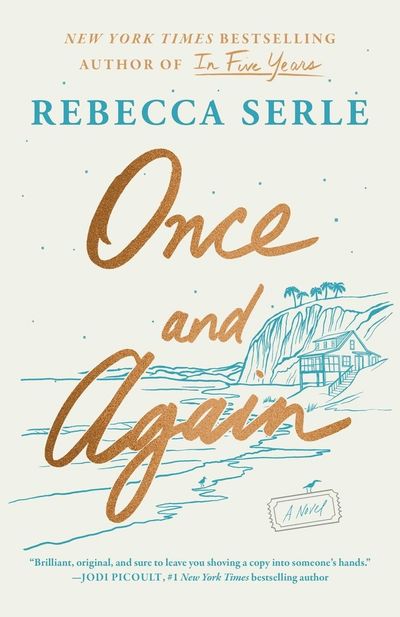
Once and Again
2,330-word summary 10 min read 256 pages in the book
- First published
- 2026
- Publisher
- Atria Books
- Pages
- 256
- ISBN
- 9781668025918
Reading options
What's inside (16 sections)
I have read enough Rebecca Serle to know her moves: a touch of magic, a lot of heart, women at crossroads. Once and Again follows the pattern of In Five Years and One Italian Summer, and I mean that as comfort rather than complaint. The Novak women can each redo one moment in their lives. Lauren, our narrator, has spent years waiting to spend hers. The question of whether she should hangs over every page like coastal fog.
The book is short, 256 pages, and reads even shorter. Malibu surf, mother-daughter friction, a marriage under fertility strain, a first love back in town. Serle assembles familiar parts with unusual tenderness. I finished it in two sittings and thought about my own unmade choices for a day after.
The gift and its rules
Every Novak woman gets one redo. Just one. Her mother Marcella used hers at fifteen-adjacent young motherhood, reversing the car crash that killed Lauren's father, and has lived carefully ever since. Dave walks the waves daily, alive because his wife spent the family miracle on him. That debt shapes everything between mother and daughter.
The rules matter less than the psychology. Knowing you have one reversal makes every decision feel enormous. Marcella's caution calcified into fear. Lauren inherited the fear without spending the gift. Sylvia, the grandmother, offers the counter-model: a glamorous iconoclast who hints at a spectacular past and treats the gift as freedom rather than burden. Three generations, three philosophies of regret.
Serle keeps the mechanism vague on purpose. No lore chapters, no system referees. The magic works the way love works in her books: as a given the characters must live around. Readers who need hard magic systems should look elsewhere. Readers who accept one impossible thing will find the rest follows honestly.
Lauren waiting
Lauren has built a life out of waiting. She waited for Leo through a long courtship. She waits now for a pregnancy that will not come. She waits to use the gift, half convinced catastrophe lurks around every corner. Waiting has become her personality, and the book knows it. The opening chapters show a woman paused at every level.
Her marriage to Leo reads as genuinely solid, which is rarer in this genre than it should be. Three years in, rock steady by all accounts, strained only by the fertility grind that wears grooves into both partners. Leo gets enough interiority through Lauren's eyes to feel like a person rather than a placeholder. His patience has limits, and the book respects them.
Work and friends fill the margins lightly. Serle keeps the focus tight on family and marriage, which suits the short length. Malibu functions as more than backdrop: surf rhythms structure Lauren's days, and the ocean becomes the book's image for time itself, always moving, never returning the same wave twice.
Back to Broad Beach Road
When Leo takes a six-week New York job, Lauren returns to her childhood home and her parents' orbit. Dave surfs daily, cheerful and oblivious to the weight his survival placed on everyone. Marcella fusses and frets, her love indistinguishable from anxiety. The old house holds every unresolved conversation in its walls.
The mother-daughter fracture gets careful treatment. Marcella's brittleness comes from spending her miracle young and living decades with the knowledge that no second chances remain. Lauren's distance comes from growing up inside that fear. Neither is wrong. Both are stuck. Their scenes together mix love and static in proportions anyone with a difficult mother will recognize.
Sylvia provides relief and contrast. Where Marcella hoards caution, Sylvia spends stories freely, hinting at a past full of drama she will not fully disclose. Her glamour is not vanity but philosophy: life is short, spend it vividly. Lauren grew up stretched between these poles, and the book's present finds her still stretched.
Stone walks back in
The boy next door returns: Stone, Lauren's first love, back after a decade away, carrying the breakup that shaped her ideas about love. His reappearance tests everything. Old patterns reassert with frightening speed. Familiar jokes, familiar fights, familiar pull. Lauren finds herself thinking in ways she thought marriage had retired.
Serle writes the triangle without villains. Leo is good. Stone is genuinely changed, or performing change convincingly. Lauren's confusion reads as honest rather than fickle. The fertility strain has already cracked the marriage's foundation; Stone is pressure on the crack, not the crack itself. That distinction matters and the book honors it.
Surf scenes with Stone carry the book's best physical writing. Two people who learned waves together falling back into rhythm: it works as metaphor and as plain pleasure. Water holds memory in Serle's Malibu. Every wave Lauren catches with Stone echoes waves from a decade ago. Choosing what those echoes mean becomes the book's work.
Mothers, daughters, choices
The three-generation structure gives the novel its spine. Sylvia spent freely, Marcella spent once and froze, Lauren hoards. Each approach costs something. The book refuses to rank them. Instead it shows how each woman's choice made the next woman's dilemma. Gifts become inheritances become burdens. Family magic works like family money that way.
Marcella's crash reversal gets revisited with new context late, and the revisit lands hard. What looked like pure salvation at fifteen looks more complicated at Lauren's age. Saving Dave meant binding him to a wife who never stopped fearing loss. Love as rescue has ongoing costs. The book sits with that discomfort rather than resolving it.
Pregnancy threads through everything as the choice Lauren cannot control. Waiting for lines on a test while holding a time-reversal gift creates exquisite tension. The thing she wants most cannot be taken by magic, only waited for. That limitation shapes the finale more than any supernatural rule.
The undoing question
Whether Lauren uses the gift, and on what, I will not spoil. The book builds to the decision carefully, weighing every candidate moment. A kindness to Leo? A repair with Marcella? A different answer to Stone years ago? Each option gets a full hearing in Lauren's deliberations and in the plot's arrangement of temptations.
What matters more than the choice is the book's answer to why one gets only one. Scarcity forces meaning. If every moment were reversible, none would matter. The Novak gift works dramatically because it mirrors real life: we all get a few moments we would undo, and living with them defines us more than undoing would.
Serle's handling of consequences feels mature. Actions ripple. Reversals ripple differently. Nobody gets a clean timeline. The magic obeys emotional logic rather than physics, which frustrates literalists and satisfies everyone else. Read for the heart logic, not the rulebook.
Serle's shelf and style
Fans will find the usual pleasures: luminous California settings, food and surf and light, dialogue that sounds like people who love each other, magical premises treated as emotional facts. The prose stays smooth and accessible throughout. Nobody will get lost. Everybody will get misty at least once.
Compared to In Five Years, this is gentler and less devastating. Compared to Expiration Dates, it is warmer and less prickly. It resembles One Italian Summer most in its mother-daughter core and travel-free Malibu equivalent. Readers have a favorite Serle mode; this one plays her most comforting notes.
The 256 pages mean no bloat and occasional thinness. Leo could use one more solo scene. Sylvia's past stays deliberately hazy, which works thematically but frustrates curiosity. Stone's decade away gets summarized more than shown. The book trades depth for momentum and mostly wins the trade.
Who should open it
Grief-free readers seeking warmth will find it. Anyone navigating fertility strain should know the subject runs through the whole book, handled with care but unavoidable. Mother-daughter pairs might read it together and argue happily about Marcella for hours.
The magic is light enough for skeptics and serious enough for believers. Romance readers get a genuine triangle with no cartoon villain. Family-saga readers get three generations in miniature. At 256 pages the commitment is small and the aftertaste lingers pleasantly.
Serle remains the most reliable warm read in mainstream fiction. Once and Again will not change minds about her, but it will confirm affections. Sometimes knowing exactly what a book will do, and watching it do that thing beautifully, is enough. It was enough for me, twice over.
A final accounting
The book's wisdom, such as it is, fits in a sentence the novel never quite speaks: the unchangeable past matters less than the changeable present. Lauren's gift tempts her backward while her life waits forward. Choosing forward, with or without magic, is the whole story.
I closed it thinking about my own unspent gifts, real and imagined. We all have Novak moments we hoard against catastrophe. Serle suggests spending attention instead: on mothers, marriages, waves. The magic is optional. The attention is not.
For fans, essential. For newcomers, a fine entry point. For everyone, a reminder that redoing one moment would not fix a life, but living this one might. That is a lot for 256 pages to carry, and it carries it lightly.
The Malibu canvas
Serle's Malibu does more than decorate. Surf schedules structure Lauren's days the way office hours structure other heroines. Dawn patrols, swell reports, board wax: the rituals of a life built around water. When pregnancy worry and marriage strain unmoor her, the ocean remains the one reliable rhythm. Place as stabilizer is a Serle specialty.
Broad Beach Road carries class texture too. This is wealthy Malibu, houses with histories, neighbors with opinions. Lauren's family belongs without quite fitting, artistic rather than moneyed. Marcella's glamour reads as armor. Sylvia's iconoclasm reads as privilege spent well. Money shapes every choice here without becoming the subject.
The New York interlude, when Leo takes the job there, gives the book its only non-California air. Cold streets, tight schedules, a marriage conducted by phone. The contrast sharpens what Malibu means to Lauren: not just home but habitat. She thinks differently near water. The book trusts readers to feel that without explanation.
Serle's time obsession
Time works differently across Serle's books, and Once and Again fits the pattern. In Five Years jumped forward. One Italian Summer looped through grief. Expiration Dates dated everything. Here time becomes currency: one reversal to spend, infinite moments to weigh it against. The gimmick varies. The preoccupation stays.
What distinguishes this entry is how little the magic does. No chapters relived in full, no alternate timelines mapped. The gift functions mostly as pressure on ordinary decisions. That restraint suits a novel about waiting. The fantastic element mirrors the mundane problem: too much thinking, too little living.
Leo's role in the time theme deserves notice. He waits too, for a child, for Lauren's attention, for his own career to clarify. Two waiters married to each other: the book's quietest insight is that waiting together is its own kind of intimacy. They keep each other company in the lobby of the future. That image stayed with me.
Mothers in miniature
Marcella and Sylvia could have been types: the anxious mother, the free grandmother. Serle gives each a private logic that resists typing. Marcella's fear comes from spending everything young and living decades unprotected. Who would not become careful? Who would not check locks twice? Her brittleness reads as scar tissue, not character flaw.
Sylvia's freedom likewise gets grounded. Glamour requires maintenance. Iconoclasm has costs the book hints at without itemizing. Her hints about the past suggest wilder chapters than she shares. Lauren grew up on those hints the way other kids grew up on fairy tales. Wonder and warning in one package.
Dave, the saved father, might be the book's stealth achievement. A man living because his wife spent a miracle on him: does he know? How does borrowed time feel from inside? The book touches these questions lightly through his cheerfulness, which starts to read as its own kind of bravery. Surfing every day as gratitude practice.
The Stone question
First loves haunt Serle novels the way seaside towns haunt hers. Stone is drawn with unusual care for a rival figure. Charming without villainy, changed without proof, tempting without cruelty. He represents not a better choice but an unmade one, and the book understands the difference. Roads not taken glow precisely because no one walked them.
The surfing past they share gives the attraction physical memory. Bodies remember what minds debate. Scenes in the water with Stone carry charge that scenes on land lack. Serle writes athletes' ease well. Movement as flirtation, balance as trust exercise. The ocean witnesses without judging, which is more than the characters manage.
Whether Stone has genuinely changed stays productively unclear. He says the right things. His absence was real. His return coincides with Lauren's vulnerability suspiciously well. The book lets readers distrust him at their own rate. My own verdict shifted twice. That instability feels intentional and honest.
Why it lands softly
Some readers will find the stakes too soft. Nobody dies on the page. The marriage never truly cracks. The gift's rules stay fuzzy. Compared to the gut punches of In Five Years, this is Serle in comfort mode. Comfort mode still beats most writers' best days, but expectations set by her sharper books may leave some wanting weight.
The short length both helps and limits. At 256 pages nothing drags, but subplots stay sketches. Leo's work life, Sylvia's past, Stone's decade: all summarized more than shown. A longer book could have deepened each. A longer book might also have diluted the central question. The trade favors momentum.
Still, the final chapters earn their tears honestly. Lauren's decision, whatever readers think of its wisdom, completes her arc from waiting to choosing. The last surf scene mirrors the first with telling differences. Same ocean. Different woman. That is all any novel needs to do, and this one does it with grace to spare.
FAQ
When was Once and Again published?
Atria published it on March 10, 2026. The hardcover runs 256 pages with ISBN 9781668025918.
Is it part of a series?
No. It is a standalone novel about the Novak family women and their one-time gift.
Who are the main characters?
Lauren, her husband Leo, mother Marcella, father Dave, grandmother Sylvia, and first love Stone.
Similar books

What the Wind Knows
Annie scatters her grandfather's ashes on Lough Gill and is pulled into 1921 Ireland, where she becomes the missing Anne Gallagher and falls for Dr. Thomas…
2,056-word summary · 9 min read
The Rules of Magic
Franny, Jet, and Vincent Owens test strict family rules and a love curse in 1960s Manhattan and Massachusetts in Alice Hoffman's warm prequel about love, loss,…
2,686-word summary · 12 min read
Practical Magic
Orphaned sisters Sally and Gillian Owens flee magic and love, until Gillian returns with a dead boyfriend and Sally must face the family curse.
2,974-word summary · 13 min read
One & Only
Matchmaker Cassia Park finds fated love for everyone but herself, until a 28-year-old fling and a new boss named Daniel Nam collide.
2,033-word summary · 9 min read

The Fiery Cross
Jamie musters militia for Tryon while Brianna and Roger wed on the Ridge, ending at Alamance with a hanging that steals Rogers voice.
2,719-word summary · 12 min read

Drums of Autumn
Brianna crosses stones to save parents, finding love, assault fallout, and a home to build.
2,003-word summary · 9 min read

Tom Lake
Lara tells daughters about young love with actor Peter Duke at Tom Lake.
2,600-word summary · 12 min read

Before the Coffee Gets Cold
In a Tokyo cafe where guests can revisit the past until their coffee cools, four visitors seek words left unsaid with lovers and kin.
2,233-word summary · 10 min read
One Italian Summer
Grieving Katy meets her mother Carol at 30 in Positano and learns to see her as a young woman with wishes of her own.
2,399-word summary · 11 min read

What Happened to Goodbye
Mclean has reinvented herself in four towns since her parents divorced. In Lakeview she uses her real name, and for the first time staying put becomes a choice.
2,796-word summary · 12 min read

The Japanese Lover
A Polish refugee and the son of a Japanese gardener fall in love in San Francisco in 1939, then keep the affair secret for nearly seventy years.
2,286-word summary · 10 min read

The Shadow Sister
Star D'Apliese steps out of her sister's shadow and follows a bookshop clue into the Edwardian life of Flora MacNichol, a woman who gave up love for duty.
2,260-word summary · 10 min read

River Marked
Mercy and Adam's honeymoon on the Columbia River turns into a fight with an ancient river devil, and Mercy finally learns the truth about her father.
2,008-word summary · 9 min read

Magic Burns
A magic flare hits Atlanta, and mercenary Kate Daniels must recover stolen maps, find a missing witch, and keep a teenage girl alive while Celtic gods try to…
2,021-word summary · 9 min read

Blood Bonds
Oleander is chained in a Resistance camp, and her five Bonds have to find her before Silas Davies finishes what he started in this third Bonds that Tie book.
2,018-word summary · 9 min read
The Unmaking of June Farrow
A woman in a North Carolina flower-farming family walks through a red door into 1951, where she must solve her mother's disappearance and decide whether to…
2,701-word summary · 12 min read
The Time Paradox
When his mother falls ill with a fairy disease, Artemis Fowl travels back in time to find the extinct lemur that can cure her and confronts his younger self.
2,601-word summary · 12 min read

The Siren
Saved from a shipwreck in 1930, Kahlen becomes a siren who sings men to their deaths for the Ocean, until a boy in a college library makes her want a life she…
2,369-word summary · 11 min read
Ricochet
Lily Calloway tries to stay celibate for ninety days while Loren is in rehab, leaning on Rose, Connor, and Ryke as therapy forces her to face her childhood.
2,575-word summary · 11 min read
Under Locke
Iris Taylor moves to Austin broke and wary, takes a front-desk job at a tattoo shop, and spends the book learning that Dex Locke’s blunt cruelty and unexpected…
2,591-word summary · 12 min read

Tales from the Café
Four more visitors to a Tokyo café travel through time under strict rules, each hoping to say the thing they could not say before.
2,242-word summary · 10 min read

Sam's Letters to Jennifer
A grieving journalist reads her grandmother's letters and finds a decades-long love affair that changes how she sees her family.
2,310-word summary · 10 min read

Fantasy Lover
A New Orleans sex therapist summons a cursed Spartan general from an ancient book and gets one month to break his spell.
2,315-word summary · 10 min read

Act Your Age, Eve Brown
Eve Brown crashes into a Lake District bed and breakfast, breaks the owner's arm, and talks her way into his kitchen. A grumpy-sunshine romance about work,…
2,474-word summary · 11 min read
The Rumor
Two Nantucket best friends, Madeline and Grace, watch a summer of small indiscretions get retold into gossip that reshapes both their households.
2,017-word summary · 9 min read

Two by Two
Sparks's twentieth novel turns from first love to a marriage breaking up: Russell Green loses his wife and his job, then rebuilds his life around his…
2,192-word summary · 10 min read
Between Sisters
Estranged sisters Meghann and Claire reunite in Washington when Claire announces a rushed wedding, then face their mother's desertion and a medical crisis.
2,467-word summary · 11 min read

The Rose & the Dagger
Shahrzad is pulled from her Caliph husband and left in a desert camp of rebels, needing to break his curse and end a war before it ends her.
2,520-word summary · 11 min read

At First Sight
Jeremy and Lexie are married and expecting a baby when anonymous emails tell him the child may not be his.
2,317-word summary · 10 min read

2 States: The Story of My Marriage
A Punjabi boy from Delhi and a Tamil Brahmin girl from Chennai meet at IIM Ahmedabad, and turn a love marriage into a campaign to convince two families.
2,634-word summary · 12 min read