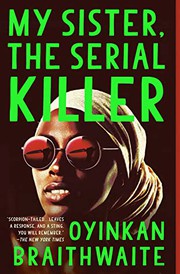
My Sister, the Serial Killer
2,739-word summary 12 min read 226 pages in the book
- First published
- 2018
- Publisher
- Doubleday
- Pages
- 226
- ISBN
- 9780385544238
Reading options
What's inside (9 sections)
A friend handed me this one with a grin and said it reads fast. She was right about the speed, but not about the aftertaste. Oyinkan Braithwaite published My Sister, the Serial Killer with Doubleday in 2018 as a 226 page hardcover, her debut, and it went on to get shortlisted for the Women's Prize and longlisted for the Booker the next year. I finished it in two evenings and spent a third evening thinking about the sisters more than the murders. That feels like the point.
The setup is blunt. In Lagos, Korede is a senior nurse, careful and tired, and her younger sister Ayoola is beautiful in a way that rearranges rooms. Ayoola has just killed her third boyfriend, Femi, stabbed through the heart with a knife, and she calls Korede the way other people call for a ride home. Korede brings bleach and rubber gloves and a steady head. By the time the book starts, cleanup is routine.
What hooked me was not the question of whether Ayoola did it. She did. The question is what Korede will keep doing about it, and how long family can be used as a reason.
Bleach and Rubber Gloves
The opening reads like instructions you wish you did not know. Korede gets the call during dinner. Ayoola says she killed him. Korede does not scream or faint. She thinks about blood in tile grout, about sheets, about the trunk of her car, about what to wear so nothing stains.
Braithwaite gives you the practical list without making it sound like a manual. Korede knows the best solutions for cleaning blood, and the refrain in the publisher copy is honest: bleach, bleach, and more bleach. She wraps the body in sheets like a mummy. She drives with Ayoola over the bridge and into the water, where the last one went too. At least he will not be lonely, Korede thinks, in one of those flat jokes that makes you laugh before you catch yourself.
Femi makes three, she whispers later to a patient who cannot answer. Three, and they label you a serial killer. She actually types the words into a search box at 3 a.m., which is such a plain and human beat. She wants a definition to tell her whether this is already beyond saving.
The other job is social. Ayoola wants to post pictures of her dinner to Instagram while her boyfriend is supposedly missing. Korede has to talk her out of it. The story they will tell is that Femi vanished, that Ayoola is a worried girlfriend, that life goes on. Ayoola is bad at mourning on cue. She is good at being photographed. That gap drives half the tension in the first third, because Korede can scrub a shower but she cannot scrub her sister's feed.
There is a detail reviewers kept quoting because it sticks. The hardest place to get clean is the join between the shower and the caulking. I believe it. The book is full of small cleaning truths like that, learned the hard way, and they do more work than any speech about guilt.
Two Sisters in One House
Korede narrates, so you see Ayoola through older sister eyes. Ayoola is the favorite child, the beautiful one, possibly sociopathic if you want the back cover words. She is shorter than Korede, curvy, with skin the book places between cream and caramel next to Korede's darker brown. Femi once wrote her a poem daring anyone to find a flaw in her beauty. Men fall for her quickly and forgive her easily. Police, nurses, boyfriends, strangers. Beauty is treated here as a kind of passport. It gets Ayoola waved through checkpoints that stop Korede cold.
Korede is tall and angular, all hard edges in her own description. She is efficient at work and anxious at home. She keeps her uniform crisp. She notices when other people are sloppy. At the hospital the younger nurses respect her and fear her a little. At home she is the one their mother calls on. Big sisters look after little sisters, their mother says, and Korede took that sentence the way some people take vows.
Their mother lives in a haze of sleeping pills. Their father is dead. He was a man who sold refurbished cars as brand new, built a smart ranch house on the proceeds, beat his daughters, tried to trade on them with important friends, and brought his mistress into the house while his wife was there. When his wife screamed, he told her to shut up or he would deal with her. The cane he used had carved patterns on the wood. Braithwaite lets that object sit in your mind without a lecture.
Ayoola would steal an apple and Korede would be blamed for letting her get hungry. Ayoola would break a glass and their mother would blame Korede for handing her the glass. That pattern never really ended. It just scaled up from kitchen accidents to boyfriends. Korede knows it is unfair and still answers the phone every time.
I found this section stronger than any murder scene. You understand why Korede cannot walk away even when she wants to. It is not only love. It is training.
The Hospital and the Doctor She Watches
Much of the middle happens on shift. Korede works as a senior nurse in a Lagos hospital, where the days are crowded and the hierarchy is clear. She is good at her job. She likes order. She corrects charts. She keeps the supply room straight. Patients trust her because she tells the truth in a calm voice.
Her one relief is a patient in room 313 named Muhtar Yautai, who has been in a coma for months. His wife visits and talks about pulling the plug and moving on with her life. Korede talks to him the way you talk to someone on a long bus ride. She tells him she wishes Tade would really see her. She tells him her sister has killed three men. It feels safe because he cannot repeat it. It also feels lonely in a way the book does not underline too hard, which I appreciated.
Tade Otumu is the doctor Korede loves from a distance. He is kind to children, keeps a bowl of candy on his desk, sings a lullaby to a toddler who flinches at a needle. Korede describes his voice as being like the ocean. She has built a whole future around small kindnesses: the way he asks her opinion, the way he remembers a detail, the way he stands a little too close in a corridor. Nothing has happened between them. Everything has happened in her head, which anyone who has nursed a work crush will recognize at once.
Ayoola, meanwhile, is trying to get going as an aspiring fashion designer and social media presence. She is not rich or famous yet, but she photographs well and knows it. When she shows up at the hospital uninvited one day, Tade notices her the way everyone notices her. He asks Korede for Ayoola's phone number. Korede gives it to him. What else could she do without explaining why she should not.
That handover is the turn of the novel. From here the danger is no longer abstract. It has a name Korede says softly to herself and a desk she passes every day.
When Ayoola Starts Dating Tade
The courtship is painful to watch because Braithwaite writes it from the wrong side of the glass. Ayoola and Tade text. They meet for food. They laugh in hallways. Tade, who never saw Korede, suddenly sees everything when he looks at her sister. He calls Ayoola beautiful and perfect when Korede presses him for why he is so taken. He does not mention that she laughs easily or holds no grudges or any of the ordinary things people love. He mentions the surface. Korede hears the thinness of it and hates herself for hearing it.
Korede tries to warn him. She tells him Ayoola is dangerous, that the last boyfriends ended badly, that he should slow down. He hears jealousy. Who would not. An older, plainer sister warning a handsome doctor off her gorgeous younger sister sounds exactly like envy, and Tade has no reason to read it any other way. Ayoola helps that reading along by playing sweet and puzzled. Only the guilty go to jail, she tells herself at one point, confident she is not in that group.
Lagos presses in around them. Traffic that eats hours. Police who expect payment and offer little help. Rain that breaks cheap umbrellas. Gossip that moves faster than any van. Korede thinks about going to the authorities more than once. Then she thinks about what Nigerian police custody means for two women with no powerful protector, about bribes and leaks and shame, about her mother alone in the house. Family always comes first, people say, and in this city that sentence carries weight beyond sentiment. It is logistics.
There is a sharp beat where Ayoola says Tade is no different from the rest. He is not deep, she says. All he wants is a pretty face. That is all they ever want. It is cruel and self serving coming from her, and it also lands because Tade keeps proving her right in small ways. He does not ask hard questions. He does not notice Korede going quiet. He proposes quickly and for reasons that sound borrowed from a song. The book lets you dislike him without letting Ayoola off the hook, which is a neat trick.
The Knife Their Father Left
Every boyfriend died by the same tool. Ayoola carries a knife in her purse, a heavy bladed thing that once belonged to their father. Korede wonders at one point whether her sister would stab if that particular knife were not always at hand, as if the object had its own pull. It is the closest the book comes to mysticism, and it passes quickly.
The history behind it is plain and ugly. Their father used force to run the house. Words first, then hands, then the cane. One night he came at Korede with that cane raised, and in the struggle he died. The sisters did not call for help in time. You can read it as accident or as choice. The book does not stage a trial to decide. It shows two girls learning that a violent man can be stopped by a sudden act and then hidden by steady nerves.
After that, Ayoola kept the knife. She says the boyfriends attacked her. She says it was self defense. The first time, Korede believed her without much thought. The second time, she believed her with effort. The third time, with Femi, the story thins. Femi was not a large threatening stranger. He was a young man who wrote bad poems and wanted to be loved. There were no bruises on Ayoola, no torn clothes, no panic that looked real. Korede cleans anyway, because that is what she does, and then lies awake sorting what she saw against what she was told.
This is where the novel is smartest about abuse. It does not argue that hurt children must hurt others. It shows how a house can teach two different lessons. Korede learned to anticipate and absorb. Ayoola learned to strike first and smile after. Their mother, lost to pills, taught them that looking away is also a choice. None of this excuses a murder. It explains why the person who should stop it keeps mopping instead.
Readers who want a clear diagnosis will be frustrated. Braithwaite never hands you a childhood flashback that clicks like a key. Ayoola is careless and charming and empty in places where other people have fear. Whether you call that sociopathy or selfishness raised in violence is left to you. I prefer that gap to a label, though I wanted at least one scene where Ayoola drops the act when no man is watching. We get hints. We never get the full drop.
What Breaks Near the End
I will keep the last stretch light on specifics so you can feel the turn yourself, but the shape is this. Korede finally tries to draw a line around Tade. She fails to hold it. Ayoola senses the pressure and tightens her grip on both of them. A hospital that was a workplace becomes a crime scene in waiting.
Muhtar wakes up. That thread pays off the way you feared from page forty. Korede told a coma patient everything because she needed one person who could not judge her. Now he can. What he does with what he heard matters more than any police plot, because his silence or speech decides whether Korede gets to keep the story she tells herself about being the good sister.
Tade gets hurt and the sisters tell different stories about how it happened. Ayoola cries prettily and points outward. Korede, covered in the dust of all her cleanups, looks guilty even when she is trying to help. Tade, shaken and angry, tells Korede she is worse than her sister. It is a harsh line and the book earns it. Ayoola kills in bursts. Korede enables for years, with bleach and alibis and careful lies to nurses and friends.
The closing pages do not stage a courtroom triumph. There is no clever detective laying out photos on a table. The sisters end bound tighter, not freed. Korede understands that protecting Ayoola may cost her Tade, her job, and the self image she polished every morning with her uniform. She chooses Ayoola anyway, or fails to choose otherwise, which in this novel amounts to the same thing.
If that sounds bleak, it is, but Braithwaite keeps the tone dry rather than heavy. Short chapters with plain titles like Bleach and Body and Heat move like drumbeats. Jokes land in bad moments on purpose. You laugh, then feel bad for laughing, then keep reading to see if the laugh was allowed.
Where It Shines and Where It Wobbles
The voice is the win. Deadpan, quick, unsentimental, with Lagos rendered in traffic and hospital smells and living room politics rather than postcards. Korede is a strong narrator because she is compromised. She judges Ayoola's vanity while counting Tade's glances. She preaches responsibility while hiding bodies. You trust her eye and distrust her conclusions, which is a fun place to sit for 226 pages.
The length helps and hurts. At this size the book never drags. You can read it in a weekend and press it on someone else Monday. The trade is thinness in places. Tade never quite becomes a person beyond kind doctor with candy. The police and hospital inquiries flare and fade. Two dead ex boyfriends before Femi get little room, so the pattern feels told rather than shown. Ayoola herself stays opaque by design, but design or not, I wanted one more unguarded hour with her to understand what she wants when no boyfriend is around.
Some readers will also trip on the moral math. The novel uses murder as material for comedy about dating and beauty and sibling rivalry. Most of the time the balance holds because Korede's dread is real. Once or twice the jokes arrive too fast after blood and the effect is chilly rather than funny. Your tolerance for that chill will decide how you rate the middle.
Who should pick it up. If you like short crime novels with a comic edge, if you liked the Bad sister energy in stories about family cover ups, if you want Lagos on the page without a travelogue, start here. If you need a detective, a trial, or a therapist explaining everything in the last chapter, this will annoy you. It is a story about two sisters first and a case second, and it refuses to become the procedural some readers keep waiting for.
I closed it thinking about the mother’s line more than the knife. Big sisters look after little sisters. It sounds warm until you watch what it costs when the little sister keeps killing and the big sister keeps cleaning. Braithwaite leaves that cost on the table without sweeping it off. That is why the title, which sounds like a joke, stops sounding like one by the end.
FAQ
Who published My Sister, the Serial Killer and how long is it?
Doubleday published the first US edition in 2018 as a 226 page hardcover. Braithwaite had earlier released the story in Nigeria as an ebook called Thicker Than Water.
Does the coma patient remember what Korede told him?
Yes. Muhtar Yautai wakes from his coma in room 313 and remembers the confessions Korede made at his bedside. What he chooses to do with that knowledge shapes the final pressure on her.
Is Ayoola caught or punished at the end?
No. There is no trial or detective reveal. Tade is hurt, the sisters tell different stories, and Korede stays bound to Ayoola even after Tade calls her worse than her sister.
Similar books
More like My Sister, the Serial Killer →
Wrong Place Wrong Time
Jen sees her son Todd kill a stranger, then wakes the day before, slipping back in time to stop the murder.
2,522-word summary · 11 min read

The Locked Door
Surgeon Nora Davis hides serial killer father while patients die.
2,465-word summary · 11 min read

The Family Upstairs
Libby Jones inherits a Chelsea mansion and a past tied to a cult house, two runaways, and a baby left waiting.
3,300-word summary · 15 min read

A Flicker in the Dark
Psychologist Chloe Davis faces copycat disappearances in Baton Rouge twenty years after her father confessed to murders.
3,074-word summary · 14 min read

Dark Places
Libby Day, sole survivor of family murders, is paid to rethink her testimony.
1,910-word summary · 8 min read

The Silkworm
A missing novelist and a cruel manuscript pull Strike and Robin into London publishing.
3,583-word summary · 16 min read