
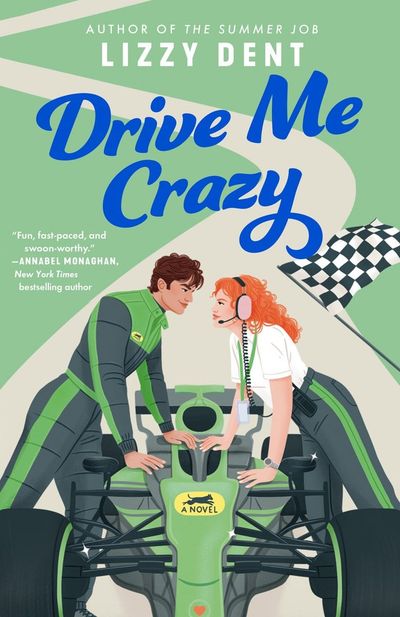
Drive Me Crazy
2,236-word summary 10 min read 368 pages in the book
- First published
- 2026
- Publisher
- G. P. Putnam's Sons
- Pages
- 368
- ISBN
- 9798217045204
Reading options
What's inside (8 sections)
I grabbed Drive Me Crazy because Lizzy Dent used to work at Red Bull, developing content around motorsport, and I wanted to see what a romance writer with actual paddock miles would do with Formula 1. The book came out in January 2026 from G. P. Putnam's Sons, and my reading follows the 368 page paperback. Emily Henry blurbed it with unusual enthusiasm, and the cover promises a funny, steamy season with a backmarker team. That is exactly what you get, plus a childhood crush plot that Dent plays straighter than I expected.
The setup is simple and strong. Chloe Coleman has just become one of the first female team principals in Formula 1, handed a failing outfit called Arden Racing and told to turn it around. On the same stretch of days, the team signs a new lead driver: Matt Warner, a former champion who has not won since a terrible crash put his best friend and teammate in the hospital. Matt also happens to be the boy Chloe crushed on years ago and never quite got over. They are now boss and employee, which makes every spark between them a professional hazard.
I read it across a race weekend, which I recommend. Something about checking timing screens between chapters puts you in the right mood.
Chloe Coleman gets the hardest job in the paddock
Chloe walks into Arden with a plan and a stopwatch. The team is losing, money is tight, morale is worse, and everyone in the press room wants to know whether she got the job for her talent or for the headline. Dent gives her competence first and insecurity second, which I liked. Chloe knows strategy, she knows people, and she knows when someone on her staff is protecting a bad process because it is familiar. Her early chapters are full of the small moves of a new leader: listening in meetings before speaking, finding the one engineer who still cares, telling the sponsors the truth with a smile that costs her something.
What makes her more than a girlboss cutout is that the job keeps asking her to be two people at once. She has to be warm enough that a fractured garage trusts her and hard enough that rival principals do not eat her alive. One scene I kept thinking about has her holding her ground in a room full of men who keep explaining her own team to her. She does not flip a table. She asks the question nobody prepared for. Dent worked in sports media, and it shows in these rooms. The dialogue sounds like people who have done television interviews and learned to say nothing with great energy.
Chloe also carries the particular loneliness of being first. There is no older woman in the job to call for advice. Her friends outside racing love her but cannot quite picture her days. Her family history with Matt complicates the one person who understands the pressure, because leaning on him would look like favoritism and feel like something else. I believed her tiredness. Leadership books talk about decision fatigue as if it is scheduling. Here it reads as Chloe lying awake doing sums about tires and headcount.
If you have ever started a job where half the room hoped you would fail, the opening third will hold you tight.
Matt Warner and the crash he cannot outdrive
Matt Warner arrives at Arden under a cloud. He used to win. Then came the crash that sent his best friend and teammate to the hospital, and since then the wins stopped coming. Other teams decided he was trouble or finished. Arden is his last credible seat, which means he knows exactly what people say about him and drives anyway. Dent does not overexplain the accident. She lets it sit in the background like a noise Matt hears under every engine note, then shows how it changed his driving: later braking where he should wait, wild lunges where patience would pay, a habit of apologizing to mirrors.
Off track, Matt is cocky in the way athletes use as armor. He flirts, he jokes with mechanics, he acts like the demotion to Arden is a funny story instead of a verdict. Chloe sees through it because she knew him before the fame, and that shared past is the engine of the romance. They grew up circling each other, she crushing from a distance while he collected podiums and girls. Now the balance of power has flipped. She signs his paychecks. He has to knock before entering her office. Dent clearly enjoys that reversal and wrings real feeling from it. Matt is used to being wanted by everyone and known by no one. Chloe knows him and is professionally required not to want him.
His arc is about learning that bravery and recklessness are different settings. A driver coming back from someone else's injury has to decide which risks belong to him. I liked that Dent does not cure him with love. Chloe cannot fix his braking points with a pep talk. He has to do the slow work with his engineers and his own conscience, and the book respects that by keeping several race scenes focused on process rather than destiny.
Readers who dislike the tortured athlete will still find Matt easy company. He is funny on purpose, not as a cover for cruelty, and his kindness to junior staff feels real rather than planted for the reader's benefit.
A boss, a driver, and a season of bad ideas
The middle of the book runs on the central problem: they cannot touch, and everything about the job presses them together. Debriefs run long. Flights get delayed. A sponsor dinner seats them side by side. Dent structures much of this around the race calendar, so the romance breathes in a rhythm of practice, qualifying, race, fallout. Each Grand Prix weekend becomes a small story with its own stakes, and the season points table quietly tracks the relationship. When the car improves, they celebrate like colleagues and look away like something more.
The banter is good. Dent writes flirtation the way people actually flirt at work, in jokes with deniability built in. There is a running thread about a karaoke night that reviewers keep mentioning, and I will leave the details for you, except to say it earns its place. Songs people choose in front of coworkers reveal more than speeches do. Chloe and Matt keep score in teasing the way drivers keep score in lap times, and the scorekeeping turns tender before either of them admits it.
The heat, when it comes, is explicit and tied to emotion rather than inserted for temperature. Dent has said the physical scenes move the emotional story, and that matches my reading. These are two guarded people, and closeness forces admissions that meetings never would. One encounter late in the book lands hard because both of them arrive carrying the full weight of the season. It is not a reward scene. It is a confession with the lights low.
Around them, Dent builds a garage worth rooting for. A veteran mechanic near retirement. A young strategist Chloe promotes over louder candidates. A press officer who lies for the team and tells the truth to Chloe. The found family material works because everyone has a job to do besides adoring the leads. When Arden scores points nobody predicted, I felt it in my chest the way I feel it watching an actual midfield team steal fourth place.
What sizzles and what sputters
The racing is the best thing here and occasionally the problem. Dent knows the sport, so strategy calls, tire talk, and pit wall arguments carry weight. Readers who follow F1 will catch the texture: the politics of engine suppliers, the sponsor math, the way a single safety car can rewrite a Sunday. Readers who do not follow the sport might find a few stretches heavy on procedure. I did not mind, because Chloe's thinking makes even a tire choice feel personal, but two chapters in the back third read like homework before the payoff arrives.
The villain side is thin. Rival principals sneer, journalists bait, and one figure from Matt's past causes trouble on schedule. None of them surprise. Dent is so good at the garage that the outside threats feel sketched by comparison. I wanted one antagonist with a real argument, someone who could tell Chloe an uncomfortable truth instead of just doubting her. The book's conflict comes almost entirely from inside the team and inside the two leads, which is honest but makes the paddock feel smaller than the real one.
Pacing wobbles around the three quarter mark. A misunderstanding keeps Chloe and Matt apart for a stretch, and while the reasons fit their jobs, the shape of it will feel familiar to anyone who reads a lot of romance. Two conversations held earlier would have shortened it. Dent compensates with a strong final race sequence where professional and romantic stakes finally share the same lap. The ending also avoids the most predictable version of happily ever after, which I respected. They choose each other without pretending the job gets easy.
One more fair complaint: the title of team principal gets misspelled as principle in some early copy I saw quoted around release. The book itself treats the role with respect. Newcomers will still learn what the job involves, which is half the fun.
Why Dent's paddock past matters
Dent has said she would not have written this book unless the woman held a senior job, and that choice shapes every chapter. She has talked about admiring real figures like Susie Wolff, who runs the F1 Academy, and Hannah Schmitz, one of the sport's best strategists. That admiration reads on the page. Chloe is not a token hire learning the sport from her boyfriend. She arrives knowing more about Arden's problems than most of the men paid to brief her, and the story trusts her judgment from the first meeting. For readers tired of F1 romances where the heroine holds a pit pass and little else, this difference matters. Chloe holds the pen that signs the checks.
Her Red Bull years show in the small things. The way sponsors get thanked in exact order. The way a press officer kills a story with a joke and a lunch. The way travel exhaustion makes everyone slightly feral by the third flyaway race in a row. These details never turn into lectures. They arrive as jokes between tired people or asides in Chloe's head while she waits for a session to start. I believed Arden as a workplace because the tiredness felt right. Night shifts before a new parts package. Interiors that smell of coffee and solvents. Junior staff who love the team and flinch when the timing screens turn red.
It also helps that Dent understands losing. Arden starts the season as a team nobody fears, and Dent writes that position with affection instead of pity. There is honor in her garage's stubbornness. The mechanics keep polishing a car that qualifies seventeenth. The strategists keep hunting for the one chaotic Sunday that pays for the whole year. Sports fans know this feeling. Most of us support teams that lose more than they win, and Dent captures why we stay: the occasional points finish feels better than a frontrunner's routine victory. When Arden finally strings good weekends together, the joy lands because the drought was real.
Against the current wave of racing romances, this one earns its spot by taking both halves of the genre seriously. The romance gets full attention, with a slow burn that respects the workplace stakes. The racing gets full attention too, with strategy that affects the plot instead of decorating it. Some competitors in this space treat the sport as a sexy backdrop. Dent treats it as a job with rules, and the love story has to survive inside those rules. That friction is what kept me reading past midnight.
Should you pack it for race weekend
Bring this book if you like sports romances where the sport is real and not wallpaper. It sits well next to the current wave of F1 love stories but stands apart by putting the woman in charge of the whole team instead of handing her a pit pass and a crush. Chloe leads. Matt follows her lead at work while leading on track. That tension never fully resolves, and the book is smarter for leaving it humming.
Skip it if you want pure escapism without shop talk, or if workplace power gaps bother you even when the woman holds the power. The boss dates her employee shape is the whole plot, and while Dent handles consent and professionalism with care, the premise still requires you to accept a season of bad judgment from two smart people.
For me, the takeaway is simple. Dent wrote the F1 romance only she could write, using her Red Bull years for texture and her romcom instincts for the rest. Chloe Coleman deserves her seat. Matt Warner earns his second act. Arden Racing feels like a team I watched all year. When the last page came, I sat still for a minute the way I do after a good race, tired and pleased and already checking the calendar for what comes next.
FAQ
When was Drive Me Crazy published?
G. P. Putnam's Sons published it on January 6, 2026. The paperback runs 368 pages and the ISBN is 9798217045204.
Who are Chloe Coleman and Matt Warner?
Chloe is the new principal of the struggling Arden Racing team. Matt is her lead driver, a former champion chasing a comeback and her estranged childhood crush.
Do I need to follow Formula 1 to enjoy it?
No. Strategy and garage politics come through Chloe's eyes, so newcomers follow fine while racing fans catch extra texture in the pit wall scenes.
Similar books
The Proposal
Nik says no to a stadium proposal and rebounds with Carlos in flirty LA romance.
2,044-word summary · 9 min read

The Re-Do List
After a public breakup, Willow Lewis redoes her romantic firsts with her brother's best friend while dog-sitting in Des Moines.
2,390-word summary · 11 min read

Love Song
Hockey heirs spend one Tahoe summer together, split by tragedy, then get a second verse.
2,222-word summary · 10 min read
Just for the Cameras
A grumpy football star and a sunny flamingo keeper fake a romance for the cameras, then catch real feelings fast.
2,366-word summary · 11 min read

In Her Own League
Baseball's first female owner clashes with her manager until banter turns to heat.
2,076-word summary · 9 min read

Catch Her If You Can
Yankees catcher Madden proposes a secret marriage of convenience to burlesque club owner Eve when two kids land on her doorstep.
2,187-word summary · 10 min read
Shopaholic and Sister
Becky Brandon returns from a ten-month honeymoon to meet the half-sister she always wanted, then discovers that Jess is thrifty, prickly, and nothing like the…
2,591-word summary · 12 min read
True Believer
Jeremy Marsh, a science journalist who debunks paranormal claims, comes to a small North Carolina town and falls for a librarian who believes in things he…
2,125-word summary · 9 min read

Ten Big Ones
Stephanie witnesses a gang robbery dressed as a devil, and the Comstock Street Slayers put her on a list of people to kill.
2,062-word summary · 9 min read
Take a Hint, Dani Brown
A viral rescue video turns a PhD student and a grumpy security guard into internet couple goals, and the fake relationship they build to keep the attention…
2,005-word summary · 9 min read
Same Time Next Summer
A woman planning a perfect wedding meets her first love back at the beach house.
2,329-word summary · 10 min read

Collided
Sophie bets she can resist playboy Liam, then pit walls fall.
2,219-word summary · 10 min read

Bridget Jones: The Edge of Reason
Bridget doubts Mark, takes a job with Daniel, and lands in trouble in Thailand.
2,198-word summary · 10 min read
Shopaholic Ties the Knot
Becky Bloomwood plans two weddings at once while debts pile up and Luke's mother interferes.
2,218-word summary · 10 min read

Playing for Keeps
Childhood neighbors Haley and Jason turn a long prank war into a fake relationship that turns real.
2,571-word summary · 11 min read

Hello Stranger
Portrait artist Sadie loses face recognition after brain surgery and must finish a contest piece while falling for two men.
2,210-word summary · 10 min read

The Play
Briar U hockey star Hunter coaches quiet junior Demi in confidence and fake dating until real feelings break the plan.
3,080-word summary · 14 min read

Tangled
Told by a cocky businessman, a bet to win the new associate who rejects him turns into real pursuit, strict rules, a painful reveal and a wedding-level happy…
2,868-word summary · 13 min read

The Roommate
Uptight Clara shares a flat with porn star Josh and teams up to build ethical adult films for women.
2,362-word summary · 10 min read
Shopaholic Takes Manhattan
Becky and Luke move to New York where shopping fame tempts her to ruin both.
2,025-word summary · 9 min read
Shopaholic and Baby
Pregnant Becky shops for the perfect nursery while Luke's ex becomes her obstetrician.
2,247-word summary · 10 min read

Seven Up
Stephanie hunts old mobster Eddie DeChooch, finds a body, a missing heart, and trouble from Morelli to Ranger.
2,798-word summary · 12 min read
My Not So Perfect Life
Katie chases London creative life while her perfect boss Demeter hides cracks, until a farm trip flips roles.
2,300-word summary · 10 min read
Hard Eight
Janet Evanovich's Hard Eight fully retold: a missing mother and child, Abruzzi's medal hunt, Valerie's rescue, and Ranger crossing a line.
2,961-word summary · 13 min read

Funny You Should Ask
Chani profiles star Gabe Parker, then ten years later a reunion interview tests memory, work, and timing.
2,603-word summary · 12 min read

Before We Were Strangers
Matt waits fifteen years to ask Grace why she left after one college night that shaped them both.
2,386-word summary · 11 min read

When in Rome
A burnt-out pop star hides out in small-town Kentucky and falls for the grumpy pie-shop owner hiding her.
2,495-word summary · 11 min read
The Starter Ex
A retired bad-girlfriend-for-hire takes one last job and falls for the mark.
2,092-word summary · 9 min read
The Rosie Effect
Married in New York, Don Tillman turns Rosie's pregnancy into research and nearly loses her, until a crisis forces him to listen.
2,869-word summary · 13 min read