
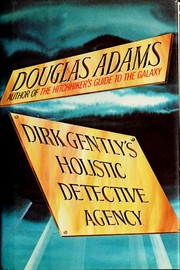
Dirk Gently's Holistic Detective Agency
3,000-word summary 13 min read 247 pages in the book
- First published
- 1987
- Publisher
- Simon & Schuster
- Pages
- 247
- ISBN
- 9780671625825
- Series
- Dirk Gently (#1)
Reading options
What's inside (7 sections)
I came to this one sideways. I had read The Hitchhiker's Guide to the Galaxy years ago and liked it in the patchy way you like a funny friend who talks too much. Then someone told me Douglas Adams had written a detective novel where the detective barely detects anything and still charges you for it. That sounded worth an evening.
The basics first, so we know where we stand. Dirk Gently's Holistic Detective Agency came out in 1987, published by Heinemann in Britain and by Simon and Schuster in America. The hardcovers run 247 pages. It is the first book in the Dirk Gently series, followed by The Long Dark Tea-Time of the Soul, with an unfinished third book, The Salmon of Doubt, left behind when Adams died. Adams himself billed it on the cover as a thumping good detective-ghost-horror-who dunnit-time travel-romantic-musical-comedy-epic, which is honest in a way most cover copy never manages.
It also grew out of his Doctor Who work, in particular the cancelled serial Shada and the aired City of Death. A Cambridge professor who is far older than he looks, a plan to rewrite history at the cost of the present, those came along for the ride. I did not know any of that when I started. I just wanted to see whether a detective story could survive its detective being Dirk.
A bad evening in Cambridge
The book opens far from Cambridge, on a dead world with a tower on it, and the tower explodes. Then we jump forward four billion years and meet an Electric Monk.
The Monk needs some explaining, because Adams clearly loved the idea. An Electric Monk is a labor saving device, built to believe things on your behalf so you do not have to bother. This one is faulty. It believes, among other things, that the world is pink, and its makers abandoned it in a desert. When a strange door appears on a rock face, the Monk walks through it. That door matters more than it looks.
Cut to Cambridge. Richard MacDuff is a young programmer, clever with computers, hopeless with people he loves. His old tutor, Professor Urban Chronotis, who everyone calls Reg, has invited him to a formal college dinner. The entertainment is a reading of Coleridge's Kubla Khan, except the poem has a second part here that does not exist in our world. Richard is distracted anyway, because he was supposed to bring his girlfriend and forgot.
His girlfriend is Susan Way. She plays the cello, she has little patience left for Richard, and she happens to be the sister of Richard's boss. That boss is Gordon Way, a rich and pushy tech founder who leaves long messages on answering machines. Gordon is driving to his country house that night, narrating his life into Susan's machine, when he stops to shut the boot of his car. Someone shoots him dead with one of his own guns.
The killer is the Electric Monk. It had been wandering the college grounds, where a porter told it to shoot off, and the poor literal thing hid in Gordon's boot at a petrol station. It does not grasp that shooting a man ends him. It just leaves.
Gordon does not leave. He becomes a ghost, confused and weak, able to nudge small objects only when strong feeling gives him a push. His first attempts at haunting mostly end with him hanging up phones by accident. I found these scenes sadder than funny, though Adams plays them for laughs. Here is a man who talked all through life and cannot finish one message in death.
Meanwhile Richard has made everything worse. He left his own message on Susan's machine promising a weekend holiday he cannot deliver, then panicked and broke into her flat to steal the tape back. He is caught in the act, or half caught, by a large man in a leather coat and a ridiculous hat who phones the flat, tells Richard to meet him, and hangs up.
That is how Richard meets Dirk Gently again. They knew each other at Cambridge, back when Dirk was called Svlad Cjelli and already seemed to be running some long con on the university. Richard feels guilt and puts the tape back. Susan comes home with a pale acquaintance named Michael Wenton-Weakes in tow. Richard apologizes. Susan, tired but kind, hands him the answering machine tape and asks him to drop it at Gordon's office for typing up. Nobody has listened to it. That tape will sit there like a loaded gun for half the book, which is a neat trick in a story about a shooting nobody heard.
There is also the sofa. Richard has a sofa stuck on the stairs up to his flat, wedged at an angle that looks permanent. He has run the numbers and believes it could never have been got there in the first place. Adams based this on a real Cambridge incident, and you can tell. It becomes a standing joke about impossible things that clearly happened, which is the whole book in miniature.
The detective who bills first
Dirk Gently runs Dirk Gently's Holistic Detective Agency out of a messy office, assisted by a long suffering secretary named Janice Pearce and trailed, at a distance, by a police sergeant named Gilks who thinks Dirk is a fraud. Dirk's pitch is that everything is connected, so to solve a crime you must grasp the whole thing. The whole crime. The whole person. Phone today.
In practice this means Dirk charges large fees, eats your biscuits, takes naps, and shows up where the interesting mess is. He believes, correctly in this book, that the odd bits around Richard must belong together. A magic trick Reg performed at dinner that should have been impossible. A missing girlfriend at a dinner she was invited to. A dead boss. A horse in a bathroom, which I will get to. A client who never hired him and never will.
Richard looks Dirk up after failing to meet him, half out of curiosity and half because his life is coming apart. Susan is cold. Gordon is dead, though Richard does not know it yet. Work is sliding. Dirk listens to Richard's story with his feet up and decides Richard is now part of the case whether he likes it or not. There is a scene where Dirk explains his methods that I enjoyed more than I expected, because Adams lets Dirk sound both pompous and right. Of course the sofa matters, Dirk insists. Of course the poem matters. Throw nothing away.
I should say what Dirk is like on the page, since the TV versions pull him in different directions. Book Dirk is big, loud, theatrical, and oddly gentle when it suits him. He lies without shame and pays attention without warning. He is not Sherlock Holmes with jokes. Holmes collects facts and reasons down to one answer. Dirk starts from the answer, that it is all one thing, and reasons outward until the facts give in.
The honest criticism starts here too, and I will keep it short for now because there is more later. Dirk vanishes for stretches of his own book. Richard carries the middle, and Richard is a fine worried programmer but not the reason anyone picks this up. You keep waiting for Dirk to kick a door in, and instead he sends someone else to Cambridge with instructions. When he does act, he is great. I just wanted more of him.
Reg and the rooms that lie
The trip to Cambridge to ask Reg about the magic trick is where the book tilts from odd to strange. Reg is a sweet, vague old professor with rooms full of clutter and a telephone that never works. Pressed by Dirk and Richard, he admits the truth, or some of it.
Reg is not human, or not only human. He is immensely old, so old he has forgotten his origins, and he holds a post that lets him watch time without, as a rule, meddling in it. His college rooms are not rooms. They are a craft that can move through space and time, disguised as an ordinary set with coal fire and armchairs. Every time he uses it, something burns out the phone. A man from British Telecom has opinions about this later. That detail, the telephone engineer versus the time machine, is Adams at his best, treating the impossible as a maintenance problem.
Reg also admits he broke his own rule. To perform the dinner trick, he popped back in time and stopped off on a distant world, and while his back was turned the Electric Monk stepped through his open door. That is how the Monk reached Earth. That is how it reached Gordon's boot. The chain of the whole crime starts to show its links, and Dirk looks insufferably pleased.
The Monk itself is worth a pause. Adams gives it a horse, which it rides with great seriousness, and the horse ends up standing in a bathroom. The Monk believes what it is told, and being told to shoot off led to murder. There is something bleak under the joke. A machine built for faith, abandoned for faulty belief, keeps believing whoever speaks firmly. Adams never quite says what he thinks about that.
My favorite small thing in this section is how Reg talks about his past. He drops two hundred years the way other men drop names. He knew Coleridge. He apologizes for nearly everything. On the page he reads sadder than on the radio, a man who has lived so long among students that he has become a student of everything and a master of very little except hiding.
If I followed one thread loosely, it was the exact limits of Reg's craft. Adams keeps them soft. Readers who want hard mechanics will fidget. I decided to treat the rooms the way the porters treat Reg, with discretion, and move on.
The ghost and the four-billion-year mistake
Here is the middle of the book, and I will take it slowly because Adams throws a lot at you in a few chapters.
The ghost riding Michael Wenton-Weakes is the engineer of a starship crew from long ago. His people, the Salaxalans, fled a war on their own world and went looking for a new planet where they could build a society around music. They parked their great ship, the mothership, in orbit around Earth about four billion years back and sent a landing craft down to refuel and repair. The engineer missed a fault. The craft blew up. The whole crew died except, in a sense, him. His body died. His ghost lived on, bodiless and furious, with millennia to plan a fix.
The fix needs a living host and a working time machine. The ghost has tried before. It once rode Samuel Taylor Coleridge and pushed him to write the strange second part of Kubla Khan, which in this telling contains coded guidance for preventing the explosion, written so that only someone who knew what to look for could use it. It has nudged Richard into small wrong decisions. It has ridden Reg in passing. It even pushed the Monk around. None of them could finish the job. Michael can, because Michael nurses a grievance and wants, badly, to correct a mistake. The ghost is good at finding that hunger in people.
Michael in life is a thin, overlooked young man who lost a job he thought was his to a rival. That rival turns up murdered, and Gordon's ghost, drifting near a telephone with enough emotion at last, manages to leave Susan a message naming the scene. Finishing it lets him rest. He falls back and is gone. I found that goodbye unexpectedly moving. Gordon spent the book learning, too late, that messages need listeners.
Richard hears Susan play Gordon's message and sees the shape of the lie. The Salaxalans were not planning a harmless refuelling stop. They meant to settle Earth, which means no humans, ever. The explosion that killed them saved us by accident. The ghost wants to undo the accident. Michael, walking around with an alien engineer in his head and a head full of old instructions from a drugged poet, is ready to go back and get it right this time.
So the chase becomes a race into the past. Dirk, Richard, and Reg take the rooms, with the phone crackling, back to Somerset in 1797, to the farmhouse where Coleridge is writing. History says Coleridge was interrupted by a person from Porlock and lost the rest of the poem. Here our heroes arrange the interruption themselves. They break in, muddle him, and make sure the second part never gets finished. No finished instructions, no repaired landing craft, no rewritten Earth.
Reg slips off during the trip and makes what he calls a few adjustments. Soon after, a small light in the sky flares and goes out. The mothership is gone, Adams leaves it soft. In the present, Susan plays Richard a cello piece that sounds like nothing on Earth. Reg admits he once recorded some of the aliens' music and passed a scrap of it to Bach. The chorale Ach bleib bei uns, Herr Jesu Christ, from the cantata BWV 6, carries a Salaxalan echo and nobody in church ever knew. Then a telephone engineer finally fixes Reg's phone properly, which burns out the time craft for good. Magic ends with paperwork.
I want to be fair about this stretch. The ghost's history arrives mostly as talk, men sitting in rooms explaining four billion years at each other while Susan waits by a phone. On my reading the talk went on a little long. Michael's turn from sulky hanger on to willing vessel happens fast. The Coleridge plan is clever but fragile, and readers who need every joint screwed tight will feel the wobble.
And yet the audacity carries it. A murder mystery that needs Bach scholarship and orbital mechanics, a love story conducted through answering machines, a poet dosed by a ghost, that is not a combination you forget. The plot earns its cover boast, at least the ghost and horror and time travel parts. The musical and romantic parts are there if you look sideways.
What works and what drags
Let me put the praise where it belongs first.
The set pieces are superb. The sofa on the stairs. The horse in the bathroom. Gordon's ghost learning to knock a coin. The Cambridge dinner with its rituals and wines. The Porlock interruption, staged like burglars who have read too much poetry. Adams writes a Cambridge I believe, all porters and locked doors. His dialogue snaps. Dirk's patter, Reg's apologies, Susan's tired sense, Richard's programmer logic applied to impossible things, each voice stays distinct.
The Bach joke is my favorite idea in the book. That the most perfect church music carries a scrap of alien song, copied by an old professor who could not resist sharing it, makes the interconnectedness theme sing instead of just lecture. Susan playing the piece at the end lands because music has been humming under the plot since the Salaxalans were named.
The structure around communication is smart too. Answering machines, letters, poems, messages that arrive too late, a ghost who can only speak when feeling runs high. Everyone in this book is trying to leave a message and failing. When Gordon finally gets through to Susan, the relief is real even though the news is grim.
Now the drags, stated plainly.
The middle third sags under explanation. Once Michael is taken over, the story stops moving and starts telling, through the same device repeatedly, a possessed or informed man lecturing Richard while Dirk nods. I checked how many pages were left at one point, which is never a good sign in a book this short.
Susan deserves better. She is bright, musical, loyal beyond reason, and the plot parks her beside a phone for long stretches while the men time travel. Her one big scene, playing the alien touched piece, is lovely but brief. I kept waiting for Adams to let her into the rooms and take her along. He never does.
The coincidence engine also groans. Holistic detection is a fine license, and Adams knows it is a cheat, but some links feel pulled rather than found. That the Monk, the ghost, the sofa, the horse, the poem, and the phone all knot around Richard is the point, yet a few knots are tied by authorial hand in plain view. If you are the kind of reader who wants mysteries to play fair, with clues you could have caught, this will annoy you. The clues here are carpet threads. You see the pattern only when Dirk lifts the carpet.
A smaller gripe. The tone wobbles between farce and grief. Gordon's death is played as machinery and then mourned at a distance. Michael's erasure by the ghost is horrible if you stop to think, and the book prefers you do not stop.
Who should read it? If you liked Hitchhiker but wanted a tighter puzzle and a sadder heart, come in. If you like campus comedy or stories where poems change the world, come in. If you want hard science fiction with rules and diagrams, or a detective who dusts for prints, this is not your stop.
I closed it thinking about the sofa. Something impossible, stuck where it cannot be, that everyone steps around. Dirk would say that is the case and the universe in one image. I think he has a point, even if I would not trust him with my wallet. The novel is 247 pages of jokes with grief tucked behind them, first published back in 1987 and still fresh where it counts.
FAQ
Do I need to read The Hitchhiker's Guide to the Galaxy first?
No. Dirk Gently stands alone with its own cast. The humor is close, so Hitchhiker fans will feel at home, but no plot carries over.
Is this the first Dirk Gently book?
Yes. It appeared in 1987 from Heinemann in Britain and Simon and Schuster in America, and The Long Dark Tea-Time of the Soul comes next.
Does the time travel hold together?
Mostly. The rules stay loose and the ending moves fast, so it pays to enjoy the ride rather than diagram every crossing.
Similar books
More from Dirk Gently first, then related titles.
The First Fifteen Lives of Harry August
Harry August dies and is born again into the same life, again and again, until a warning from a child tells him the world is ending faster with each pass.
2,189-word summary · 10 min read
The Caves of Steel
Detective Elijah Baley must solve a Spacer's murder in a domed New York, partnered with R. Daneel Olivaw, a humaniform robot built in the victim's image.
2,445-word summary · 11 min read

Paper Girls, Volume 1
Four paper girls in 1988 Ohio chase a stolen walkie-talkie into a basement and stumble into a time war, flying dinosaurs, and an older version of themselves.
2,235-word summary · 10 min read
When You Reach Me
A sixth grader in 1970s New York gets strange notes that seem to predict the future.
2,456-word summary · 11 min read
The Eyre Affair
Literary detective Thursday Next chases a villain who kidnaps Jane Eyre from her own novel in an alternate 1985 England.
1,929-word summary · 9 min read
Recursion
False pasts feel truer than true ones as a memory chair lets the grieving rewrite deaths.
1,995-word summary · 9 min read
Mostly Harmless
Arthur makes sandwiches on Lamuella while Ford steals a Guide Mk II that wipes Earths across realities.
2,059-word summary · 9 min read
So Long, and Thanks for All the Fish
Arthur Dent finds Earth back again and meets Fenchurch, who sensed the planet's odd moment, in Adams's softer fourth Hitchhiker novel from 1984.
2,448-word summary · 11 min read
Life, the Universe and Everything
Arthur in slippers must stop cricket robots from rebuilding the Wikkit Gate.
2,216-word summary · 10 min read
The Restaurant at the End of the Universe
Arthur Dent flees Vogons, dines at Milliways at the end of time, and strands on prehistoric Earth in Adams' sharp 1980 sequel.
2,749-word summary · 12 min read

The Hitchhiker's Guide to the Galaxy
Douglas Adams' Hitchhiker's Guide retold: Earth's end, Ford, Zaphod, Marvin, and the answer 42.
2,253-word summary · 10 min read
How the Light Gets In
Gamache investigates the murder of the last Ouellet quintuplet while the Sûreté he served is dismantled from inside by the man who took his protégé.
2,279-word summary · 10 min read

Bury Your Dead
Recovering from a failed raid that killed his officers, Gamache investigates a murder in a Quebec City library while Beauvoir reopens a case in Three Pines.
2,022-word summary · 9 min read

The Trespasser
A Dublin Murder Squad detective investigates a staged dinner-party killing and finds a cover-up that reaches into her own department.
2,051-word summary · 9 min read

Rules of Prey
Minneapolis detective Lucas Davenport hunts a killer who leaves a new rule at every scene and treats murder as a game of wits.
1,914-word summary · 9 min read

Authority
The new director of the Southern Reach takes over an agency that is hiding the truth about Area X, and the building starts to change around him.
2,029-word summary · 9 min read
The Unmaking of June Farrow
A woman in a North Carolina flower-farming family walks through a red door into 1951, where she must solve her mother's disappearance and decide whether to…
2,701-word summary · 12 min read
The Late Show
Exiled to the LAPD night shift after accusing her supervisor, Renée Ballard keeps two cases that were meant to be handed off at dawn: a brutal assault and a…
2,563-word summary · 11 min read
Finger Lickin' Fifteen
Lula sees a celebrity chef decapitated and talks Stephanie into entering a barbecue contest to lure the killers, while Ranger hires her to find a security leak…
2,248-word summary · 10 min read
Sleeping Giants
A girl falls into a field and lands in a giant metal hand. Years later a secret team assembles the rest of the machine, and it chooses its own pilots.
2,466-word summary · 11 min read

The Moonstone
A cursed yellow diamond vanishes on the night of a birthday party, and eight witnesses tell what they saw.
2,603-word summary · 12 min read
Fearless Fourteen
Bounty hunter Stephanie Plum babysits a teenager, guards a fading singer, and hunts nine stolen million dollars under her boyfriend's basement.
2,466-word summary · 11 min read

3rd Degree
The third Women's Murder Club novel follows a San Francisco terror cell and a three-day killing schedule, and it costs the club a member.
2,685-word summary · 12 min read
The Vanishing Stair
Stevie Bell returns to Ellingham Academy under a secret bargain, chasing the truth about a 1936 kidnapping while a new death makes the school feel smaller and…
2,026-word summary · 9 min read
Lean Mean Thirteen
Stephanie Plum's ex-husband disappears after she attacks him, leaving her suspected of murder and chasing a forty-million-dollar secret through Trenton.
2,100-word summary · 9 min read
The Memoirs of Sherlock Holmes
Doyle's second Holmes collection gathers twelve Strand stories, including the early case of the Gloria Scott and the confrontation with Moriarty at Reichenbach…
2,390-word summary · 11 min read
The Redbreast
Harry Hole chases an ageing sniper through modern Oslo while two Norwegian volunteers on the Eastern Front carry a fifty-year-old betrayal toward a royal…
2,453-word summary · 11 min read
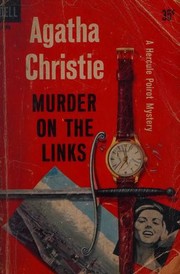
The Murder on the Links
Poirot arrives in France too late to save his client, who is found stabbed in a grave and was not the man he claimed to be. Christie's second Poirot novel.
2,055-word summary · 9 min read

Ten Big Ones
Stephanie witnesses a gang robbery dressed as a devil, and the Comstock Street Slayers put her on a list of people to kill.
2,062-word summary · 9 min read
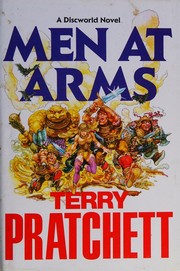
Men at Arms
The City Watch gets new recruits and a murder case when the Disc's only handgun turns up in Ankh-Morpork, in the fifteenth Discworld novel.
2,216-word summary · 10 min read