
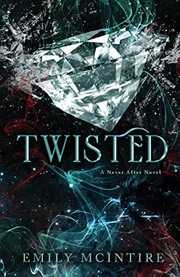
Twisted
2,051-word summary 9 min read 400 pages in the book
- First published
- 2023
- Publisher
- Bloom Books (Sourcebooks)
- Pages
- 400
- ISBN
- 9781728275840
- Series
- Never After (#4)
Reading options
What's inside (8 sections)
A fractured fairy tale for adults
The publisher's line for this book is a dark and delicious fractured fairy tale reimagining of Aladdin. It is worth taking that seriously, because the marketing also makes clear what it is not: not fantasy, not a literal retelling. It is a contemporary romance built on the skeleton of the story, and it is the fourth complete standalone in Emily McIntire's Never After series, in which classic tales are retold with the villains at the center. The site already has other books in that series, and the tone here is consistent with them.
I picked it up because the premise is so ruthless. What if the vizier, the man who manipulates the princess and uses her father's power, were the romantic lead? That is the question the book asks, and it does not flinch from the answer. This is a story about coercion, abuse and a woman who ends up choosing the man who caged her. Whether that is compelling or appalling depends a great deal on the reader, and the book does very little to make it comfortable.
Yasmin Karam is the daughter of one of the richest men in the world. She has never known strife, and she is bound to her family's legacy in ways she does not fully understand until the plot starts closing around her. She is secretly in love with Aidan, the son of household staff, the "street rat" her father would never consider worthy of her. That is the Aladdin parallel, and it is the only part of the original tale that stays gentle.
The Aladdin parallels are scattered through the book with a light hand. Aidan is the poor boy inside the walls of a wealthy household, loved by the daughter of the man who employs him. Julian is the vizier figure, the man who understands the levers of power and knows exactly how to pull them. Yasmin is the princess whose marriage is a political asset before it is a personal choice. What is missing, deliberately, is the lamp. There is no magical intervention here, no chance for the poor boy to reinvent himself and win the girl honestly. The only force that changes anyone's circumstances is human manipulation.
That choice is what makes the book a dark romance rather than a fantasy. McIntire is interested in what the fairy tale looks like if you remove the magic and leave the power relations intact. The result is a story in which the people with money and position use them, and the people without them are used. Aidan never has a chance because the rules of this world are written by men like Ali and Julian. Yasmin has a chance only because she is her father's daughter, and even that chance comes with conditions.
The man in the shadows
Julian Faraci is her father's chief operating officer and right-hand man. He is enigmatic, ruthless and driven by a single goal: to become the most powerful man in the world. The book tells us that he built his future from broken bones and faded bruises, and that his childhood was violent and abusive. He is a man who learned control as a survival skill and has never unlearned it.
His first moves in the story are quiet and terrible. He removes Yasmin's potential suitors before they can become serious. Samuel, one of them, is captured and presumably killed, though the book does not linger on the details. Julian does this because no one else can be allowed to claim Yasmin, and because the power attached to marrying her is power he intends to have for himself. He watches, he waits, and he positions himself as the most trustworthy man in the building.
Ali Karam's health begins to fail. His dying wish is that Yasmin marry a man of his choosing to carry on the family legacy. Yasmin is devastated, because she wants to reveal Aidan but knows her father's reaction would be catastrophic. Julian overhears, and forms a new plan. He will marry Yasmin himself. That gives him the Karam empire and satisfies an obsession that has been growing in him for years.
The deal Yasmin strikes with him is desperate. She does not understand that he has his own agenda, and that the arrangement is less a rescue than a trap. Julian presents himself as the ideal suitor: loyal, competent, trusted by Ali. Yasmin, cornered by her father's deteriorating condition, eventually agrees.
The cage
Once they are engaged, Julian uses the relationship as a weapon. He isolates her from Aidan. He manipulates her emotions, moving between menace and seduction with a calculated rhythm. He has decided she will be his no matter what it takes to convince her, and the book is explicit about the fact that convincing her is not the same as winning her consent. This is the part of the novel that readers tend to either embrace or reject outright. There is no middle position.
The removal of Aidan from Yasmin's life is both emotional and physical. Julian does not merely ask her to forget him. He arranges circumstances so that Aidan is gone, leaving Yasmin grieving and furious and increasingly dependent on the man who caused it. Her rebellion is real, but his dominance is nearly complete. The book is at its most claustrophobic here, and that is clearly the intention.
Then something shifts. Julian's hardened facade cracks, and genuine feelings for Yasmin emerge that he did not plan for. His attraction deepens from a power play into an obsession that is, in its own damaged way, about her rather than about the company. This is the turn the genre requires, and McIntire handles it carefully. He does not become good. He becomes attached, which is a different thing and considerably less reassuring.
After Ali dies, Yasmin inherits control of the company on the condition that she stay married. That condition is the legal version of the cage. She is now bound to Julian by inheritance law as well as by circumstance. Her response is to grow colder and more strategic. She learns to push back against his control and to become as ruthless as the man who trapped her. This is the part of her arc I found most interesting. She does not escape the dynamic by leaving it. She survives by mastering it.
I want to say a little about the BookTok context, because it explains a lot about the book's shape. McIntire's novels became popular through short videos recommending them, and that audience has particular expectations: high heat, high stakes, a dominant male lead and a heroine who is tested to her limit. Twisted delivers all four. It is short on the slower pleasures of the genre, the long courtship or the gradual building of trust, because those are not what the audience is here for. The chapters are built around confrontations and revelations, and the emotional beats arrive with the speed and intensity of a clip. That is not a criticism of the book so much as an observation about what it was designed to do.
It also explains the series structure. Each Never After book is a standalone, so there is no accumulated history to rely on. The author has to establish the stakes and the attraction from scratch in every volume and resolve them within a few hundred pages. That pressure produces the kind of plot this book has: a single dominant conflict, a small cast, and an ending that has to settle everything at once.
The confrontation
As the secrets unravel, Julian's traumatic past and the full extent of his manipulation come into the open. Yasmin confronts him, and the confrontation does not produce hatred or a reckoning in the ordinary sense. Instead it produces what the book calls a twisted understanding. Both of them are people who have been broken by pain. Both have built lives out of control because control was the only thing available to them. They choose to coexist inside the intimacy they have created.
That resolution is the book's most controversial element, and it is worth being precise about it. This is not a story in which the abuser apologizes and is forgiven, nor one in which the victim leaves and heals. It is a story in which two damaged people recognize each other and decide that recognition is enough. For readers who want the language of healing and boundaries, this will feel like a capitulation. For readers who are drawn to dark romances precisely because they refuse that language, it is the point.
The epilogue jumps forward. Yasmin is a powerful woman in full control of her life and her business. Julian stands beside her as an equal rather than a captor. Their bond is still dark, but it is now grounded in mutual understanding and a fierce, corrupted loyalty. She has not been rescued from the world of the book. She has become its most successful inhabitant.
What the book is doing
The recurring themes are power and manipulation in intimate relationships, family loyalty versus desire, blurred morality in a corrupt world, the damage abuse does to identity, and the corruption of love itself. McIntire is not writing a story about a woman who learns to love the man who hurt her in a way that excuses him. She is writing about a woman who decides that the ordinary moral categories available to her do not describe the life she actually has. That is a bleak idea, and it is handled with a kind of cold conviction.
The series context matters. Never After books take fairy tales and hand them to the characters who were originally villains. Hooked, Scarred and Wretched do the same work with other stories, and Twisted extends the project to Aladdin. If you like the idea of a villain's origin story as a romance, the series has a clear and consistent premise. If you do not, this book will not change your mind. Within its own terms it is competent and often striking.
The prose is direct and unpretentious. McIntire knows the effect she wants and goes for it without hedging. The early chapters, in which Julian quietly eliminates Yasmin's suitors and positions himself beside her father, are genuinely unsettling because they are so calm. The later chapters, in which the emotional stakes become explicit, are more conventional. The book is strongest when it is being cold rather than passionate.
Where it strains
The central difficulty is the one I have been circling throughout. This is a romance that asks the reader to accept a relationship built on coercion, manipulation and isolation as the basis for a satisfying ending. The epilogue tries to solve this by making Yasmin powerful and Julian an equal, but the power she has is the power of the company she inherited by marrying him. The book's own logic makes it hard to read that as freedom.
There is also a structural problem. The middle section spends a long time on Julian's manipulation and Yasmin's rebellion, and because the outcome is never really in doubt, the repetition begins to feel like marking time. The supporting cast is thin. Aidan is mostly a symbol of the life Yasmin cannot have, and her father is a plot mechanism rather than a person. Even Julian's abusive childhood arrives as backstory rather than as something the narrative explores.
I finished it admiring the coldness of the premise and uneasy about the warmth of the resolution. That is probably the correct response. The book is not trying to be a comfort read, and it succeeds at being a dark one. What it does not do is offer a version of this story in which the harm is named as harm and the ending is arranged around something other than the two characters deciding that their damage is a kind of love. If that is the kind of book you want, this delivers it with unusual conviction. If it is not, nothing here will change your mind.
The title is accurate. There is nothing twisted about the fairy tale's shape. What is twisted is the deal these two people make with each other at the end, and the book knows it.
FAQ
Which fairy tale does Twisted retell?
It is a dark contemporary reimagining of Aladdin, not a fantasy version. Yasmin is the princess, Aidan the poor staff son she loves, and Julian the vizier figure who manipulates his way into power.
Where does Twisted fit in the Never After series?
It is book four, a complete standalone. The series retells classic fairy tales with the villains at the center, and the site already has other Never After books.
Is Twisted a comfort read?
No. It is a dark romance built on coercion, manipulation and isolation, and its ending chooses a corrupted mutual loyalty over conventional healing. Readers looking for a gentle retelling will not find one here.
Similar books
More from Never After first, then related titles.
Hooked
James Hook kidnaps Wendy to take revenge on Peter Pan in this dark retelling.
2,584-word summary · 11 min read
Scarred
A spy bride sent to ruin a scarred king learns his scars first.
2,074-word summary · 9 min read
Wretched
The Wicked Witch of the West becomes a heroin chemist, and the DEA agent sent to destroy her family falls for the very woman he was assigned to ruin.
2,117-word summary · 9 min read
God of Wrath
Rina Kent's God of Wrath pairs a quiet REU student who spies on a rival club with the ruthless leader who catches her. A dark college romance of obsession,…
2,740-word summary · 12 min read
Game On
Tyler Neumann blackmails tattoo artist Stella McCormick into fake dating as a route to his father, and this trilogy closer turns revenge into something harder…
2,395-word summary · 11 min read

Daggermouth
A trained killer is sent to execute the Executioner, then bound to him in a forced marriage that could ignite a revolution. H. M. Wolfe's dark dystopian…
2,798-word summary · 12 min read
My Dark Romeo
A debutante ball kiss traps Dallas Townsend in a marriage to Romeo Costa, a man who wants her as leverage in a war against his father and her fiance.
2,530-word summary · 11 min read

Cruel Beauty
A girl raised to kill the demon prince who rules her cursed land instead falls in love with him, in a retelling that mixes Beauty and the Beast with Bluebeard…
2,669-word summary · 12 min read

There Are No Saints
Two rival artists circle a struggling San Francisco painter. Cole Blackwell wants her, Alastor Shaw wants her dead. Book one of the Sinners duet.
2,190-word summary · 10 min read

The Predator
Coder Morana Vitalio and mob enforcer Tristan Caine chase stolen software while a case of missing girls from twenty years back catches up with them both.
2,296-word summary · 10 min read
Savage Bonds
Oli's deadly gift is out in the open, her Bond runs the show, and the Resistance is closer than ever in the second Bonds that Tie novel.
2,431-word summary · 11 min read
Pestilence
Firefighter Sara Burns shoots the Horseman Pestilence and discovers he cannot die. Taken captive, she rides with him as his plague sweeps the world.
2,508-word summary · 11 min read
The Kiss Thief
Promised to one man, taken by another, Francesca must choose in Chicago.
2,545-word summary · 11 min read
The Dark One
Winnie trades with Hook while Peter Pan turns cruel in Neverland.
2,596-word summary · 12 min read
Bound by Honor
An arranged mafia marriage between a Chicago girl and a New York heir turns to love.
2,586-word summary · 11 min read
God of Malice
Rina Kent's God of Malice fully retold: Glyndon King, Killian Carson's fixation, secret societies, and the Devlin twist that resets everything.
2,849-word summary · 13 min read

The Maddest Obsession
Sharp-tongued Gianna spars with secretive Christian Allister in this 2019 Made #2 mafia romance, where teasing hides danger and lies.
3,903-word summary · 17 min read
Does It Hurt?
Running Sawyer hitches a sailboat with guarded Enzo and wrecks off the Australian coast.
2,251-word summary · 10 min read

Heartless
Cath Pinkerton wants a bakery with Mary Ann, not a crown, until secret love for Jest and Jabberwock attacks pull her toward becoming the Queen of Hearts.
2,968-word summary · 13 min read
Neon Gods
Promised to Zeus, Persephone flees to Hades and trades fake dating for real choice in Olympus.
2,002-word summary · 9 min read

The Dare
A prom queen and the goth outcast she once bullied settle an old score over a beer pong game at a Halloween party.
2,152-word summary · 10 min read

Steel Princess
After a near drowning, Elsa Quinn starts recovering the memories that explain her fear of water and the boy who promised to destroy her.
2,204-word summary · 10 min read
Forced Bonds
The Sanctuary's shield is down and the Resistance is inside. Oli must complete her bond group, including the hostile Nox, before the war costs her everything.
2,316-word summary · 10 min read
A Game of Fate
The Fates choose a queen for Hades, but the god of the dead resists, and the journalism student sent to expose him defies him at every turn.
2,373-word summary · 11 min read

Wrecked
A reckless Formula 1 driver meets the PR specialist hired to shadow him, and both are forced to face the grief they have been outrunning.
2,329-word summary · 10 min read
The Sacrifice
On her wedding day Laikyn Minson is handed to Tyson Crawford, a Lord who wants her family's ruin, in a dark revenge romance set inside a brutal secret society.
2,603-word summary · 12 min read

The River Has Roots
A fairy-tale novella in which a village on the edge of Faerie, a river that turns a girl into a swan and a harp that sings an accusation retell The Bonny Swans.
2,025-word summary · 9 min read
Ten Tiny Breaths
Four years after a drunk-driving crash took her parents, boyfriend and best friend, Kacey flees to Miami with her sister and falls for a neighbor hiding a…
2,599-word summary · 12 min read
Spark of the Everflame
A village healer stops taking the powder that keeps her strange powers quiet. After a dying king names her his heir, Diem Bellator faces a choice between a…
2,293-word summary · 10 min read
Off to the Races
A disgraced politician's daughter takes a job training a difficult racehorse at Gold Rush Ranch, where her new boss carries a family scandal of his own.
2,318-word summary · 10 min read