
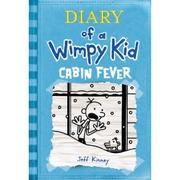
Cabin Fever
2,221-word summary 10 min read 224 pages in the book
- First published
- 2011
- Publisher
- Amulet Books
- Pages
- 224
- ISBN
- 9781419702235
- Series
- Diary of a Wimpy Kid (#6)
Reading options
What's inside (8 sections)
I read Cabin Fever out loud to my nephew last winter while actual snow piled against the windows, which felt perfect and a little risky because he started copying Greg Heffley immediately. Jeff Kinney published it November 15, 2011 with Amulet Books, a 224 page hardcover with ISBN 9781419702235. It is book six of Diary of a Wimpy Kid, between The Ugly Truth and The Third Wheel. I have read most of the series. This one is the Christmas book, the snowed in book, the Santa is watching book. It is funny in the way the series is always funny, and a little meaner about family than I remembered.
Greg starts the book worried. Not about school exactly, about his record. Someone damaged school property during a surprise blackout, green paint on walls, and rumors say Greg is involved. He says he is innocent. He also says a lot of things. The school sends a note. His mom signs him up to be good. His dad Frank starts talking about Santa and the naughty list like Santa runs security cameras. Greg, who is in middle school and knows better but not fully better, starts to sweat. He tries to do good deeds fast, which in Greg terms means deeds that look good and cost little.
Then snow comes. Not pretty movie snow. Heavy, wet, trapping snow. The Heffleys get stuck at home just before Christmas. Power flickers. Food gets weird. Manny, the little brother, will not share his toys or his logic. Rodrick, the older brother, practices drums and disappears. Rowley, Greg best friend, is stuck at his own house and communicates in short worried bursts. Susan, the mom, tries to make it cozy with games and togetherness. Frank tries to shovel and fix and control the weather by glaring at it. Greg tries to play video games and avoid blame.
Santa math
Kinney structures the book around Greg Santa math. Every chapter is Greg weighing whether a past act counts as naughty and whether a new act can cancel it. He made a card for a neighbor? Good. He scared Rowley? Bad. He cleaned without being asked? Suspiciously good, probably counts double. The joke lands because kids really think like this in December, and adults pretend they do not.
The school vandalism thread runs under the snow plot. In flashback we learn what happened during the blackout. Kids were stuck at school when lights went out. Someone started a rumor, someone else started a chase, paint ended up where paint should not be. Greg was there. Rowley was there. A kid named Freeman was there. Greg version shifts a little each time he tells it, which Kinney draws with perfect timing. The pictures show what Greg words skip. You see Greg holding paint while saying he barely touched it. My nephew caught that before I did and shouted, liar, which is the correct response.
Frank Heffley gets more page time here than in some books. He is obsessed with being prepared, with shoveling the driveway the right way, with proving he can handle a storm without calling for help. He fails in normal dad ways. The snow blower dies. The car gets stuck. He tries to grill in the snow. Susan films him. Rodrick films him to mock later. Greg narrates it all with zero sympathy and total accuracy. The family feels real because nobody listens to each other for more than two sentences.
Snowed in
The middle is pure cabin fever. The title is literal. The Heffleys run low on food and patience. They eat strange combinations. They argue about the thermostat. Manny controls the television. The power goes out and they huddle. Greg and Frank have to go out to shovel and almost get lost going around the block. A snowplow buries their work twice, which is the most true thing in the whole series.
Kinney uses the pictures to carry the cold. White space grows. Greg small in big drifts. The house small in white. The gutters groaning. Inside, faces get closer together in panels until everyone is shouting. There is a great sequence where Greg tries to play his game console with gloves on, fails, tries with a blanket over his head, fails, then tries to read and cannot focus because Rodrick is humming. Anyone who worked from home during a storm will feel seen.
Rowley absence matters. In other books Rowley is there to absorb Greg schemes. Here Greg has to sit with himself. He calls Rowley. He writes notes. He worries Rowley will tell the truth about the paint. He also misses him, though he would never write that sentence. When Rowley finally trudges over in full snow gear looking like a marshmallow, Greg is so relieved he is almost nice for a page and a half.
Fregley, the odd neighbor, appears in a short brilliant scene. He shows up in a homemade snow suit, offers weird candy, predicts the storm will last forty days. Greg is horrified and bored and then, when Fregley leaves, a little grateful. It is one of those Kinney moments where the weird kid is the only honest person in the storm.
Work and excuses
Greg needs Christmas money. His usual scams do not work in a blizzard. He tries to shovel driveways for cash, which goes badly because he undercharges, overpromises, and brings the wrong shovel. He tries to sell old toys. He tries to get Rowley to pay him for lessons in being cool. All fail. Frank finally offers to pay him to help shovel properly, real work, no shortcuts. Greg complains the whole time and then feels proud when the driveway is clear. Kinney lets that pride sit without a speech. The picture just shows Greg leaning on the shovel, tired, while Frank nods.
The vandalism truth comes out sideways, not in a big trial. Greg learns that covering for a friend and covering for himself are different things, and that adults can tell when a story has been polished. I will not spoil who held the paint, but the resolution is fair. Greg does not get fully punished and does not fully escape. He has to apologize, clean, and accept that Santa, meaning his parents, saw the whole thing. My nephew thought this was unfair. I thought it was exactly right.
Christmas morning is sweet without being soft. The Heffleys get power back, eat a late meal, open gifts. Greg gets something he wanted and something he needed. Manny gets what Manny wants because Manny always does. Rodrick pretends he does not care and cares a little. Susan cries. Frank falls asleep in a chair. Greg writes that it was the best Christmas ever and then crosses it out and writes it was pretty good, which is more honest.
Fair criticism is easy with this series. The formula shows. Greg learns a lesson and will forget it by next book. Girls barely exist except as background. The humor leans on Manny being a tyrant and Fregley being gross, which repeats. The blackout plot is thinner than the snow plot, and the two do not fully join until late. If you read the books in order, you will predict beats. Greg will scheme, Rowley will forgive, Frank will yell, Susan will craft.
But the craft is strong. Kinney pacing is excellent for reluctant readers. Short chapters, a joke every page, pictures that reward careful looking. The snow chapters teach without teaching about boredom, about how small spaces make small irritations big, about how work helps mood. Greg voice is consistent. He is selfish, observant, funny, and twelve. He does not grow much, but he notices a little more each book.
Why kids still grab it
I watched my nephew read the shoveling chapter twice and then go try to shovel our walk for three dollars. He did a bad job. We paid him. That is the book working as intended. It makes work look hard and funny and worth doing. It makes apologies look normal, not fatal.
Parents sometimes ask if Greg is a bad role model. He is a realistic model of a kid figuring out ethics in real time. He lies, he calculates, he backtracks. He also helps when no one is watching, shares his blanket with Manny once, and tells the truth when it costs him. Kids see themselves without being lectured. That is why teachers keep the books even when they roll their eyes at the cheese jokes.
For series order, read The Ugly Truth before this if you want the school dynamics, but you can start here. Kinney recaps enough. The Third Wheel follows and is better on crushes. Cabin Fever is the winter one, the family one. Keep hot chocolate nearby. Expect to hear quoted lines about Santa cameras for weeks.
The pictures do half the work
One reason this book holds up for rereads is the art. Kinney draws in that loose stick style that looks simple until you try to copy it. Greg face barely changes, two dots and a line, but the tilt of the line tells you everything. In Cabin Fever the tilt gets a lot of use. Greg worried has a flat mouth pushed to one side. Greg caught has small eyes and a big fake smile. Greg cold has hats pulled low and shoulders up around ears.
The snow drawings deserve credit. Pages go white in stages. First a dusting on the Heffley steps. Then drifts against the garage. Then the street disappears. Kinney does not draw every flake. He draws wind lines, a buried mailbox, a car that becomes a lump. Kids who live where it snows recognize it at once. Kids who do not get a clear sense of why snow traps people. My nephew lives where snow is rare. He kept asking if they could just walk out. I showed him the panel where Frank opens the door and snow falls in. He stopped asking.
Look also at how Kinney uses lists. Greg loves lists of good deeds, lists of suspects, lists of supplies. The lists are jokes because Greg math is always off. He counts bringing Manny a cookie as two good deeds because Manny is hard to like. He counts not hitting Rowley as a good deed. The pictures undercut the lists every time. You read the list, then you see the drawing of what really happened, and you laugh because Greg believes his own press release.
Reading out loud, I learned to pause on the pictures. Greg writes, I was very helpful during the storm. The picture shows him asleep on the couch while Susan carries laundry. If you rush past, you miss the second joke. Kinney trusts kids to get irony without explaining it. That trust is why the series works for ages eight to twelve and still amuses adults stuck reading it for the tenth time.
Manny, Rodrick, and the thermostat war
Every Wimpy Kid book is really about the Heffley system, and Cabin Fever shows the system under stress. Manny is three or four and runs the house through stubbornness. He will not eat unless food is cut a certain way. He will not share the outlet for his games. He calls the shots on what show plays because he will scream until others give in. Greg resents him and also uses him as an excuse. I cannot shovel, Manny needs me. I cannot clean, Manny is in the way. Susan sees through it and calls him out in that calm mom voice that ends discussion.
Rodrick is mostly absent, which is its own joke. He appears to eat, to drum for five minutes, to announce he is going to a friend house despite the blizzard, to get stuck, to return wet and angry. He and Greg share a room during the power outage and negotiate like rival countries. Who gets the blanket. Who gets the outlet. Who breathes too loud. Kinney draws their dividing line down the middle of the floor with pillows. It lasts one night.
Frank and Susan fight about small things that stand for big things. Thermostat setting. Whether to open the fridge. Whether to call a neighbor for help. Frank hates asking for help. He would rather shovel for three hours than knock next door. Susan hates wasting food. She makes soup from leftovers that Greg describes as gray. They bicker, then they team up when pipes groan or when Manny cries. Their marriage looks tired and fond, which feels true after years of these books.
I liked one small scene a lot. Frank tries to teach Greg how to shovel in strips, lift with legs, throw forward not sideways. Greg does it wrong three times. Frank corrects him without yelling, just shows again. Greg gets it on the fourth try. No hug, no speech. They just keep shoveling side by side while snow keeps falling. For a series built on jokes, moments like that land because they are rare and plain.
I closed it tired in a good way, the way you feel after shoveling. The Heffleys survived the storm without fixing everything. Greg is still Greg, but he cleared a driveway and told one true thing. In this series, that counts as growth.
FAQ
When was Cabin Fever published and how long is it?
Amulet Books published it November 15, 2011. The hardcover runs 224 pages with ISBN 9781419702235.
Is Cabin Fever part of a series?
Yes. It is book six of Diary of a Wimpy Kid, between The Ugly Truth and The Third Wheel.
What age is Cabin Fever appropriate for?
Ages 8 to 12 fits best. There is cartoon mischief, mild language, and family arguing during a blizzard.
Similar books
More from Diary of a Wimpy Kid first, then related titles.
Diary of a Wimpy Kid
Greg Heffley records middle school survival in his journal, dodging the Cheese Touch and Rowley's popularity.
1,912-word summary · 8 min read
Rodrick Rules
Greg Heffley starts a new school year hiding a summer secret with Rodrick, whose party, photos, and talent show chaos threaten to expose everything.
2,971-word summary · 13 min read
The Last Straw
Frank wants Greg toughened through sports while Greg dodges everything and military school looms.
2,020-word summary · 9 min read
Dog Days
Greg wastes summer perfectly through pools, dogs and dad fishing trips.
2,127-word summary · 9 min read
The Ugly Truth
Greg faces puberty, a school lock-in and Uncle Gary's wedding while Mom returns to college in Wimpy Kid book five.
2,766-word summary · 12 min read
The Third Wheel
Greg tries to find a date for the Valentine's dance, ends up the third wheel in his own plan, and watches Rowley get the girl.
2,019-word summary · 9 min read

Hard Luck
Rowley has a girlfriend, so Greg turns to a Magic 8 Ball, a family Easter hunt and the school yearbook for answers.
2,586-word summary · 11 min read
George's Marvellous Medicine
George stirs a brew of dozens of household chemicals and gives it to his grumpy grandmother, and the medicine works far better than anyone planned.
2,014-word summary · 9 min read
Beezus and Ramona
Nine year old Beezus tries to be a good older sister while four year old Ramona turns every ordinary day into a disaster, until a tenth birthday forces honesty.
2,062-word summary · 9 min read
Bud, Not Buddy
A ten year old orphan in the Depression walks to find a jazzman he thinks is his father.
2,568-word summary · 11 min read

Stellaluna
A baby fruit bat falls into a bird nest, learns to perch and eat bugs, then reunites with her mother in Cannon's acclaimed 1993 picture book about difference…
2,486-word summary · 11 min read
Tales of a Fourth Grade Nothing
Nine-year-old Peter Hatcher tries to get through fourth grade while his toddler brother Fudge steals every scene.
2,469-word summary · 11 min read
Fantastic Mr. Fox
Mr. Fox raids three cruel farmers to feed his family, then outdigs tractors and a siege to host a feast underground.
2,910-word summary · 13 min read
Falling Up
Poems about falling up, messes that win and tender goodbyes in between.
2,055-word summary · 9 min read
Pippi Longstocking
A super-strong nine-year-old lives alone in Villa Villekulla, upending school, circus and town rules with neighbors Tommy and Annika.
3,115-word summary · 14 min read
Nothing to See Here
A struggling young woman spends one summer caring for twins who burst into flame when upset, in this warm oddball novel.
2,167-word summary · 10 min read

Heidi
Orphan Heidi blooms with her grandfather in the Swiss Alps, wilts in Frankfurt as a companion, then helps Klara walk.
2,952-word summary · 13 min read
Because of Winn-Dixie
Lonely Opal names a stray Winn-Dixie and finds ten friends, plus a way to ask her preacher father hard things.
2,024-word summary · 9 min read
If You Give a Mouse a Cookie
A mouse gets a cookie and turns one small favor into a whole busy day.
2,560-word summary · 11 min read
A Light in the Attic
Silverstein's attic poems and line drawings turn chores, monsters, and homework into jokes and small rebellions.
2,998-word summary · 13 min read
Winnie-the-Pooh
Edward Bear comes downstairs bump-bump-bump and into the Hundred Acre Wood for honey, hunneys, and heffalumps.
2,068-word summary · 9 min read
The House at Pooh Corner
Tigger bounces into the Hundred Acre Wood while Pooh builds Eeyore a house and Piglet does a grand thing.
2,022-word summary · 9 min read
Matilda
Brilliant Matilda Wormwood teaches herself to read, faces her crooked parents and the fearsome Miss Trunchbull, and finds Miss Honey.
2,296-word summary · 10 min read
Where the Sidewalk Ends
Sidewalk Ends retold: poems and drawings, Sarah Cynthia, unicorns, homework and giants.
1,952-word summary · 9 min read

Make Way for Ducklings
A pair of mallards raise eight ducklings on the Charles River and lead them across Boston to the Public Garden, with a little help from a friendly policeman.
2,044-word summary · 9 min read

Little Town on the Prairie
In the spring after the Long Winter, fifteen-year-old Laura sews shirts, studies for a teaching certificate, and helps send her blind sister Mary to college.
2,071-word summary · 9 min read

Little Earthquakes
Four Philadelphia women meet during pregnancy and discover that new motherhood is nothing like the plan, while friendship becomes the thing that holds them…
1,997-word summary · 9 min read

Amelia Bedelia
A literal-minded housekeeper follows her employer's list to disastrous and funny effect in the 1963 picture book that made wordplay a children's staple.
2,038-word summary · 9 min read
Five Point Someone: What Not to Do at IIT
Three friends at IIT drift to a five-point GPA, mock the system, and break into a professor's office for an exam paper.
2,458-word summary · 11 min read
Clifford the Big Red Dog
Emily Elizabeth picks the smallest puppy in the litter, loves him as hard as she can, and wakes up to a dog the size of a house.
2,092-word summary · 9 min read